NCERT Solutions: Print Culture & the Modern World

Q1: Give reasons for the following:
(a) Woodblock print only came to Europe after 1295.
Ans: The Italian traveller Marco Polo encountered woodblock printing in China and brought knowledge of it back to Europe when he returned in 1295. Before sustained contact with Asia, Europeans had little access to East Asian techniques, so woodblock printing only began to spread in Europe after his reports increased curiosity and trade links. The transfer of technology took time, so woodblock print became known in Europe only after 1295.
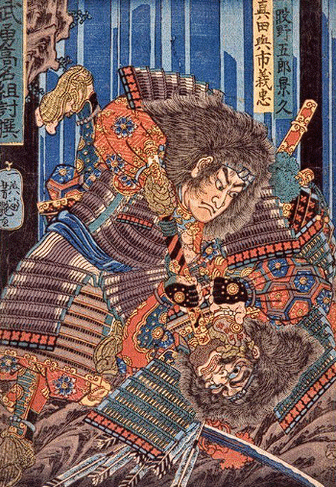 Woodblock
(b) Martin Luther was in favour of print and spoke out in praise of it.
Ans: Martin Luther used the new technology of printing to spread his ideas rapidly. When he posted his Ninety-Five Theses in 1517, printers produced thousands of copies that reached towns across Germany and beyond. Printing allowed Luther's arguments, sermons and translations to circulate widely and quickly, helping people read and discuss them. For this reason Luther appreciated print as a powerful tool to inform and persuade ordinary people.
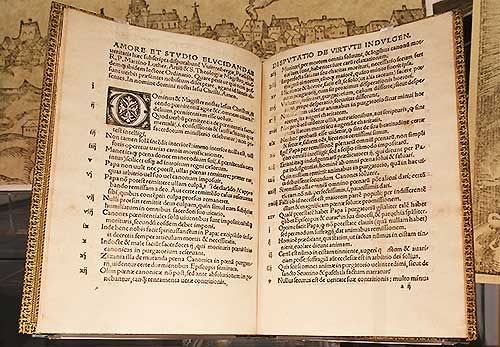 Ninety Five Theses
(c) The Roman Catholic Church began keeping an Index of Prohibited Books from the mid-sixteenth century.
Ans: From the mid-1500s the Church saw that printed books could spread opinions that challenged religious authority. To check what it considered harmful or heretical ideas, the Church compiled an Index of Prohibited Books. One reason for this censorship was the case of Menocchio, a miller who read widely and developed his own ideas about God and creation; his views alarmed Church authorities and led to trials. The Index aimed to prevent similar challenges by limiting access to books judged dangerous to orthodox belief.
(d) Gandhi said the fight for Swaraj is a fight for the liberty of speech, liberty of the press, and freedom of association.
Ans: Mahatma Gandhi argued that political self-rule required basic civil liberties. In 1922, during the years of mass nationalist movements, he stated that Swaraj depended on the freedom to speak, to publish, and to meet freely. Without these liberties people could not exchange ideas, criticise government, organise collectively or build popular support-all essential for a successful struggle for independence.
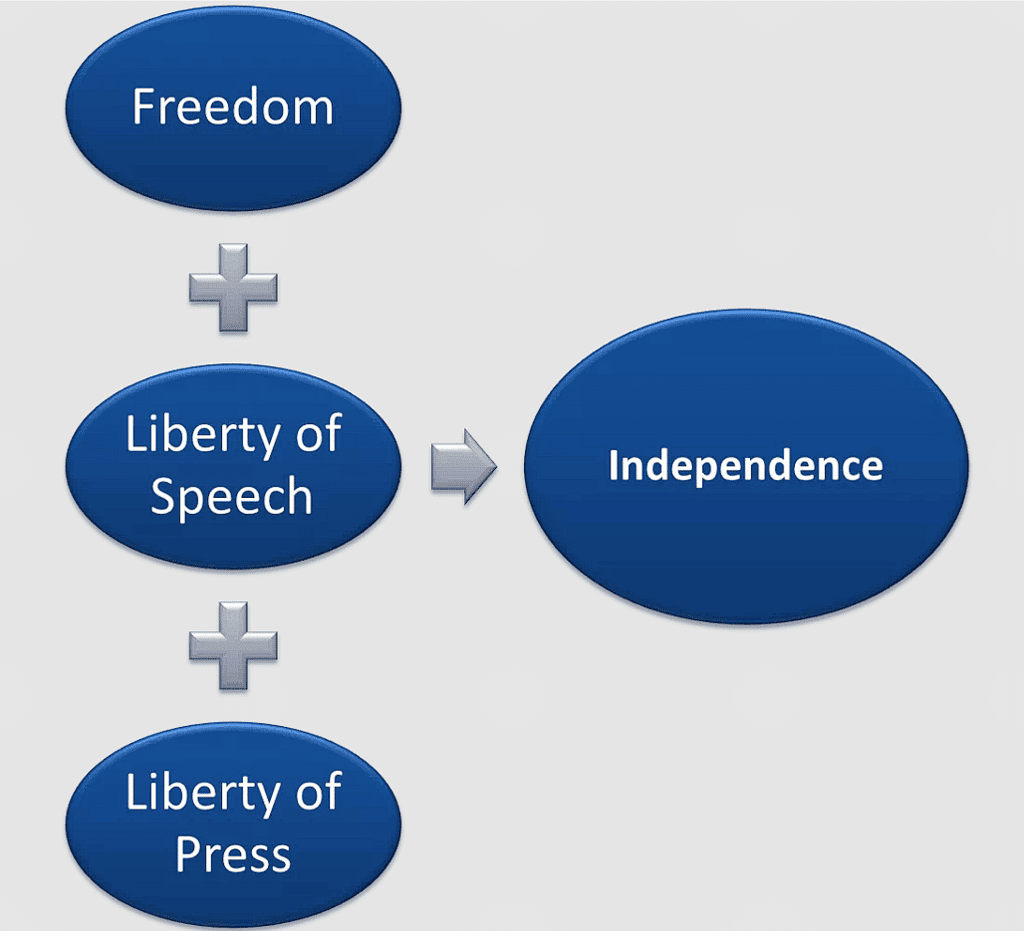 Formula of Independence
Q2: Write short notes to show what you know about:
(a) The Gutenberg Press
(b) Erasmus's idea of the printed book
(c) The Vernacular Press Act
Ans:
(a) The Gutenberg Press
Johannes Gutenberg , from Strasbourg, developed movable-type printing in Europe in the mid-15th century, drawing on earlier mechanical presses and casting metal type for repeated use. Around the 1440s-1450s his method made it possible to produce many identical copies of a book quickly. The Gutenberg Bible was among the first major books printed in Europe. The press reduced the cost of books, standardised texts and greatly increased the spread of learning and information.
(b) Erasmus's idea of the printed book
Erasmus welcomed the possibilities of printing but was also anxious about its rapid expansion. He feared that a flood of poorly produced or frivolous books could spread false or irreligious ideas. At the same time, he used print positively by producing reliable editions of classical and religious texts, aiming to improve the quality of what readers received rather than allowing careless or scandalous writings to circulate unchecked.
(c) The Vernacular Press Act
The Vernacular Press Act of 1878 was a colonial law aimed at controlling newspapers printed in Indian languages. It gave the government sweeping powers to suppress or penalise vernacular publications that criticised British rule. Authorities could ban reports, demand security deposits, and seize printing presses. The Act sought to curb the influence of local newspapers that mobilised public opinion against colonial policies.
 Vernacular Press
Q3: What did the spread of print culture in nineteenth-century India mean to:
(a) Women
(b) The poor
(c) Reformers
Ans:
(a) Women
As literacy among women rose, many became active readers and writers. Print provided journals and books that argued for women's education and discussed women's lives. Publishers produced magazines and texts aimed specifically at women, giving them access to ideas about rights, health, education and reform. This helped women form opinions, join debates and campaign for social change.
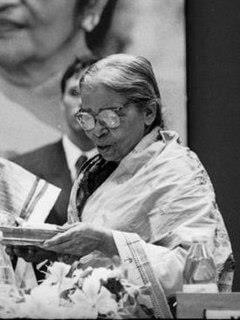 Rashundari Devi
(b) The poor
Printed material became affordable and available in different formats for poorer people. In England, for example, penny magazines and cheap chapbooks reached wide audiences; in India small inexpensive booklets and circulating libraries made reading possible for those of modest means. Oral reading, rented books and public readings also spread printed stories to people who could not read, widening participation in print culture.
(c) Reformers
Reformers used the press to expose social evils and argue for change. Raja Ram Mohan Roy's newspaper Sambad Kaumudi campaigned against social injustices such as the treatment of widows. From the 1860s, Bengali women writers like Kailashbashini Debi used print to describe women's experiences and criticise practices that confined and burdened women. Print helped reformers reach a national audience and press for legal and social reforms.
Q4: Why did some people in eighteenth-century Europe think that print culture would bring enlightenment and end despotism?
Ans:
- Spreading of new ideas: Print made the writings of scientists and philosophers widely available, so ordinary people could learn about new discoveries and ways of thinking. Ancient and medieval scientific texts were collected and published for a broader readership.
- Writings of scholars: Thinkers such as Thomas Paine, Voltaire and Jean-Jacques Rousseau were printed and widely read. Their writings promoted reason, individual rights and criticism of arbitrary authority.
- Books as a medium of progress: By the mid-18th century books were seen as instruments of social progress; many believed that spreading knowledge would weaken ignorance and oppressive rule.
- Ideas of enlightened thinkers: Printed works popularised the ideas of reformers who questioned Church authority and absolute monarchy, encouraging people to demand legal and political change.
- A new culture of dialogue and debate: Print created public spheres-salons, societies and periodicals-where citizens discussed ideas openly, learned to argue and questioned received truths, which undermined support for despotism.
Q5. Why did some people fear the effect of easily available printed books? Choose one example from Europe and one from India.
Ans: The mass availability of printed books alarmed many because books could spread ideas that challenged established authority, morals or social order.
- Example from Europe: Martin Luther's Ninety-Five Theses (1517) criticised Church practices. Once printed and widely distributed, these ideas fuelled the Protestant Reformation and weakened the Catholic Church's unquestioned control.
- Example from India: In 19th-century India conservative groups opposed women's education and the spread of print aimed at women. They feared that reading and new ideas would undermine traditional roles and moral codes. Despite such resistance, many women embraced education and print culture.
Q6. What were the effects of the spread of print culture for poor people in nineteenth-century India?
Ans:
- Cheap printed books, pamphlets and periodicals became available at low cost or through lending libraries, enabling wider access to reading material for the poor.
- Print helped highlight social inequalities. Jyotiba Phule's Gulamgiri (1871) exposed caste injustices. Later leaders such as B. R. Ambedkar and Periyar used print to challenge untouchability and caste oppression, reaching readers across regions.
- Workers and local activists used print to give voice to their concerns. For example, Kanpur mill worker Keshibaba published Chhote Aur Bade Ka Sawal (1938), linking caste and class issues. Poems and journals-like those in the Sudarshan Chakra-expressed working-class experiences. By the 1930s mill workers in cities such as Bangalore and Bombay set up libraries and reading groups to educate themselves and organise for better conditions.
Q7. Explain how print culture assisted the growth of nationalism in India.
Ans:
- New ideas and debates: Print allowed critics of existing practices and supporters of change to publish articles, pamphlets and books. Debates about rights, reform and self-rule became public and persuasive.
- Connecting various communities: Newspapers and journals transmitted news and opinions across regions and languages, helping people in different parts of India to learn about common grievances and campaigns.
- Nationalist newspapers: Despite censorship and repression, nationalist newspapers grew in number and influence. They reported on colonial misrule, organised public opinion and announced meetings and campaigns.
- Novels and history: Indian novelists and writers produced works that fostered a sense of a shared past and common identity. Bankim Chandra Chatterjee's Anandamath inspired feelings of unity, while Munshi Premchand's Godan drew attention to peasant suffering under colonial rule.
- Images and symbols: Printed images and visual representations-such as popular prints of Bharatmata and nationalist illustrations by artists and printers-gave people a shared symbol to rally around and helped build emotional bonds of nationhood.
FAQs on NCERT Solutions: Print Culture & the Modern World
| 1. How did the printing press change the spread of ideas in early modern Europe? |  |
| 2. What role did print culture play in creating a sense of national identity? | |
| 3. How did censorship and book banning work during the print culture era? | |
| 4. Why did women face barriers to publishing and reading in early print culture? | |
| 5. What impact did newspapers and periodicals have on shaping public opinion in the modern world? | |





