NCERT Solutions: Resources & Development

Q1. Multiple-Choice Questions
(i) Which one of the following is the main cause of land degradation in Punjab?
(a) Intensive cultivation
(b) Deforestation
(c) Over irrigation
(d) Overgrazing
Ans: (c) Over irrigation
Excessive irrigation in Punjab, Haryana, and western Uttar Pradesh causes waterlogging and increases soil salinity and alkalinity.
(ii) In which one of the following states is terrace cultivation practised?
(a) Punjab
(b) Plains of Uttar Pradesh
(c) Haryana
(d) Uttarakhand
Ans: (d) Uttarakhand
Terrace cultivation is practiced in hilly areas to reduce water runoff and soil erosion.
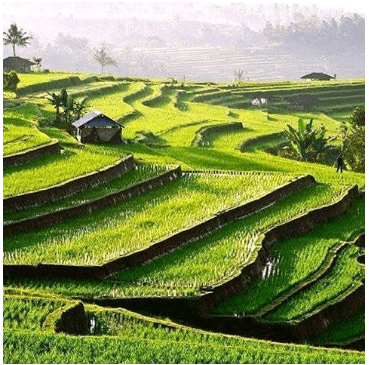 Terrace Cultivation
(iii) In which of the following states is black soil predominantly found?
(a) Uttar Pradesh
(b) Rajasthan
(c) Maharashtra
(d) Jharkhand
Ans: (c) Maharashtra
Black soil is found in Maharashtra, Madhya Pradesh, Gujarat, and Chhattisgarh, and extends along Godavari and Krishna valleys. It is ideal for cotton cultivation.
Q2. Answer the following questions in about 30 words.
(i) Name three states having black soil and the crop which is mainly grown in it.
Ans: The three states are
- Maharashtra
- Madhya Pradesh
- Gujarat
It is clayey, retains moisture, and is nutrient-rich. Cotton is the main crop grown in these soils due to their fertility.
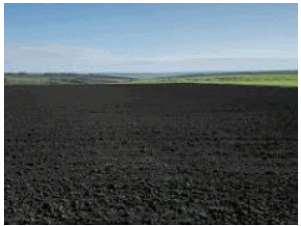 Black Soil
(ii) What type of soil is found in the river deltas of the eastern coast? Give three main features of this type of soil.
Ans: Alluvial soil occurs in the deltas of the Mahanadi, Godavari, Krishna, and Kaveri rivers. Its main features are-
- Alluvial soil is rich in potassium and phosphoric acid, and lime.
- It has a high water retention capacity.
- It is highly fertile soil.
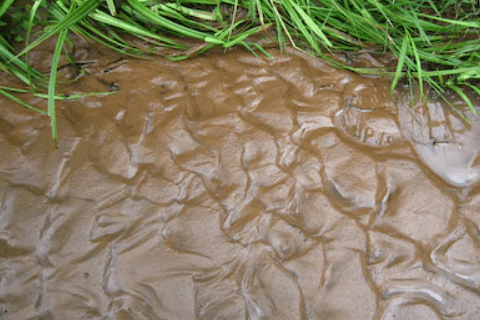 Alluvial Soil
(iii) What steps can be taken to control soil erosion in the hilly areas?
Ans: Some steps that can be followed to prevent soil erosion in hilly areas include:
- Terrace cultivation
- Contour ploughing
- Planting shelter belts and trees
- Strip cropping
Q3. Answer the following questions in about 120 words.
(i) Explain the land use pattern in India and why has the land under forest not increased much since 1960-61?
Ans:
(a) The land use pattern in India in 1960-61 and 2008-09 is given in the figure given below:
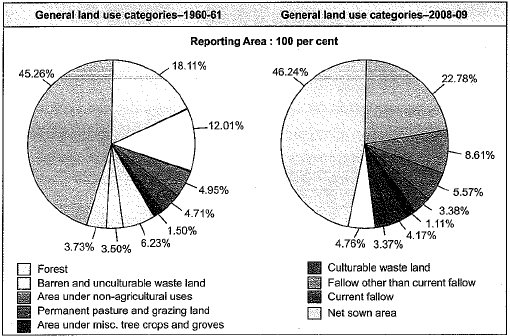 Source: Directorate of Economics and Statistics, Ministry of Agriculture, 2008 - 09
(b) From above it is clear that in 2008-09, the main uses are as mentioned below:
- Net sown area - 46.24%
- Forest - 22.78%
- The rest is used for other purposes such as non-agricultural uses, tree crops, groves, etc.
(c) The land under forest has shown only a marginal increase (0.98%). This is due to increasing population, industrialisation and urbanisation.
(ii) How have technical and economic development led to more consumption of resources?
Ans: (a) As technology improves with development, more resources are needed for production.
(b) According to Gandhi, the misuse of modern technology is a major cause of resource depletion worldwide.
(c) The advanced technology of colonial powers allowed them to exploit resources and dominate the countries they colonised.
(d) Resources only help in development if there is suitable technology and the right changes in the institutions of the country. India went through these stages during colonisation.
Example: In Punjab and Haryana, water resources are heavily used to increase irrigation and farming during dry seasons. This has led to a drop in water levels, causing problems for farmers.
FAQs on NCERT Solutions: Resources & Development
| 1. What are the different types of resources and how do they differ from each other? |  |
| 2. Why is sustainable development important when using natural resources? | |
| 3. How do renewable and non-renewable resources differ in the context of India's resource management? | |
| 4. What is resource planning and why do we need it for development? | |
| 5. How do human activities cause land degradation and soil erosion in India? | |





