NCERT Solutions: Water Resources

Q1. Multiple choice questions.
(i) Based on the information given below classify each of the situations as 'suffering from water scarcity' or 'not suffering from water scarcity'.
(a) Region with high annual rainfall.
(b) Region having high annual rainfall and large population.
(c) Region having high annual rainfall but water is highly polluted.
(d) Region having low rainfall and low population.
Ans:
(a) Not suffering from water scarcity. This is because the freshwater and groundwater are replenished with the annual rainfall.
(b) Suffering from water scarcity. Even though the annual rainfall is high, the large population results in a high demand for water, resulting in scarcity.
(c) Suffering from water scarcity. If there is high rainfall and the water is polluted, then there will be scarcity as the water is unfit for domestic, industrial or agricultural use.
(d) Not suffering from water scarcity. In this case, the rainfall is low, but the population is also low. In such cases, the demand for water by the population is met. As the usage is not much, water scarcity will not prevail.
(ii) Which one of the following statements is not an argument in favour of multi-purpose river projects?
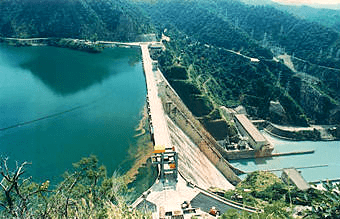 Multi-purpose River Valley Projects
(a) Multi-purpose projects bring water to those areas which suffer from water scarcity.
(b) Multi-purpose projects by regulating water flow help to control floods.
(c) Multi-purpose projects lead to large scale displacements and loss of livelihood.
(d) Multi-purpose projects generate electricity for our industries and our homes.
Ans: (c) Multi-purpose projects lead to large-scale displacements and loss of livelihood.
This is not an argument in favour of multi-purpose river projects. Dams require a large area of land to be built, and local people living in that area are forced to move to another area, causing loss of livelihood and displacement. For various reasons, multi-purpose projects and huge dams have come under intense scrutiny and resistance in recent years. River regulation and construction of dams alter their natural flow, resulting in poor sediment flow and heavy sedimentation at the reservoir's bottom. Dams split rivers, making migration difficult for aquatic animals.
(iii) Here are some false statements. Identify the mistakes and rewrite them correctly.
(a) Multiplying urban centres with large and dense populations and urban lifestyles have helped in proper utilisation of water resources.
(b) Regulating and damming of rivers does not affect the river's natural flow and its sediment flow.
(c) In Gujarat, the Sabarmati basin farmers were not agitated when higher priority was given to water supply in urban areas, particularly during droughts.
(d) Today in Rajasthan, the practice of rooftop rainwater water harvesting has gained popularity despite high water availability due to the Indira Gandhi Canal.
Ans:
(a) Multiplying urban centres with large and dense populations and urban lifestyles have caused over-exploitation of water resources.
(b) Regulating and damming of rivers affect their natural flow, causing reduced sediment flow and excessive sedimentation at the bottom of reservoirs.
(c) In Gujarat, the Sabarmati basin farmers were agitated and nearly protested when higher priority was given to water supply in urban areas, particularly during droughts.
(d) Today in Western Rajasthan, the practice of rooftop rainwater harvesting is on the decline because plentiful water is available in many areas due to the perennial Indira Gandhi Canal.
Q2. Answer the following questions in about 30 words.
(i) Explain how water becomes a renewable resource.
Ans: Water is renewable because of the hydrological cycle. Evaporation from oceans, lakes and rivers, followed by condensation and precipitation, continually renews freshwater and replenishes surface and groundwater supplies.
(ii) What is water scarcity and what are its main causes?
Ans: Water scarcity means insufficient water to meet demands of people, agriculture and industry. It arises from low rainfall or drought, poor water quality, population growth, intensive industrialisation and rapid urbanisation.
 Water Scarcity
Causes:
- The increase in population leads to more water for domestic use and to the production of more food.
- Intensive industrialisation increases demand for water and power.
- Urbanisation raises water use and concentrates demand in cities.
(iii) Compare the advantages and disadvantages of multi-purpose river projects.
Ans:
Advantages:
- They provide reliable water for irrigation, increasing agricultural production.
- They generate hydroelectricity for industries and homes.
- They help control floods by regulating river flow.
- They supply water for industries and urban use.
Disadvantages:
- They alter the river's natural flow, reducing downstream sediment transport and causing sedimentation in reservoirs.
- They often cause large-scale displacement of local communities and loss of livelihoods.
- They can lead to interstate disputes over water sharing.
Q3. Answer the following questions in about 120 words.
(i) Discuss how rainwater harvesting in semi-arid regions of Rajasthan is carried out.
Ans:
- In semi-arid and arid parts of Rajasthan, such as Bikaner, Phalodi and Barmer, most traditional houses had underground storage tanks called tankas to store drinking water.
- These tankas could be as large as a big room and formed part of an effective rooftop rainwater harvesting system.
- They were usually built inside the house or in the courtyard and connected to sloping roofs through pipes.
- Rain falling on the roof flowed through the pipe into the tanka and was stored for later use.
- The first spell of rain was often allowed to run off to wash dust from roofs and pipes; water from subsequent showers was then collected.
- The stored water in the tankas was used until the next rainfall, helping households cope with long dry periods.
(ii) Describe how modern adaptations of traditional rainwater harvesting methods are being carried out to conserve and store water.
Ans: Modern adaptations combine traditional ideas with simple technology to harvest rooftop rainwater in both rural and urban areas.
- In Gendathur village, near Mysore, about 200 households installed rooftop collection systems. With roughly 1,000 mm annual rainfall, about 80% collection efficiency and multiple effective rainy days, each house can harvest around 50,000 litres annually.
- From 200 houses, the total harvested water can thus be about 1,00,00,000 litres each year, showing how local collective action can create a substantial water reserve.
- Tamil Nadu was the first Indian state to make rooftop rainwater harvesting mandatory for buildings. Legal provisions and enforcement encourage construction of recharge and storage systems, helping to replenish groundwater and reduce dependence on distant water sources.
FAQs on NCERT Solutions: Water Resources
| 1. How is water scarcity defined and what are its causes? |  |
| 2. What are the different sources of water on Earth? | |
| 3. How does deforestation affect water resources? | |
| 4. How can individuals contribute to water conservation efforts? | |
| 5. What are the potential consequences of water scarcity on ecosystems and human health? | |





