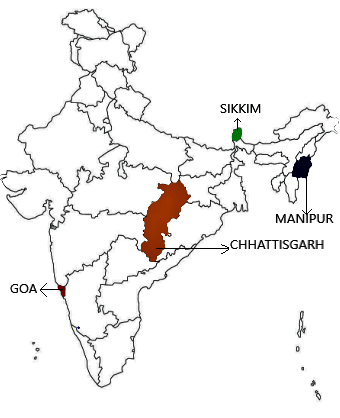
Q1. Locate the following States on a blank outline map of India:
Manipur, Sikkim, Chhattisgarh, and Goa.
Ans:
- Manipur: In the far north-east of India, bordering Myanmar.
- Sikkim: A small Himalayan state north of West Bengal, between Nepal and Bhutan.
- Chhattisgarh: In central-east India, south of Uttar Pradesh and east of Maharashtra and Madhya Pradesh.
- Goa: A small coastal state on the west coast of India, between Maharashtra and Karnataka.
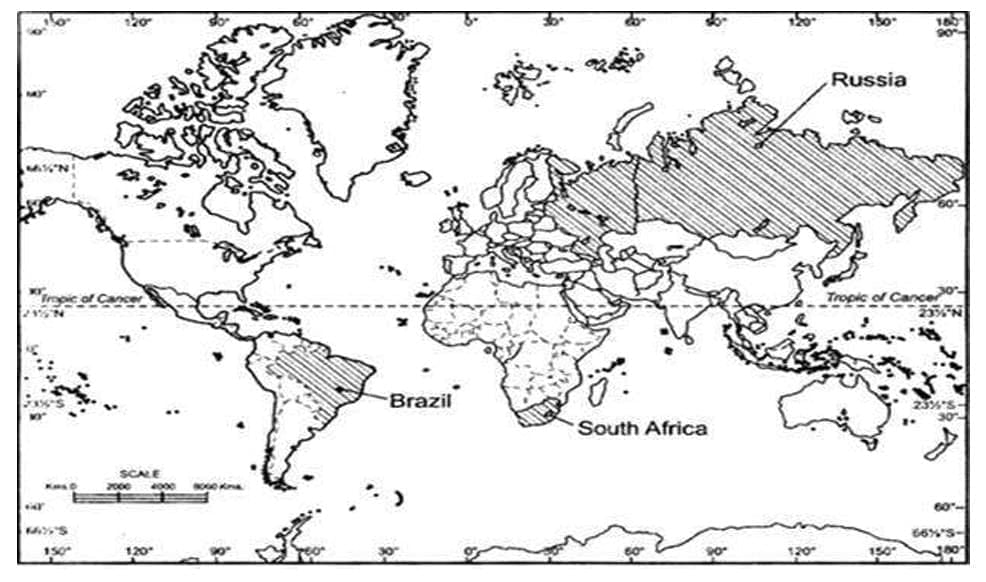
Q2: Identify and shade three federal countries (other than India) on a blank outline map of the world.
Ans: Three federal countries other than India are:
Q3. Point out one feature in the practice of federalism in India that is similar to and one feature that is different from that of Belgium.
Ans: (a) Similar feature: Distribution of powers:
(i) In both countries, power is divided among the national (federal) government and sub-national units; responsibilities are allocated to different levels of government.
(ii) In Belgium, the community governments look after cultural, educational and language matters.
(iii) In India, legislative powers are divided into the Union List, State List and Concurrent List; local governments have also been given greater powers.
(b) Different features:
In Belgium there are three distinct kinds of government: the federal government, regional governments and community governments. Community governments are elected by people of a particular language community (Dutch, French or German) and handle language, culture and education, regardless of where those people live. India does not have such language-based community governments.
In India the third tier is formed by local governments (Panchayats and Municipalities) which function at village, town and city levels and are responsible for local administration and development.
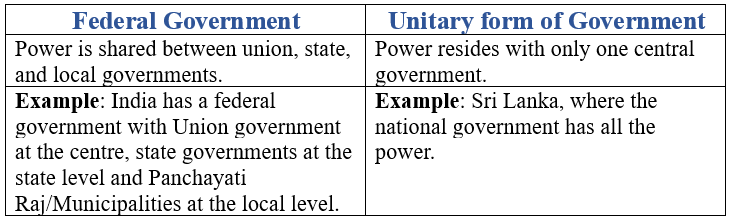
Q4. What is the main difference between a federal form of government and a unitary one? Explain with an example.
Ans:
Q5. State any two differences between the local government before and after the Constitutional amendment in 1992.
Ans: Two differences between the local government before and after the constitutional amendment in 1992 are as follows:
(i) Before 1992, elections to the local bodies were not held regularly. After the 1992 amendments (the 73rd and 74th Constitutional Amendments), regular elections to Panchayats and Municipalities were made mandatory and fixed terms were introduced.
(ii) Before 1992, local bodies had limited powers and resources. After the amendments, local governments were granted constitutional status, greater responsibilities, and provisions were made for sharing functions, powers and revenues with them. Reservation of seats for women and weaker sections was also introduced to broaden political representation.
Q6. Fill in the blanks:
Since the United States is a (i) ______________ type of federation, all the Constituent States have equal powers and States are (ii)______________vis-a-vis the federal government. But India is a (iii) ______________ type of federation and some States have more power than others. In India, the (iv) __________ government has more powers.
Ans:
Ans: (i) coming together
(ii) strong
(iii) holding together
(iv) central
Q7. Here are three reactions to the language policy followed in India. Give an argument and an example to support any of these positions.
Sangeeta: The policy of accommodation has strengthened national unity.
Arman: Language-based States have divided us by making everyone conscious of their language.
Harish: This policy has only helped to consolidate the dominance of English over all other languages.
Ans:
Ans: Sangeeta's view that the policy of accommodation has strengthened national unity is valid. To avoid privileging a single language and creating tensions, the Central Government maintained both Hindi and English for official purposes and recognised many regional languages. For example, unlike Sri Lanka where privileging a single language led to conflict, India's policy of recognising multiple languages and creating language-based states has helped accommodate regional identities while keeping the country united. This policy reduced language-based conflicts, allowed people from different regions to participate in administration, and promoted cooperative governance.
Q8. The distinguishing feature of a federal government is:
(а) National government gives some powers to the provincial government.
(b) Power is distributed among the legislature, executive and judiciary.
(c) Elected officials exercise supreme power in the government.
(d) Governmental power is divided between different levels of government.
Ans:
Ans: (d)
Explanation: A federal system is defined by a constitutional division of powers between different levels of government (for example, national and state governments). This means each level has authority in certain areas that the other cannot override. Option (a) is incomplete because federal powers are not merely 'given' by the national government; they are constitutionally divided. Option (b) describes separation of powers within a single level of government, not federalism. Option (c) refers to democratic rule generally and is not specific to federal structures.
Q9. A few subjects in various Lists of the Indian Constitution are given here. Group them under the Union, State and Concurrent Lists as provided in the table below:
A. Defence
B. Police
C. Agriculture
D. Education
E. Banking
F. Forests
G. Communications
H. Trade
I. Marriages
Ans: (i) Union List: Defence, Banking and Communications.
(ii) State List: Police, Agriculture and Trade.
(iii) Concurrent List: Education, Forests and Marriages.
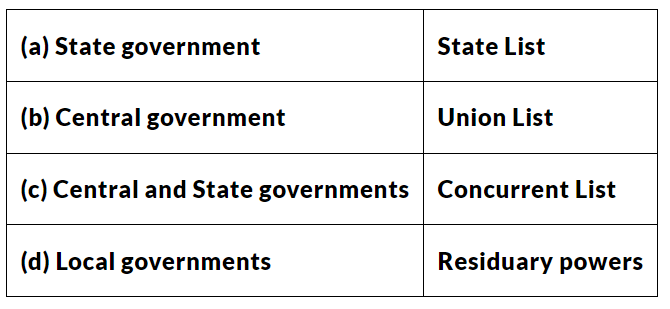
Q10. Examine the following pairs that give the level of government in India and the powers of the government at that level to make laws on the subjects mentioned against each. Which of the following pairs is not correctly matched?
Ans: (d) Local governments - Residuary powers.
Explanation: This pairing is incorrect because residuary powers (powers over subjects not listed in any of the three lists) rest with the Union Parliament, not with local governments. Local governments exercise powers delegated to them by the State governments and by statutes, but they do not hold residuary legislative authority.
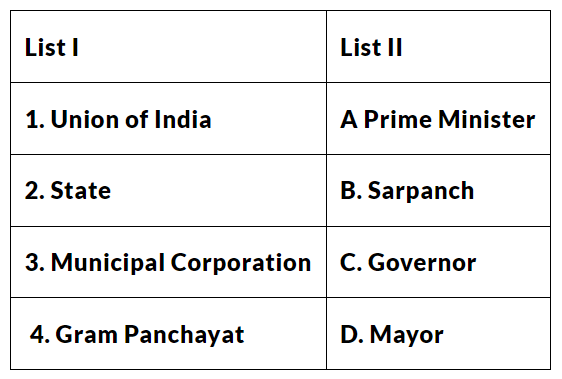
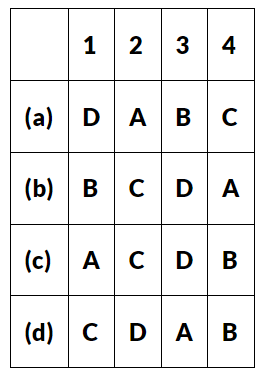
Q11. Match List I with List-II and select the correct answer using the codes given below the lists:
Ans: (c) A-1, C-2, D-3, B-4.
Q12. Consider the following statements:
A. In a federation, the powers of the federal and provincial governments are clearly demarcated.
B. India is a federation because the powers of the Union and State Governments are specified in the Constitution and they have exclusive jurisdiction on their respective subjects.
C. Sri Lanka is a federation because the country is divided into provinces.
D. India is no longer a federation because some powers of the States have been devolved to the local government bodies.
Which of the statements given above are correct?
(a) A, B and C
(b) A, C and D
(c) A and B only
(d) B and C only
Ans: (c)
Explanation:
A. Correct - In a federation the Constitution clearly demarcates powers between the federal and provincial/state governments.
B. Correct - India is a federation because the Constitution specifies subjects for the Union and the States and each level has exclusive jurisdiction over its subjects.
C. Incorrect - Division into provinces alone does not make a country a federation; Sri Lanka is a unitary state despite having provinces.
D. Incorrect - Devolution of certain powers to local bodies does not change India's federal character; local bodies exercise powers delegated by the Constitution and state laws.