Q1.Mention different aspects of life in which women are discriminated or disadvantaged in India.
Ans: The different aspects of life in which women are discriminated or disadvantaged in India are:a) Education: Education is one of the most important areas where women face discrimination. Female literacy in many parts of India remains lower than male literacy; for example, the literacy rate for women is often reported much below that for men. Lower educational attainment limits women's opportunities for higher studies, better jobs and social mobility.
b) Proportion of women in paid jobs: Women have a smaller share in well-paid and formal employment. Although many women work longer hours when unpaid work is included, they are often confined to low-paid or insecure jobs and have less access to leadership positions and formal benefits.
c) Preference for a male child: A persistent social preference for sons has led to discriminatory practices such as sex-selective abortions and neglect of girl children. This has contributed to a declining child sex ratio in several regions.
d) Crime and violence against women: Women face harassment, domestic violence, sexual assault and other crimes both in public spaces and at home. Lack of safety and social support makes it harder for many women to participate fully in public life and work.
Q2.State different forms of communal politics with one example each.
Ans: Different forms of communal politics:
a) Everyday beliefs that one religion is superior to others.
Example: Militant religious groups that claim superiority over other faiths.
b) Political demands based on religion that seek separate or dominant political space for a community. Example: Separatist leaders and political parties in Jammu and Kashmir who have sought a distinct political identity.
c) Political mobilisation on religious lines to gather votes and build support among followers of a religion. Example: Political campaigns or appeals that specifically target voters of the two largest religious communities to influence election outcomes.
d) Communal violence - riots, massacres and organised attacks based on religious identity. Example: Communal riots between groups in India and Pakistan at different times in history.
Q3.State how caste inequalities are continuing in India.
Ans: Caste inequalities are continuing in India in the following ways:
- Most people still marry within their own caste or tribe; inter-caste marriages are often discouraged, especially by upper castes.
- Despite being outlawed by the Constitution, untouchability and related social exclusion persist, particularly in rural areas.
- Communities that historically had access to education and resources continue to perform better, while others excluded earlier still lag behind.
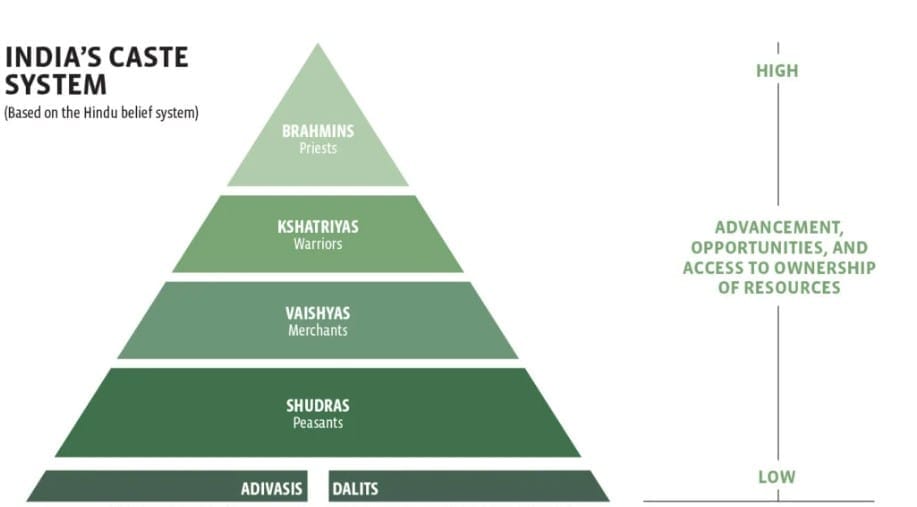
- Caste affects access to resources and economic opportunities. Upper castes are, on average, better off; Dalits and Adivasis remain the worst off, with backward classes in between.
- Although every caste has some poor members, the proportion of people living in extreme poverty is much higher for the lowest castes. Lower caste people, like rural landless labourers, are generally poor and are exploited even today. The percentage of the population living below the poverty line between 1999-2000 was 45.8% (STs) 35.9%, (SCs) and 27% (OBCs) in the rural areas.
Q4. State two reasons to say that caste alone cannot determine election results in India.
Ans: Two reasons to say that caste alone cannot determine election results in India are:
(i) No parliamentary constituency has a clear majority of a single caste. Candidates and parties therefore must seek support across several castes and communities to win.
(ii)No political party captures all votes of any one caste. Voters from the same caste may be divided in their political choices, so caste by itself does not guarantee an electoral outcome.
Q5. What is the status of women's representation in India's legislative bodies?
Ans: The status of women's representation in India's legislative bodies is low and can be summarised as:
- In the Lok Sabha, elected women members have never reached even 10% of total membership.
- Their share in many State Legislative Assemblies is often below 10% and in some states less than 5%.
- Because of this limited representation, women's organisations and activists have long demanded reservation of about one-third of seats in the Lok Sabha and State Assemblies to improve participation.
Q6.Mention any two constitutional provisions that make India a secular state.
Ans: Two constitutional provisions that make India a secular state are:
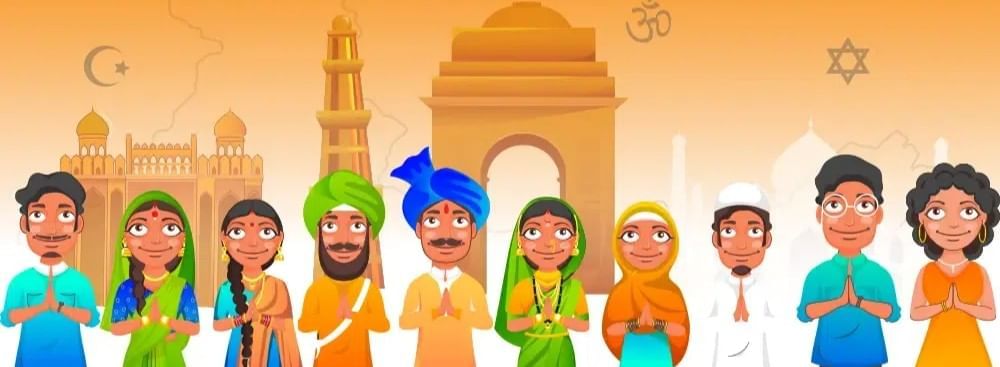
- The Constitution guarantees all individuals the freedom to profess, practise and propagate any religion, or not to follow any religion.
- The Constitution prohibits discrimination on the grounds of religion and protects cultural and educational rights, ensuring equal treatment of citizens irrespective of their religion.
 Secular India
Q7. When we speak of gender divisions, we usually refer to:
(a) Biological difference between men and women
(b) Unequal roles assigned by society to men and women
(c) Unequal child sex ratio
(d) Absence of voting rights for women in democracies
Ans: (b)
Explanation: Gender divisions refer to the roles, responsibilities and expectations that society assigns to men and women. These social roles are learned and enforced through customs and institutions, and often lead to unequal opportunities and treatment for women compared with men.
Q8.In India, seats are reserved for women in
(a) Lok Sabha
(b) State Legislative Assemblies
(c) Cabinets
(d) Panchayati Raj bodies
Ans: (d)
Explanation: The Constitution and subsequent laws provide for reservation of seats for women in Panchayati Raj institutions (rural local bodies). There is currently no nationwide reservation of seats for women in the Lok Sabha, State Legislative Assemblies or cabinets, although there have been demands for such reservation.
Q9.Consider the following statements on the meaning of communal politics. Communal politics is based on the belief that:
Α. One religion is superior to that of others.
Β. People belonging to different religions can live together happily as equal citizens.
C. Followers of a particular religion constitute one community.
D. State power cannot be used to establish the domination of one religious group over others.
Which of the statements is/are correct?
(a) A, B, C and D
(b) A, B and D
(c) A and C
(d) B and D
Ans: (c)
Explanation: Communal politics asserts the superiority of one religion over others (statement A) and treats followers of a religion as a single community with common political interests (statement C). Statements B and D reflect secular and equal-citizenship principles, which are contrary to communal politics.
Q10.Which among the following statements about India's Constitution is wrong? It
(a) prohibits discrimination on grounds of religion
(b) gives official status to one religion
(c) provides to all individuals freedom to profess any religion
(d) ensures equality of citizens within religious communities
Ans: (b)
Explanation: India's Constitution does not give any one religion official status; instead it establishes a secular state that prohibits discrimination on religious grounds and guarantees freedom of religion and equality for all citizens.
Q11. Social divisions based on ______________ are peculiar to India.
Ans: Social divisions based on caste are peculiar to India.
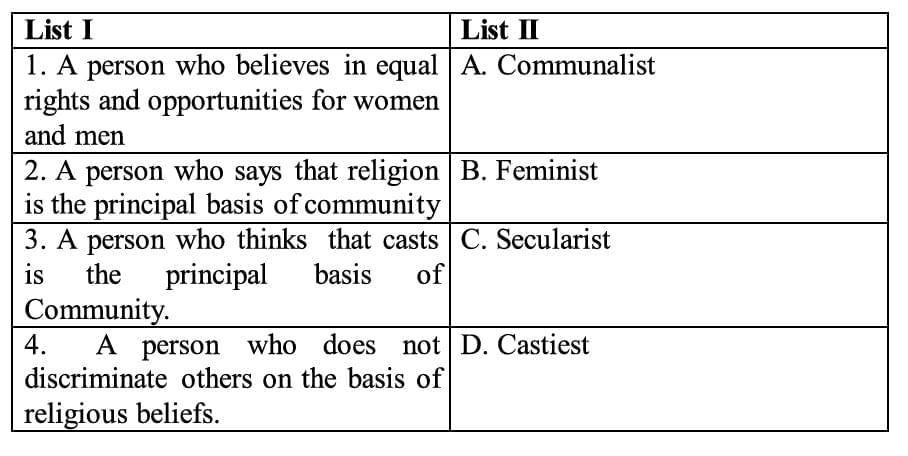
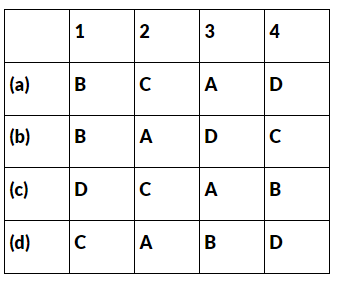
Q12. Match List I with List-II and select the correct answer using the codes given below the Lists:
Ans: (b) B, A, D, C is the correct answer.
A person who believes in equal rights and opportunities for women and men: Feminist
A person who says that religion is the principal basis of community: Communalist
A person who thinks that caste is the principal basis of community: Casteist
A person who does not discriminate others on the basis of religious beliefs: Secularist