NCERT Solutions: Political Parties

Q1: State the various functions political parties perform in a democracy.
Ans: The various functions of political parties in a democracy are:
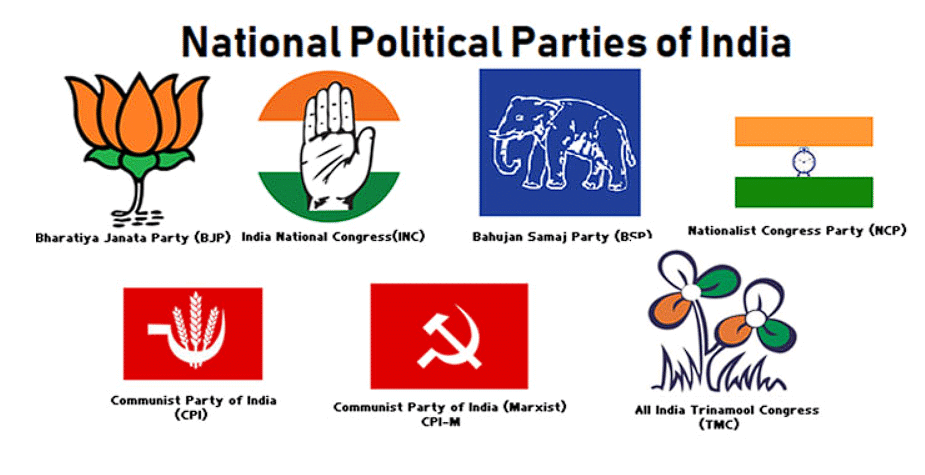
(i) In most democracies, political parties take part in elections by selecting and supporting candidates to contest from different constituencies. Parties recruit and prepare candidates and run election campaigns to win public support.
(ii) Voters choose a party that matches their views and opinions. To gain support, parties offer different policies and programmes so that more people feel connected to them. These policies help voters decide which party best represents their interests.
(iii) Parties play a key role in making laws. Elected members belonging to parties meet in legislatures to debate and pass laws. The winning party or coalition usually promotes laws based on the promises and policies it presented to the voters.
(iv) Parties also form and run the government. Leaders chosen by the majority party or coalition become ministers and run the executive. Parties organise collective decision-making and help co-ordinate policy at national and local levels.
(v) Parties that do not win and do not form the government become the opposition. The opposition keeps a check on the government, questions its actions, and offers alternative policies. This scrutiny helps maintain accountability.
(vi) Parties help to shape public opinion by highlighting important issues, explaining their viewpoints and persuading citizens about their policies. They organise public meetings, campaigns and use the media to reach people.
(vii) Party members help connect people to the government by informing citizens about government schemes and helping them access benefits. Because parties depend on public support during elections, they often act as intermediaries between people and the government.
Q2: What are the various challenges faced by political parties?
Or
Examine the main 'challenges' before 'political parties.'
Ans: Main challenges before political parties:
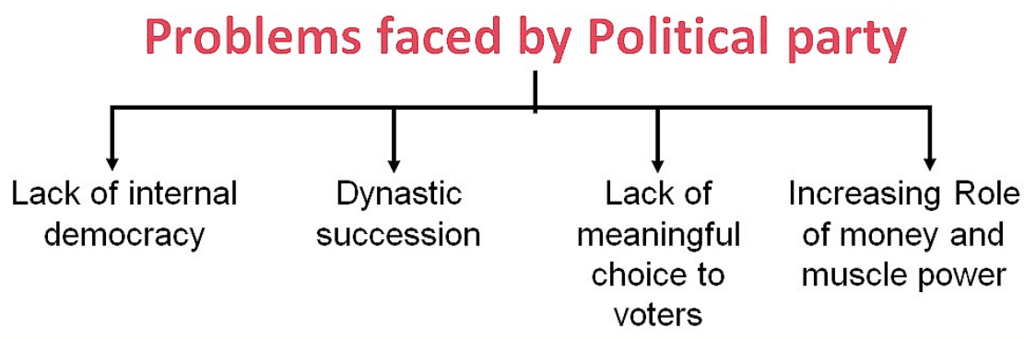
(i) Lack of internal democracy: Many parties concentrate power in the hands of a few leaders. They do not keep proper membership registers, hold regular organisational meetings or hold fair internal elections. Ordinary members often have little information about internal decisions, so leaders make choices without wider consultation.
(ii) Dynastic succession: Some parties favour family members for leadership and important posts. This practice blocks talented ordinary members from rising and is contrary to democratic values.
(iii) Money and muscle power: Wealthy individuals and groups who fund parties may try to influence party policies and the selection of candidates. Use of money and coercion in elections undermines free and fair competition.
(iv) No meaningful choice: In many places, ideological differences between parties have narrowed. Parties sometimes copy each other's policies or leaders shift between parties, so voters may not get a clear choice between alternative visions.
(v) Casteism and religion: Voting on the basis of caste or religion remains a serious challenge. When people vote primarily for candidates of their own caste or faith, politics becomes divisive and social unity suffers.
These challenges weaken parties and reduce their ability to perform democratic functions effectively.
Q3: Suggest some reforms to strengthen parties so that they perform their functions well?
Ans:
(i) Internal affairs:
(a) A law could be made to regulate internal party functioning so that parties are more transparent.
(b) Parties should hold open and regular elections for organisational posts to ensure accountability.
(c) Parties should maintain an up-to-date register of members and keep records of meetings and decisions.
(ii) Women candidates:
(a) Parties should adopt rules to ensure that at least one-third of candidates are women to improve representation.
(b) Women should have adequate representation in decision-making bodies so that their voices shape party policy.
(iii) State funding of elections: To reduce money politics, state funding or regulated financial support could be provided for campaigns. Funding may be direct or indirect (for example, free airtime, facilities or limited grants) as agreed by law.
(iv) If parties resist change, two other ways to bring reform are:
(a) Citizens can press for reform through petitions, public campaigns and peaceful agitations to make parties take reform seriously.
(b) People can join parties in large numbers and work from within to change them. It is often easier to reform a party by active participation than only by criticising it from outside.
Q4: What is a political party?
Ans: A political party is a group of people who come together to contest elections and hold power in the government. A political party has three important components:
(i) Party leadership
(ii) Party members
(iii) Party followers.
Political parties contest elections and occupy political offices to exercise political power and implement their policies.
Q5: What are the characteristics of a political party?
Ans: Characteristics of a political party
(i) A political party is a group of people who come together to contest elections and hold power in the government.
(ii) They agree on some policies and programmes for society to promote the common good.
(iii) Because people may disagree about what is best for society, parties try to persuade voters why their policies are better than others.
(iv) They seek to implement these policies by winning popular support through elections.
(v) Parties reflect important political divisions in society, and they involve partisanship - that is, loyalty to a group or set of ideas.
(vi) A party is recognised by the part of society it represents, the policies it supports and the interests it seeks to protect.
Q6: A group of people who come together to contest elections and hold power in the government is called a ___________.
Ans: A group of people who come together to contest elections and hold power in the government is called a political party.
Q7: Match List I (organisations and struggles) with List II and select the correct answer using the codes given below the lists:
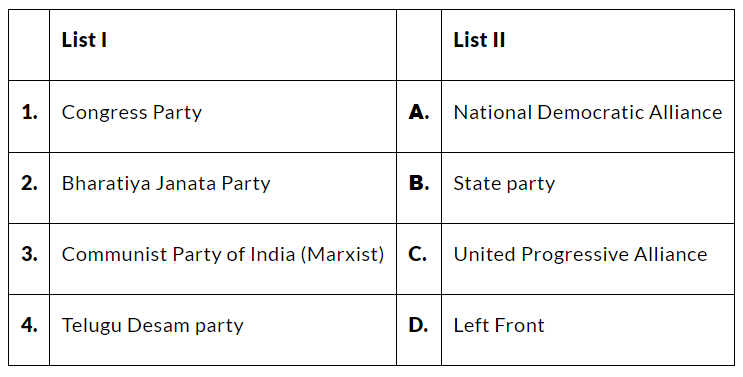
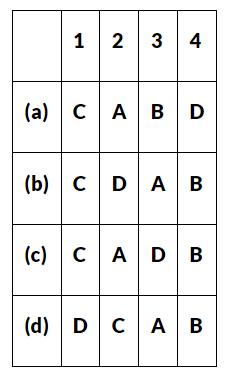
Ans:
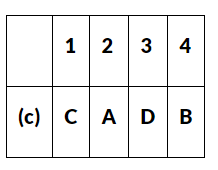
Q8: Who among the following is the founder of the Bahujan Samaj Party?
Α. Kanshi Ram
Β. Sahu Maharaj
C. Β.R. Ambedker
D. Jotiba Phule
Ans: (A)
Explanation: Kanshi Ram founded the Bahujan Samaj Party (BSP) in 1984 with the aim of representing and empowering the marginalised and disadvantaged sections of society, especially Scheduled Castes, Scheduled Tribes and Other Backward Classes. The BSP sought to give political voice and leadership to those communities.
Q9: What is the guiding philosophy of the Bharatiya Janata Party?
A. Bahujan Samaj
B. Revolutionary democracy
C. Integral humanism
D. Modernity
Ans: (C)
Explanation: The guiding philosophy of the Bharatiya Janata Party (BJP) is Integral Humanism, put forward by Deendayal Upadhyaya. This idea emphasises balanced development that honours India's cultural values while promoting material and moral progress. It stresses a holistic view of human welfare rather than focusing only on economic growth.
 Bhartiya Janta Party
Q10: Consider the following statements on parties.
(a) Political parties do not enjoy much trust among the people.
(b) Parties are often rocked by scandals involving top party leaders.
(c) Parties are not necessary to run governments.
Which of the statements given above are correct?
(a) A, B and C
(b) A and B
(c) B and C
(d) A and C
Ans: (b)
Explanation: Statements (a) and (b) are correct. Many people lose trust in parties because of corruption, scandals and poor leadership. Parties are often affected by controversies involving top leaders. Statement (c) is incorrect because political parties are essential in most democracies: they organise elections, form governments and represent different sections of society.
Q11: Read the following passage and answer the questions given below:
Muhammad Yunus is a famous economist of Bangladesh. He received several international honours for his efforts to promote economic and social development for the benefit of the poor. He and the Grameen Bank jointly, received the Nobel Peace Prize for the 2006. In February 2007, he decided to launch a political party and contest in the parliamentary elections. His objective was to foster proper leadership, good governance and build a new Bangladesh. He felt that only a political party different from the traditional ones woxild bring about new political culture. His party would be democratic from the grassroots level.
The launching of the new party, called Nagarik Shakti (Citizens' Power), has caused a stir among the Bangladeshis. While many welcomed his decision, some did not like it. "Now I think Bangladesh will have a chance to choose between good and bad and eventually have a good government", said Shahedul Islam, a government official. "That government, we hope, would not only keep itself away from corruption but also make fighting corruption and black money a top priority."
But leaders of traditional political parties who dominated the country's politics for decades were apprehensive. "There was no debate (over him) winning the Nobel, but politics is different - very challenging and often controversial", said a senior leader of the Bangladesh Nationalist Party. Some others were highly critical. They asked why he was rushing into politics. "Is he being planted in politics by mentors from outside the country", asked one political observer.
(a) Do you think Yunus made the right decision to float a new political party?
(b) Do you agree with the statements and fears expressed by various people?
(c) How do you want this new party organised to make it different from other parties?
(d) If you were the one to begin this political party, how would you defend it?
Ans:
(a) Yes. In a democracy every citizen has the right to form a political party or to join one. If Yunus believed a new party could bring better leadership and cleaner governance, he was entitled to attempt this through peaceful and democratic means.
(b) The fears expressed by some traditional leaders are understandable but not necessarily justified. Politics can be challenging and critics may question motives. However, being critical does not mean the formation is wrong; concerns should be answered by openness and clear policies rather than by rejecting the idea alone.
(c) To make the new party genuinely different, it should be organised on democratic lines with:
- Regular and transparent internal elections for party posts;
- A clear code of conduct and financial transparency to avoid corruption;
- Adequate representation for women and minorities;
- Grassroots decision-making so local members have a real voice.
(d) I would defend the formation of the party by saying that democratic politics benefits from new ideas and honest leadership. If the party follows transparent procedures, focuses on public welfare and allows citizens to judge it at the ballot box, it strengthens democracy rather than weakens it.
FAQs on NCERT Solutions: Political Parties
| 1. राजनीतिक पार्टियां क्या होती हैं और इनका महत्व क्या है? |  |
| 2. भारत में प्रमुख राजनीतिक पार्टियों के नाम क्या हैं? | |
| 3. राजनीतिक पार्टियों के प्रकार कौन-कौन से होते हैं? | |
| 4. राजनीतिक पार्टियों के चुनावी प्रक्रिया में क्या भूमिका होती है? | |
| 5. राजनीतिक पार्टियों के खिलाफ उठने वाले मुख्य आरोप क्या हैं? | |





