NCERT Solutions: Outcomes of Democracy

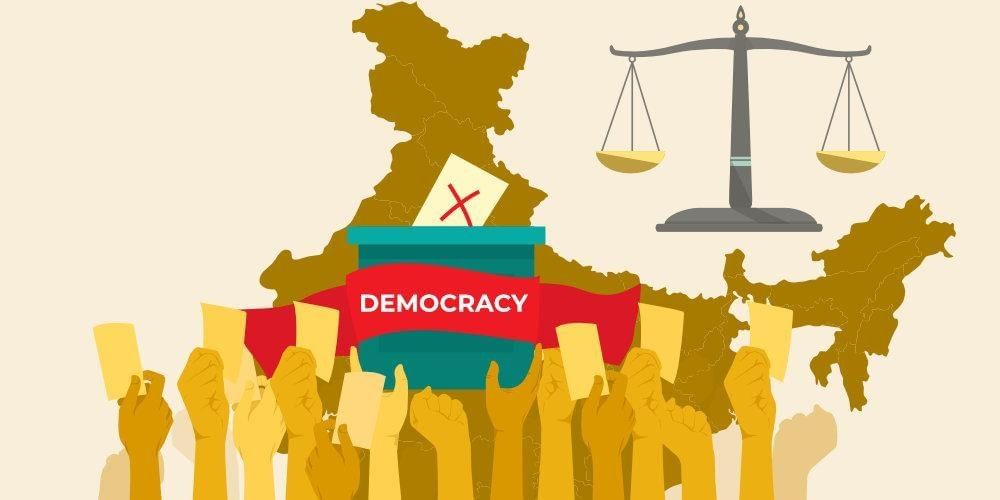
Q1. How does democracy produce an accountable, responsive, and legitimate government?
Ans: In a democracy, citizens choose their representatives and can influence decisions that affect their lives. This creates three linked outcomes:
- Accountable: Elected officials must justify their actions to citizens and can be voted out if they do not perform. Accountability is reinforced by institutions such as independent courts and a free press .
- Responsive: Governments in a democracy tend to respond to public needs because leaders depend on public support to remain in office. Mechanisms such as local bodies, and regular elections help governments listen and adapt to citizens' demands.
- Legitimate: Legitimacy means that the government's authority is accepted because it is chosen through free and fair elections. When people believe leaders are chosen fairly, they are more likely to respect laws and cooperate with public policies.
Key features that help produce these outcomes include:
- Regular, free, and fair elections that allow peaceful change of government.
- Open public debates and a free media that expose wrongdoing and inform citizens.
- Civil rights such as freedom of association, speech, and access to information that enable people to hold rulers to account.
Democracies may sometimes take longer to decide because of discussion and checks on power, but this deliberation helps reduce misuse of power and can improve the quality of governance over time.
Q2. What are the conditions under which democracies accommodate social diversities?
Ans: Democracies are designed to respect and accommodate social diversities. They evolve mechanisms to negotiate differences, as seen in the case of Belgium. However, the example of Sri Lanka highlights two essential conditions for a democracy to effectively manage social diversities:
- Collaboration between majority and minority: The majority must be willing to engage with minority groups so that government policies represent the interests of different communities. Dialogue, power-sharing arrangements and institutions that include minority voices help to build trust.
- Inclusivity in majority rule: Majority rule should not become domination by one community. Democracy thrives when every citizen has the opportunity to be part of the majority at some point.
Practically, democracies accommodate diversity through measures such as federal or devolved governance, proportional representation, minority safeguards, and independent courts. When these mechanisms are present and respected, democracies can manage differences peacefully and fairly.
Q3. Give arguments to support or oppose the following assertions:
(a) Industrialised countries can afford democracy but the poor need dictatorship to become rich.
(b) Democracy can't reduce inequality of incomes between different citizens.
(c) The government in poor countries should spend less on poverty reduction, health, and education and spend more on industries and infrastructure.
(d) In democracy all citizens have one vote, which means that there is an absence of any domination and conflict.
Ans:
(a) This assertion is not correct.
There is no automatic link that only industrialised countries can have democracy or that dictatorships produce wealth. Economic growth depends on many factors such as resources, policies, institutions, and how gains are distributed. Dictatorship does not guarantee rapid or fair development and may deny political freedoms that citizens value.
Example: China grew fast under dictatorship but Zimbabwe did not.
(b) Democracy by itself does not automatically remove income inequality as there are sectional communities which have different professions. However, democratic governments can adopt policies-such as progressive taxation, social welfare, minimum support prices, public health and education-that reduce economic inequality. In short, democracy provides the space to demand such policies, but outcomes depend on the choices made by governments.
(c) The statement is incorrect as a general rule. Investing in health, education, and poverty reduction builds human capital and long-term productivity. Without a healthy and educated population, industrial and infrastructure investments are less effective. A balanced approach is best: invest in people while also developing industry and infrastructure.
(d) The claim is partly true but incomplete. One person, one vote is a key democratic principle that reduces political inequality, but it does not eliminate domination or conflict. Social divisions, economic disparities, and weak institutions can still cause conflicts and unequal influence within a democracy.
Q4. Identify the challenges to democracy in the following descriptions. Also, suggest policy/institutional mechanism to deepen democracy in the given situations:
(a) Following a High Court directive a temple in Orissa that had separate entry doors for Dalits and non-Dalits allowed entry for all from the same door.
(b) A large number of farmers are committing suicide in different states of India.
(c) Following allegation of killing of three civilians in Gandwara in a fake encounter by Jammu and Kashmir police, an inquiry has been ordered.
Ans:
(a) (i) Challenge: Social inequality and caste discrimination. There are separate doors for Dalits and Non-Dalits to enter the temple.
(ii) Ways to deepen democracy: Enforce laws that ban caste discrimination, promote awareness campaigns, support local community groups that oppose discriminatory practices, and ensure that courts and local administrations act promptly when rights are violated.
(b) Challenge:This relates to economic inequalities with special reference to the poor condition of farmers in different states of India. The government should take the following steps to improve their condition:
Measures to deepen democracy:
(i) Provide timely and accessible credit, crop insurance and drought relief.
(ii) Improve irrigation, storage, and marketing facilities so farmers get fair prices.
(iii) Ensure minimum support prices (MSP), strengthen extension services, and offer mental-health and social support. Greater transparency in subsidy and loan schemes will increase trust in public institutions.
(c) (i) Challenge: Lack of transparency and accountability
(ii) Ways to deepen democracy: Conduct independent and transparent inquiries, allow oversight by human rights commissions and courts, hold accountable those responsible if found guilty, and introduce police reforms that strengthen training, accountability, and community policing. Public access to information about investigations helps rebuild trust.
Q5. In the context of democracies, which of the following ideas is correct - democracies have successfully eliminated:
(a) conflicts among people
(b) economic inequalities among people
(c) differences of opinion about how marginalised sections are to be treated
(d) the idea of political inequality
Ans: (d)
Explanation: Democracies aim to reduce political inequality by giving all citizens equal political rights, such as the right to vote and the right to stand for public office. This makes political power formally accessible to everyone. However, democracies have not fully eliminated conflicts, economic inequalities, or disagreements over how marginalised groups should be treated.
Q6. In the context of assessing democracy which among the following is odd one out. Democracies need to ensure:
(a) free and fair elections
(b) dignity of the individual
(c) majority rule
(d) equal treatment before the law
Ans: (c)
Explanation: While majority rule is a feature of democracy, it is not sufficient by itself to assess the quality of a democracy. A healthy democracy must also protect the rights and dignity of individuals and ensure equal treatment before the law, so that majority decisions do not trample minority rights.
Q7. Studies on political and social inequalities in democracy show that
(a) democracy and development go together
(b) inequalities exist in democracies
(c) inequalities do not exist under dictatorship
(d) dictatorship is better than democracy
Ans: (b)
Explanation: Research shows that inequalities of various kinds-economic, social and political-can and do exist within democratic societies. Democracy does not automatically remove these inequalities, though it provides avenues (such as public debate, elections and policy change) to address them.
Q8. Read the passage below:
Nannu is a daily wage earner. He lives in Welcome Mazdoor Colony, a slum habitation in East Delhi. He lost his ration card and applied for a duplicate one in January 2004. He made several rounds to the local Food and Civil Supplies office for the next three months. But the clerks and officials would not even look at him, leave alone do his job or bother to tell him the status of his application. Ultimately, he filed an application under the Right to Information Act asking for the daily progress made on his application, names of the officials, who were supposed to act on his application, and what action would be taken against these officials for their inaction.
Within a week of filing an application under the Right to Information Act, he was visited by an inspector from the Food Department, who informed him that the card had been made and he could collect it from the office. When Nannu went to collect his card next day, he was given a very warm treatment by the Food and Supply Officer (FSO), who is the head of a Circle. The FSO offered him tea and requested him to withdraw his application under the Right to Information since his work had already been done.
What does Nannu's example show? What impact did Nannu's action have on officials? Ask your parents their experiences when they approach government officials to attend to their problems.
Ans:
Ans: (a) Nannu's example shows that ordinary citizens can use their legal rights to make public officials answerable. When people know their rights and use tools such as the Right to Information, they can reduce official indifference and compel authorities to act.
(b) Nannu's action produced a quick response from officials: an inspector confirmed that the card was ready and the Food and Supply Officer (FSO) personally received him and offered polite treatment. This shows that seeking information publicly can pressure officials to complete pending work and improve their behaviour. At the same time, the request to withdraw the application shows that officials may prefer to avoid formal scrutiny, which underlines why transparency matters.
(c) Many people report that officials often delay or ask them to return again and again when they first approach government offices. However, with instruments like the Right to Information and stronger citizen awareness, service delivery has improved in several places. Citizens' experiences vary, but increased demands for transparency have made it more difficult for officials to ignore genuine grievances.
FAQs on NCERT Solutions: Outcomes of Democracy
| 1. What are the key outcomes of democracy discussed in Class 10 NCERT Solutions? |  |
| 2. How does democracy improve the quality of decision-making? | |
| 3. Why is accountability an important outcome of democracy? | |
| 4. In what ways does democracy contribute to social justice? | |
| 5. How does the participation of citizens affect the outcomes of democracy? | |





