NCERT Solutions: Development

Page - 6
Q1: Why do different persons have different notions of development? Which of the following explanations is more important and why?
(a) Because people are different. (b) Because life situations of persons are different.
Ans: (b) Because life situations of persons are different.
People have different notions of development primarily because their life situations, needs, and priorities differ. For instance, a person in a rural area might prioritise access to clean water and electricity, while someone in an urban area might focus on better healthcare and educational opportunities. Thus, life situations play a crucial role in shaping what individuals consider important for their development.
Q2: Do the following two statements mean the same? Justify your answer.
(a) People have different developmental goals.
(b) People have conflicting developmental goals.
Ans: No, they do not mean the same.
(a) People have different developmental goals - This means that various individuals or groups aim for different outcomes because of their differing needs, resources and priorities. The goals are simply not identical.
(b) People have conflicting developmental goals - This implies that the goals of different individuals or groups clash or cannot be achieved together without trade-offs. In this case pursuing one group's goal may harm or prevent another group's goal.
For example, a farmer wanting to divert river water for irrigation may come into conflict with conservationists who wish to maintain the river's natural flow to protect wildlife.
Q3: Give some examples where factors other than income are important aspects of our lives.
Ans:
- Health: Access to quality healthcare is crucial for a good quality of life, irrespective of income.
- Education: Schools and learning opportunities shape future prospects and quality of life beyond current earnings.
- Environmental Quality: Clean air, safe drinking water and a healthy environment affect everyday life and long-term health.
- Social Security: Safety from crime and reliable social support systems matter for people's sense of security.
- Equality: Fair access to opportunities regardless of gender, caste or background ensures that development benefits everyone.
Q4: Explain some of the important ideas of the above section in your own words.
Ans:
- The World Bank classifies countries based on per capita income, but this measure has limitations.
- Per capita income does not capture income inequality or how income is distributed among people.
- It overlooks non-monetary aspects of well-being such as health and education, which affect people's quality of life.
- It also ignores environmental sustainability and differences in the cost of living across places.
- Therefore, while per capita income gives a useful economic snapshot, a full assessment of development must include social, health and environmental dimensions as well as access to basic services.
Page - 9
Q1: Give three examples where an average is used for comparing situations.
Ans:
- Average Temperature: Comparing the average temperatures of two cities helps to understand climatic differences.
- Average Marks: Comparing the average marks of students in different schools gives a general idea of academic performance.
- Average Income: Comparing the average income of different countries gives a broad measure of economic well-being.
Q2: Why do you think average income is an important criterion for development? Explain.
Ans: Average income is important because it gives a simple, comparable measure of the average economic resources available per person in a country. It helps to compare living standards between countries or over time. However, it should be used together with other indicators - such as health, education and income distribution - because average income alone does not show whether wealth is shared fairly or whether most people actually benefit.
Q3: Besides size of per capita income, what other property of income is important in comparing two or more societies?
Ans: Income distribution is another important property. It shows whether income is spread evenly or concentrated in the hands of a few. Two societies with the same per capita income can have very different levels of equality and well-being depending on how income is distributed.
Q4: Suppose records show that the average income in a country has been increasing over a period of time. From this, can we conclude that all sections of the economy have become better? Illustrate your answer with an example.
Ans: No, we cannot conclude that all sections of the economy have become better. For example, if the average income increases due to a rise in the incomes of the wealthiest individuals, while the incomes of the poorer sections remain stagnant or even decrease, then the economic improvement is not uniformly distributed. This could lead to greater income inequality and social disparity.
Q5: From the text, find out the per capita income level of about 10-15 low-income countries as per World Development Reports.
Ans: The provided text does not list per capita incomes for specific low-income countries. According to the World Bank classification used in recent World Development Reports, low-income countries are those with a per capita income below a specified threshold (around US$1,085 or less in the most recent classification). For exact figures for 10-15 countries, one should refer to the latest World Development Report or World Bank country tables.
Q6: Write a paragraph on your notion of what should India do, or achieve, to become a developed country.
Ans: To become a developed country, India should pursue inclusive and sustainable growth that reaches all sections of society. Priorities should include improving the quality and reach of education and healthcare so people are healthy and skilled; investing in infrastructure such as roads, reliable electricity and digital connectivity; reducing poverty and income inequality through targeted social programmes; promoting clean energy and sustainable use of resources; encouraging investment in technology and manufacturing to create jobs; and ensuring good governance and transparency so public services work effectively. Together these measures will raise living standards and enable long-term, fair development.
Page - 12
Q1: Look at data in Tables 1.3 and 1.4. Is Haryana ahead of Kerala in literacy rate etc., as it is in terms of per capita income? 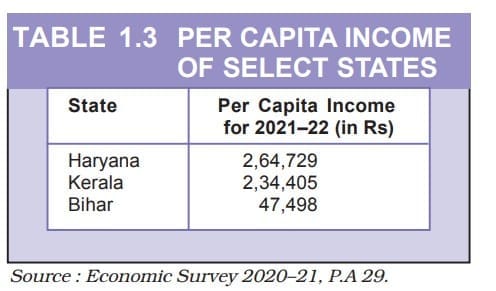
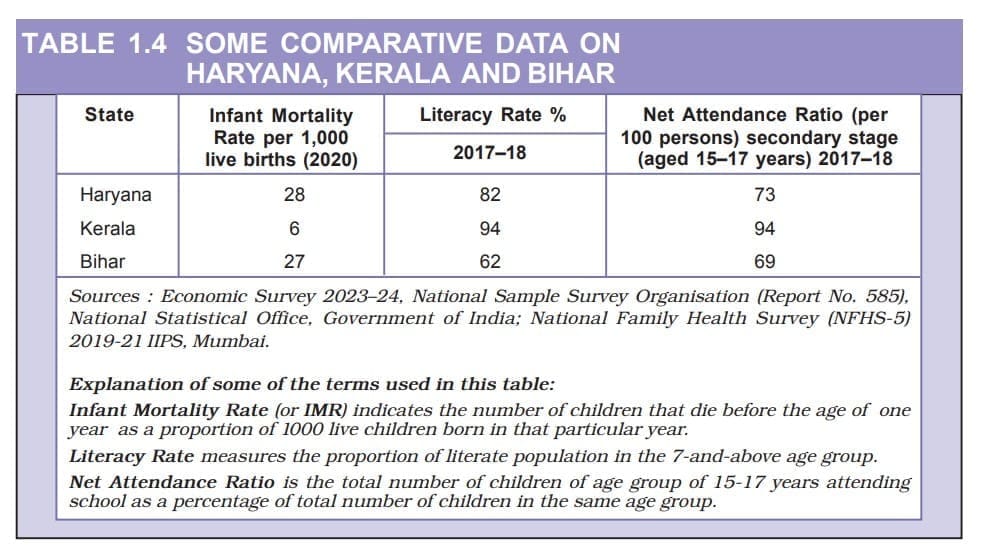
Ans: No. Haryana is not ahead of Kerala in literacy and other human development indicators, even if it may have a higher per capita income.
Explanation: Kerala performs better on many social indicators such as literacy rates, life expectancy and health services. This is because Kerala has long invested in education, healthcare and social welfare, which raises overall human development even if per capita income is lower. Thus per capita income alone does not tell the full story of people's well-being.
Q2: Think of other examples where collective provision of goods and services is cheaper than individual provision.
Ans:
- Public Transportation: Buses and trains used by many people are cheaper per person than each person owning and running a private vehicle.
- Public Libraries: A library provides access to many books for many users, instead of each person buying the same books.
- Public Healthcare: Vaccination campaigns and primary health centres serve many people at lower per-person cost compared with individual private healthcare spending.
Q3: Does availability of good health and educational facilities depend only on amount of money spent by the government on these facilities? What other factors could be relevant?
Ans: No. Spending is important, but other factors matter too:
- Efficient Use Of Resources: Funds must be used well and reach the intended services.
- Quality Governance: Transparent and accountable administration reduces leakages and improves service delivery.
- Infrastructure: Adequate buildings, equipment, transport and utilities are necessary.
- Skilled Workforce: Trained teachers and health workers are essential for quality services.
- Community Participation: Local involvement in planning and monitoring helps services meet real needs.
- Policy Implementation: Good policies must be well executed at the local level.
Q4: In a study, it was found that in Tamil Nadu, 90 per cent of the people living in rural areas used a ration shop, whereas in West Bengal only 35 per cent of rural people did so. Where would people be better off and why?
Ans: People in Tamil Nadu would generally be better off because higher use of ration shops suggests a more effective and accessible Public Distribution System (PDS). A functioning PDS gives poor households access to staple foods at subsidised prices, helping to reduce hunger and food insecurity. However, high usage should be seen together with the quality and adequacy of the supplies to judge overall wellbeing.
Page - 16
Q1: Development of a country can generally be determined by:
(a) It's per capita income
(b) Its average literacy level
(c) Health status of its people
(d) All the above
Ans: (d) All of the above
The country's development depends on the following factors
- In general, a country's growth is decided by its per capita income, its average level of literacy as well as the health status of the people in the nation.
- A country's growth is a general concept that improves people's per capita income and living standards. It also lowers the poverty, the rate of crimes as well as the illiteracy of individuals.
- Development not just depends on the economic factors of a country but is also dependent on resources that are available for the people of a country to use.
- Two aspects of development are
Economic growth or increase in people's income.
Social progress includes literacy, health and the provision of public services.
Q2: Which of the following neighbouring countries has better performance in terms of human development than India?
(a) Bangladesh
(b) Sri Lanka
(c) Nepal
(d) Pakistan
Ans: (b) Sri Lanka
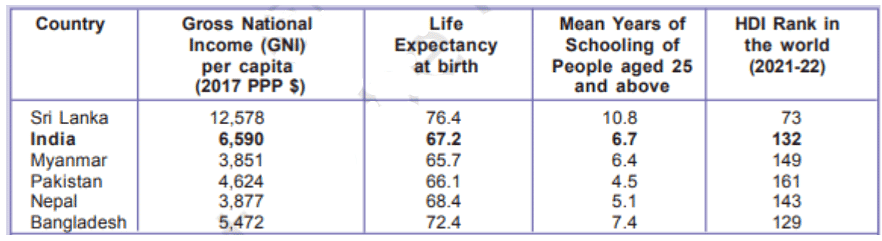
Explanation: Sri Lanka's Human Development Index (HDI) position is higher than India's. For example, in the HDI ranking referenced in the text, Sri Lanka stands much better (around rank 73) compared with India's rank (around 132). Bangladesh, Nepal and Pakistan have lower HDI positions than Sri Lanka in that comparison.
Q3: Assume there are four families in a country. The average per capita income of these families is Rs 5000. If the income of three families is Rs 4000, Rs 7000 and Rs 3000 respectively, what is the income of the fourth family?
(a) Rs 7500
(b) Rs 3000
(c) Rs 2000
(d) Rs 6000
Ans: (d)
Sol:
Total income of all four families = Average × Number of families = Rs 5000 × 4 = Rs 20000.
Total income of three known families = Rs 4000 + Rs 7000 + Rs 3000 = Rs 14000.
Income of the fourth family = Rs 20000 - Rs 14000 = Rs 6000.Therefore, the income of the fourth family is Rs 6000.
Q4: What is the main criterion used by the World Bank in classifying different countries? What are the limitations of this criterion, if any?
Ans: Countries are classified by per capita income, which is the average income per person. The World Bank uses this classification in its World Development Reports. Low-income countries have a per capita income below a certain threshold, while high-income countries have much higher per capita incomes.
Limitations
1. Per capita income does not show how income is distributed among people; it can hide large inequalities.
2. It ignores non-economic aspects of development such as infant mortality, literacy, health and access to services.
3. Per capita income includes the whole population, including those who do not earn (children, elderly), so it may not reflect the true economic situation of working adults. Thus it gives an incomplete picture of people's real welfare.
Q5: In what respects is the criterion used by the UNDP for measuring development different from the one used by the World Bank?
Ans: The World Bank mainly classifies countries by per capita income. The UNDP uses a broader measure called the Human Development Index (HDI) that combines several dimensions - such as life expectancy, educational attainment and per capita income - to judge development. UNDP's approach recognises that health, education and living standards together determine people's quality of life, not income alone.
Q6: Why do we use averages? Are there any limitations to their use? Illustrate with your own examples related to development.
Ans: We use averages because different countries have different populations, so calculating the average helps in getting an estimated answer which can be used to compare different things at different levels.
There are limitations to calculating averages because this does not give any information about the distribution of resources between people.
Example: If we calculate the per capita income of two countries A and B with 5 people each, the salary of five people in country A is Rs.23,000, Rs.22,000, Rs.23,500, Rs.28,000 and Rs.25,000 and the income of people living in country B are Rs.1,50,000, Rs. 22,000, Rs.50,000, Rs.4000, Rs.2500.
The average income of country A will be Rs.24,300, and that of country B will be Rs.45,700. This proves that the average of country B is higher than that of country A, and yet there is a disparity in the income distribution of country B and the income is evenly distributed in country A.
Q7: Kerala, with lower per capita income has a better human development ranking than Haryana. Hence, per capita income is not a useful criterion at all and should not be used to compare states. Do you agree? Discuss.
Ans: No. Per capita income is a useful measure but not sufficient on its own. It gives an idea of average material resources but does not tell us how income is distributed or how people fare in health and education. Kerala's better human development performance despite lower per capita income shows that investments in education, public health and social policies can raise living standards even without very high average income. Therefore, per capita income should be used alongside social indicators such as literacy, life expectancy and access to services when comparing states.
Q8: Find out the present sources of energy that are used by the people in India. What could be the other possibilities fifty years from now?
Ans: Present common energy sources in India include electricity (from mixed sources), coal, crude oil (petrol and diesel), natural gas, biomass (wood, cow dung), and growing use of solar and wind energy. Fifty years from now, India could rely much more on renewable energy such as solar, wind, hydro and possibly tidal energy; expanded use of biofuels (ethanol, biodiesel); greater use of nuclear energy in a safe manner; improved energy storage and hydrogen technologies; and more efficient use of energy across industry, transport and households.
Q9: Why is the issue of sustainability important for development?
Ans: Sustainability matters because development today must not damage the environment or exhaust resources needed by future generations. Sustainable development aims to meet present needs while preserving natural resources and the environment so that future generations can also achieve a good quality of life. For example, over-extraction of groundwater can raise incomes now but cause shortages later; sustainable practices avoid such long-term harm.
The Sustainable Development Goals are
- To encourage growth that minimises environmental damage.
- To meet current needs while protecting the environment for future generations.
For growth, sustainability requires that resource reserves, including exhaustible natural resources and environmental capacities, be conserved. Recent studies show that in some parts of India groundwater is being overused, creating long-term risks for agriculture and livelihoods.
Q10: "The Earth has enough resources to meet the needs of all but not enough to satisfy the greed of even one person". How is this statement relevant to the discussion of development? Discuss.
Ans: This statement highlights that resources must be used responsibly. The Earth can provide for everyone's basic needs if resources are shared fairly and used sustainably. But unrestrained greed and excessive consumption by some can deplete resources and harm others. For development to be meaningful and lasting, it should focus on fulfilling needs, reducing inequality and conserving the environment rather than encouraging limitless consumption.
Q11: List a few examples of environmental degradation that you may have observed around you.
Ans: Few examples of environmental degradation:
- Deforestation
- Soil erosion
- Falling levels of groundwater
- Air pollution from vehicles and industrial emissions
- Water pollution in rivers and lakes
Q12: For each of the items given in Table 1.6, find out which country is at the top and which is at the bottom.
Ans:
- Gross National Income (GNI) per capita: Sri Lanka (top), Myanmar (bottom)
- Life Expectancy at birth: Sri Lanka (top), Myanmar (bottom)
- Mean Years of Schooling: Sri Lanka (top), Pakistan (bottom)
- HDI Rank in the world: Sri Lanka (top), Pakistan (bottom)
Q13: The following table shows the proportion of adults (aged 15-49 years) whose BMI is below normal (BMI <18.5 kg/m2 ) in India. It is based on a survey of various states for the year 2019-21. Look at the table and answer the following questions.
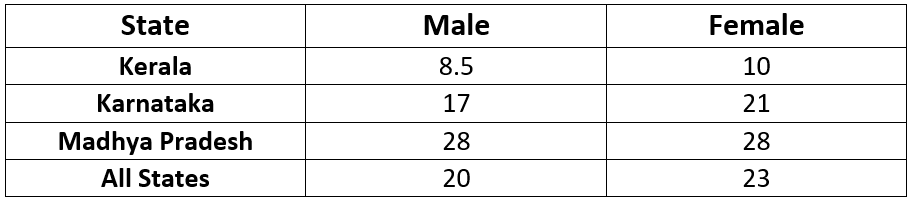
(i) Compare the nutritional level of people in Kerala and Madhya Pradesh.Ans: The nutritional level in Kerala is better than in Madhya Pradesh. Kerala shows a lower proportion of adults with BMI below normal, which indicates healthier nutrition and better overall health status compared with Madhya Pradesh.
(ii) Can you guess why around one-fifth of people in the country are undernourished even though it is argued that there is enough food in the country? Describe in your own words.
Ans: Even when there is enough food produced nationally, about one-fifth of people can be undernourished because of unequal access and other problems:
- Poverty: Many households cannot afford a balanced diet.
- Ineffective Public Distribution: In some places the PDS does not reach the needy or supplies are irregular.
- Lack of Education and Health Services: Poor knowledge about nutrition, sanitation and limited healthcare can lead to malnutrition.
FAQs on NCERT Solutions: Development
| 1. What is the concept of development according to the article? |  |
| 2. How does the article define sustainable development? | |
| 3. What are some key indicators of development discussed in the article? | |
| 4. How does the article explain the role of education in development? | |
| 5. How does the article address the issue of inequality in the context of development? | |





