Digestive System - Notes, Biology


Digestive System in Humans
The digestive system converts food into energy-giving and structural substances that the body can absorb and use. It consists of the alimentary canal (a continuous muscular tube from mouth to anus) and the associated digestive glands such as the liver, pancreas and salivary glands.
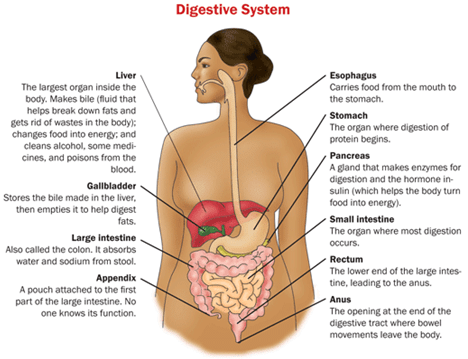
Human Digestive System Parts and Their Functions
1. Buccal Cavity (Mouth)
- The buccal cavity receives food. It begins the digestive process by mechanical and chemical means and forms the food into a soft mass called the bolus for swallowing.
- Salivary glands secrete saliva, which contains ptyalin (salivary amylase), mucus and antibacterial substances. Saliva moistens food, begins the digestion of starch to maltose and helps form the bolus.
- Saliva also contains lysozyme, an enzyme that can kill or inhibit bacteria, contributing to oral defence.
(I) Teeth
- Humans have two sets of teeth: the temporary (deciduous) set and the permanent set.
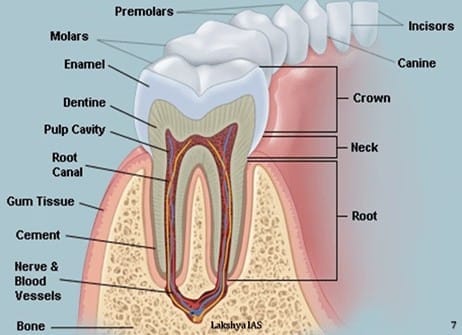
- There are four types of teeth: incisors, canines, premolars and molars. Each type has a different shape and function (cutting, tearing, grinding).
- The standard adult dental formula for one half of the jaw is 2 incisors, 1 canine, 2 premolars, 3 molars - written as 2123 / 2123. Doubling both halves gives a total of 32 permanent teeth.
- Premolars and molars are adapted for grinding. The last molars are the wisdom teeth.
- In some animals, incisors or canines are modified: e.g., elephant upper incisors form large tusks; large canines are characteristic of many predators such as cats, dogs and lions.
Structure of a Tooth
- A tooth has three main regions: crown (the exposed part), neck (the constricted part at the gum line) and root (embedded in the jaw bone).
- The crown is covered by enamel, which is the hardest substance in the human body.
- Beneath enamel lies dentine, and a central pulp cavity contains blood vessels and nerves. The root is covered by cementum and secured to the jaw by the periodontal ligament.
2. Pharynx
- The pharynx (throat) is a common passage for both food and air.
- It connects the mouth (buccal cavity) to the oesophagus (food pipe), and the nose (nasal cavity) to the larynx (voice box).
- During swallowing, the bolus (chewed food) moves from the mouth → pharynx → oesophagus with the help of muscle movements.
- The larynx opens into the pharynx.
Its opening is called the glottis, which leads to the trachea (windpipe). - While swallowing, a flap called epiglottis closes the glottis so that food does not enter the windpipe.
- The pharynx also has openings of Eustachian tubes, which connect the throat to the middle ear (in the upper part called nasopharynx).
3. Oesophagus
- The oesophagus (gullet) is a muscular tube that links the pharynx to the stomach.
- Food is propelled along the oesophagus by peristalsis: coordinated waves of circular and longitudinal muscle contraction that push the bolus forward.
- Sphincters at both ends - the upper and lower oesophageal sphincters - regulate entry and prevent regurgitation.
4. Stomach
- The stomach is a J-shaped muscular bag where food from the oesophagus is stored and subjected to mechanical churning and chemical digestion. The semi-fluid mass in the stomach is called chyme.
- It has three major regions: cardiac, fundus and pyloric regions. The pyloric sphincter controls the passage of chyme into the small intestine.
- Gastric glands in the stomach wall secrete gastric juice containing hydrochloric acid (HCl), pepsinogen (activated to pepsin), mucus and, especially in infants, rennin (also called chymosin) that acts on milk protein.
- HCl provides an acidic medium (pH 1.5-3.5) that kills many microorganisms and converts pepsinogen to active pepsin, which begins the digestion of proteins into peptones and peptides. Gastric lipase participates in limited fat digestion.
- The stomach stores food and performs initial stages of digestion before controlled release of chyme into the small intestine.
5. Small Intestine
The small intestine is the principal site of chemical digestion and absorption. It is divided into three parts: duodenum, jejunum and ileum.
- The duodenum receives acidic chyme from the stomach and secretions from the pancreas and liver (via the bile duct). The bile duct and pancreatic duct join or open close to one another so their secretions mix with the duodenal contents.
- Bile, produced by the liver and stored in the gall bladder, contains bile salts that emulsify fats, increasing the surface area for lipase action; bile also has bicarbonates that help neutralise acidic chyme. Bile does not contain digestive enzymes.
- Pancreatic juice contains a range of enzymes that act on proteins, carbohydrates and fats; it also supplies bicarbonate ions to neutralise stomach acid.
- The inner surface of jejunum and ileum bears numerous finger-like projections called villi and on their epithelial cells there are microvilli. These structures increase the absorptive surface area enormously.
- Each villus contains a network of blood capillaries (for absorption of amino acids, monosaccharides, water-soluble substances) and a central lymphatic vessel called a lacteal (for absorption of fatty acids and monoglycerides as chylomicrons).
6. Large Intestine
- The large intestine (colon) receives undigested and unabsorbed material from the small intestine.
- Main functions are absorption of water and electrolytes, formation and temporary storage of faeces, and elimination of wastes via the rectum and anus.
- The large intestine includes the caecum (with the vermiform appendix attached), the colon (ascending, transverse, descending and sigmoid), the rectum and the anal canal.
- In the caecum and colon, gut bacteria (intestinal flora) act on some undigested carbohydrates (e.g. cellulose in herbivores) and synthesise certain vitamins (notably vitamin K and some B vitamins) that are absorbed by the host. In humans the caecum and appendix are relatively small and largely vestigial, though the appendix has some lymphoid tissue and immunological function.
- Faeces are expelled through the anus, controlled by internal and external anal sphincters.
7. Pancreas
The pancreas has both exocrine and endocrine functions. The exocrine pancreas secretes pancreatic juice containing digestive enzymes (amylases, proteases, lipases, nucleases) and bicarbonate ions into the duodenum. The endocrine portion (islets of Langerhans) secretes hormones such as insulin and glucagon into the blood (endocrine functions are beyond the scope of this digestive-system overview).
8. Intestinal Glands
- The mucosa of the small intestine contains glands called crypts of Lieberkühn.
- These glands secrete intestinal juice.
- Intestinal juice contains enzymes or enzyme activators such as enterokinase and disaccharidases.
- These enzymes complete digestion at the brush border.
- Intestinal juice also contains mucus which protects and lubricates the intestinal lining.
Digestive Enzymes: Source and Action
| Secreted by | Enzymes / Components | Acts on | Products |
|---|---|---|---|
| Salivary glands | Ptyalin (salivary amylase) | Starch, glycogen, dextrins | Maltose, isomaltose, limit dextrins |
| Gastric (stomach) | Pepsin (from pepsinogen activated by HCl) | Proteins, some casein derivatives | Peptones and peptides |
| Rennin (prorennin → rennin in infants) | Casein (milk protein) | Paracasein (curd) and whey proteins | |
| Gastric lipase | Fats (limited action) | Fatty acids and monoglycerides | |
| Pancreas | Trypsin (trypsinogen activated by enterokinase) | Proteins | Peptides |
| Chymotrypsin (from chymotrypsinogen activated by trypsin) | Proteins, casein | Peptides, curd (paracasein) | |
| Pancreatic amylase | Starch, glycogen, dextrins | Maltose, isomaltose, limit dextrins | |
| Pancreatic lipase | Emulsified fats | Fatty acids, glycerol, mono- and di-glycerides | |
| Carboxypeptidases (from procarboxypeptidases) | Peptides | Amino acids and dipeptides | |
| DNAse | DNA | Deoxyribonucleotides | |
| RNAse | RNA | Ribonucleotides | |
| Intestinal glands (brush border) | Intestinal amylase | Starch, glycogen, dextrins | Maltose, isomaltose, limit dextrins |
| Maltase | Maltose | Glucose | |
| Isomaltase | Isomaltose | Glucose | |
| Limit dextrinase | Limit dextrins | Glucose | |
| Invertase (sucrase) | Sucrose | Glucose and fructose | |
| Lactase | Lactose | Glucose and galactose | |
| Intestinal lipase | Emulsified tri-, di- and monoglycerides | Fatty acids and glycerol | |
| Nucleotidases | Nucleotides | Nucleosides and inorganic phosphate | |
| Nucleosidases | Nucleosides | Nitrogenous bases and pentose sugars |
FAQs on Digestive System - Notes, Biology
| 1. What is the function of the digestive system? |  |
| 2. How does the digestive system work? | |
| 3. What are the main organs of the digestive system? | |
| 4. What can affect the functioning of the digestive system? | |
| 5. How can I maintain a healthy digestive system? | |