Ignition, Engine Friction, Lubrication & Cooling

Introduction
The purpose of the ignition system is to provide sufficient energy at the correct time to start combustion and to sustain burning of the charge until normal combustion occurs.
Type Of Ignition System
Battery Ignition System
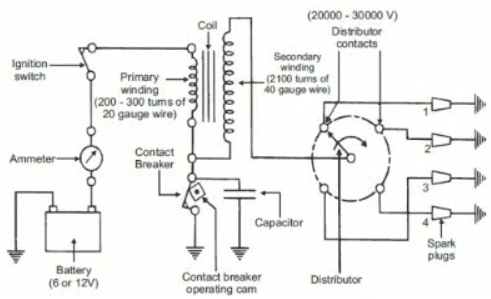
The battery ignition system uses a storage battery as the source of electrical energy. The system has two electrical circuits: the primary circuit and the secondary circuit. The main components and typical features are:
- Primary circuit: ignition switch, ignition coil primary winding (typically 100-200 turns), contact breaker or transistor-switching device, ballast/resistance unit and battery (commonly 6 V or 12 V).
- Secondary circuit: ignition coil secondary winding (typically several thousand turns, e.g. ≈2000 turns), high-tension lead, distributor or rotor and spark plug.
- When current flows in the primary winding a magnetic field is set up in the coil. On sudden opening of the primary circuit (interrupting current) the magnetic field collapses rapidly and a high voltage is induced in the secondary winding. This high voltage produces the spark at the spark plug gap and ignites the mixture.
- The distributor times and distributes the high-voltage pulses to the spark plugs of individual cylinders in the required sequence.
Magneto Ignition System
The magneto ignition system generates its own electrical current required for ignition by rotating a permanent magnet relative to a coil; no battery is needed for spark generation. Key points:
- Current in the primary circuit is produced by the relative motion of magnet and coil driven by the engine.
- Advantages: independent of battery, robust at high speeds, reliable for high-speed applications such as certain racing cars and aircraft engines.
- Disadvantages: more difficult to start (particularly at cold start) and historically heavier or more complex than simple battery systems for road vehicles.
Comparison between Battery and Magneto Ignition Systems
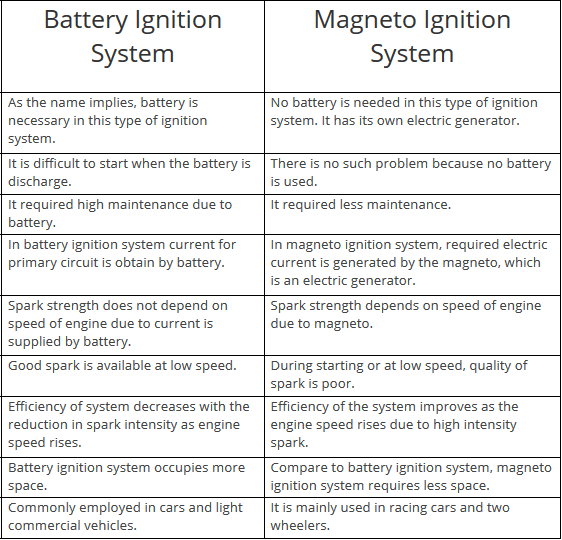
- Source of energy: battery system uses stored electrical energy; magneto generates energy on engine rotation.
- Starting: battery systems generally give easier starting; magnetos can make starting harder without auxiliary starting aids.
- High rpm performance: magnetos can provide strong sparks at very high speeds; modern battery-coil systems with electronic ignition also provide adequate high-speed performance.
- Dependence on battery: battery system needs a charged battery; magneto does not.
- Applications: battery ignition is common in automobiles; magneto ignition is traditional for aircraft and some racing engines where battery independence and high-rpm reliability are important.
Firing Order
The firing order is the sequence in which the cylinders in a multi-cylinder engine are fired. A suitable firing order
- reduces engine vibration,
- improves cooling uniformity,
- reduces crankshaft torsional stresses and back pressure in the exhaust system.
Common firing orders:
- Four-cylinder engines: 1-3-4-2
- Six-cylinder engines: 1-5-3-6-2-4
Engine Friction and Lubrication
Friction Power
Friction power (f.p.) = indicated power (i.p.) - brake power (b.p.).
Indicated power (i.p.) is the power developed in the combustion chamber, calculated from the indicator diagram. Brake power (b.p.) is the useful power delivered at the crankshaft measured on a dynamometer. Accurate measurement of i.p. by indicator diagram is often difficult in practice, so several indirect methods are used to determine friction power.
Methods to Determine Friction Power
Morse Test
The Morse test is used for multi-cylinder engines to determine the indicated power of individual cylinders and hence the total indicated power and friction power. Procedure summary:
- Run the engine at constant speed and load and measure the brake power (all cylinders firing).
- Successively cut out each cylinder (short-circuit its inlet or ignition) so that it does not contribute to power, and measure the brake power with one cylinder cut out.
- The difference in brake power between the all-cylinders condition and the condition with one cylinder cut out gives the indicated power of the cut-out cylinder (assuming friction power remains essentially unchanged for the same speed).
- Sum individual cylinder indicated powers to obtain total i.p.; subtract measured b.p. to obtain f.p.
This method requires a multi-cylinder engine and is applicable when cylinders can be cut off without changing the engine speed and friction significantly.
Willans' Line Method
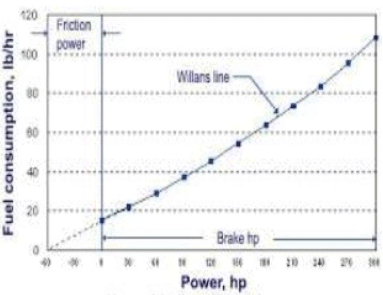
The Willans' line method is based on plotting fuel consumption (fuel flow rate) against brake power (or torque) at constant speed. Procedure and principle:
- Run the engine at several loads and record the corresponding fuel consumption and brake power.
- Plot fuel consumption (vertical axis) versus brake power (horizontal axis) and draw the best straight line through the points.
- Extrapolate the line to zero fuel consumption. The negative intercept on the brake power axis gives an estimate of the mechanical losses (proportional to friction power) expressed in the same units.
The method is most accurate when the relationship between fuel consumption and brake power is approximately linear; it is commonly applied to compression-ignition (diesel) and other engines where the linear assumption holds reasonably well.
Motoring Method
In the motoring method the engine is driven by an external prime mover (motor) with no combustion taking place. The power delivered by the external motor to keep the engine turning at a given speed equals the engine's friction power at that speed. Additional features:
- By disassembling or stripping parts and repeating the test, friction contribution of components (pistons, bearings, accessory drives) can be estimated.
- This method gives direct measurement of friction but requires suitable driving arrangement and safe procedures for motoring the engine.
Functions of Lubrication
- Reduce friction between moving parts.
- Carry away heat from rubbing surfaces (cooling).
- Clean internal surfaces by carrying contaminants and combustion by-products to the oil filter.
- Provide sealing between piston rings and cylinder walls to reduce blow-by.
- Reduce wear and prolong component life.
- Dampen and reduce mechanical noise.
- Provide corrosion protection for metal surfaces.
Properties of a Good Lubricating Oil
- Stable viscosity over operating temperatures: high viscosity index indicates smaller change of viscosity with temperature.
- Suitable viscosity at operating temperature: sufficiently viscous to maintain a load-carrying film but not so viscous as to cause excessive pumping losses.
- Low cloud point and pour point: oil must remain fluid at low ambient temperatures.
- High flash and fire points: to resist ignition at elevated temperatures.
- Good oxidation and thermal stability: resists oil degradation at high temperatures.
- Low acidity and corrosive tendencies: to protect engine parts.
- Good oiliness and film strength: to resist metal-to-metal contact under boundary lubrication conditions.
- Detergent and dispersant properties: to keep contaminants in suspension and avoid deposit formation (important in modern engine oils).
Lubricating Systems
Mist Lubrication System
Mist lubrication is used mainly in some two-stroke engines where a measured amount of lubricating oil is mixed with the fuel or is injected into the intake and carried as an oil mist to engine components. Features:
- Advantage: simple and low cost, eliminates separate oil sump for crankcase lubrication.
- Disadvantages: higher exhaust smoke and hydrocarbon emissions, less precise lubrication control, reduced lubrication when throttle is closed or at some operating conditions.
Wet Sump Lubrication
In a wet sump system the bottom of the crankcase (sump) stores the lubricating oil. The oil is drawn by a pump, filtered and circulated under pressure to bearings and other lubricated parts; some lubrication is also provided by splash from the rotating crank and connecting rods. Typical features:
- Simple and widely used in road vehicles and small stationary engines.
- Includes oil pump(s), oil filter, pressure relief valve and sump (oil reservoir).
Dry Sump Lubrication (brief)
In a dry sump system oil is stored in a separate external tank and scavenged from the crankcase by pumps. Advantages include improved oil control at high-G or high-speed operation, reduced windage losses and the ability to lower engine mounting for vehicle handling. Dry-sump systems are used in high-performance and racing engines.
Engine Cooling
Purpose of cooling:
- Prevent overheating of engine parts and avoid loss of strength or dimensional changes.
- Reduce thermal stresses that can cause cracking and premature failure.
- Maintain appropriate operating temperature to obtain good volumetric efficiency and consistent power output.
Effects of overcooling: excessive cooling causes poor warm-up, increased fuel consumption, incomplete combustion, and faster formation of deposits; low cylinder temperatures may increase wear from contaminated oil or cause condensation and corrosion.
Types of Cooling
Air Cooling
Air cooling removes heat from the engine by direct flow of air over the cylinder barrels and heads. Typical characteristics:
- Common for small engines (motorcycles, scooters, small stationary engines).
- Finned cylinder surfaces increase heat transfer area.
- Simpler, lighter and less vulnerable to freezing; less effective for high-power engines.
Water Cooling
Water (liquid) cooling uses a liquid coolant circulated through water jackets in the engine and through a radiator to dissipate heat. Modern coolants are mixtures that lower freezing point and raise boiling point and often contain corrosion inhibitors (examples include ethylene glycol or glycerine (glycerol) based antifreeze additives). Key circulation methods:
- Thermosyphon (natural circulation): coolant circulation is produced by density differences between hot and cold coolant-heated coolant becomes lighter and rises while cooler heavier coolant flows down. Advantage: no pump required. Disadvantage: circulation depends on temperature difference and may be insufficient at low engine speeds or heavy loads; cooling rate is not directly linked to engine speed.
- Forced (pump) circulation: a coolant pump circulates the coolant through engine jackets and radiator. A thermostat controls flow to the radiator to regulate engine temperature and to avoid overcooling. Advantage: controlled cooling, faster warm-up and effective at all engine speeds.
- Pressurised water cooling: the cooling system is sealed and pressurised to raise the coolant boiling point, allowing higher operating temperatures without boiling. This improves heat rejection and avoids local boiling at hot spots.
- Evaporative cooling: cooling by vaporisation uses the high latent heat of vaporisation of water; the vapor carries away heat. Evaporative systems were used historically but modern engines use closed liquid cooling with radiators, as evaporative systems require handling and condensing the vapour and are less common today.
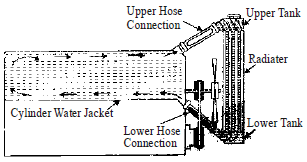
Additional components of a liquid cooling system include the radiator, fan, thermostat, water pump and hoses. Proper coolant mixture and corrosion inhibitors are essential to protect the engine and maintain heat-transfer efficiency.
Summary
This chapter covered the principal ignition systems (battery and magneto), reasons for and methods to measure engine friction and friction power, the functions and desirable properties of lubricating oils, common lubrication systems used in internal combustion engines, and the principal cooling methods (air and liquid cooling) including circulation methods and important components. Understanding these topics is essential for correct engine design, maintenance and troubleshooting.
FAQs on Ignition, Engine Friction, Lubrication & Cooling
| 1. What is ignition in the context of mechanical engineering? |  |
| 2. How does engine friction affect the performance of a mechanical system? | |
| 3. Why is lubrication important in mechanical engineering? | |
| 4. What are the different types of cooling systems used in mechanical engineering? | |
| 5. How can the cooling system be optimized in mechanical engineering applications? | |