Gas Cycle Refrigeration

Drawbacks of the Carnot Cycle when a Gas is Used as Refrigerant
- Isentropic compression in a gas-based Carnot cycle requires very high pressures for the same temperature lift; combined with isothermal heat rejection this leads to very large specific volumes at some points of the cycle.
- Practical isothermal heat transfer with a gas is difficult because the specific heat and heat transfer coefficients of gases are small; achieving near-isothermal processes demands large heat-transfer area and long times.
- Small irreversibilities in a gas cycle produce a large change in work input because the ideal gas-cycle Carnot refrigeration loop is narrow; therefore real deviations cause significant performance loss.
Reversed Brayton (Joule or Bell-Coleman) Cycle
The reversed Brayton cycle, also known as the Joule or Bell-Coleman cycle, is the practical gas refrigeration cycle most commonly used where air is the refrigerant (for example, aircraft refrigeration). It replaces the two isothermal processes of the Carnot cycle by two isobaric (constant-pressure) heat-transfer processes, while keeping the two adiabatic (isentropic) compression and expansion processes.
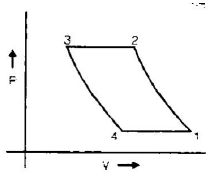
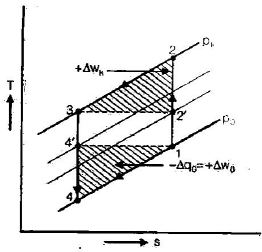
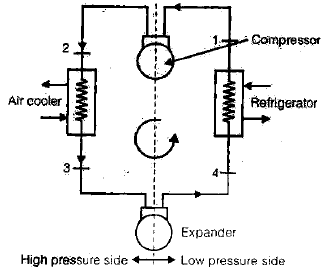
The idealised four processes of the reversed Brayton cycle are:
- 1 → 2: Isentropic compression in the compressor (pressure rises from P1 to P2).
- 2 → 3: Isobaric heat rejection to ambient (air cools at high pressure).
- 3 → 4: Isentropic expansion in the expander or turbine (pressure falls from P2 to P1).
- 4 → 1: Isobaric heat absorption from the refrigerated space (air is warmed at low pressure).
The cycle is shown on p-v and T-s diagrams in the figures below.
Refrigeration effect
q0 = Cp (T1 - T4)
Heat rejected
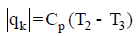
Isentropic compressor work

Isentropic expander work

Net work input
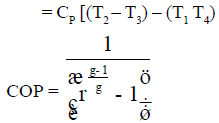
Pressure ratio
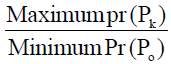
For an ideal gas with constant specific heats and ideal isentropic processes, the compressor and expander works can be expressed in terms of temperature differences:
- Compressor work = Cp (T2 - T1).
- Expander work = Cp (T3 - T4).
- Net work = Cp[(T2 - T1) - (T3 - T4)].
- COP (coefficient of performance) = q0 / Wnet = (T1 - T4) / [(T2 - T1) - (T3 - T4)] (for ideal constant-Cp gas).
- If the maximum pressure Pk increases or the minimum pressure P0 decreases, the pressure ratio r = Pk/P0 increases and the COP of the cycle generally decreases.
- The minimum pressure is usually fixed at atmospheric pressure in open systems; in closed systems the suction pressure can be higher than atmosphere.
- If the maximum pressure is increased (higher compression ratio) both the refrigeration effect and the work done increase, but the work increases proportionally more and hence COP decreases.
Regeneration (Heat-Recovery) in Brayton Refrigeration
A regenerator or heat exchanger placed between the cold and hot streams reduces the external heat transfer required and improves cycle efficiency. Hot air leaving the compressor rejects heat to the colder air leaving the expander; this preheats the cold stream before compression or pre-cools the hot stream before expansion, reducing net work and increasing the refrigeration effect. Regeneration is commonly used in aircraft air-cycle machines to raise COP and reduce component sizes.
Application to Aircraft Refrigeration
- The gas (air) cycle is widely used for aircraft environmental control systems in both military and commercial aircraft.
- Only air is used as the working substance in these systems; hence the application is commonly referred to as an air refrigeration cycle.
- Power per ton of refrigeration (specific power) for air cycles is higher compared with vapour-compression systems-i.e., air cycles generally require more input power for the same refrigeration capacity.
Types of Air Refrigeration Cycle
Closed Cycle
- The working fluid circulates in a closed loop and the suction pressure can be higher than atmospheric.
- Closed cycles usually have a higher COP than open cycles for the same pressure ratio, because the pressure ratio can be reduced for the same temperature change.
- Closed systems require a heat exchanger (regenerator) between the high- and low-pressure streams for effective refrigeration.
- Closed systems generally have greater weight and cost due to the extra components and sealing requirements.
Open Cycle
- Ambient air is drawn in, processed through compressors/expanders and then delivered directly to the conditioned space or exhausted; suction pressure is atmospheric.
- Open cycles have a lower COP than closed cycles for similar operating conditions.
- Open systems do not require a heat exchanger for the refrigeration process because fresh air is directly supplied to the conditioned space.
- Open cycles tend to be lighter and less costly than closed cycles and are simpler in construction.
Advantages of Air (Gas) Refrigeration over Vapour-Compression Systems
- Leakage of refrigerant (air) is tolerable and does not pose chemical hazards; air is non-toxic and non-flammable.
- In open-type air systems no separate refrigeration heat exchanger between evaporator and space is required when fresh air is supplied directly.
- Air is universally available in the atmosphere and requires no storage of special refrigerant liquids.
- Cabin pressurisation and air conditioning can be combined using air cycles-both duties are achieved using the same air handling equipment.
- Initial compression of inlet air in high-speed aircraft may be assisted by the ram effect, reducing compressor work.
Ram Effect
Ram effect is the conversion of the kinetic energy of the incoming airstream into increased stagnation pressure and enthalpy as the air is decelerated in an inlet or diffuser. In high-speed flight the dynamic pressure (½ρV²) at the inlet can be significant and is partly converted into increased total pressure and temperature at the engine or air-cycle machine inlet. This reduces the compressor work required or raises the pressure available to the cycle.
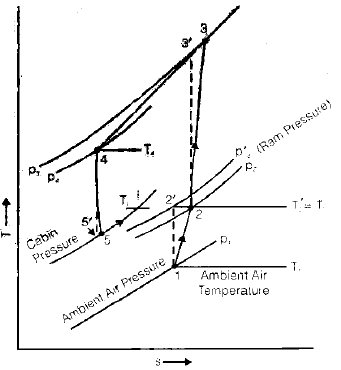
Ram Efficiency
The quantitative expression for ram efficiency used in aircraft air-intake performance and in some air-cycle machine analyses is shown in the figure below.

Practical Considerations and Performance
- Real compressors and expanders are not isentropic; mechanical and aerodynamic inefficiencies reduce net refrigeration for a given work input. The presence of losses reduces COP compared with ideal expressions.
- Heat-exchanger effectiveness (regenerator performance) strongly influences performance; an effective regenerator reduces external heat transfer and net work, improving COP.
- For aircraft applications weight, volume, reliability, and the ability to operate with air (no special refrigerant) are decisive advantages despite lower COP compared with vapour compression systems.
- Design choices (open vs closed, size and effectiveness of regenerator, choice of compressor/expander machines) are trade-offs between COP, weight, cost, and reliability.
Summary
The reversed Brayton (Bell-Coleman) cycle is a practical gas refrigeration cycle used mainly when air is the refrigerant, notably in aircraft environmental control systems. It uses isentropic compression and expansion together with isobaric heat rejection and absorption. Compared with vapour-compression systems, air cycles have lower COP and higher specific power, but offer advantages in safety, availability of refrigerant, and integration with aircraft systems. Regeneration and inlet ram recovery are important practical measures to improve performance.
FAQs on Gas Cycle Refrigeration
| 1. What is gas cycle refrigeration? |  |
| 2. How does gas cycle refrigeration work? | |
| 3. What are the advantages of gas cycle refrigeration? | |
| 4. What are the limitations of gas cycle refrigeration? | |
| 5. What are some common refrigerants used in gas cycle refrigeration? | |