Thin, Thick Cylinders & Spheres

Thin Cylinders
- If the wall thickness of a cylindrical shell is less than about one-tenth to one-fifteenth of its diameter, it is treated as a thin cylinder.
- It is assumed that stresses through the thickness are uniformly distributed and that the radial stress is negligible compared with the hoop and longitudinal stresses.
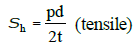
- Hoop (circumferential) stress: for an internally pressurised thin cylindrical shell, the circumferential or hoop stress is
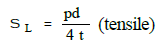
- Longitudinal (axial) stress: the tensile stress along the axis of the cylinder (for closed ends) is
- Maximum shear stress: the maximum shear in a thin cylindrical shell (from the two principal stresses) is

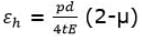
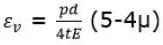
- Hoop (circumferential) strain: in terms of elastic constants the hoop strain is
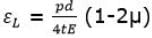
- Longitudinal (axial) strain: the corresponding axial strain is
- Volumetric strain: total volumetric (dilatation) strain for a thin shell (radial stress ≈ 0) is
Symbols used:
- p = internal pressure
- d = diameter of cylinder
- t = thickness of the cylinder
- μ = Poisson's ratio
- E = Young's modulus
If sa is the permissible tensile stress for the shell material, then from strength considerations the major principal stress (usually the hoop stress) should satisfy s ≤ sa.
Hence, for design the thickness must satisfy

or, rearranged,

Remarks and common closed-form relations (for reference and quick checks):
- Hoop stress σh = pd / (2t).
- Longitudinal (axial) stress σl = pd / (4t) for a closed-ended thin cylinder.
- Maximum shear = (σh - σl) / 2 = pd / (8t).
- Hoop and longitudinal strains follow from linear elasticity using plane-stress relations: εθ = (1/E)(σh - μ σl), εl = (1/E)(σl - μ σh).
- Volumetric strain = εθ + εl + εr with εr ≈ -(μ/E)(σh + σl); simplifies to εv = ((1 - 2μ)/E)(σh + σl).
Thin Spherical Shells
- For a thin spherical shell under internal pressure the two principal membrane stresses (meridional and circumferential) are equal.
- Membrane stress in a thin spherical shell: σ = pd / (4 t) (tensile in nature)

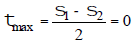
- Maximum shear stress: with principal stresses σ, σ and 0 (radial), the maximum shear is
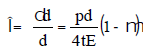
- Strain in any in-plane direction: the linear strain in a spherical shell element is
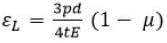
- Volumetric strain: summing principal strains gives
Notes:
- For identical internal pressure and nominal radius and thickness, a spherical shell carries stress more uniformly than a cylindrical shell; the membrane stress in a sphere is half the hoop stress of an equivalent thin cylinder (for the same diameter and thickness).
- Spherical shells are therefore efficient under internal pressure and are commonly used for pressure vessels (e.g., small pressure bulbs, domes, end caps).
Cylinders with Hemispherical Ends
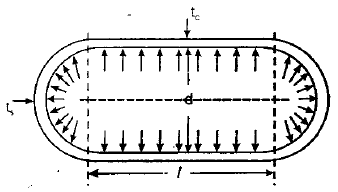
Consider a cylindrical shell of thickness tc with hemispherical ends of thickness ts subjected to internal pressure p. For reference diagrams see the image below.
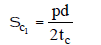
- Hoop stress in the cylindrical part: (circumferential stress in cylinder)
- Hoop (circumferential) stress in the hemispherical end: (same as spherical shell stress)

- Longitudinal (axial) stress in the cylindrical part:

- Longitudinal (meridional) stress in the hemispherical part:

- Circumferential strain in the hemispherical part:
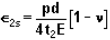
- Circumferential strain in the cylindrical part:
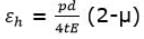
At the junction of the cylinder and hemisphere the circumferential strains must match for the joint not to distort. Equating the circumferential strains of cylinder and hemisphere gives the condition:
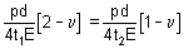
From that relation one obtains (after simplification):

This shows that the thickness of the cylindrical portion must be greater than that of the hemispherical portion for compatible strains at the junction.
- For equal maximum stress in cylinder and hemisphere: equating the relevant maximum stresses yields
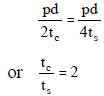
Two commonly used practical design rules derived from the above relations are:
- To avoid distortion at the junction, choose tc = ts (2 - μ)/(1 - μ) (for elastic behaviour) - this typically gives tc several times ts for μ ≈ 0.3.
- To make maximum stresses equal, tc = 2 ts (when equating hoop stresses only).
Thick Cylindrical Shell (Thick-Walled Cylinder)
- If the thickness of a cylindrical shell is not small compared with its diameter (typically t > d/10), it is called a thick shell.
- In thick cylinders the circumferential (hoop) stress varies across the wall thickness and the radial stress is no longer negligible.
- The three stresses present in a thick cylinder are:
- (i) radial stress σr (compressive on the inner surface),
- (ii) hoop (circumferential) stress σθ (tensile),
- (iii) longitudinal (axial) stress σz (tensile for closed ends and relatively uniform across thickness).
The radial and hoop stresses vary with radius r and are given by Lame's solution for a thick-walled cylinder:

That is, the radial stress σr and hoop stress σθ may be written in the form
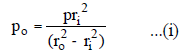
Explicitly,
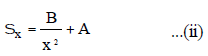
and the radial pressure (radial stress) is
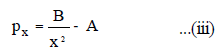
In the Lame expressions above:
- ro = outer radius of shell
- ri = inner radius of shell
- A and B are constants determined from boundary conditions (internal pressure at r = ri, external pressure at r = ro - often external pressure is atmospheric and taken as zero gauge).
Important observations (behaviour across the thickness):
- Longitudinal stress σz is approximately uniform across the thickness when the ends are closed and carries the axial resultant from pressure on the ends.
- Hoop stress σθ varies from a maximum tensile value at the inner face to a smaller tensile value at the outer face; the variation follows a hyperbolic form given by Lame's equations.
- Radial stress σr varies from -p (compressive) at the inner face to the external pressure (often zero gauge) at the outer face; it therefore decreases in magnitude across the thickness.
Design and checks:
- For thick cylinders a simple thin-wall formula (σ = pd / 2t) gives unsafe results when t is not small; use Lame's formulae to evaluate maximum hoop stress (typically at the inner surface) and check against permissible material stress.
- When external pressure is significant (e.g., vacuum or submerged vessels), radial stresses and the possibility of buckling must be considered in design.
Worked Example (thin cylindrical shell - thickness required)
Problem: Determine the minimum thickness t of a thin cylindrical shell of diameter d under internal pressure p if the permissible tensile stress of the material is sa.
Sol.
The principal (maximum) stress for a thin cylinder is the hoop stress which must not exceed sa.
Hoop stress σh = pd / (2t).
Set σh = sa for limiting thickness.
Rearrange to find thickness t.
Ans.
t = pd / (2sa).
Applications and Design Notes
- Thin shells: used where wall thickness is small relative to radius - examples include storage cylinders, thin-walled pipelines, boiler shells (historically), and many pressure vessels where t/d < />
- Spherical shells: used for pressure vessels where uniform stress distribution and minimum material for given internal volume are required - examples include small pressure bulbs, hemispherical end caps, and certain high-pressure containers.
- Thick shells: required when internal pressure is high compared with allowable stress or when wall thickness is large (e.g., gun barrels, hydraulic cylinders, high-pressure reactors). Lame's formulae must be used in design and stress analysis.
- When joining cylindrical and spherical components, check both stress compatibility and strain compatibility at junctions; ensure smooth transitions and suitable thickness ratios to avoid local overstress and distortion.
FAQs on Thin, Thick Cylinders & Spheres
| 1. What's the difference between thin and thick cylinders in pressure vessel design? |  |
| 2. How do I calculate hoop stress in a thin-walled cylinder under internal pressure? | |
| 3. Why does the stress distribution differ between thin spheres and thin cylinders? | |
| 4. What's the relationship between internal pressure and radial stress in thick-walled cylinders? | |
| 5. How do I determine whether a hollow sphere will fail under given pressure conditions? | |