Primary Treatment of Waste Water


Chapter 5
PRIMARY TREATMENT OF WASTE WATER
Preliminary treatment
Preliminary treatment removes coarse and heavy inorganic material, floating matter, oils and greases, and other large objects that might damage or clog subsequent treatment equipment. Its main purpose is to protect downstream units and to reduce maintenance and operational problems.
- Screening - Removes floating solids and large debris such as rags, sticks, plastics and other bulky items by a series of screens (bar screens, mechanical screens). Screens are usually arranged in coarse and fine stages depending on the size of the material to be retained.
- Grit chambers - Remove sand, gravel, and other dense inorganic particles that settle rapidly. Grit removal prevents abrasion and excessive accumulation in tanks and channels.
- Skimming tanks (or oil and grease traps) - Remove floatable oil and grease by allowing them to rise to the surface, where they are mechanically or manually removed.
Primary treatment (Primary sedimentation)
Primary treatment aims to remove large suspended organic material and settleable solids by gravity sedimentation. The processes and hydraulic principles are similar to sedimentation used in drinking-water treatment. Primary clarifiers reduce suspended solids and a portion of the biochemical oxygen demand (BOD), producing settled primary sludge that is removed for further handling or digestion.
Secondary treatment (Biological treatment)
Secondary treatment removes dissolved and colloidal organic matter by biological means. Microorganisms convert organic matter into more stable forms (biomass, carbon dioxide, water). Two common types of secondary treatment are:
- Filters
- Activated sludge process
1. Filters
Filters provide a surface or medium on which microorganisms grow and form a biological film. Sewage passes through or over the media and is biologically treated as it contacts the film. Major types include:
- Contact beds - Small-scale bed systems where sewage and biological solids are contacted in a relatively short treatment unit; suitable for small plants.
- Intermittent (sand) filters - Sand filters that receive sewage intermittently; commonly used in small to medium plants for secondary treatment and polishing.
- Trickling (percolating or sprinkling) filters - Tanks or basins filled with coarse media (stones, slag, or plastic media) over which sewage is sprayed or distributed. The effluent trickles down through the media and is collected through an underdrain system.
In trickling filters, microorganisms form a film (biomass) on the media surface. Aerobic bacteria within the film oxidise organic matter as the sewage passes. The treated liquid (percolate) is collected at the bottom by a well-designed underdrainage system.
Key variables and performance for trickling filters
The following relations and design parameters are commonly used for trickling filters. Where formulae are provided as images in this document, the images are retained below for reference and calculation.

In the expression above, m = organic loading in kg/ha·m·day (kg per hectare-metre per day).
For high-rate trickling filters, re-circulation of sewage is an important feature. The re-circulation factor is defined as:
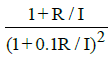
where R/I is the ratio of the volume of sewage recirculated R to the volume of raw sewage I. The re-circulation ratio (R/I) is the recirculation factor used to improve filter efficiency and load distribution.
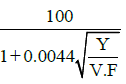
In equations using total organic loading:
Y = total organic loading in kg/day.
V = filter volume (ha·m or appropriate volume unit).

The symbol in the image denotes u (organic loading) as used in standard filter equations.
Final efficiency of two-stage filter
For two-stage filter systems the combined or final efficiency can be expressed with the relation shown in the image below.
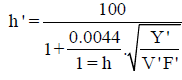
In the relation above:
- Y′ = total BOD in effluent from first stage (kg/day)
- V′ = volume of second stage filter (ha·m)
- F′ = recirculation factor for second stage
2. Activated sludge process
The activated sludge process is a suspended-growth biological treatment in which sewage from primary sedimentation is mixed with a portion of settled biomass from the secondary clarifier. This returned biomass is known as activated sludge. Typical return rates are 20-30% by volume of the mixed liquor or as required to maintain the desired concentration of microorganisms in the aeration tank.
Operational sequence:
- Sewage and returned activated sludge are mixed and sent to the aeration tank where air (or oxygen) is supplied to support aerobic microorganisms.
- Microorganisms oxidise organic matter; suspended and colloidal particles coagulate to form flocs which can settle in the secondary settling tank.
- Settled sludge (activated sludge) is partly returned to the aeration tank to maintain biomass concentration; the excess sludge is wasted for further processing (digestion, dewatering).
The fraction of sludge returned depends on the required BOD removal and system control. The returned activated sludge percentage is calculated as:
Returned activated sludge (%) = (QR / Q) × 100
where QR is the returned sludge flow rate (m³/day) and Q is the sewage inflow rate (m³/day).
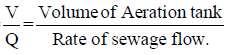
Aeration period (Hydraulic Retention Time, HRT)
Hydraulic retention time (HRT) or aeration period is the average time the wastewater remains in the aeration tank. It is given by the tank volume divided by the influent flow rate:
BOD volumetric loading (organic loading)
The BOD loading per unit volume of aeration tank describes the organic loading applied to the aerobic reactor. It is also called volumetric BOD loading.

Food (F) to microorganism (M) ratio (F/M)
The F/M ratio is an important design and control parameter in activated sludge systems. It represents the amount of biodegradable substrate (food) available per unit mass of active biomass.

Sludge age (Mean Cell Residence Time, MCRT)
Sludge age or MCRT is the average time for which solids (microorganisms) remain in the aeration system. It is expressed as the mass of solids in the aeration system divided by the mass of solids wasted per day.

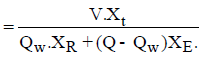
Sludge Volume Index (SVI)
SVI is the volume (in mL) occupied by 1 gram of solids after 30 minutes of settling in the mixed liquor. It is used to evaluate settleability of the activated sludge.

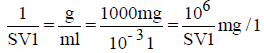
Sludge circulation and return
The sludge circulation (return) rate is denoted QR. The circulating or return sludge concentration is usually expressed as MLSS (mixed liquor suspended solids) with units mg/L.
The sludge circulation ratio and related expression are shown in the image below.
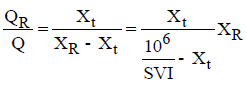
In the expression above, values of MLSS in returned sludge and in the aeration tank appear in mg/L and are used to compute required return rates.
Tertiary treatment (Polishing and nutrient removal)
Tertiary treatment refers to processes applied after secondary treatment to further improve effluent quality. Tertiary steps can be physical, chemical or biological and are used to remove residual suspended solids, nutrients (nitrogen and phosphorus), pathogens, or specific contaminants.
Effluent polishing
Effluent polishing is a physical treatment stage that further reduces suspended solids, removes pin floc or fine particles, and improves effluent clarity. Typical polishing operations include:
- Filtration - Rapid sand filters or mixed-media filters similar to those used for drinking water treatment. Filters have several components: media layers, underdrain systems for collection and backwash distribution, and valving arrangements. Filter boxes may be rectangular, circular, or segment-shaped and are typically several feet deep. The underdrain supports the media, collects filtered water and distributes backwash water evenly. Leopold tiles and Wheeler blocks are examples of underdrain systems.
- Polishing ponds (effluent polishing ponds) - Shallow aerobic lagoons that receive secondary effluent for additional settlement, biological oxidation and natural disinfection. Ponds are usually 2-3 feet deep and rely on wind action, surface oxygen transfer and sometimes mechanical aeration. They offer additional detention time and exposure to sunlight (UV) which helps in natural dechlorination after disinfection and further reduction of BOD and suspended solids.
Nutrient removal
Besides BOD and suspended solids, nutrients such as nitrogen and phosphorus must often be removed to prevent eutrophication and toxicity in receiving waters. Excessive nutrients act as fertilisers, causing algal blooms and oxygen depletion.
Nitrification
Nitrification is the aerobic biological oxidation of ammonia (NH3) to nitrite (NO2-) and then to nitrate (NO3-) by specialised nitrifying bacteria such as Nitrosomonas (ammonia to nitrite) and Nitrobacter (nitrite to nitrate). Nitrification generally occurs after much of the BOD has been removed and requires:
- High dissolved oxygen (DO) concentrations, typically in the 4-6 mg/L range,
- Sufficient alkalinity because alkalinity is consumed during nitrification,
- Longer detention times or multi-stage systems (extended aeration, multi-stage activated sludge, or aerated biological contactors) to allow slow-growing nitrifiers to establish.
Denitrification
Denitrification follows nitrification when removal of nitrogen from the effluent is required. Denitrifying bacteria convert nitrates to elemental nitrogen gas (N2) under anoxic conditions by using nitrates as electron acceptors. Denitrification removes nitrogen from the wastewater stream and releases harmless nitrogen gas to the atmosphere. Process control often requires an anoxic zone and a carbon source to support denitrifying bacteria.
Phosphorus removal
Phosphorus removal is commonly achieved by chemical precipitation or biological phosphorus removal.
- Chemical precipitation - Addition of coagulants such as aluminium sulphate (alum) or lime causes soluble phosphorus to precipitate as particulate flocs that can be removed by sedimentation and filtration. Tertiary flocculation and sedimentation followed by filtration are typical equipment components for chemical phosphorus removal.
- Biological phosphorus removal - Alternating anaerobic and aerobic conditions encourage phosphorus-accumulating organisms to take up and store excess phosphorus; the stored phosphorus is removed in the waste sludge. This biological route is applied where chemical addition is to be minimised.
Summary and practical notes
Primary and secondary treatments form the core of conventional wastewater treatment. Preliminary treatment protects the plant by removing coarse solids, grit and floatables. Primary sedimentation removes settleable solids and some BOD. Secondary biological treatment-either attached-growth systems (filters, trickling filters) or suspended-growth systems (activated sludge)-reduces organic load substantially. Design and operation depend on parameters such as organic loading, HRT, F/M ratio, sludge age (MCRT), MLSS and SVI. Tertiary (polishing) processes and nutrient removal may be required to meet discharge standards or protect receiving waters from eutrophication.
For design and operation, engineers use the relations and parameters shown in the images retained above. Consult standard wastewater engineering texts and national design standards for detailed design procedures, unit conversions and safety factors.
FAQs on Primary Treatment of Waste Water
| 1. What is the primary treatment of wastewater in civil engineering? |  |
| 2. How does primary treatment of wastewater help in the overall treatment process? | |
| 3. What are the different methods used for primary treatment of wastewater in civil engineering? | |
| 4. Is primary treatment sufficient to make wastewater safe for discharge into the environment? | |
| 5. Can primary treatment of wastewater be used in small-scale or decentralized systems? | |