Civil Engineering (CE) Exam  >  Civil Engineering (CE) Notes  >  Civil Engineering SSC JE (Technical)  >  Stress Distribution in the Soil - Civil Engineering SSC JE (Technical) - Civil Engineering

Stress Distribution in the Soil - Civil Engineering SSC JE (Technical) - Civil Engineering

Vertical Stress

Stress induced in a soil mass by the weight of overlying soil and by applied external loads is called vertical stress. Vertical stress controls settlement, bearing capacity and the transmission of loads through the ground.

  • Causes of vertical stress
    • Self-weight of soil
    • Applied surface loads (live loads, point loads, uniformly distributed loads)

Boussinesq's Theory

Boussinesq developed elastic solutions to determine stresses at any point in a semi-infinite, homogeneous, isotropic and elastic soil mass due to surface loads. The theory is used to estimate vertical stress beneath point, strip, circular and uniformly loaded areas on the ground surface.

Assumptions

  • The soil mass is homogeneous, elastic and isotropic.
  • The soil mass is semi-infinite (extends infinitely in horizontal directions and to great depth).
  • The soil is unstressed and weightless before the application of the load; self-weight is ignored in the theoretical derivation.
  • No permanent volume change occurs due to the elastic application of loads (purely elastic behaviour during loading).
Assumptions

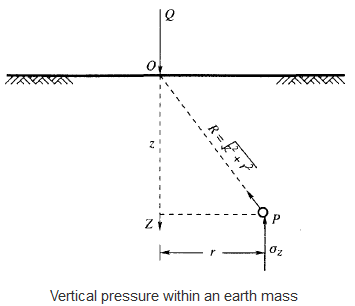
Consider a point load Q applied at the surface and a point P located at depth z below the surface and at horizontal distance r from the vertical through the load.

Assumptions

In Boussinesq's solution the vertical stress at point P due to a surface point load Q is written as

σz = Q · IB

where r is the horizontal radial distance to P and z is the depth. The Boussinesq stress coefficient is

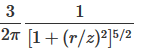
IB = (3 / 2π) · (z³ / (r² + z²)^(5/2))

Assumptions

Therefore the vertical stress becomes

σz = (3Q z³) / [2π (r² + z²)^(5/2)]

Assumptions

The intensity of vertical stress directly below the point load (on the axis of loading, r = 0) simplifies to

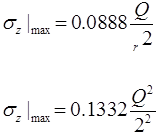
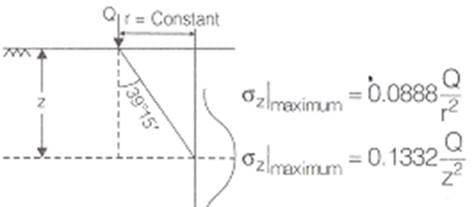
σz (r=0) = (3Q) / (2π z²)

Boussinesq's result summarises the above expressions for σz due to a point load at the surface for any radial position r and depth z.

Assumptions
Assumptions

Westergaard's Theory

Westergaard proposed an alternative elastic solution for stress distribution that is useful when the assumption of isotropy is not appropriate - for example, when the soil contains closely spaced rigid layers that prevent lateral deformation.

Assumptions

  • The soil is elastic and semi-infinite.
  • The mass is composed conceptually of numerous closely spaced horizontal layers of negligible thickness, modelling the soil as an assembly constrained against horizontal deformation.
  • The rigid layering permits only vertical (downward) deformation; horizontal strains are assumed zero.
Assumptions

Note: Boussinesq's theory is applicable for an isotropic soil mass, whereas Westergaard's theory is applicable for soils approximating non-isotropic behaviour (constrained horizontal deformation).

Westergaard's results

Westergaard derived stress coefficients for point, strip and area loads. The coefficients differ from Boussinesq's and usually give lower stresses away from the axis when horizontal strain is constrained.

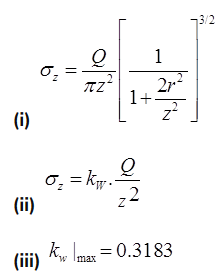
(i) Vertical stress due to live (surface) point loads

Westergaard`s results

In the Westergaard solution the vertical stress at a point (x, z) beneath a surface load of intensity q' / m (as expressed in the original derivation) can be written using the Westergaard stress coefficient for the particular geometry.

Westergaard`s results

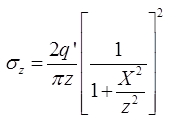
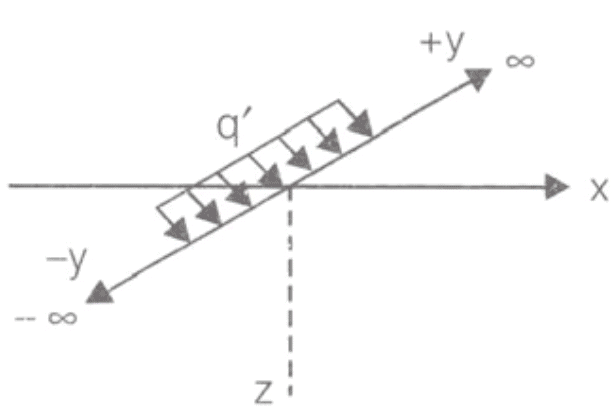
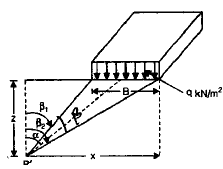
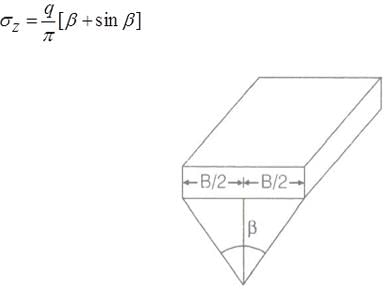
(ii) Vertical stress due to strip loading

Westergaard`s results

For a strip load the vertical stress at point P is obtained from the appropriate Westergaard expression for the strip geometry.

Westergaard`s results

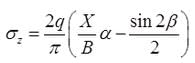
(iii)

Westergaard`s results

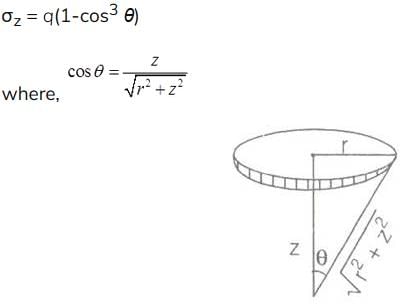
(iv) Vertical stress below uniform load acting on a circular area

Westergaard`s results

Newmark's Chart Method

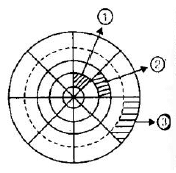
Newmark's chart method is a practical graphical technique to estimate vertical stress under uniformly distributed loads of any irregular plan shape on a semi-infinite, homogeneous, isotropic and elastic soil mass. The method cannot be used directly for layered soils with different elastic properties.

The chart consists of concentric circles and radial lines; the standard construction uses 10 concentric circles and 20 radial lines.

  • No. of concentric circles = 10
  • No. of radial lines = 20
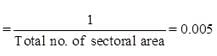
  • The area of influence corresponding to each sector of the chart is equal; stresses from equivalent sectors are summed to obtain the total influence.
Newmark`s Chart Method

When applying Newmark's chart the incremental contribution to the vertical stress at depth z due to a unit pressure q on an area element is summed over the chart sectors that lie within the loaded plan area. A simple empirical relation commonly used is

σz = 0.005 q Na

Newmark`s Chart Method

where Na is the total number of chart sectors (sectorial areas) covered by the loaded area when the Newmark chart is drawn to the correct scale for a particular depth z.

Approximate Methods

When exact elastic solutions are not convenient, approximate methods provide simple estimates of vertical stress beneath loaded areas. Common approximate methods include:

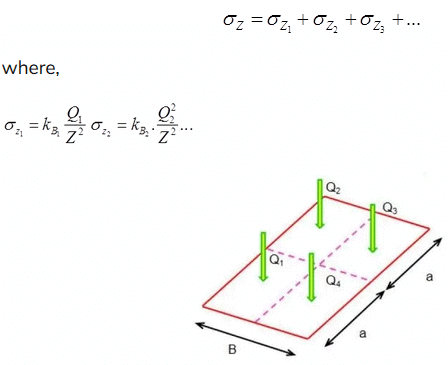
  • Equivalent load method - an irregular loaded area is replaced by an equivalent shape (often a rectangle or circle) whose stress distribution is easier to compute; the equivalent load or pressure is selected so that the total load remains the same.
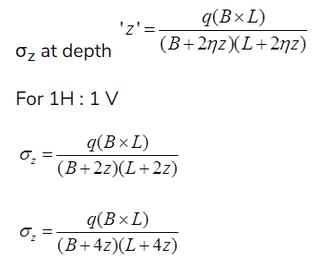
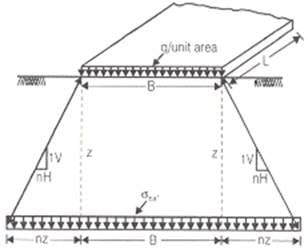
  • Trapezoidal method - used to integrate influence or pressure diagrams by approximating the loaded area or the influence function by trapezia for easier area calculation.
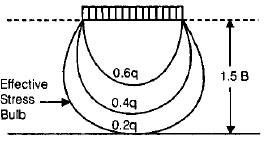
  • Stress-isobar method - uses stress isobars (contours of equal stress increment) and assumes the area bounded by a chosen isobar (commonly the 0.2q isobar) is fully effective in producing the stress increment at the depth of interest.
Approximate Methods
Approximate Methods
Approximate Methods

In the stress-isobar method a commonly used criterion is the 0.2q isobar (i.e. the contour where the increment equals 20% of the applied surface pressure). The area inside this isobar is taken as the effective area producing the stress increment at the chosen depth.

Approximate Methods

Worked Example - Vertical Stress Beneath A Surface Point Load (Boussinesq)

Calculate the vertical stress directly beneath a point load Q at depth z using Boussinesq's on-axis expression.

Given a point load Q applied at the surface and a depth z below the load, the vertical stress at the point on the axis (r = 0) is

σz = (3Q) / (2π z²)

For illustration, let Q = 100 kN and z = 2.0 m.

The vertical stress at depth is obtained by substituting the values into the formula.

σz = (3 × 100 kN) / (2π × (2.0 m)²)

σz = 300 kN / (2π × 4 m²)

σz = 300 kN / (25.1327 m²)

σz ≈ 11.93 kN/m² = 11.93 kPa

Practical Notes And Applications

  • Use Boussinesq's equations for homogeneous, isotropic soils where lateral strain is not severely constrained.
  • Use Westergaard's formulas when soil behaviour is constrained by rigid horizontal inclusions or layers that limit lateral deformation.
  • Apply Newmark's chart to estimate stresses beneath loaded areas of irregular plan shape at various depths when elastic theory-based calculation is inconvenient.
  • Approximate methods are useful for preliminary design and quick checks; for final design, use more rigorous solutions or numerical methods and account for layered soils, consolidation and actual soil properties.

Summary: Vertical stress distribution determines settlement and bearing capacity. Choose the appropriate method-Boussinesq for isotropic elastic soil, Westergaard when lateral deformation is constrained, Newmark for irregular loaded areas, and approximate methods for quick estimates-and remember to account for layering, consolidation effects and actual soil stiffness in design calculations.

The document Stress Distribution in the Soil - Civil Engineering SSC JE (Technical) - Civil Engineering is a part of the Civil Engineering (CE) Course Civil Engineering SSC JE (Technical).
All you need of Civil Engineering (CE) at this link: Civil Engineering (CE)
2 videos|160 docs|55 tests

FAQs on Stress Distribution in the Soil - Civil Engineering SSC JE (Technical) - Civil Engineering

1. What is stress distribution in soil?
Ans. Stress distribution in soil refers to the way that forces or loads are transmitted and distributed within the soil. It involves understanding how the soil carries and distributes the applied stress or load, which is important in various engineering and geotechnical applications.
2. How is stress distributed in soil?
Ans. Stress distribution in soil is influenced by several factors, including the type of soil, its density, and the applied load. Generally, stress is distributed through the soil in a non-uniform manner, with higher stress concentrations near the load and lower stress levels further away from it. The stress distribution can be influenced by the soil's strength, stiffness, and its ability to withstand deformation.
3. What are the factors that affect stress distribution in soil?
Ans. Several factors affect stress distribution in soil. These include the type of soil (e.g., clay, sand, silt), its compaction and density, the magnitude and distribution of the applied load, the shape and size of the load, the presence of water or pore pressure within the soil, and the soil's strength and deformation characteristics.
4. Why is understanding stress distribution in soil important?
Ans. Understanding stress distribution in soil is crucial in various engineering and geotechnical applications. It helps in designing structures and foundations, determining the stability and safety of slopes and embankments, predicting soil settlement and deformation, analyzing the behavior of retaining walls, and assessing the overall performance and integrity of soil-based structures.
5. How can stress distribution in soil be analyzed?
Ans. Stress distribution in soil can be analyzed through various methods, including theoretical calculations, numerical modeling, and laboratory testing. Techniques such as finite element analysis (FEA) and limit equilibrium analysis are commonly used to simulate and predict stress distribution in soil. Additionally, field tests like plate load tests and pressure cells can provide valuable data for understanding the stress distribution in situ.
Related Searches
pdf , mock tests for examination, video lectures, Sample Paper, shortcuts and tricks, MCQs, practice quizzes, Stress Distribution in the Soil - Civil Engineering SSC JE (Technical) - Civil Engineering, Exam, Previous Year Questions with Solutions, Important questions, study material, Semester Notes, Stress Distribution in the Soil - Civil Engineering SSC JE (Technical) - Civil Engineering, Objective type Questions, Stress Distribution in the Soil - Civil Engineering SSC JE (Technical) - Civil Engineering, Extra Questions, Free, past year papers, Summary, Viva Questions, ppt;