Civil Engineering (CE) Exam  >  Civil Engineering (CE) Notes  >  Civil Engineering SSC JE (Technical)  >  Shear Strength of Soil - Civil Engineering SSC JE (Technical) - Civil Engineering

Shear Strength of Soil - Civil Engineering SSC JE (Technical) - Civil Engineering

Shear strength

Shear strength of a soil is the capacity of the soil to resist shearing stress. It is defined as the maximum value of shear stress that can be mobilised within a soil mass.

Shear strength
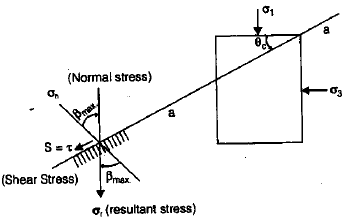
  • Plane a-a is the critical plane (plane on which failure is likely to occur).
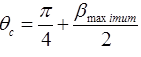
  • θc = Angle of the critical plane (a-a).
  • σ1 and σ3 are the principal stresses acting on the given planes.

Relation between resultant, normal and shear stresses on the critical plane

Relation between resultant, normal and shear stresses on the critical plane

In the figure above, βmax = Angle between resultant stress and normal stress on the critical plane. For many soils the maximum value of this angle corresponds to the internal friction angle φ.

Relation between resultant, normal and shear stresses on the critical plane

For purely cohesive clays idealised as having no frictional resistance, φ = 0.

Relation between resultant, normal and shear stresses on the critical plane

Common idealised cases of soil strength

(i)

Common idealised cases of soil strength

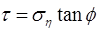
Represents the case for non-cohesive soils (sands) where shear strength is mainly from friction - a φ-soil.

(ii)

Common idealised cases of soil strength

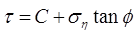
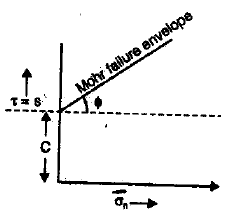
Represents a combined C-φ soil where both cohesion (C) and friction (φ) contribute.

(iii)

Common idealised cases of soil strength

Represents an idealised C-soil (purely cohesive clay) where shear strength is independent of normal stress.

(iv)

Common idealised cases of soil strength

Another representation for C-φ soils (mixed behaviour).

(v)

Common idealised cases of soil strength

Represents a purely φ (frictional) soil.

(vi)

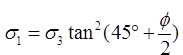
For purely cohesive soils, at failure under uniaxial compression the major principal stress at failure satisfies:

σ1 = 2C for an ideal C-soil.

Common idealised cases of soil strength

Mohr-Coulomb theory

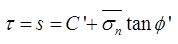
The Mohr-Coulomb failure criterion expresses shear strength as a linear function of normal effective stress. The commonly used form is:

τ = c′ + σ′ tan φ′

where τ = shear strength, c′ = effective cohesion, σ′ = effective normal stress, and φ′ = effective angle of internal friction.

Mohr-Coulomb theory

In effective stress notation, the parameters are:

  • c′ = Effective cohesion.
  • σ′ = Effective normal stress (total stress minus pore pressure).
  • φ′ = Effective friction angle.
Mohr-Coulomb theory
Mohr-Coulomb theory

Direct shear test

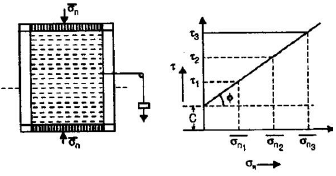
The direct shear test is a laboratory test to determine the shear strength parameters (c and φ) of a soil. A specimen is placed in a shear box split horizontally; a normal stress is applied and a horizontal force is imposed until the specimen fails along the split plane. The test gives a plot of shear stress versus normal stress; the failure envelope approximated by a straight line yields c and φ.

Direct shear test
Direct shear test
  • Advantages: simple, quick, useful for granular materials and to obtain shear stress-displacement behaviour.
  • Limitations: fixed failure plane, non-uniform stress distribution, sample disturbance, drainage conditions depend on specimen thickness.

Unconfined compression test

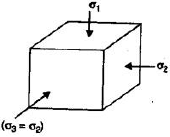
The unconfined compressive strength test is used for saturated cohesive soils (clays) to obtain a quick estimate of undrained shear strength.

qu = (σ1)f

where qu is the unconfined compressive strength and 1)f is the major principal stress at failure. In this test the minor principal stress σ3 = 0 (no lateral confinement).

Unconfined compression test

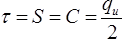
For an ideal purely cohesive soil under undrained conditions, the relation between qu and cohesion is:

qu = 2C

Unconfined compression test

Vane shear test

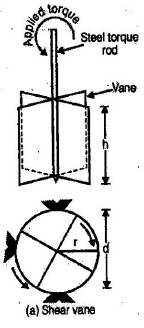
The vane shear test is suitable for determining the undrained shear strength of soft, sensitive clays in the field and in the laboratory. A four-bladed vane is embedded into the soil and rotated; the torque required to cause failure is related to the shear strength.

Vane shear test
Vane shear test

Lab sizeField size
Height of vane (H)20 mm10 to 20 cm
Diameter of vane (D)12 mm5 to 10 cm
Thickness of vane (t)0.5 to 1.0 mm2 to 3 cm

Interpretation of vane shear results

Interpretation of vane shear results

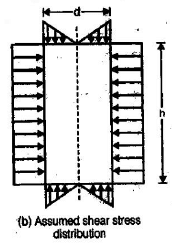
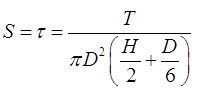
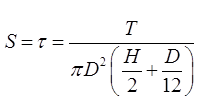
Shear strength obtained from the vane test depends on whether both top and bottom of the vane participate in shearing or only one portion shears. Typical representations:

- When top and bottom of vanes both participate in shearing:

Interpretation of vane shear results

- When only bottom of vane participates in shearing:

Interpretation of vane shear results

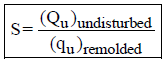
The sensitivity of a soil is defined as the ratio of the undisturbed shear strength to the remoulded shear strength and is denoted Sf. Sensitive clays have high values of Sf.

Pore pressure parameters and pore pressure change

During shearing and loading, changes in pore water pressure occur. These changes affect effective stresses and therefore shear strength. Two commonly used pore pressure parameters are B and A, defined for different stress increments.

Pore pressure parameters and pore pressure change

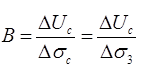
For change in pore pressure due to an increase in isotropic cell pressure (Δσc or Δσ3):

  • B = pore pressure parameter defined by ΔUc = B · Δσc.
  • Here ΔUc = change in pore pressure due to increase in cell pressure and Δσc = Δσ3 = change in cell pressure.
  • Range: 0 ≤ B ≤ 1.
  • B = 0 for dry soil.
  • B = 1 for saturated soil when pore pressure change equals applied total stress change.

(ii)

Pore pressure parameters and pore pressure change

For pore pressure change associated with deviatoric loading:

A = pore pressure parameter given by ΔUd = A · Δσd.

Pore pressure parameters and pore pressure change

where:

  • ΔUd = Change in pore pressure due to deviator stress.
  • Δσd = Change in deviator stress.

(iii)

Overall pore pressure change:

ΔU = ΔUc + ΔUd

ΔU = total change in pore pressure (sum of isotropic and deviatoric contributions).

(iv)

Pore pressure parameters and pore pressure change

Shear strength parameters and practical considerations

  • Shear strength parameters are usually expressed as c (cohesion) and φ (angle of internal friction). For effective stress analyses they are written as c′ and φ′.
  • Selection of parameters for design must consider drainage conditions: drained parameters for slow loading/drained conditions; undrained parameters (su or cu) for short-term undrained conditions.
  • Factors affecting shear strength include soil type, density, confining stress, water content, sample disturbance, strain rate and structure.
  • Common applications: slope stability, bearing capacity of foundations, earth pressure problems, design of retaining structures, and stability assessment of embankments and levees.

Summary

The shear strength of soil controls many geotechnical design problems. It is characterised by cohesion and friction components, and may be obtained from laboratory tests such as the direct shear, unconfined compression and vane shear tests. Effective stress concepts and pore pressure parameters are essential when interpreting strength under drained and undrained conditions. Appropriate selection and interpretation of shear strength parameters is critical for safe and economical geotechnical design.

The document Shear Strength of Soil - Civil Engineering SSC JE (Technical) - Civil Engineering is a part of the Civil Engineering (CE) Course Civil Engineering SSC JE (Technical).
All you need of Civil Engineering (CE) at this link: Civil Engineering (CE)
2 videos|160 docs|55 tests

FAQs on Shear Strength of Soil - Civil Engineering SSC JE (Technical) - Civil Engineering

1. What is shear strength of soil in civil engineering?
Ans. Shear strength of soil in civil engineering refers to the ability of soil to resist shear forces or stresses. It is a measure of the soil's ability to withstand deformation or failure under applied shear loads.
2. How is shear strength of soil determined in civil engineering?
Ans. The shear strength of soil in civil engineering is determined through laboratory tests such as the direct shear test, triaxial shear test, or field tests like the vane shear test. These tests involve applying controlled shear forces on soil samples and measuring the resulting deformation or failure.
3. What factors affect the shear strength of soil in civil engineering?
Ans. Several factors affect the shear strength of soil in civil engineering. These include the soil type (cohesionless or cohesive), soil composition, soil structure, moisture content, density, stress history, and the presence of any reinforcing materials. These factors influence the soil's internal friction and cohesive forces, which ultimately determine its shear strength.
4. Why is shear strength of soil important in civil engineering?
Ans. Shear strength of soil is crucial in civil engineering as it helps determine the stability and safety of various structures such as foundations, retaining walls, slopes, and embankments. Understanding the shear strength of soil allows engineers to design structures that can withstand anticipated shear forces and prevent failure or collapse.
5. How can the shear strength of soil be improved in civil engineering?
Ans. In civil engineering, there are several methods to improve the shear strength of soil. These include adding stabilizing agents like cement or lime, compacting the soil to increase its density, reinforcing the soil with geosynthetics or soil nails, and implementing proper drainage systems to control the moisture content. These techniques enhance the soil's shear strength and overall stability.
Related Searches
past year papers, Shear Strength of Soil - Civil Engineering SSC JE (Technical) - Civil Engineering, Semester Notes, MCQs, Exam, Objective type Questions, Free, shortcuts and tricks, Important questions, pdf , Sample Paper, ppt, Shear Strength of Soil - Civil Engineering SSC JE (Technical) - Civil Engineering, Shear Strength of Soil - Civil Engineering SSC JE (Technical) - Civil Engineering, practice quizzes, Summary, Extra Questions, Viva Questions, video lectures, Previous Year Questions with Solutions, mock tests for examination, study material;