Stability Analysis of Slopes


Stability Analysis of Slopes
Factor of safety: Factor of safety of a slope is defined as the ratio of the average shear strength of the soil mobilised along the potential failure surface to the average shear stress developed along that surface.

Notation
- Fs = Factor of safety
- τf = average shear strength of the soil along the potential failure surface
- τd = average shear stress developed along the potential failure surface
Mathematical definition
Fs = τf / τd
Shear strength of soil
Mohr-Coulomb shear strength equation: The shear strength τ of a soil on a plane is given by the Mohr-Coulomb relation:
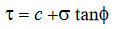
where
- c = cohesion
- φ = angle of internal friction
- σ = normal stress on the potential failure surface
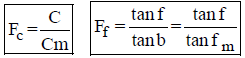
Mobilised shear strength: When shear strength is reduced or mobilised due to loading or deformation, the mobilised shear strength is written as:

where cd and φd are the cohesion and friction angle actually developed (mobilised) along the potential failure surface.
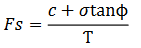
Factor of safety with respect to cohesion can be expressed in terms of cohesion components; the relevant expression is shown below.
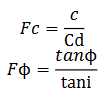
Types of slopes
- Infinite slope
- Finite slope
Infinite slope
An infinite slope is a model in which the slope represents the surface of an infinitely extensive soil mass so that conditions at the same depth below the ground are identical everywhere. In this idealised case:
- Failure usually takes place by sliding of a thin slice parallel to the ground surface.
- The potential failure surface is assumed to be planar and parallel to the slope surface.
Stability analysis of infinite slopes
(i) Cohesionless dry soil (dry sand)
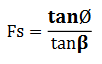
For an element (slice) of thickness z on an infinite slope inclined at angle β, the resisting shear per unit area is determined by the frictional component and the driving shear by the weight component parallel to the slope. The factor of safety against sliding is obtained as the ratio of resisting shear to driving shear.
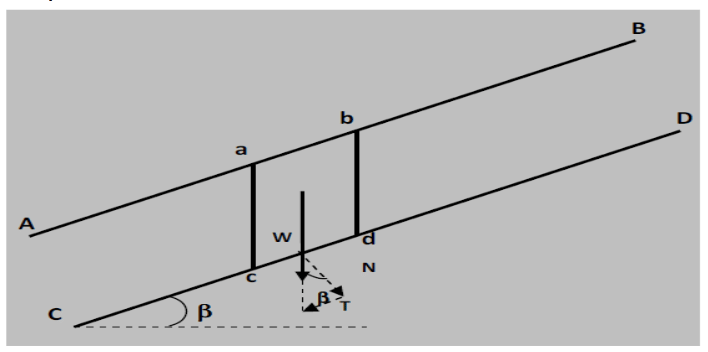
The factor of safety against sliding failure for a cohesionless dry infinite slope is:
Under limiting equilibrium (Fs = 1), the condition becomes:
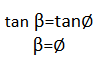
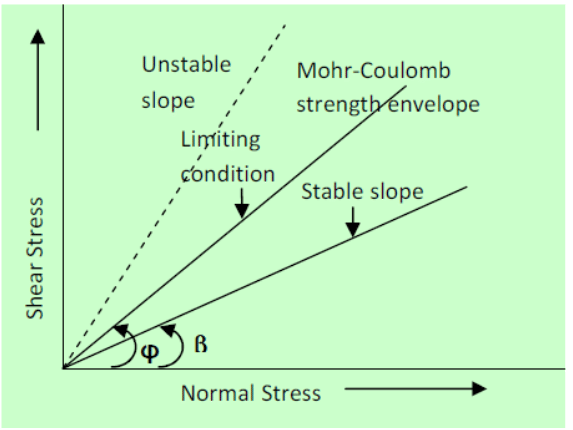
Thus, the maximum stable inclination β of an infinite slope in cohesionless soil is equal to the angle of internal friction φ. In other words, for stability β ≤ φ.

(ii) Cohesionless soil with seepage (water table parallel to slope)
When seepage occurs and the water table is parallel to the slope at a height h above the failure plane, the effective normal stress is reduced due to pore-water pressure. The factor of safety becomes:
Fs = (1 - (γw·h) / (γ·z)) · (tan φ) / (tan β)
Here γ is the total unit weight of soil, γw is unit weight of water, and z is the depth of the sliding slice (vertical thickness).
(iii) Water table at ground level (h = z)
If the water table coincides with the ground surface so that h = z, the factor of safety reduces to:
Fs = γ' tan φ / (γ tan β)
where γ' is the effective unit weight (γ - γw) of the soil below the water table.
(v) Infinite slope of purely cohesive soil
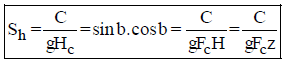
For a purely cohesive soil (φ = 0), the resisting force is due to cohesion only. The equilibrium for a slice of depth H = z gives a stability relation expressed using a non-dimensional Stability Number Sh.
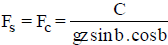
Here H = z is the depth of the slice or cut. At the critical stage for which Fs = 1, the stability number and corresponding relations are used to determine required cohesion for stability or allowable slope height.

where Sh = Stability Number.
(vi) C-φ soil in infinite slope
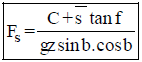
For soils with both cohesion and friction, the general infinite-slope stability formula combines contributions from cohesion and friction. The specific form and non-dimensional plots for design are typically represented graphically or numerically.
Stability analysis of finite slopes
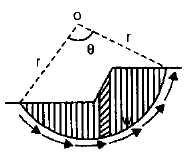
Finite slopes are bodies of soil of limited extent bounded by the ground surface above and a base below. Failures in finite slopes commonly involve rotational mechanisms and circular or spiral slip surfaces. Several methods exist to assess stability; the common ones are described below.
(i) Fellenius method (Ordinary method of slices) - for purely cohesive or general soils
The Fellenius method (also called the ordinary method of slices) subdivides a potential sliding mass into vertical slices, calculates forces on each slice, and assumes inter-slice shear interactions to simplify equilibrium. For purely cohesive soils simplified forms are used.

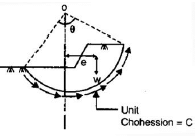
In the typical notation:
- F = Factor of safety
- r = Radius of rupture (centre of circular failure)
- l = Length of rupture curve under consideration

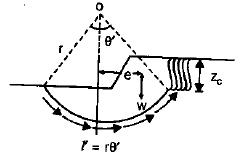
If tension cracks develop at the crest, the driving and resisting forces change; the factor of safety is computed considering the changed geometry and weight distribution of slices.

(ii) Swedish Circle method
The Swedish Circle method is a graphical/analytical approach for circular slip surfaces in homogeneous or layered slopes. It gives the factor of safety as the ratio of available shear resistance along the slip circle to the mobilised shear stresses due to slice weights.
F = (c'L + tan φ · Σ W cos α) / Σ W sin α
where
- c' = effective cohesion mobilised along the arc length
- L = length of the slip arc
- W = weight of each slice
- α = angle that the base of slice makes with the horizontal
- Summations are taken over all slices
(iii) Friction Circle method
The Friction Circle method is a variant in which the geometry of the slip circle and frictional resistance are used in a graphical construction to find the critical circle giving minimum factor of safety. It is commonly applied for cases where frictional resistance is significant.

(iv) Taylor's Stability Number method (c-φ soil)
Taylor developed charts (Taylor stability charts) that relate a dimensionless stability number to the slope geometry and soil properties. For a given slope angle and desired factor of safety, the charts give the permissible ratio of cohesion to unit weight and slope height.
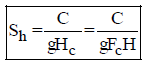
Notes on unit weight to be used:
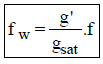
- In case of a submerged slope, use the submerged unit weight γ' (or g' in dimensional form) instead of the total unit weight γ.
- If the slope is saturated with capillary effects or other saturation states, use the appropriate saturated unit weight γsat.
Practical considerations and use
- Select the method that best represents the likely failure mechanism and site conditions: infinite-slope formulae for shallow translational slides in long slopes; slice and circle methods for finite slopes with circular mechanisms; Taylor charts for preliminary design.
- Account for pore-water pressures: seepage can significantly reduce effective stress and hence the factor of safety. Use correct effective unit weights and pore-pressure distributions.
- Consider layering, anisotropy, and changes in soil properties with depth: layered soils may require special treatment and numerical or limit-equilibrium methods with more slices or adapted formulations.
- Check sensitivity: evaluate how Fs varies with assumptions about pore pressure, cohesion, or φ to understand uncertainty and required safety margins.
- For design, adopt an appropriate target factor of safety (engineering judgement and codes determine the required Fs), and consider remedial measures (drainage, flattening slope, retaining structures, soil reinforcement) if Fs is inadequate.
Concluding remark: Stability analysis of slopes combines equilibrium relations, soil shear-strength characteristics and pore-water effects. Use of appropriate method and careful assessment of subsurface conditions are essential for safe and economical slope design.
FAQs on Stability Analysis of Slopes
| 1. What is stability analysis of slopes? |  |
| 2. Why is stability analysis important for slopes? | |
| 3. What are the methods used for stability analysis of slopes? | |
| 4. What factors influence slope stability? | |
| 5. What are the common slope stabilization measures? | |