NEET Exam > NEET Notes > Biology Class 12 > Biodiversity: Types, Importance, Biodiversity in India
Biodiversity: Types, Importance, Biodiversity in India | Biology Class 12 - NEET PDF Download
| Table of contents |

|
| What is Biodiversity? |
|
| Types of Biodiversity |
|
| Importance of Biodiversity |
|
| Loss of Biodiversity |
|
| Biodiversity in India |
|
What is Biodiversity?
Biodiversity is the variation among living organisms from different sources including terrestrial, marine and desert ecosystems, and the ecological complexes of which they are a part.
- Biodiversity describes the richness and variety of life on earth. It is the most complex and important feature of our planet. Without biodiversity, life would not sustain
- The term biodiversity was coined in 1985. It is important in natural as well as artificial ecosystems. It deals with nature’s variety, the biosphere. It refers to variabilities among plants, animals, and microorganism species.
- Biodiversity includes the number of different organisms and their relative frequencies in an ecosystem. It also reflects the organization of organisms at different levels.
- Biodiversity holds ecological and economic significance. It provides us with nourishment, housing, fuel, clothing, and several other resources. It also extracts monetary benefits through tourism. Therefore, it is very important to have a good knowledge of biodiversity for a sustainable livelihood.
Types of Biodiversity
There are the following three different types of biodiversity:
- Genetic Biodiversity
- Species Biodiversity
- Ecological Biodiversity
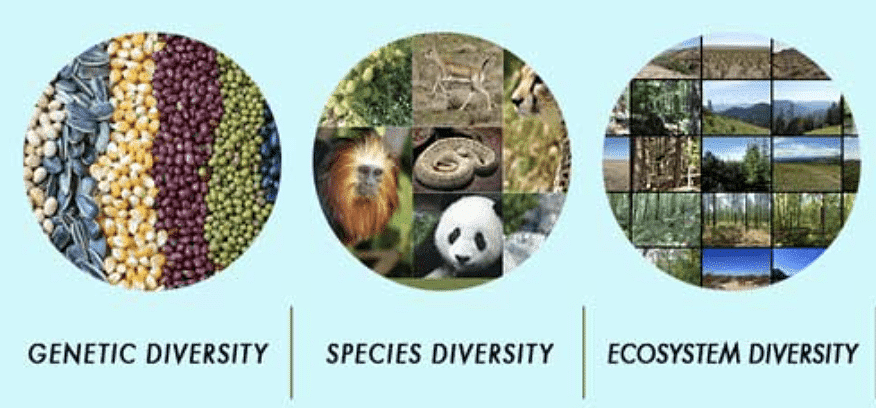
Genetic Diversity
- It refers to the variations among the genetic resources of the organisms.
- Every individual of a particular species differs from others in their genetic constitution. That is why every human looks different from the other.
- Similarly, there are different varieties in the same species of rice, wheat, maize, barley, etc.
Species Diversity
- Species diversity refers to the variety of different types of species found in a particular area.
- It is biodiversity at the most basic level. It includes all the species ranging from plants to different microorganisms.
- No two individuals of the same species are exactly similar. For example, humans show a lot of diversity among themselves.
Ecological Diversity
- An ecosystem is a collection of living and non-living organisms and their interaction with each other. Ecological biodiversity refers to the variations in the plant and animal species living together and connected by food chains and food webs.
- It is the diversity observed among the different ecosystems in a region. Diversity in different ecosystems like deserts, rainforests, mangroves, etc., include ecological diversity.
Question for Biodiversity: Types, Importance, Biodiversity in IndiaTry yourself:What is the feature of the biosphere?
View Solution
Importance of Biodiversity
Biodiversity and its maintenance are very important for sustaining life on earth. A few of the reasons explaining the importance of biodiversity are:
Ecological Stability
- Every species has a specific role in an ecosystem. They capture and store energy and also produce and decompose organic matter.
- The ecosystem supports the services without which humans cannot survive. A diverse ecosystem is more productive and can withstand environmental stress.
Economic Importance
- Biodiversity is a reservoir of resources for the manufacture of food, cosmetic products and pharmaceuticals.
- Crops livestock, fishery, and forests are a rich source of food.
- Wild plants such as Cinchona and Foxglove plant are used for medicinal purposes.
- Wood, fibres, perfumes, lubricants, rubber, resins, poison and cork are all derived from different plant species.
- The national parks and sanctuaries are a source of tourism. They are a source of beauty and joy for many people.
Ethical Importance
- All the species have a right to exist.
- Humans should not cause their voluntary extinction. Biodiversity preserves different cultures and spiritual heritage. Therefore, it is very important to conserve biodiversity.
Question for Biodiversity: Types, Importance, Biodiversity in IndiaTry yourself:For what reason is rich biodiversity important?
View Solution
Loss of Biodiversity
- Loss of biodiversity is the decrease in the number of a particular species in a certain habitat. Loss of biodiversity also leads to the extinction of the plant and animal species and this loss can be either reversible or permanent.
- Human activities have been the major cause of the loss of biodiversity which has led to sudden changes in climate causing a big threat to biodiversity.
- There has also been an increased demand for natural resources along with the growing population leading to greater waste generation.
Causes of Loss of Biodiversity
Some of the major causes that have resulted in the loss of biodiversity are mentioned below:- The natural habitat of the ecosystem plays a major role in maintaining the ecological balance. Several trees are cut down every year for the construction of industries, highways, settlements,s and so on to fulfill human demands. As a result, the species become the target of predation and eventually dies.
- Hunting of wild animals for the commercialization of their products has been a major reason for the loss of biodiversity. Since the year 2013, more than 90 rhinos were killed by the poachers for their horns and as per the records of 2016, 9 Indian Rhinos have been killed in Kaziranga National Park of Assam.
- The exploitation of medicinal plants for several laboratory purposes has resulted in the extinction of these species. Also, several animals are sacrificed for various research in science and medicine.
- Natural calamities like floods, earthquakes, forest fires also lead to the loss of biodiversity.
- Air pollution has a major role in the loss of biodiversity. Rapid cutting down of the trees has resulted in the increase of carbon dioxide in the atmosphere leading to climate change. As a result, there has been an increase in the land and ocean temperature leaving an inimical impact on species.
Biodiversity in India
- India is one of the most diverse nations in the world. It ranks ninth in terms of plant species richness. Two of the world’s 25 biodiversity hotspots are found in India.
- It is the origin of important crop species such as pigeon pea, eggplant, cucumber, cotton, and sesame. India is also a center of various domesticated species such as millets, cereals, legumes, vegetables, medicinal and aromatic crops, etc.
- India is equally diverse in its faunal wealth. There are about 91000 animal species found here.
- However, diversity is depleting at a drastic rate and various programs on biodiversity conservation are being launched to conserve nature.
The document Biodiversity: Types, Importance, Biodiversity in India | Biology Class 12 - NEET is a part of the NEET Course Biology Class 12.
All you need of NEET at this link: NEET
|
78 videos|276 docs|174 tests
|
FAQs on Biodiversity: Types, Importance, Biodiversity in India - Biology Class 12 - NEET
| 1. What is biodiversity? |  |
Ans. Biodiversity refers to the variety of life forms, including plants, animals, microorganisms, and the ecosystems in which they exist. It encompasses the different species, genetic variations within species, and the various habitats and ecosystems that support them.
| 2. What are the types of biodiversity? | |
Ans. Biodiversity can be categorized into three main types: species diversity, genetic diversity, and ecosystem diversity. Species diversity refers to the variety of different species within a particular area or ecosystem. Genetic diversity refers to the variation in genes within a species, allowing for adaptation and evolution. Ecosystem diversity refers to the variety of different habitats and ecosystems within a region.
| 3. Why is biodiversity important? | |
Ans. Biodiversity is crucial for the functioning of ecosystems and the well-being of human societies. It provides essential ecosystem services such as air and water purification, pollination, nutrient cycling, and climate regulation. Biodiversity also supports food security, as many crops rely on diverse genetic resources for resistance to diseases and pests. Additionally, it offers aesthetic, cultural, and recreational values, and contributes to scientific and medicinal discoveries.
| 4. What are the causes of biodiversity loss? | |
Ans. Biodiversity loss is primarily caused by human activities. The major drivers include habitat destruction and fragmentation, overexploitation of natural resources, pollution, climate change, and the introduction of invasive species. These activities often disrupt ecosystems, leading to the extinction of species, loss of genetic diversity, and degradation of habitats.
| 5. How is biodiversity in India? | |
Ans. India is one of the world's mega-diverse countries, with a rich and varied biodiversity. It is home to numerous species of plants, animals, and microorganisms, many of which are endemic to the country. India's diverse ecosystems range from the Himalayas in the north to the coastal areas in the south, providing habitats for a wide range of species. However, rapid urbanization, habitat destruction, and pollution pose significant threats to India's biodiversity. Conservation efforts, such as protected areas and sustainable resource management, are being undertaken to preserve and restore the country's unique biodiversity.
Related Exams
About this Document

|
4.9K Views |

|
4.88/5 Rating |

|
Dec 23, 2024 Last updated |
Document Description: Biodiversity: Types, Importance, Biodiversity in India for NEET 2024 is part of Biology Class 12 preparation.
The notes and questions for Biodiversity: Types, Importance, Biodiversity in India have been prepared according to the NEET exam syllabus. Information about Biodiversity: Types, Importance, Biodiversity in India covers topics
like What is Biodiversity?, Types of Biodiversity, Importance of Biodiversity, Loss of Biodiversity, Biodiversity in India and Biodiversity: Types, Importance, Biodiversity in India Example, for NEET 2024 Exam. Find important definitions, questions, notes, meanings, examples, exercises and tests below for Biodiversity: Types, Importance, Biodiversity in India.
Introduction of Biodiversity: Types, Importance, Biodiversity in India in English is available as part of our Biology Class 12
for NEET & Biodiversity: Types, Importance, Biodiversity in India in Hindi for Biology Class 12 course.
Download more important topics related with notes, lectures and mock test series for NEET
Exam by signing up for free. NEET: Biodiversity: Types, Importance, Biodiversity in India | Biology Class 12 - NEET
Description
Full syllabus notes, lecture & questions for Biodiversity: Types, Importance, Biodiversity in India | Biology Class 12 - NEET - NEET | Plus excerises question with solution to help you revise complete syllabus for Biology Class 12 | Best notes, free PDF download
Information about Biodiversity: Types, Importance, Biodiversity in India
In this doc you can find the meaning of Biodiversity: Types, Importance, Biodiversity in India defined & explained in the simplest way possible. Besides explaining types of
Biodiversity: Types, Importance, Biodiversity in India theory, EduRev gives you an ample number of questions to practice Biodiversity: Types, Importance, Biodiversity in India tests, examples and also practice NEET
tests

|
Explore Courses for NEET exam
|
|
Signup for Free!
Signup to see your scores go up within 7 days! Learn & Practice with 1000+ FREE Notes, Videos & Tests.
Related Searches
video lectures
,Previous Year Questions with Solutions
,Free
,MCQs
,Objective type Questions
,Exam
,Biodiversity in India | Biology Class 12 - NEET
,Summary
,Important questions
,Biodiversity: Types
,mock tests for examination
,shortcuts and tricks
,Biodiversity in India | Biology Class 12 - NEET
,Extra Questions
,Importance
,Importance
,Sample Paper
,Biodiversity: Types
,practice quizzes
,ppt
,Semester Notes
,study material
,Biodiversity: Types
,Importance
,Biodiversity in India | Biology Class 12 - NEET
,Viva Questions
,past year papers
;




Additional Information about Biodiversity: Types, Importance, Biodiversity in India for NEET Preparation
Biodiversity: Types, Importance, Biodiversity in India Free PDF Download
The Biodiversity: Types, Importance, Biodiversity in India is an invaluable resource that delves deep into the core of the NEET exam.
These study notes are curated by experts and cover all the essential topics and concepts, making your preparation more efficient and effective.
With the help of these notes, you can grasp complex subjects quickly, revise important points easily,
and reinforce your understanding of key concepts. The study notes are presented in a concise and easy-to-understand manner,
allowing you to optimize your learning process. Whether you're looking for best-recommended books, sample papers, study material,
or toppers' notes, this PDF has got you covered. Download the Biodiversity: Types, Importance, Biodiversity in India now and kickstart your journey towards success in the NEET exam.
Biodiversity: Types, Importance, Biodiversity in India
The importance of Biodiversity: Types, Importance, Biodiversity in India cannot be overstated, especially for NEET aspirants.
This document holds the key to success in the NEET exam.
It offers a detailed understanding of the concept, providing invaluable insights into the topic.
By knowing the concepts well in advance, students can plan their preparation effectively.
Utilize this indispensable guide for a well-rounded preparation and achieve your desired results.
Biodiversity: Types, Importance, Biodiversity in India Notes
Biodiversity: Types, Importance, Biodiversity in India Notes offer in-depth insights into the specific topic to help you master it with ease.
This comprehensive document covers all aspects related to Biodiversity: Types, Importance, Biodiversity in India.
It includes detailed information about the exam syllabus, recommended books, and study materials for a well-rounded preparation.
Practice papers and question papers enable you to assess your progress effectively.
Additionally, the paper analysis provides valuable tips for tackling the exam strategically.
Access to Toppers' notes gives you an edge in understanding complex concepts.
Whether you're a beginner or aiming for advanced proficiency, Biodiversity: Types, Importance, Biodiversity in India Notes on EduRev are your ultimate resource for success.
Biodiversity: Types, Importance, Biodiversity in India NEET Questions
The "Biodiversity: Types, Importance, Biodiversity in India NEET Questions" guide is a valuable resource for all aspiring students preparing for the
NEET exam. It focuses on providing a wide range of practice questions to help students gauge
their understanding of the exam topics. These questions cover the entire syllabus, ensuring comprehensive preparation.
The guide includes previous years' question papers for students to familiarize themselves with the exam's format and difficulty level.
Additionally, it offers subject-specific question banks, allowing students to focus on weak areas and improve their performance.
Study Biodiversity: Types, Importance, Biodiversity in India on the App
Students of NEET can study Biodiversity: Types, Importance, Biodiversity in India alongwith tests & analysis from the EduRev app,
which will help them while preparing for their exam. Apart from the Biodiversity: Types, Importance, Biodiversity in India,
students can also utilize the EduRev App for other study materials such as previous year question papers, syllabus, important questions, etc.
The EduRev App will make your learning easier as you can access it from anywhere you want.
The content of Biodiversity: Types, Importance, Biodiversity in India is prepared as per the latest NEET syllabus.
|
© EduRev
|
Education Revolution
|


|


Signup to see your scores
go up within 7 days!
Access 1000+ FREE Docs, Videos and Tests
Takes less than 10 seconds to signup