Biodiversity Conservation | Biology Class 12 - NEET PDF Download
Introduction
Biodiversity conservation is the protection and management of biodiversity to obtain resources for sustainable development.
Biodiversity conservation has three main objectives:
- To preserve the diversity of species.
- Sustainable utilization of species and ecosystem.
- To maintain life-supporting systems and essential ecological processes.
India's Famous Tiger Reserve –
Jim Corbett National Park – Nainital (Uttaranchal)
Dudhwa National Park – Lakhimpur Kheri (U.P.)
Kanha National Park – Mandala and Balghat (Madhya Pradesh)
Indrawati National Park – (Chattishgarh)
Simli National Park – (Orissa)
Some Special Animals –
Asiatic wild ass – (Endangered) – Found in Rann of Kutch and Pakistan
Red Panda – (Endangered) – Found in Kanchenjunga (Sikkim)
Hangul–Kashmir Stag (Endangered)–Found in Dachigam (Sri-Nagar – Jammu & Kashmir)
Siberian Crane – (Endangered) – Found in Keoladeo (Ghana) National Park
The Great Indian Bustard is a huge ground bird with a long neck and long bare legs. It is an inhabitant of the semi-arid areas of Rajasthan, Gujarat and Maharashtra. Hunting for its flesh has reduced its population to over 800. It is a highly endangered bird.
"Ex-situ conservation" is the protection of wild life in zoos and botanical gardens. Other e.g., of Ex-situ conservation are gene banks, germ plasm bank, seed bank."In situ conservation" is the protection of species (wild life) in their natural habitat or National parks.
1. The world's first National Park (America) – Yellow stone National Park.
2. India's first National Park – Jim Corbett National Park – Nainital (Uttaranchal)
3. Smallest tiger reserve in India – Ranthambore National Park - Sawaimadhopur (Rajasthan). It is famous for Asiatic wild ass.
4. Largest Tiger reserve in India – Nagarjuna Sagar Saisailum Sanctuary - Guntoor - Andhra Pradesh.
5. Nandan-Kanan zoo is known for - White tiger.
Note : Sunderbans [W.Bengal] is also famous for tigers.
6. Periyar wild life Sanctuary (Kerala) – Famous for elephant & others.
7. Valley of flower National park – It is situated at Chamoli- Garhwal (Uttaranchal)
8. Flamingoes are protected in Chilka lake Balagaon (Orissa)
9. Rachel Carson written a book "Silent Spring" – concerned with awareness about "Nature conservation and Environment" -1962.
Note :It mentioned the effect of DDT on birds. The population of Ladybird bettle declined.
10. The black buck is one of the most graceful antelopes native of India. The male possesses a pair of spirally twisted horns. Once abundant in several parts of India, its population had come down until the enforcement of the wild life (Protection) Act.
SOME IMPORTANT INFORMATION:
1. (i) National Forest Policy revised in – 1988.
(ii) Biodiversity act of India was passed by the Parliament in the year-2002
(iii) Forest Act–1927.
(iv) Biosphere Reserve Scheme– 1986
2. Wild life protection act 1972 (Revised in 1991) : Objectives :
(1) Restriction and prohibition on hunting of animals.
(2) Protection of specified plants.
(3) Setting up and managing Sanctuaries and National parks.
(4) Empowering zoo authority.
(5) Control of trade and commerce of wildlife.
3. Chipko Movement was born in March-1973 at Gopeshwar in Chamoli district. The movement had two leaders- Sundarlal Bahuguna of Silyara in Tehri and Chandi Prasad Bhatt of Gopeshwar.
Appiko Movement – Similar type movement, Appiko movement was under taken by Poundurang hegde in south in 1983.
SPECIAL WILDLIFE PROJECTS IN INDIA
Project tiger - Running since 1 April 1973 - Central Government.
The Gir Lion Sanctuary Project - Running since 1972-Central Govt. and Gujrat Govt.
Himalayan Musk Deer Project - U.P. Govt. IUCN and Central Govt.
The Manipur Brow-Antlered Deer Project- Running since 1977 Project Hangul - Since 1970 - J.& K. Govt. IUCN, WWF.
Crocodile Breeding Project - Since 1975 UNDP, Central Govt.
Project Elephant - Recently started.
ABOUT WILDLIFE
Red Data Book :- This book contains a record of animals & plants which are known to be in danger. This Book is maintained by the IUCN [International Union of Conservation of Nature and Natural Resources].
Green Data book :- A book containing a list of rare plants in a protected area like Botanical gardens.
Silent Valley :- It is tropical evergreen forest in Kerala (Palghat) declared as National Reserve Forest. It is called silenta's first and only butterfly park was established in 1992 near Gangtok (Sikkim).
valley because there is no noise in the forest during night, even that of cicadas, as they are not found there. It is related to conservation of forest.
Butterfly Park :- Indi
SOME OTHER INFORMATION ABOUT BIODIVERSITY:
1. Sacred forest : These are forest patches protected by tribal communities due to religious sanctity in Karnataka, Maharashtra, Kerala, Meghalaya.
Sacred lake : Khecheopalri lake in Sikkim has been declared "Sacred lake" by people.
2. Mine Spoil : The land that has been destroyed due to mining is known as derelict land or mine spoil.
3. Hot Spot : Norman Myers developed the hot spot concept in 1988. This is a mega diversity zone where large number of species are found. It is an area of the richest and the most threatened reservoirs of plant and animal life on the earth. Initially 25 biodiversity hot spots were identified in world, now number of biodiversity hot spots in the world are 34 out of these 3 hot spots are found in India.
(i) Western Ghats and Sri Lanka
(ii) Indo-Burma
(iii) The Himalayas Note :
Hot spot covers the 1.4% of the earth's land area.
The key criteria for determining a hot spot are :
Number of endemic species.
Degree of threat.
4. Biodiversity :- The term biodiversity refers to the totality of genes, species and ecosystem of a region.
Species diversity : Variety of species within a region.
Species richness : The number of species in per unit area.
If species evenness or equitability is high in an area then it will be considered more diverse.
5. Diversity at the level of community – Three types :
(i) Alpha diversity : Diversity within community.
(ii) Beta diversity : Diversity between community.
(iii) Gamma diversity : Diversity of the habitats over the total landscape or geographical area.
6. Reason for loss of Biodiversity :
(i) Habitat loss and fragmentation.
(ii) Disturbance and pollution.
(iii) Introduction of exotic species – New species entering in a geographical region it is called exotic species or alien species. Such species may cause disappearance of native species through changed biotic interactions. Exotic species are having large impact especially in island ecosystem. e.g. of exotic species :
Nile perch (Predatory fish introduced into lake Victoria, (East Africa) – Responsible for extinction of Cichlid fish.
Water hyacinth (Eicchornia)
Lantana camara w African catfish (Clarias gariepinus) – Responsible for extinction of Indian cat fish.
7. Type of Extinction of species :
(i) Natural extinction : Due to change in environmental condition. (ii) Mass extinction : Due to catastrophs. (iii) Anthropogenic extinction :
Due to human activities like hunting.
Co-extinctions :When a species becomes extinct, the plant and animal species associated with it in an obligatory way also become extinct. e.g.Plant-pollinator.
8. The characteristics of species particularly susceptible to extinction are :-Large body size, small population size, low reproductive rate, feeding at high tropic levels in the food chain, Fixed migratory routes and habitat (e.g : Blue whale and whooping crane) and localized and narrow range of distribution (e.g : Woodland caribou, Island species)
9. Landscape : It is a unit of land with a natural boundary having a mosaic of patches. These patches generally represent different ecosystem.
Note : In ecological hierarchy landscape can be present between Ecosystem and Biomes.
10. India is divided into 10 Biogeographical regions.
(i) Trans - Himalaya (ii) Himalaya (iii) Desert (iv) Semi - Arid (v) Western ghats (vi) Deccan peninsula (vii) Gangetic plain (viii) Coasts (ix) North east (x) Islands
Note : Deccan peninsula has maximum coverage of the Indian land mass (42%), western ghats 4% and north-east 5.2%.
11. Endemic Flowering Species of India – 33% of flowering plants recorded in India, are en demic.
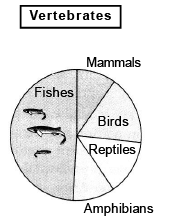
12. Endemic fauna (Animals Species) of India – Out of the recorded vertebrates, 60% amphibians, 53% fresh water fish, 36% reptiles and 10% mammalian fauna.
Maximum endemic amphibian species are found in western ghats.
From ten high-diversity localities in tropical forest some 17,000 endemic plant species and 350,000 endemic animal species could be lost in near future.
The tropical forests alone are losing roughly 14,000 - 40,000 species per year (or 2-5 species per hour).
The earth may lose up to 50 percent of the species by the end of the 21st century.
According to IUCN (2004), total number of plant and animal species on the earth is 1.5 million.
According to Robert May, global species diversity is about 7 million.
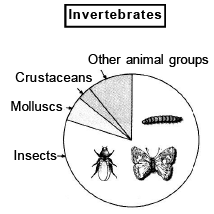
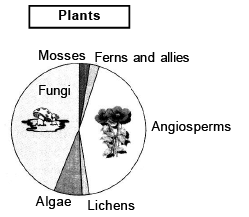
More than 70 percent of all species recorded are animals, while plants comprise no more than 22%.
Out of 10 animals on this planet, 7 are insects.
India's share of the global species diversity is about 8.1 percent.
Some examples of recent extinction include the dodo (Mauritius), quagga (Africa), thylacine (Australia), stellars' sea cow (Russia) and three subspecies (Bali, Javan, Caspian) of tigers.
According to IUCN Red list (2004), 784 species were extinct in the last 500 years.
Last 20 years alone have witnessed the disappearance of 27 species.
The Amazon rain forest is so huge that it is called "Lungs of the Planet".
13. Wet lands : Low lying area's covered with shallow water are called wet lands. The wet lands are transitional zones between terrestrial and aquatic areas. 6% of the world's land surface is occupied by wet lands.
Marshes : Wetlands where grass - like plants dominate.
Swamps : Wetlands where trees or shrubs dominate.
Riverine forest : Periodically Flooded forests found in lowland along streams.
Mangrove is a salty water swamp. Significance of Wet lands : (1) Wetland are highly productive, provide food and habitat. (2) Wetlands helps to control floods by holding excess water. (3) Ground water recharging areas. (4) Help to clean and purify water run-off. (5) Provides sites for fishing, boating, nature study.
Wetlands conservation measures :
(i) Preparation of wetland inventories. (ii) Checking waste disposal in wetland. (iii) Reduction of excessive inflow of nutrients and silt into wetlands.
14. Grassland management measures :
(1) Protection from grazing. (2) Use of rotational grazing. (3) Removal of woody bushes or shrubs and weeds. (4) Conservation of soil and water of grasslands. (5) Use of controlled burning to promote recycling of nutrients.
Some other Information related to Grass land –
India has 16 recognized forest types, which represent a rich diversity.
In India, the Grass cover area including fallow and waste land is 18% of total land area.
37% of land are available for grazing including forest.
Grassland is also called Rangeland.
The conversion of grassland or forest to desert is called desertification.
The average annual production of dry grass or hay in India is about 250 million tonnes.
15. Conservation and management of water : Main approaches for conservation of water are :
Reducing agricultural water wastage by increasing efficiency of irrigation.
Reducing water wastage in industry by recycling the used water.
Reducing domestic water wastage by constructing waste water treatment.
Rainwater harvesting by employing practices to store rainwater and recharge ground water.
Afforestation and protection of water sheds to improve water economy. Approaches to provide a sustainable supply of high quality water are :
(i) Construction of dams and reservoirs to ensure year-round supply of water, in addition, controlling floods and generating electricity.
(ii) Desalinisation of seawater and saline ground water and making it fit for drinking and other purposes.
(iii) Regular dredging and salinisation of water bodies.
16. Phenotypic Plasticity: The phenotype is the physical expression of the interaction between genotype of an organism and its environment.
The phenotypes show variations due to difference in the environmental conditions within the local habitat. Such type of variations are known as phenotypic plasticity.
17. Ecocline – Transition form between two ecotypes called "Ecocline".
18. Guild – Organism of same tropic level is known as guild (e.g. Cow, Goat, Rabbit).
19. Arboreta – Botanical garden where specific trees & shrubs species are cultivated.
20. Botanochemicals – Plants can also be used for the manufacture of innumerable synthetic products called botanochemicals.
21. The key elements that lead to so much variation in the physical and chemical conditions of different habitats are temperature, water , light and soil.
22. Mango trees do not grow in temperate countries like Canada and Germany, snow leopards are not found in Kerala forests and tuna fish are rarely caught beyond tropical latitudes in the ocean due to unfavourable temperatures.
23. The salt concentration (measured as salinity in parts per thousand) is less than 5 percent in inlands water, 30-35 percent the sea and more then 100 percent in same hypersaline lagoons. Some organisms are tolerant of a wide range of salinites (euryhaline) but others are restricted to a narrow range (stenohaline).
24. Diapause : Under unfavourable conditions many zooplankton species in lakes and ponds are known to enter diapause a stage of suspended development.
25. Predators acting as conduits for energy transfer across tropic levels, predators play other important roles. They keep prey populations under control In the absence of predators, prey species could achieve very high population densities and cause ecosystem instability, When certain exotic species are introduced into a geographical area, they become invasive and start spreading fast because the invaded land does not have its natural predators, The prickly pear cactus introduced into Australia in the early 1920's caused havoc by spreading rapidly into millions of hectares of rangeland. Finally, the invasive cactus was brought under control only after a cactus feeding predator (a moth) from its natural habitat was introduced into the country.
Biological control methods adopted in agricultural pest control are based on the ability of the predator to regulate prey population. Predator also help in maintaining species diversity in community, by reducing the intensity of competition among competing prey species. In the rocky intertidal communities of the american Pacific Coast the starfish Pisaster is an important predator. In a field experiment, when all the starfish were removed from an enclosed intertidal area, more than 10 species of invertebrates became extinct within a year, because of interspecific competition.
If a predator is too efficient and overexploits its prey, then the prey might become extinct and following it, the predator will also become extinct for lack of food. This is reason why predators in nature are 'prudent'. Prey species have evolved various defenses to lessen the impact of predation. Some species of insects and frogs are cryptically-coloured (camouflaged) to avoid being detected easily by the predator. Some are poisonous and therefore avoided by the predators. The Monarch butterfly is highly distasteful to its predator (bird) because of special chemical present in its body. Interestingly, the butterfly acquires this chemical during its caterpillar stage by feeding on poisonous weed.
You must have seen the weed Calotropis growing in abandoned fields. The plant produces highly poisonous cardiac glycosides and that is why you never see any cattle or goats browsing on this plant. A wide variety of chemical substances that we extract from plants on a commercial scale (nicotine, caffeine, quinine, strychnine, opium, etc.,) are produced by them actually as defence against grazers and browsers.
SOME GENERAL INFORMATIONS
1. Planktons – Planktons are free floating and small organisms they swim due to water currents. They lack locomotory organs or the locomotory organs may be reduced. It includes –
1. Phytoplankton – Microscopic, inactive floating plants e.g. Diatoms.
2. Zooplankton – Microscopic, inactive floating animals. e.g. Protozoans, Crustaceans, Larvae.
2. Nektons – Those aquatic plants and animals which are capable of swimming actively are called nektons. They have well developed locomotory organs. It includes –
- Phytonektons – usually flagella are present in these plants. e.g. Chlamydomonas and Dinoflagellates
- Nektons (animals) – Jelly fishes, sharks, fishes, frog, cuttle fishes.
3. Benthonic – The sedentary organisms of sea are called benthonic. e.g. Crabs, Snails, Star fishes
4. Periphyton – Organism which lives on hydrophytes like. Damsel fly, vorticella, Hydra, Rotifers.
5. Hibernation – Winter sleep or period of dormancy of Cold blooded animals e.g. Amphibians, reptiles are Hot blooded animals – e.g. Polar bear, North ground squirrels.
6. Aestivation (Summer sleep) – Escape from heat of sun e.g. Lung fishes, Snails, Ground squirrels in south-west desert.
7. Cyclomorphosis – Change in body shape with the change in temperature e.g. Daphnia, Cladocera.
WILDLIFE ORGANISATIONS
I.U.C.N. = The International Union for Conservation of Nature and Natural Resources.(Switzerland)
W.C.U. = World Conservation Union. (New Name of I.U.C.N.)
W.W.F. = The World Wildlife Fund.
W.F.N. = World Wild Fund for Nature (New Name of W.W.F.)
I.B.W.L. = India Board for Wildlife.
B.N.H.S. = The Bombay Natural History Society.
W.P.S.I. = The Wildlife Preservation Society of India.
C.P.C.B. = Central Pollution Control Board.
I.B.P. = International Biology Programme.
M.A.B. = Man and Biosphere Programme.
U.N.E.P. = United Nation Environment Programme.
N.M.N.H. = National Museum of Natural History.
U.N.D.P. = United Nations Development Programme.
B.R.P. = Biosphere Reserve Programme.
Z.S.I. = Zoological Survey of India.
B.S.I. = Botanical Survey of India.
C.A.Z.R.I. = Central Arid Zone Research Institute, Jodhpur.
C.I.T.E.S. = Convention and International Trade in Endangered Species of Wild Fauna and Flora.(1976)
F.R.I. = Forest Research Institute, Dehradun.
W.I.I. = Wild Life Institute of India, Dehradun.
U.N.E.S.C.O. = United Nations Educational Scientific and Cultural Organization
| 28th February – Science Day |
| 21st March – World Forest Day |
| 22nd April – Earth day |
| 21 May – World Biodiversity day |
| 5th June – World Environment Day |
7th July – Van Mahotsav Day 11th July – World Population day |
| 16 September – World Ozone Day |
3rd October – World Animal Day 4th October – World Habitat Day 1st Week of October – Wild life week |
2 December – National pollution prevention day or National environment day 3rd December – World Conservation day |
|
86 videos|294 docs|184 tests
|
FAQs on Biodiversity Conservation - Biology Class 12 - NEET
| 1. What is biodiversity conservation? |  |
| 2. Why is biodiversity conservation important? | |
| 3. How are species protected in biodiversity conservation? | |
| 4. What are the challenges in biodiversity conservation? | |
| 5. How can individuals contribute to biodiversity conservation? | |

|
1.3K Views |

|
4.89/5 Rating |

|
Nov 24, 2024 Last updated |

|
Explore Courses for NEET exam
|

|
Extra Questions
,Summary
,mock tests for examination
,Previous Year Questions with Solutions
,video lectures
,Semester Notes
,Free
,Biodiversity Conservation | Biology Class 12 - NEET
,Important questions
,study material
,shortcuts and tricks
,ppt
,Sample Paper
,MCQs
,practice quizzes
,Objective type Questions
,Viva Questions
,Biodiversity Conservation | Biology Class 12 - NEET
,past year papers
,Biodiversity Conservation | Biology Class 12 - NEET
,Exam
;





Biodiversity Conservation Free PDF Download
Importance of Biodiversity Conservation
Biodiversity Conservation Notes
Biodiversity Conservation NEET Questions
Study Biodiversity Conservation on the App
|
© EduRev
|
Education Revolution
|


Follow Us
|