AC Bridges - 1

What are AC Bridges?
An AC bridge is an extension of the DC Wheatstone bridge used for measurement of impedance-type quantities when the source is alternating. The basic arrangement contains four bridge arms, an AC excitation source and a null (balanced) detector. Balance of an AC bridge is achieved when voltages at the detector terminals are equal in magnitude and phase so that the detector shows zero.
Such bridge methods are especially useful for precise measurement of:
- Inductance (L)
- Capacitance (C)
- Frequency (f)
- Mutual inductance (M)
- Storage factor and loss factor (dissipation)
Types of sources used in AC bridges
- For low-frequency measurements the mains (power line) supply may be used as the excitation source.
- For higher frequencies an electronic oscillator (sine-wave generator) is used as the excitation voltage.
Types of detectors used in AC bridges
- Headphones - used for frequencies ≈ 250 Hz up to 3-4 kHz. They are highly sensitive in this audio range and commonly used where the ear acts as a null detector.
- Vibration galvanometer - suitable from about 5 Hz to 1 kHz, but mainly used up to ≈ 200 Hz. Useful for power and low audio frequency ranges when high sensitivity is required.
- Tunable amplifier detector (TAD) - covers roughly 10 Hz to 100 kHz and provides amplification and frequency selection for improved sensitivity.
- Cathode ray oscilloscope (CRO) - used for higher frequencies (above a 5 kilohertz) and for visual display of phase relationships and waveforms.
Note: For a DC bridge the usual detector is a PMMC (permanent magnet moving coil) instrument; AC bridges require detectors sensitive to the AC frequency of interest.
AC bridges through which inductance (L) is measured
1. Maxwell's inductance bridge
Maxwell's inductance bridge compares an unknown self-inductance with a standard inductance of known reactance and a few known resistances. The bridge is arranged so that the unknown inductance and resistance appear in one arm and the standard inductance (with known small series resistance) with an adjustable series resistance appears in another arm. Two remaining arms are non-inductive resistances.
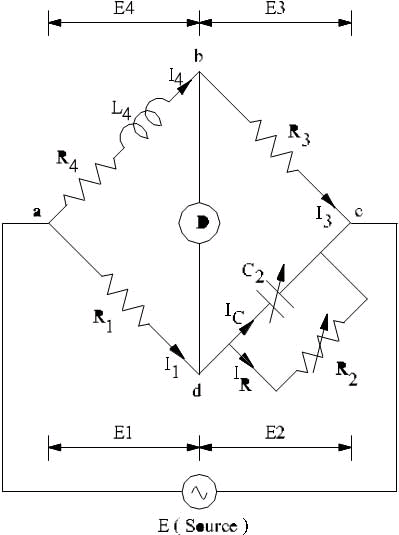 Maxwell's Inductance Bridge
If R1 and L1 are the unknown resistance and inductance respectively,
L2 is the variable standard inductance having fixed resistance r2,
R2 is the variable series resistance with L2
R3, R4 are known non-inductive resistances, then the bridge balance condition is given by
At balance condition,

equating real and imaginary parts we get,
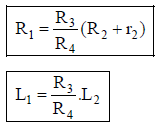
2. Maxwell's inductance-capacitance bridge
This variant measures an unknown inductance in terms of a known capacitance. The arrangement replaces the standard inductor by a standard capacitor and uses resistors in the other arms so that, under balance, the frequency terms cancel from the final expressions (if chosen appropriately).
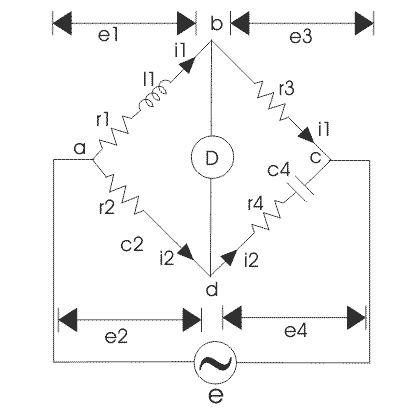 Maxwell Inductance Capacitance Bridge
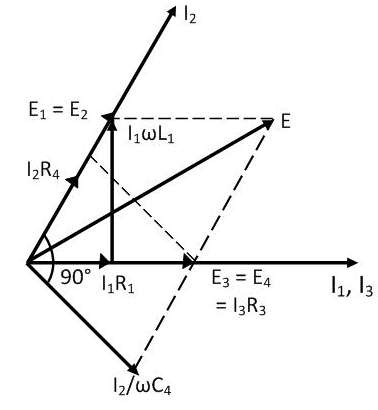
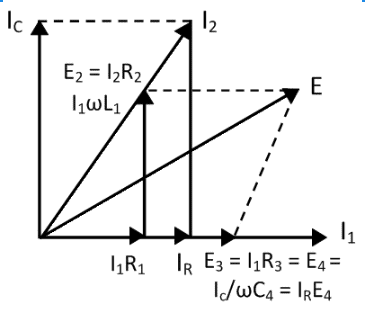 Phasor Diagram for Maxwell Inductance Capacitance Bridge
If R1 and L1 are the unknown resistance and inductance, R2, R3, R4 are known non-inductive resistances and C4 is the variable standard capacitor, the balance condition is
Z1 Z4 = Z2 Z3

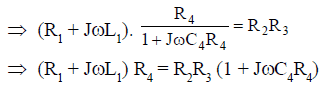
Equating the real part we get,

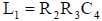
and equating the imaginary part we get,
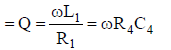
Quality factor (Q) for the coil is shown in the figure.
Advantages:
- Circuit arrangement is simple.
- Balance equations are free from the frequency term (so long as the standard elements are adjusted appropriately).
- Balance equations remain independent if R4 and C4 are chosen as the variable elements.
- Useful for measurement of a wide range of inductances at power and audio frequencies.
Disadvantages:
- Requires a variable standard capacitor which may be costly.
- Limited to coils with medium quality factor (approximately 1 < Q < 10) and is unsuitable for very low Q (Q < 1); thus Maxwell bridge suits medium-Q coils.
Try yourself: Which of the following statements is true regarding the Maxwell’s Inductance-Capacitance Bridge?
3. Hay's bridge
Hay's bridge is a modification of Maxwell's bridge designed for measurement of high-Q coils. It uses a standard capacitor in one arm with resistances arranged in series so that the expressions simplify for coils having high quality factor.
- The standard capacitor C4 is used with resistances in series as shown in the diagram to improve accuracy for high-Q coils.
 Phasor Diagram of Hay's Bridge
Let R1, L1 be the unknowns
R2, R3, R4 are non-inductive resistances
C4 is the standard capacitor.
At balance, Z1 Z4 = Z2 Z3.
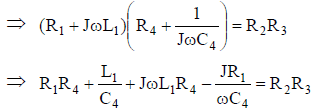
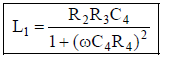
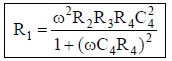
Quality factor expressions are shown below:
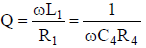

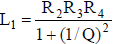
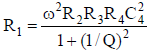
Because the expression for the unknown inductance and resistance contains the frequency term,
for high-Q coils (Q > 10) the term 1 + (1/Q)2 ≈ 1 and the relations simplify giving convenient formulae for L1 and R1.

Advantages:
- Gives a simple expression for the Q-factor.
- For high-Q coils it yields simple expressions for the unknown resistance and inductance.
Disadvantages:
- Not suitable for medium or low Q-coils; intended mainly for high-Q measurements.
4. Anderson's bridge
- Anderson's bridge is a modification of the Maxwell inductance-capacitance bridge that uses a bridge network with an extra arm to permit measurement of self-inductance in terms of a standard capacitor.
- It is often used when a fixed standard capacitance is available and accurate balance is required for low-Q coils.
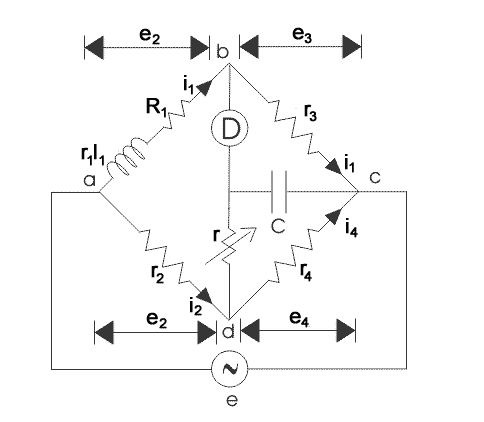 Anderson's Bridge
At balance the potentials at the detector nodes are equal and the detector current is zero. The bridge contains a delta network which is typically converted to an equivalent star (Y) network in the analysis; corresponding impedances and the algebraic relations are derived from that transformation.
At balanced condition, Vb = Ve
So, ID = 0
Also for the Delta network
we can convert this in star form
as 
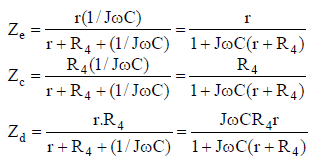
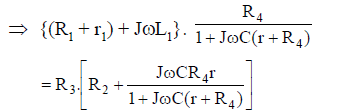

Equating real parts gives the resistive relation:
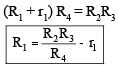
Equating imaginary parts yields (one of the forms):
L1 R4 = R3 C [R2 R4 + r R2 + r R4]

Phasor diagram for Anderson's bridge:
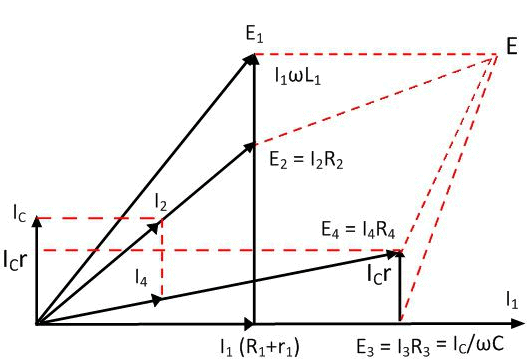 Phasor Diagram for Anderson's Bridge
Quality factor is given by:

- It is suitable for low Q-coils (Q < 1).
Advantages:
- Can be used for accurate estimation of capacitance in terms of inductance.
- Relatively economical when fixed capacitance is available.
- Balance is relatively easy to obtain in practice.
Disadvantages:
- Circuit is more complex than simpler bridges.
- Balance equations are more involved and tedious to handle.
- Additional junctions increase difficulty in shielding and wiring the network.
5. Owen's bridge
- Owen's bridge measures inductance in terms of capacitance. It provides independent balance equations and expressions for unknowns that are often free of frequency, making it useful over a wide range of inductances.
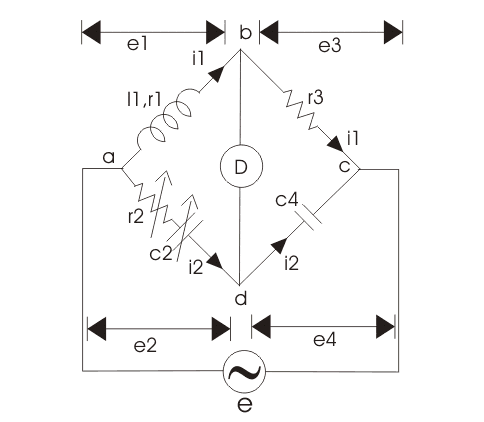 Owen's Bridge
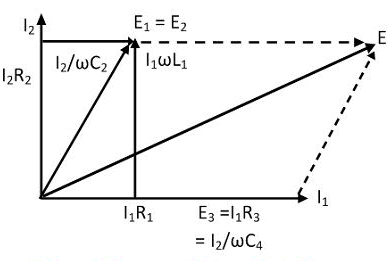 Phasor Diagram for Owen's Bridge
Let R1 and L1 be the unknown quantity
R2 = Variable non-inductive resistance
R3 = Fixed non-inductive resistance
C2 = Variable standard capacitor
C4 = Fixed standard capacitor
At balance condition,
ZabZcd = Zad. Zbc
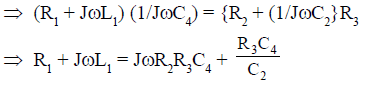

The expression for the unknown inductance is:
L1 = R2 R3 C4
Quality factor expression is shown here:
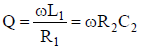
Advantages:
- Equations for balance are independent.
- Unknown expressions are free from frequency terms, allowing use over a wide inductance range.
Disadvantages:
- Requires a variable capacitor which can be costly.
- Typical practical accuracy about ±1%.
AC bridges through which capacitances are measured
1. De Sauty's bridge
- De Sauty's bridge is the simplest arrangement for comparing two capacitances.
- It can also be used to estimate the dissipation factor (D) of capacitors with suitable modification.
For ideal (lossless) capacitors the bridge circuit is:
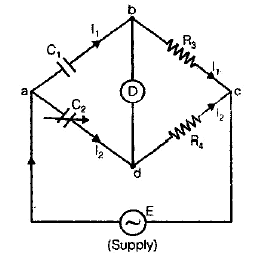 De Sauty Bridge
Let C1 = unknown capacitor
C2 = a standard capacitor
R3 and R4 = non-inductive resistors
Zab Zcd = Zad Zbc
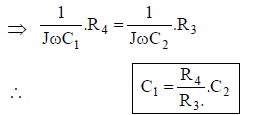
The advantage is simplicity, but the simple De Sauty arrangement cannot determine dissipation accurately. A modified De Sauty bridge using a lossy (real) capacitor model is used for dissipation factor measurement.
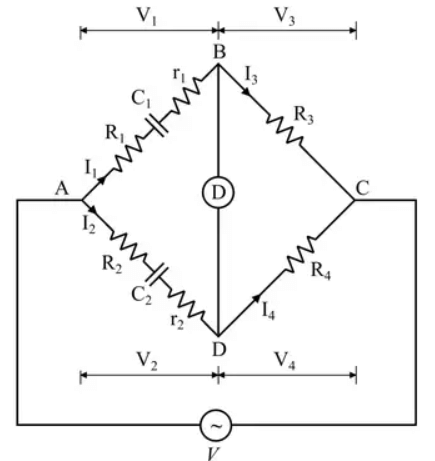 Modified De Sauty Bridge
- Given C2 and its dissipation D2 = ω C2 r2, one estimates C1 and hence D1 = ω C1 r1. At balance
Zab Zcd = Zbc Zad; the algebraic forms are shown in the figure.

Equating real part yields
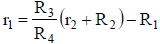
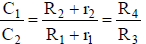
Equating imaginary part yields

And

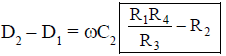
The relation for the dissipation factors is
- Because D2 - D1 = ω [C2 r2 - C1 r1]
2. Schering bridge
The Schering bridge is widely used for measurement of capacitance, dissipation factor (tan δ or D), and for testing insulating materials such as bushings and insulating oil. It operates by balancing the bridge so that the detector shows zero; the standard elements are adjusted until balance is reached.
Diagram (labelled):
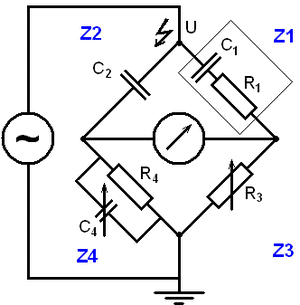 Schering Bridge
Typical element identification:
- C1 - capacitor under test (unknown capacitance and loss represented by R1 in series)
- R1 - series resistance representing loss in C1
- C2 - standard capacitor
- R3 - variable non-inductive resistance
- C4 - variable capacitor
- R4 - non-inductive resistance in parallel with C4
At balance the impedance ratios satisfy
Z1/Z2 = Z3/Z4
Z1 Z4 = Z2 Z3
Substituting the values of z1, z2, z3 and z4 in the above equation, we get

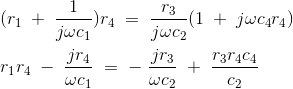
Equating real and imaginary parts

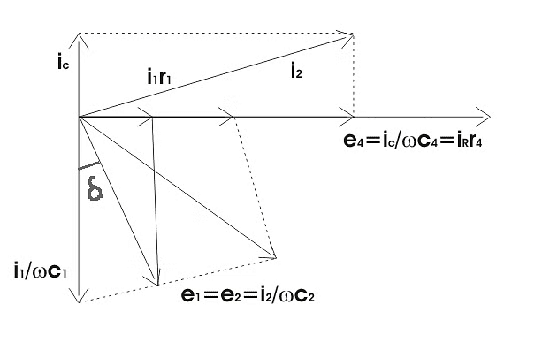 Phasor Diagram for Schering Bridge
From the phasor diagram the dissipation factor tan δ (equivalently D) can be obtained directly.

Advantages of Schering bridge:
- Balance equations are free from frequency (so the measurement is largely frequency-independent under ideal conditions).
- The bridge arrangement is economical compared with some other bridge types and is commonly used for insulating material testing.
Try yourself: Which of the following AC bridges is used for measuring the capacitance of the capacitor, dissipation factor, properties of an insulator, capacitor bushing, insulating oil and other insulating materials?
Additional notes and practical points
- Balance condition for any four-arm bridge with impedances Z1, Z2, Z3, Z4 is Z1Z4 = Z2Z3. For AC bridges the complex nature of impedances requires equating both real and imaginary parts (or amplitude and phase) to obtain two independent equations for two unknowns.
- Quality factor (Q) of a coil is defined by Q = ωL/R (where R is the series resistance) and determines whether a particular bridge (Maxwell, Hay, Owen, Anderson) is suitable: Hay for high Q, Maxwell for medium Q, Anderson for low Q.
- Choice of detector and source frequency affects sensitivity and accuracy. The detector must be suitable for the frequency range used; for example, headphones for audio, CRO for higher frequencies.
- Practical accuracy depends on the quality of standard components (standard capacitors or inductors), shielding, temperature stability and care in null detection. Variable standard capacitors or inductances are often expensive but improve accuracy.
Summary: AC bridges provide precise methods to measure inductance, capacitance and loss factors by comparison with standard elements. Selecting the appropriate bridge (Maxwell, Hay, Owen, Anderson, De Sauty, Schering) depends on the quantity to be measured and the coil or capacitor quality factor. The balance condition Z1Z4 = Z2Z3 and equating real and imaginary parts form the mathematical basis for all AC bridge analyses.
FAQs on AC Bridges - 1
| 1. How do AC bridges measure inductance? |  |
| 2. What components are typically used in AC bridges to measure capacitance? | |
| 3. How does an AC bridge work in measuring inductance? | |
| 4. What is the significance of balancing an AC bridge circuit in measuring capacitance? | |
| 5. How can AC bridges be used to measure inductance and capacitance simultaneously? | |



 | Explore Courses for Electrical Engineering (EE) exam |  |
 | Get EduRev Notes directly in your Google search | |