Detailed Chapter Notes - Forest Society and Colonialism


Introduction
- Forests provide many useful products such as paper, timber for furniture and doors, spices, dyes, rubber, gum, honey, tea, coffee, tendu leaves (for bidis), sal seed oil (used in chocolates), and medicinal herbs.
- They also supply bamboo, firewood, grass, charcoal, fruits, flowers and offer shelter to a wide range of animals and birds.
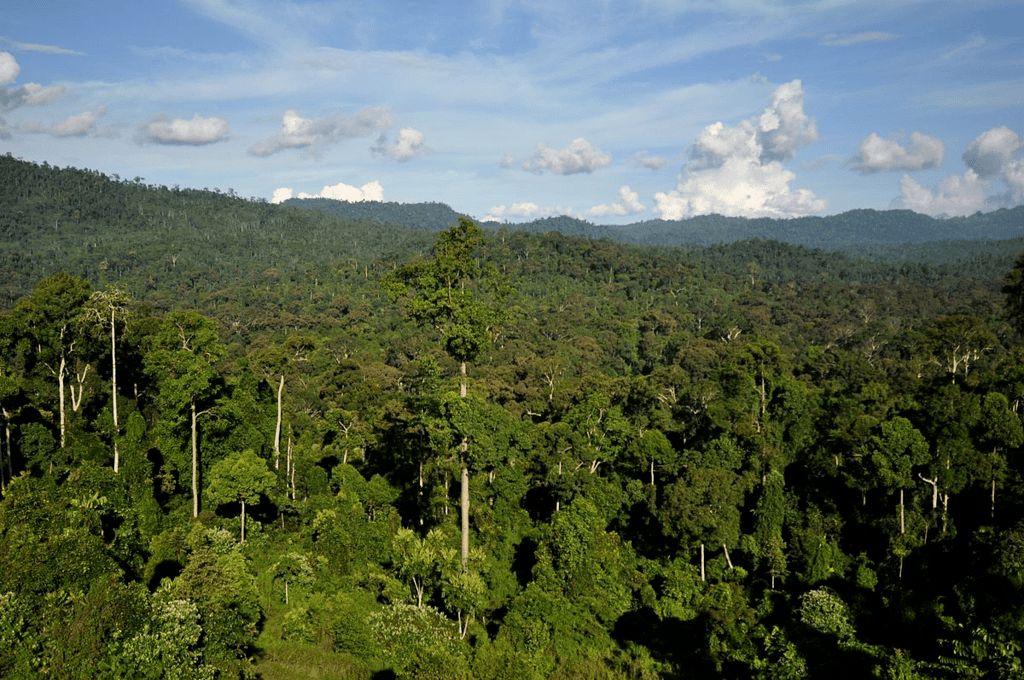
- Some forests, such as those in the Amazon and the Western Ghats, are extremely rich in biodiversity
- Large areas of forests were cleared worldwide due to industrialisation, expansion of agriculture and commercial needs.
Try yourself: What is one of the major roles played by forests in the environment?
Why Deforestation?
Deforestation means the cutting down or clearing of forests. It is an old problem but became particularly systematic and large-scale during the period of colonial rule.
Land to be Improved
- In 1600, about one-sixth of India's land was used for farming. Over time, population growth and changing land use increased the area under cultivation: by 1900 nearly half of the land was under cultivation.
- As population rose, peasants cleared forests to grow more food. During British rule, cultivation increased rapidly for several reasons:
- The British encouraged the growth of commercial crops such as jute, sugar, wheat and cotton to meet European demand for food and raw materials.
- The colonial administration considered forests "unproductive" and sought to convert forest land into farmland to raise revenue.
- Between 1880 and 1920 the area under cultivation increased by about 6.7 million hectares. Although cultivation could be seen as progress, it also resulted in widespread deforestation.
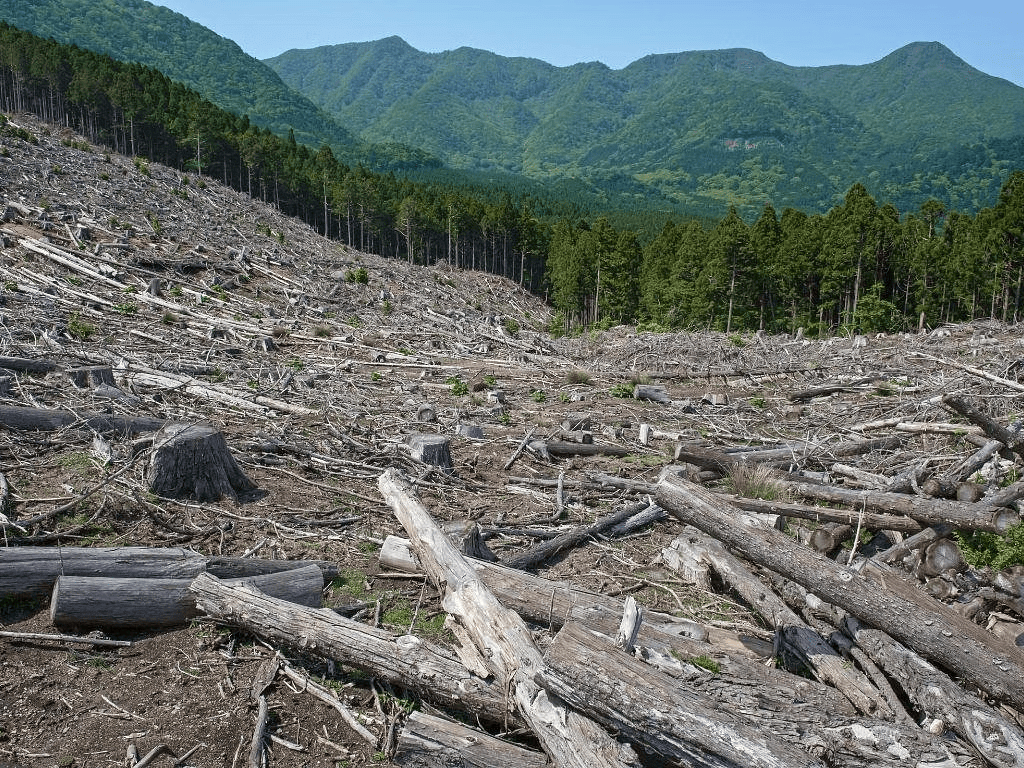 Deforestation
 When the valleys were full.
 Painting by John Dawson
Sleepers on the Tracks
Timber for Ships (early 19th century)
- By the early 1800s, oak forests in England were being depleted, leading to a shortage of timber for building ships for the Royal Navy.
- Concern about shortage of strong timber for ships and imperial power led the British, by the 1820s, to look to Indian forests for timber. Within a decade large-scale tree cutting had begun and timber began to be exported from India.
Timber for Railways (from 1850s)
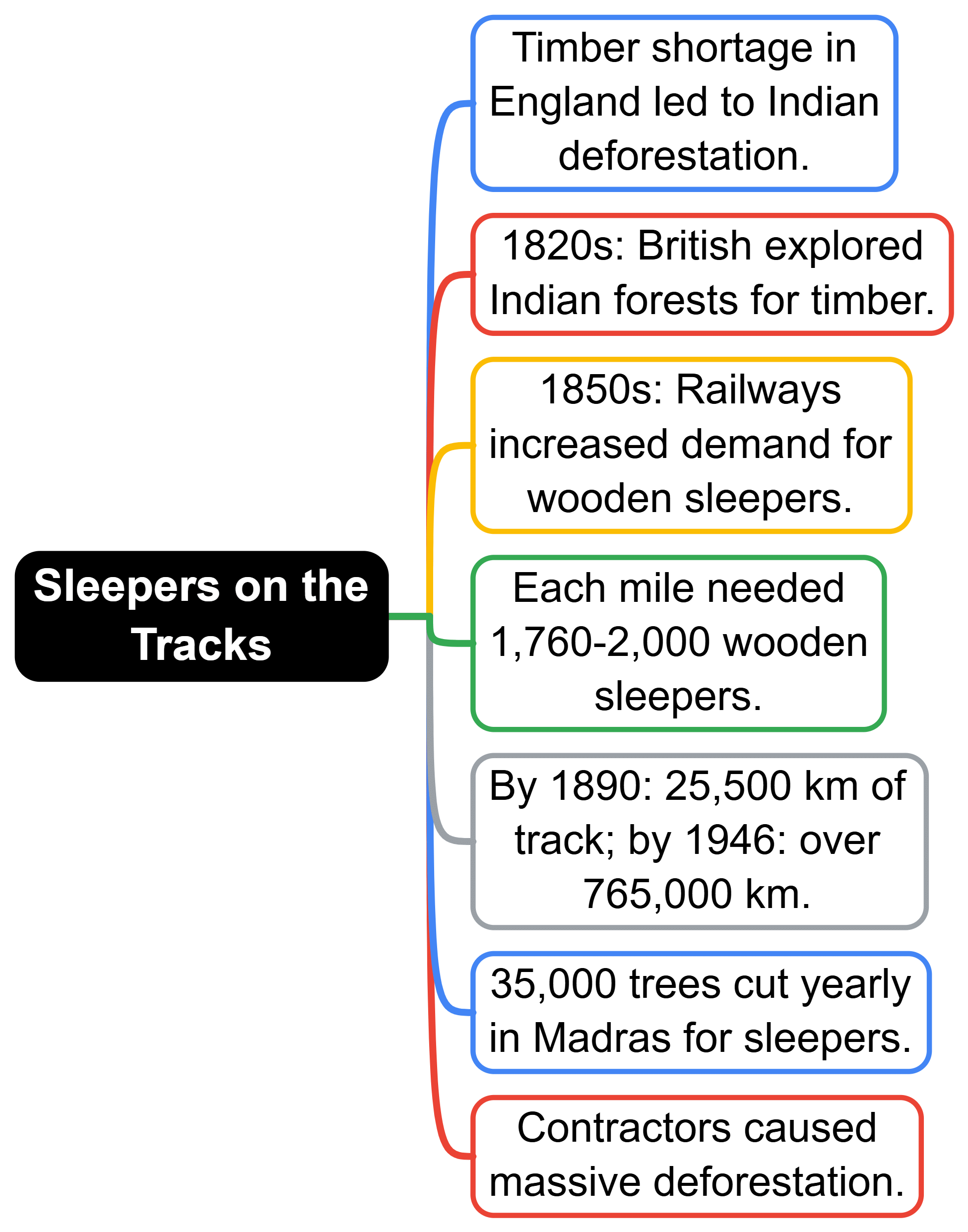
- Railways were essential for colonial trade and military movement. They required wood for fuel for engines and large numbers of wooden sleepers (the beams which support and space the rails).
- Each mile of track required between 1,760 and 2,000 sleepers. Railway expansion accelerated from the 1860s:
- By 1890 about 25,500 km of track had been laid.
- By 1946 the cumulative figure reached the hundreds of thousands of kilometres (figures in the colonial records show very large expansions).
- To meet these timber needs:
- Thousands of trees were cut. For example, in the Madras Presidency by the 1850s an estimated 35,000 trees per year were felled to supply timber.
- The government issued contracts to private suppliers and contractors to supply timber; contractors often cut trees carelessly, causing rapid deforestation, particularly near railway lines.
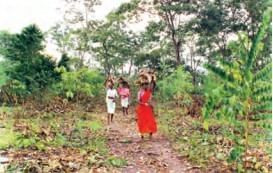 Women returning home after collecting fuelwood.
Plantations
- Many natural forests were cleared to make way for plantations of tea, coffee and rubber to satisfy Europe's growing demand for these goods.
- The colonial government took control of large forest areas and often handed them to European planters at low rates.
- These lands were enclosed, forest trees were felled and replaced by single-species plantings of tea, coffee, rubber or other commercial crops, creating plantations rather than natural forests.
 Pleasure Brand Tea
The Rise of Commercial Forestry
- The need for timber for ships and railways and the desire to control forest resources led the colonial state to develop a system of commercial forestry.
- The colonial administration feared that local people and local traders would over-exploit forests; to prevent this, they set up a professional forest bureaucracy.
- The German forester Dietrich Brandis was invited to India and became the first Inspector General of Forests. He introduced scientific forest management, trained officers and local staff, and promoted systematic conservation and timber production.
- Brandis helped create the Indian Forest Service in 1864 and contributed to the drafting of the Indian Forest Act of 1878, later revised in 1927, which gave the colonial state extensive control over forests.
- The Imperial Forest Research Institute was established at Dehradun in 1906 to support research, training and technical knowledge for forest management.
- Under this system, many natural mixed forests were felled and replaced by plantations - rows of a single species planted for easier management and for producing a steady supply of timber.
- Forest officials prepared working plans to decide how much area could be cut and re-planted each year, concentrating on species valuable for timber and industrial uses.
 The Imperial Forest School, Dehra Dun, India. (The first forestry school to be inaugurated in the British Empire)
Forest Act of 1878: Types of Forests
Forests were classified into three legal categories:
- Reserved Forests - Most strictly controlled. Local people were usually prohibited from taking any forest produce without permission.
- Protected Forests - Access by local people was limited and regulated; some rights could be allowed under rules.
- Village Forests - Forests set aside for local use where villagers could collect wood for fuel and house-building under agreed terms. In practice, very few forests were actually classified as village forests.
Try yourself: Indian Forest Service was set up in the year….?
How were the Lives of People Affected?
Different Ideas of a "Good" Forest
- For many villagers, a good forest meant a diverse forest with a mix of trees that could supply fuel, fodder, food, leaves for plates and many other daily needs.
- The colonial forest department preferred forests with tall, straight trees like teak and sal that produced valuable timber for ships and sleepers. This difference in priorities produced conflict.
- Officials often removed or suppressed species that were not considered commercially valuable, replacing mixed forests with monoculture plantations.
How Villagers Used Forests
- Villagers collected roots, leaves, fruits and tubers for food, particularly during lean months before harvest.
- Forest herbs and plants were widely used as traditional medicines.
- Wood from forests was used to make farming tools such as ploughs and yokes.
- Bamboo and creepers provided material for fences, baskets, ropes, umbrellas and other household implements.
- Examples of traditional uses: dried gourds as water bottles, stitched leaves used as plates and cups, the siadi creeper for rope-making, semur tree bark used in kitchen preparation, and mahua fruit used to make cooking and lamp oil.
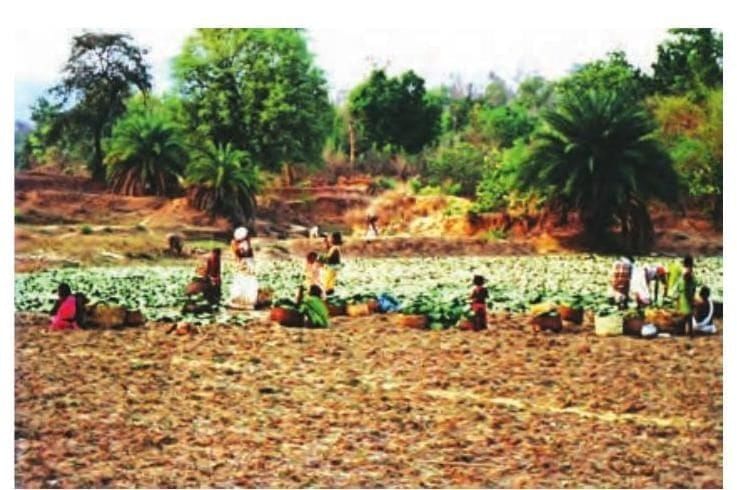 Drying tendu leaves
Impact of the Forest Act on Villagers
- The implementation of forest laws criminalised many traditional activities: cutting wood, grazing cattle, collecting fruits and roots, and hunting were made illegal without permits.
- Many villagers were forced to steal wood or other produce; when caught they were punished, while forest guards sometimes accepted bribes.
- Women, who largely collected fuelwood, suffered harassment and were particularly affected by the restrictions.
- Forest guards and local police often demanded free food or labour from villagers and frequently troubled them, increasing the burden on already poor households.
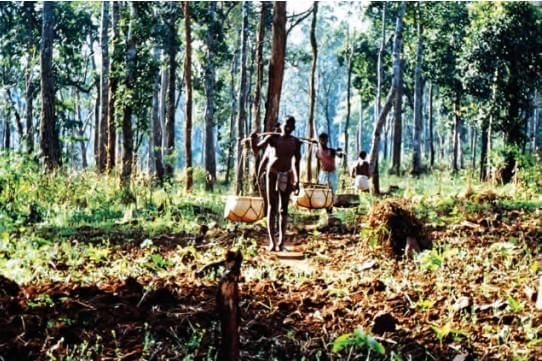 Bringing grain from the threshing grounds to the field.
How did Forest Rules Affect Cultivation?
- Shifting cultivation (also called swidden agriculture) is a traditional system practised in parts of Asia, Africa and South America.
- In this method, forest land is cut and burnt, and seeds are sown in the ash after the first monsoon rains; crops are harvested by October-November and the land is left fallow for 12-18 years to allow forest regeneration.
- Mixed crops are common: for example, millets in parts of central India, manioc in Brazil, maize and beans in Latin America.
- Local names include lading (Southeast Asia), milpa (Central America), chitemene/tavy (Africa), chena (Sri Lanka), and dhya, jhum, podu, kumri in India.
- British foresters disapproved of shifting cultivation because they believed it damaged forests and destroyed valuable timber resources. They also found it hard to collect taxes from lands that were used intermittently.
- As a result the colonial state banned or restricted shifting cultivation, leading to displacement of tribal and forest communities, loss of livelihoods and, in many areas, resistance and revolt.
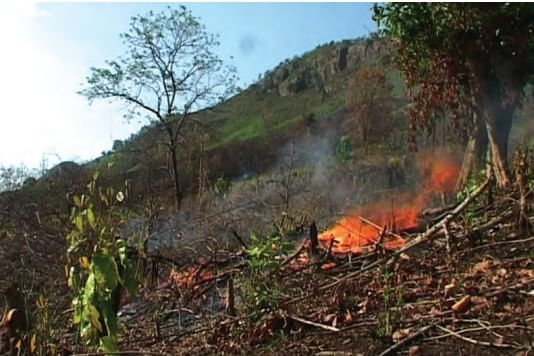 Burning the forest penda or podu plot.
- The ban on shifting cultivation forced many forest-dwelling communities to change occupations or migrate; some resisted through organised revolts.
Who could Hunt?
- Before colonial laws, people living near forests hunted wild animals like deer and birds for subsistence.
- After forest laws were introduced, hunting by local people was often banned and labelled poaching, punishable by law.
- At the same time, rulers, British officers and game hunters continued to hunt large animals as sport. Hunting on a large scale increased under colonial rule.
- The British often portrayed large wild animals as dangerous and used the language of "civilising" to justify their killing; rewards were given for killing animals that were said to threaten crops or life.
- Between 1875 and 1925 Colonial records show that tens of thousands of wild animals were killed during this period. Some rulers and officials claimed very large personal tallies: the Maharaja of Sarguja was said to have killed 1,157 tigers and 2,000 leopards by 1957; a British officer, George Yule, reportedly killed 400 tigers.
- Certain forests were reserved for hunting by rulers and officials while locals were prevented from exercising their traditional rights.
- Only later did conservationists argue for protection of wildlife rather than hunting them.
 The little fisherman
New Trades, New Employment and New Services
- When the forest department took control, many people lost traditional rights, but new opportunities also arose. Some communities adapted by trading forest products.
- These changes were global: for example in Brazil, the Mundurucu people moved from growing manioc to collecting latex from wild rubber trees to sell to traders; over time they became dependent on trading posts and traders.
- In India a long-standing trade in forest products existed in the medieval period; items included elephants, hides, horns, silk cocoons, ivory, bamboo, spices, gums and resins, often transported by nomadic traders such as the Banjaras.
- Under British rule, forest trade became tightly controlled: European companies were given exclusive rights to trade in particular forest areas, while local activities like grazing and hunting were restricted.
- Pastoral and nomadic groups such as the Korava, Karacha and Yerukula in parts of the Madras Presidency lost traditional livelihoods; some communities were labelled 'criminal tribes' and forced into factory, mine or plantation labour.
- New employment on plantations and in forest work often meant low wages, harsh working conditions and limited mobility. In Assam many tribal groups such as the Santhals, Oraons and Gonds were recruited as plantation labourers for tea estates under difficult conditions.
Rebellion in the Forest
- Across India and other colonised regions, forest communities resisted changes imposed by colonial forest policies. Many rebellions were led by local leaders who are remembered in songs and stories.
- Famous leaders include Siddhu and Kanu in the Santhal Parganas, Birsa Munda of Chhotanagpur, and Alluri Sitarama Raju of Andhra Pradesh.
- One major rebellion occurred in Bastar (present-day Chhattisgarh) in 1910.
The People of Bastar
- Bastar lies in the southern part of present-day Chhattisgarh and borders Andhra Pradesh, Odisha and Maharashtra. The central area of Bastar lies on a plateau with the Indrawati River flowing east-west through the region.
- The region is home to many communities including the Maria and Muria Gonds, Dhurwas, Bhatras and Halbas. These groups speak different languages but share many customs and beliefs.
- People in Bastar believe that land belongs to the Earth and is held in trust by each village. They honour the Earth in agricultural festivals and respect the spirits of rivers, forests and mountains.
- Villages had clearly known boundaries and local systems for sharing resources. If a family needed wood from another village's forest they paid a small fee known by names such as devsari, dand or man. Villages often hired watchmen and each household contributed grain to support forest protection activities.
- There was regular collective activity - for example an annual big hunt where village headmen from a pargana (a cluster of villages) met to discuss matters including forest rules.
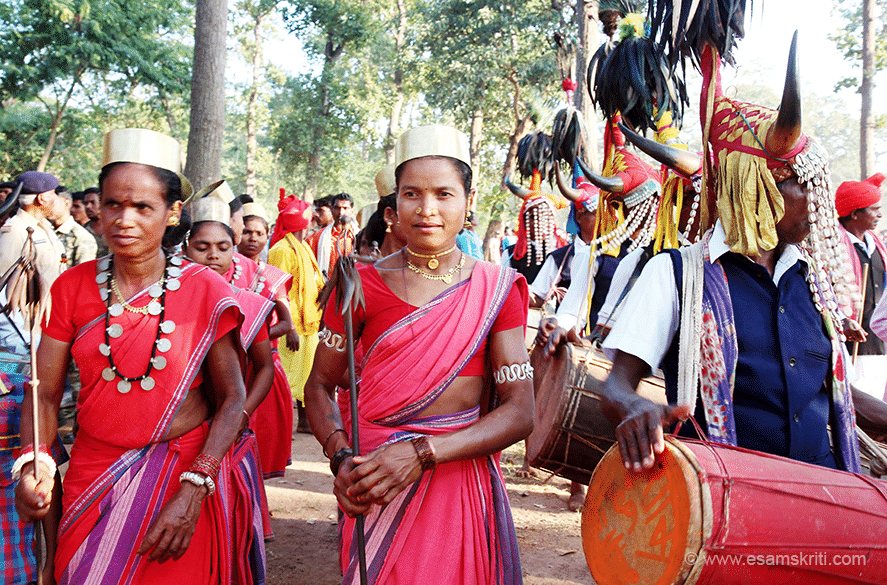 People of Bastar
The Fears of the People
- In 1905 colonial proposals suggested reserving two-thirds of the forest estate, which would stop shifting cultivation, hunting and collection of forest produce over large areas.
- Villages within proposed reserved forests were often required to provide labour to the forest department and some were converted into administrative forest villages; other villages were displaced without adequate compensation.
- Economic hardship was aggravated by rising land rents, demands for free labour and forced supplies, and by famines such as those in 1899-1900 and 1907-1908.
- Resistance in Bastar was led by figures such as Gunda Dhur. Villagers used symbolic items like mango boughs and arrows, looted bazaars, attacked colonial officials, redistributed grain and tried to block reservation work.
- The British responded by sending troops; reprisals included flogging and burning of villages. Gunda Dhur escaped capture and the rebellion temporarily halted reservation work and forced a reduction in the reserved area.
- After Independence, the practice of reserving forests for state or industrial use continued in many places. In the 1970s proposals to replace natural sal forests with plantation tropical pine for paper production were stopped only after large local protests.
- Similar conflicts over forest reservation and local resistance occurred in other parts of Asia, for example in Indonesia.
Forest Transformations in Java
- Java (part of present-day Indonesia) is now known for rice production but was once covered with extensive forests.
- The Dutch, colonial rulers in Indonesia, introduced forest control laws similar to those used by the British in India.
- Java was one of the first places where the Dutch implemented a formal system of forest management to secure timber for shipbuilding and other uses.
- Around 1600 Java's population was estimated at about 3.4 million. While many people lived in fertile plains, others in the hills practised shifting cultivation.
The Woodcutters of Java
- The Kalangs were a community in Java known for their skill in forest cutting and shifting cultivation. Their expertise in timber work made them important to the regional kingdoms.
- In 1755, when the Mataram kingdom split, some 6,000 Kalang families were divided between the two new kingdoms because of their economic and craft importance.
- They provided labour for harvesting teak and were important in palace construction.
- When the Dutch expanded control over the eighteenth and nineteenth centuries they tried to conscript the Kalangs into colonial service; the Kalangs resisted and revolts occurred, but were suppressed.
Dutch Scientific Forestry
- In the 19th century the Dutch shifted focus from merely controlling people to controlling forest territory itself, enacting laws that restricted villagers' access to forests.
- Wood could be cut only for specified purposes and only from designated forests under close supervision; villagers were punished for grazing cattle in regenerating areas or transporting wood without permits.
- Like the British, the Dutch created a forest service and used forests to supply timber for shipbuilding and railways.
- In 1882 some records show that around 280,000 sleepers were exported from Java in a single year. Such production required large amounts of labour for felling, transport and processing.
- The Dutch imposed rents on land cultivated in forests but sometimes exempted villages if they supplied free labour and buffaloes; this form of forced contribution was known as blandongdiensten. Later the Dutch replaced exemption systems with small wage payments but continued to limit cultivation rights in forest lands.
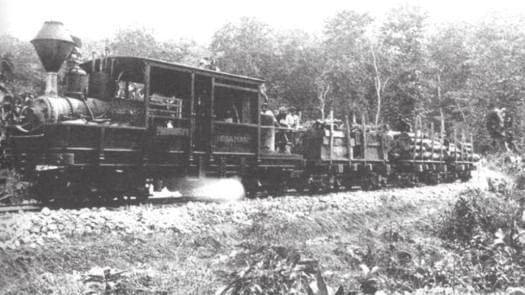 Train transporting teak out of the forest - late colonial period.
Samin's Challenge
- Around 1890 Surontiko Samin of Randublatung, a village in a teak area, questioned the state's right to claim ownership of natural resources like wind, water, earth and wood, arguing that the state had not created them.
- Samin's ideas inspired a movement: by 1907 an estimated 3,000 families were following his philosophy and protesting colonial surveys and claims by peaceful obstruction, such as lying on the land when officials came to survey it.
War and Deforestation
- The First and Second World Wars greatly increased demand for timber and wood products.
- In India many forest working plans were temporarily abandoned during the world wars and the forest departments cut trees freely to meet immediate wartime needs.
- In Java, before the Japanese occupation in World War II, the Dutch followed a scorched earth policy in some areas: destroying sawmills and burning teak log piles to prevent supplies from falling into Japanese hands.
- After the Japanese occupation began, forests were heavily exploited for Japanese war industry; forest villagers were often forced to cut trees and work for the occupiers.
- Many villagers used the wartime disruption to clear more land for cultivation, making post-war reclamation and forest recovery difficult for later forest administrations.
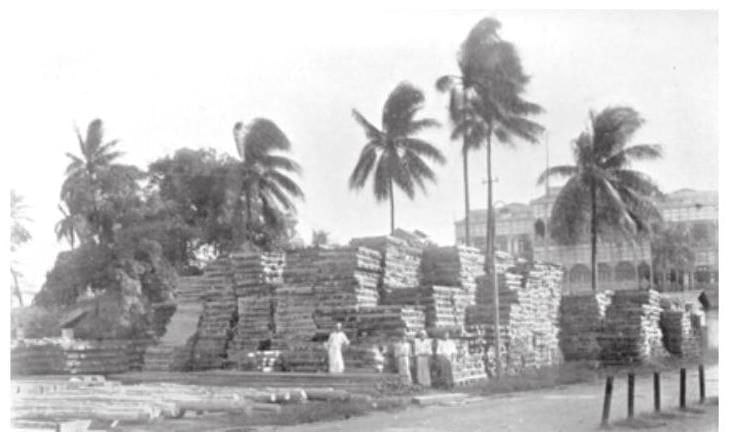 Indian Munitions Board, War Timber Sleepers piled at Soolay pagoda ready for shipment,1917.
New Developments in Forestry
- Since about the 1980s many governments and forest managers in Asia and Africa have recognised that exclusive, top-down scientific forestry often produced conflict with local communities and failed to protect forest ecosystems effectively.
- Conservation objectives have increasingly gained importance alongside timber production, shifting policy towards protecting biodiversity, watersheds and local livelihoods.
- Governments and NGOs now recognise that the participation of people living near forests is essential for sustainable forest management.
- In India, dense patches of forest have survived because local communities protected them as sacred groves (for example sarnas, devarakudu, kan, rai and others).
- Some villages have local systems of forest management in which community members take turns patrolling forests and enforcing rules rather than relying solely on state forest guards.
- Current approaches explore joint management models, community forestry, and forms of legal recognition of community rights as ways to balance conservation and livelihood needs.
Try yourself: The Kalangs resisted the Dutch in
Key Terms
- Colonialism - The policy of acquiring and maintaining colonies, typically for economic exploitation.
- Deforestation - The action of clearing a wide area of trees.
- Exploitation - The action of making use of and benefiting from resources.
- Ecological - Relating to or concerned with the relation of living organisms to one another and to their physical surroundings.
- Monopoly - The exclusive possession or control of the supply or trade in a commodity or service.
- Surplus - An amount of something left over when requirements have been met.
- Displacement - The forced movement of people from their locality or environment.
- Indentured - Bound by a formal agreement to work for a specific period in exchange for passage to a new country.
- Commercial - Concerned with or engaged in commerce.
- Subordination - The action or state of being lower in rank or position.
- Revenues - Income generated from normal business operations.
- Bureaucracy - A system of government in which most of the important decisions are made by state officials rather than by elected representatives.
- Cultivation - The action of cultivating land or crops.
- Incentives - Things that motivate or encourage someone to do something.
- Epidemics - Widespread occurrences of infectious diseases in a community at a particular time.
- Eviction - The action of expelling someone from a property.
- Prohibited - Formally forbidden by law, rule, or other authority.
FAQs on Detailed Chapter Notes - Forest Society and Colonialism
| 1. Why did the British colonial government ban shifting cultivation and jhum farming in forests? |  |
| 2. What was the main impact of the Forest Act of 1878 on tribal and forest-dependent communities in India? | |
| 3. How did deforestation during British rule affect the relationship between forest societies and the colonial administration? | |
| 4. What were the reasons behind forest revolts like the Chero and Munda rebellions during colonialism? | |
| 5. How did the colonial Forest Department's priorities differ from the needs of forest-dependent societies? | |





