Detailed Chapter Notes - Natural Vegetation and Wildlife

Introduction
India is one of the twelve mega biodiversity countries of the world. With about 47,000 plant species, India occupies tenth place in the world and fourth in Asia in plant diversity.
- There are about 15,000 flowering plants in India which account for 6 percent of the world's total number of flowering plants. The country has many non-flowering plants such as ferns, algae, and fungi.
- India also has 90,000 species of animals, as well as a rich variety of fish in its fresh and marine waters.
What is Natural Vegetation?
Natural Vegetation refers to a plant community that has grown naturally without human aid and has been left undisturbed by humans for a long time. This is also termed virgin vegetation.
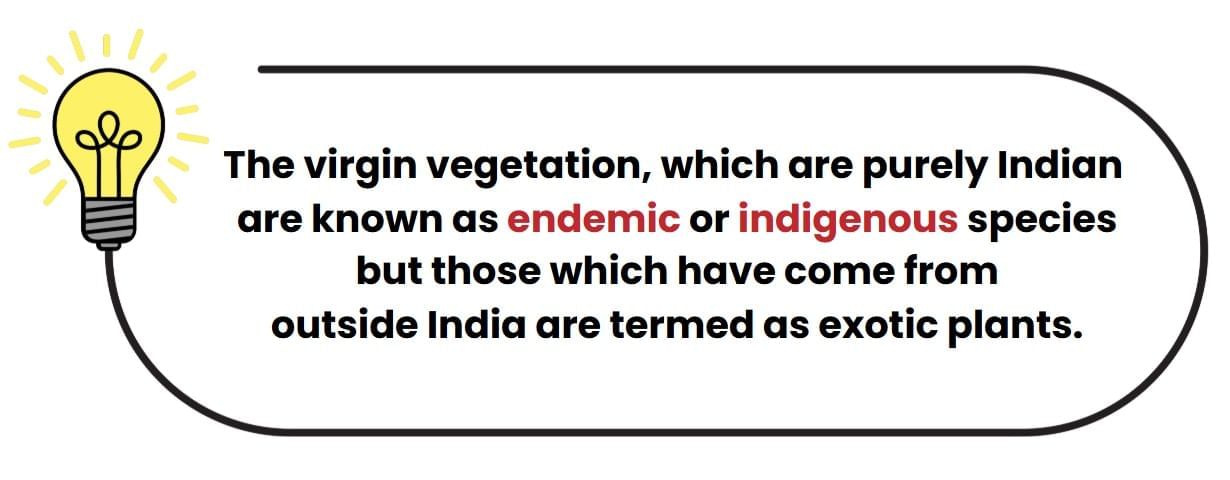
- Flora: The term flora is used to denote plants of a particular region or period.
- Fauna: The species of animals are referred to as fauna.
Try yourself: Which term is used for the original plant cover of an area which has grown naturally?
Types of Vegetation
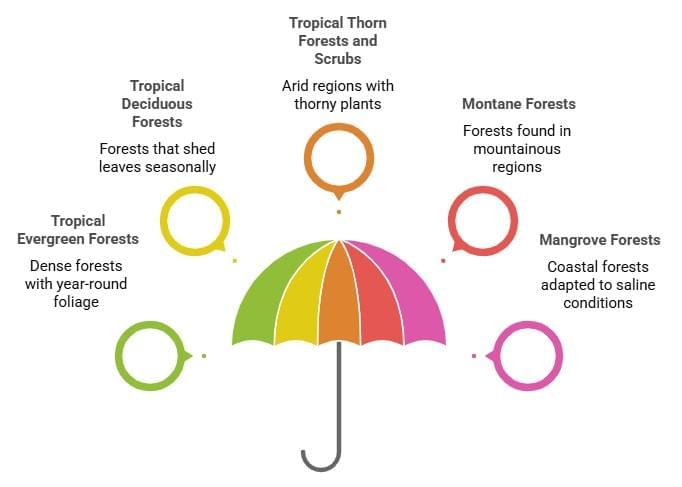
India's diverse climate and geography support a wide variety of vegetation types, ranging from tropical rainforests to desert shrubs, reflecting the country's rich ecological diversity.
Let's discuss the Types of Vegetation in India in detail below:
 Types of Vegetation
Tropical Evergreen Forests
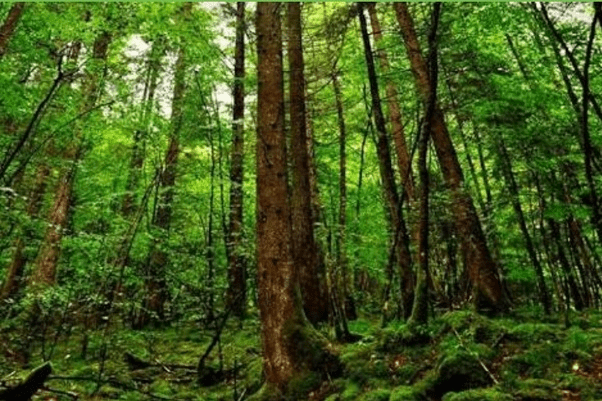
- Found in: Western Ghats, Andaman & Nicobar Islands, Lakshadweep, upper Assam, and parts of the Tamil Nadu coast.
- Rainfall: Above 200 cm, short dry season.
- Features:
- Trees grow up to 60 metres or more.
- No specific leaf-shedding season; remains green year-round.
- Multilayered vegetation: trees, shrubs, and creepers.
 Tropical Evergreen Forest
- These forests yield hardwood trees.
- Ebony, Mahogany, Rosewood, Rubber, and Cinchona are some of the important trees.
- In these forests, a large number of plant species are found in one place. It creates difficulty in their commercial exploitation.
- Elephants, monkeys, lemur, and deer are some common animals found in these forests.
Tropical Deciduous Forests
- These are the most widespread forests of India.
- They are also called the monsoon forests and spread over the region, receiving rainfall between 200 cm and 70 cm.
- Trees of this forest type shed their leaves for about six to eight weeks in dry summer.
Based on the availability of water, these forests are further divided into: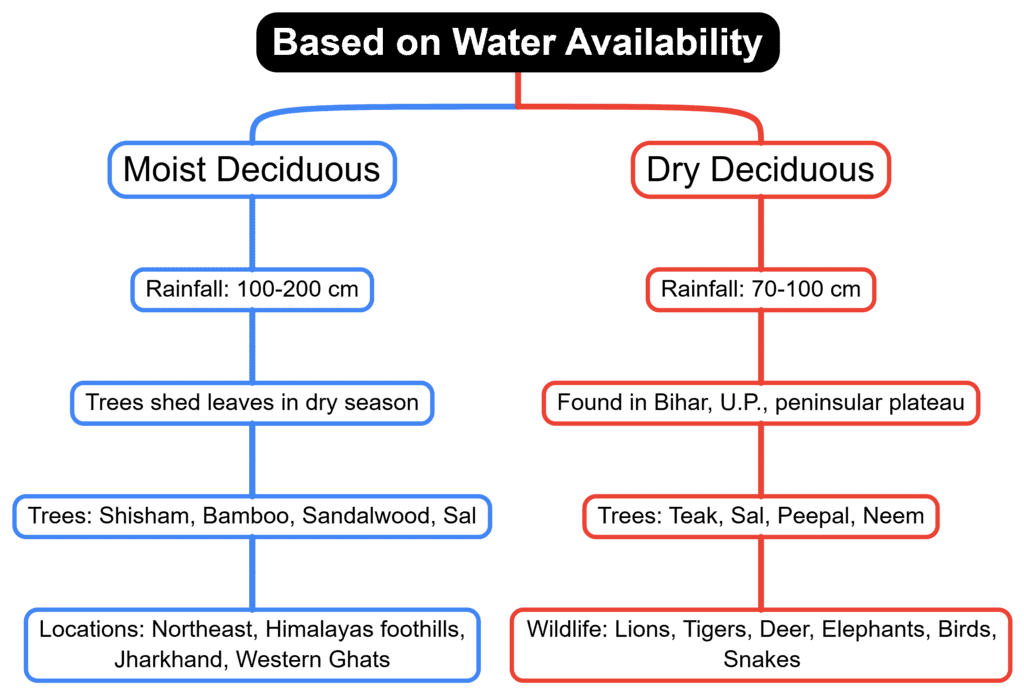 (a) Moist Deciduous
- These forests are found in areas of 100 cm to 200 cm of rainfall.
- Due to the long dry period, the trees shed their leaves.
- Shisham, Bamboo, Sandalwood, Khair, Kusum, Arjun, Mulberry, and Sal are the common trees found in these forests.
- These forests cover a vast area of the country. Northeastern states, along the foothills of the Himalayas, Jharkhand, West Odisha, and Chhattisgarh, and on the Eastern slopes of the Western Ghats.
(b) Dry Deciduous
- These are found in areas having rainfall between 70 cm to 100 cm.
- These are found in the rainier part of the peninsular plateau and the plains of Bihar and U.P.
- These are open stretches in which Teak, Sal, Peepal, and Neem grow.
- Most of these forests have been cleared for cultivation.
- In these forests, the common animals found are lions, tigers, pigs, deer, and elephants. A huge variety of birds, lizards, snakes, and tortoises are also found here.
The Thorn Forests and Shrubs
- Tropical thorn forests occur in areas that receive rainfall of less than 70 cm.
- These consist of a variety of grasses and shrubs.
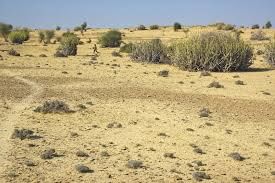 Thorn Forest and Shrubs
 - It includes semi-arid areas of Punjab, Haryana, Rajasthan, Gujarat, Madhya Pradesh, and Uttar Pradesh.
- In these forests, plants remain leafless for the most part of the year and give an expression of shrub vegetation.
- Important species found are babul and wild Date palm, Kikar, Neem, Khejri, Palas, etc.
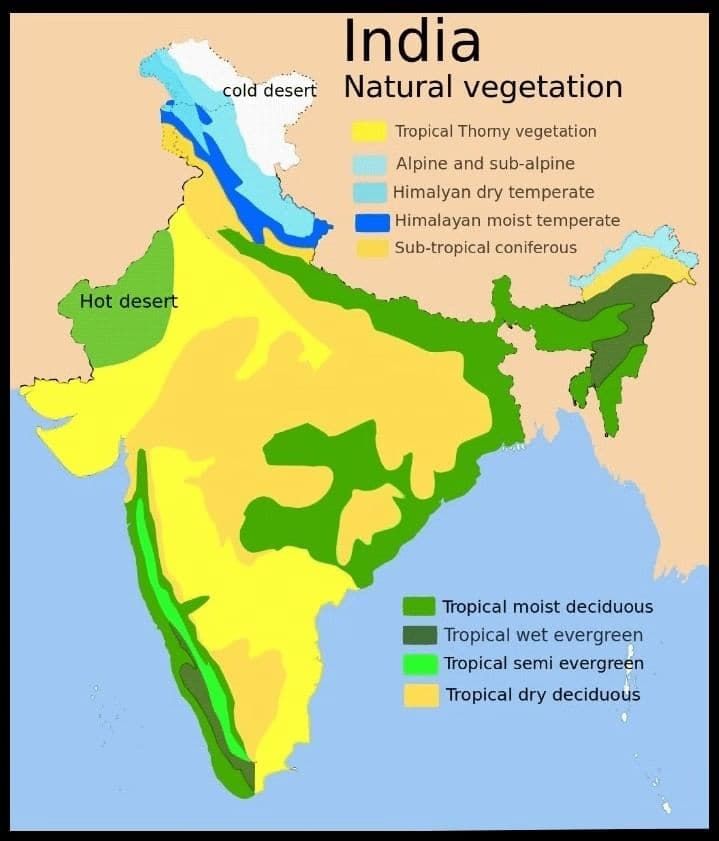 Natural Vegetation in India
Montane Forests
In mountainous areas, the decrease in temperature with increasing altitude leads to the corresponding change in natural vegetation:
- The wet temperate type of forest is between a height of 1000 and 2000 meters. Evergreen broad-leaf trees such as oaks and chestnuts predominate.
- Between 1500 and 3000 meters, temperate forests containing coniferous trees like pine, deodar, silver fir, spruce, and cedar are found. These forests cover mostly the Himalayas' southern slopes, places with high altitudes in southern and northeast India. At higher elevations, temperate grasslands are common.
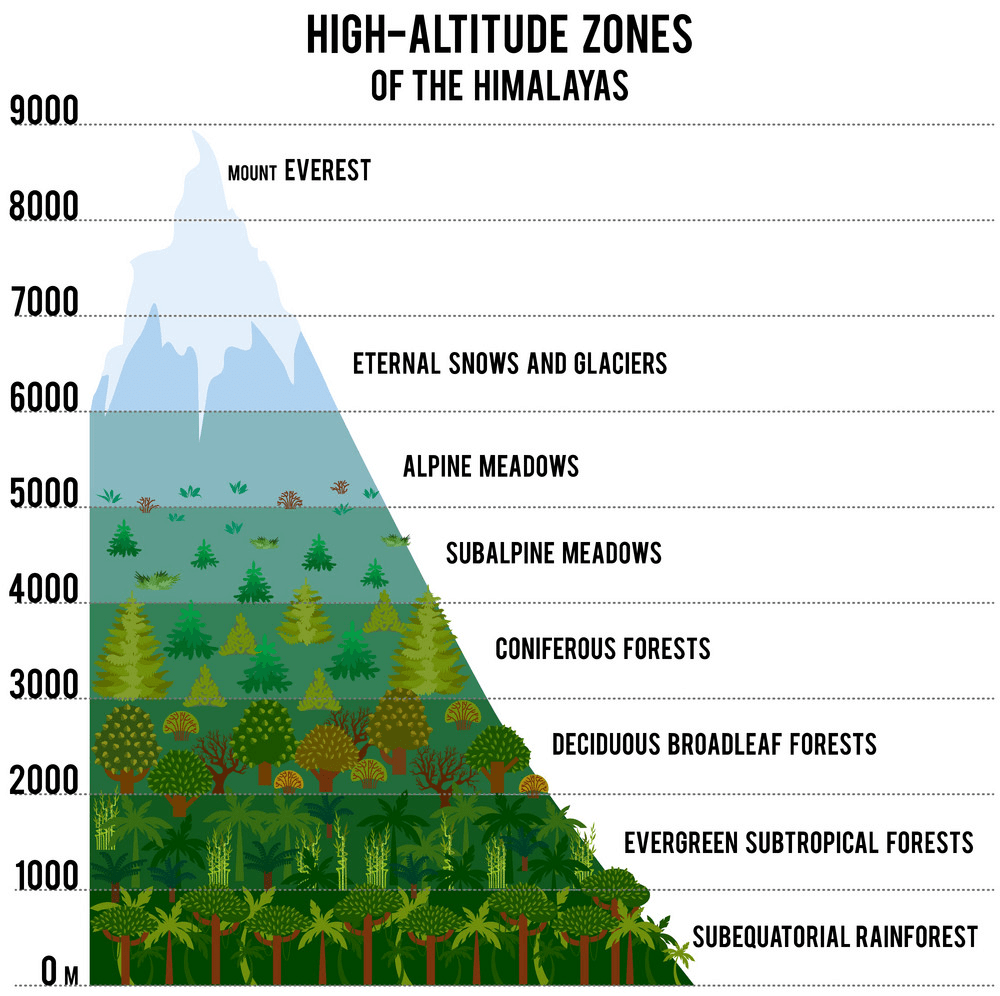 Distribution of Mountain Forest
 - At high altitudes, generally more than 3600 meters above sea level, temperate forests and grasslands give way to the Alpine vegetation. Silver fir, junipers, pines, and birches are the common trees of these forests.
- Above the Alpine vegetation, Alpine grasslands are found. These are used extensively for grazing by nomadic tribes like the Gujjars and the Bakarwals. At higher altitudes, mosses and lichens form part of tundra vegetation.
- The common animals found in these forests are Kashmir stag, spotted deer, wild sheep, jackrabbit, Tibetan antelope, yak, snow leopard, squirrels, shaggy horned wild ibex, deer, and rare red panda, sheep, and goats with thick hair.
Try yourself: Why is the southern slopes in Himalayan region covered with thick vegetation?
Mangrove Forests
- These are found in the areas that are under the influence of tides, having accumulated mud and silt.
- Dense mangroves are the common varieties with roots of plants submerged underwater.
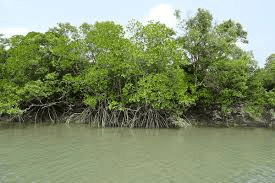 Mangrove Forest
 - These forests are found in the deltas of the Ganga, Mahanadi, Godavari, and Kaveri.
- The most important tree is the Sundari tree, after which the Sunderbans are named.
- The tree provides hard, durable, and strong wood.
- Royal Bengal Tiger is a famous animal in these forests. Turtles, crocodiles, gharials, and snakes are also found in these forests.
Medicinal Plants
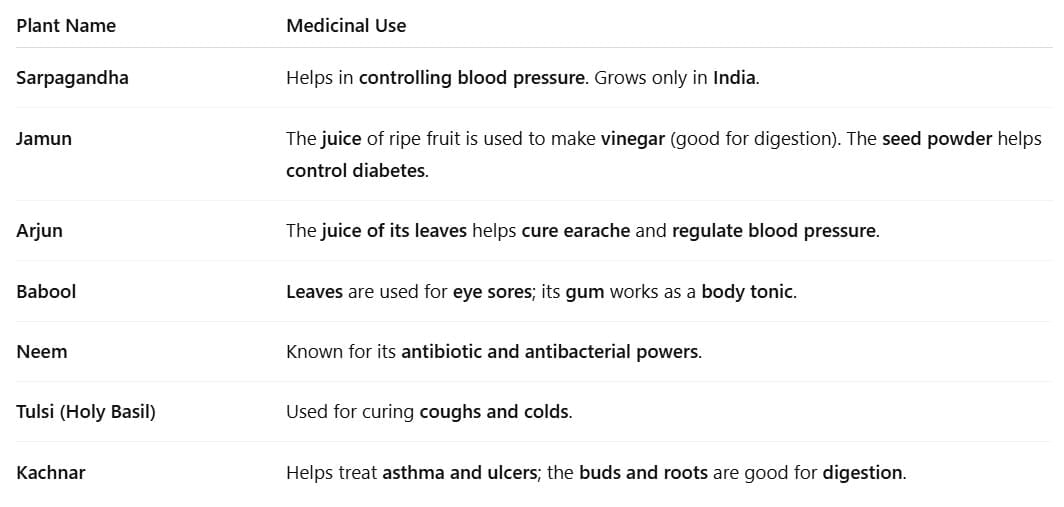
- India's Rich Heritage: Known for herbs and spices from ancient times. Around 2,000 plants have been described in Ayurveda, with at least 500 in regular use.
- Conservation Concern: The World Conservation Union's Red List identifies 352 medicinal plants as threatened, of which 52 are critically threatened and 49 are endangered.
Common Medicinal Plants and Their Uses:
Try yourself: Ebony, mahogany and rosewood trees are grown in which type of the forests?
Wildlife
- India has a diverse and rich wildlife with approximately 90,000 animal species.
- The country is home to around 2,000 species of birds, accounting for 13% of the world's total.
- India also has a significant number of fish species, with 2,546 types, which make up a considerable portion of the world's fish population.
- The country shares 5 to 8% of the world's amphibians, reptiles, and mammals.
Biodiversity in India
India is home to an incredibly rich and diverse array of flora and fauna, making it one of the world's most biodiverse countries, with habitats ranging from tropical forests to arid deserts and high-altitude regions like the Himalayas.
- Elephants thrive in the hot and wet forests of Assam, Karnataka, and Kerala.
- One-horned rhinoceroses inhabit swampy and marshy lands in Assam and West Bengal.
- Wild ass and camels are native to the arid regions of the Rann of Kachchh and the Thar Desert, respectively.
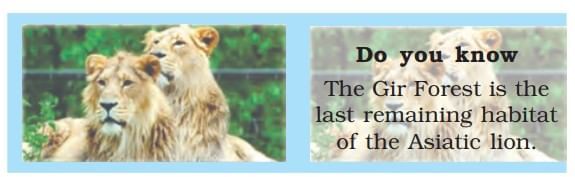
- Indian bison, nilgai (blue bull), chousingha (four-horned antelope), gazelle, various species of deer, and different types of monkeys are found across India. Indian lions are found in the Gir forest of Gujarat.
- Tigers inhabit the forests of Madhya Pradesh, the Sundarbans in West Bengal, and the Himalayan region.
- Leopards, important members of the cat family, are widespread predators in India.
- Crops in India have been selected from the rich biodiversity, including both edible and medicinal plants.
- Animals have been domesticated from nature, providing draft power, transportation, meat, and other resources.
- Fish serve as a nutritious food source, while insects play vital roles in pollination and the biological control of crops.
Wildlife Conservation in India
- Conservation is essential as the ecosystem has been disturbed due to excessive exploitation of plant and animal resources.
- Around 1,300 plant species and some animal species are endangered or extinct.
- The main causes of this threat to nature are hunting for commercial purposes, pollution from chemical and industrial waste, the introduction of alien species, and deforestation for cultivation and habitation.
- The government has implemented various measures to protect the flora and fauna of the country.
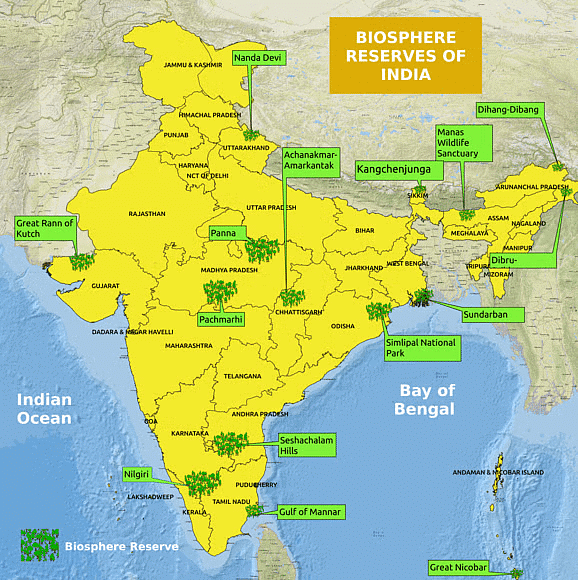
- Eighteen biosphere reserves have been established, including the Sundarbans, Nanda Devi, Gulf of Mannar, Nilgiri, Nokrek, Great Nicobar, Simlipal, Pachmarhi, Achanakmar-Amarkantak, Agasthyamalai, Kangchendzonga, and Panna. These reserves are also included in the world network of biosphere reserves.
- The government has provided financial and technical assistance to several botanical gardens since 1992.
- Initiatives like Project Tiger, Project Rhino, Project Great Indian Bustard, and other eco-developmental projects have been introduced.
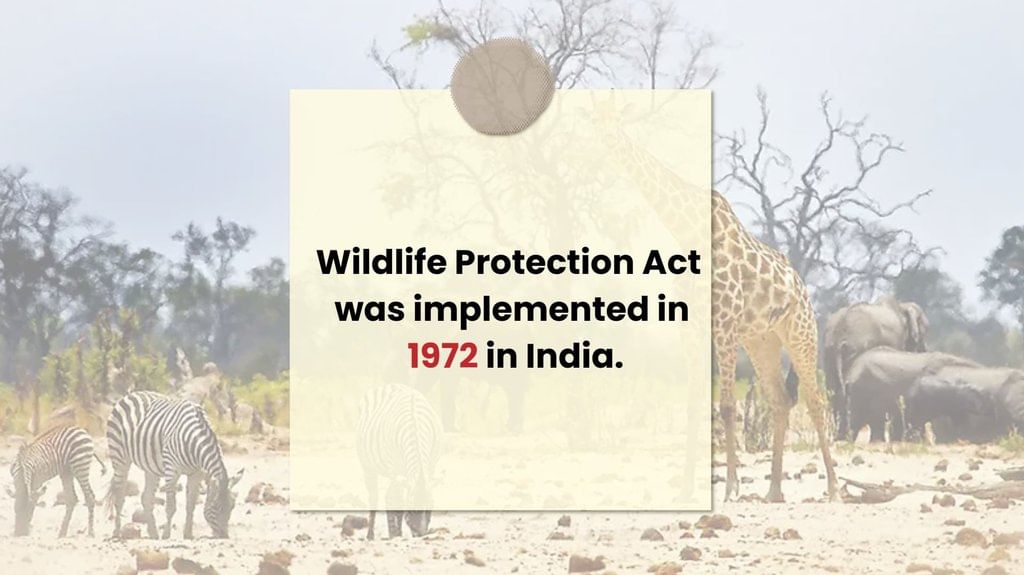
- The country has 106 National Parks, 573 Wildlife Sanctuaries, and Zoological Gardens to preserve the natural heritage.
- It is crucial for everyone to understand the importance of the natural ecosystem for our survival.
- Immediate action is required to prevent the destruction of the natural environment.
Try yourself: Which one of the following bio-reserves of India is not included in the world network of bio-reserve?
Difficult Words
- Conserving - Protecting from loss or harm; preserving.
- Vegetation - Plants considered collectively, especially those found in a particular area or habitat.
- Ecological Balance - A stable state in which natural communities of organisms interact with their environment.
- Species - A group of living organisms consisting of similar individuals capable of exchanging genes or interbreeding.
- Habitats - The natural environment in which an organism lives.
- Biodiversity - The variety of plant and animal life in a particular habitat or the world as a whole.
- Conservation - The action of conserving something, especially the environment.
FAQs on Detailed Chapter Notes - Natural Vegetation and Wildlife
| 1. What are the different types of natural vegetation found in India and how do they differ? |  |
| 2. Why does wildlife distribution vary across different forest types in India? | |
| 3. What is the relationship between natural vegetation and soil types in different regions? | |
| 4. How do human activities threaten natural vegetation and wildlife in CBSE Class 9 Social Studies? | |
| 5. What are the main characteristics of tropical deciduous forests and the animals found there? | |





