Introduction - Improvement in Food Resources


All living organisms require food for growth and survival. Food provides carbohydrates, proteins, fats, vitamins and minerals. The two major sources of food are plants and animals, obtained through agriculture and animal husbandry. Increasing human population has placed greater demand on food production; therefore, both the area under cultivation and the productivity per unit area are important. Productivity can be raised by improving crop varieties and breeds, adopting better agronomic and managerial practices (pre- and post-harvest), and using sustainable methods that conserve the environment and maintain ecological balance.
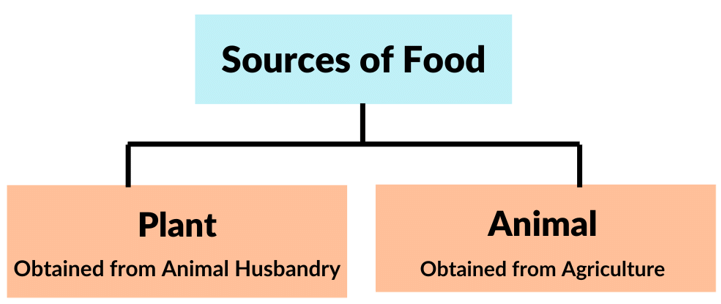
- Due to the tremendous increase in the human population, the demand for food and shelter has also increased.
- Higher grain output can be achieved by bringing more land under cultivation or by increasing the production efficiency of plants and animals. An increase in production can be brought about by the development and use of improved varieties with higher yield and by better managerial practices (both pre- and post-harvest).
- It is important that food production should be increased without degrading our environment and disturbing the natural balance. This is possible through genetic improvement of crop plants, improved breeds of domesticated animals, and by adopting sustainable agricultural and animal-husbandry practices.
Different Types of Crops
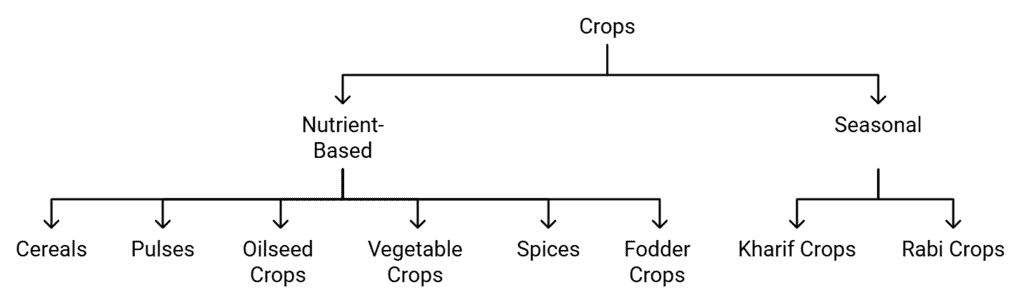 Types of Crop
A. On the basis of the nutrients they provide
(i) Cereals: These are rich in carbohydrates and provide energy.
Examples: Rice, wheat, maize, sorghum, barley, millets.
(ii) Pulses: These are rich in protein and are important for body-building.
Examples: Gram, moong, pea, lentil, pigeon pea (tur).
(iii) Oilseed crops: These are rich in oils (fats) and provide essential fatty acids.
Examples: Groundnut, sunflower, soybean, mustard, sesame.
(iv) Vegetable crops: These supply vitamins, minerals and small amounts of carbohydrate and protein. Vegetables may be classified by the edible part:
- Leaves: cabbage, spinach, Trigonella (fenugreek), lettuce
- Roots and tubers: carrot, radish, turnip, sweet potato
- Stems and storage organs: potato, corms, rhizomes (ginger)
- Bulbs: onion, garlic
- Fruits (botanical fruits used as vegetables): tomato, brinjal, gourds, cucumber
- Flowers: cauliflower
(v) Spices: Used to flavour and preserve food; they also have medicinal properties.
Examples: Chilli, black pepper, ginger, turmeric.
(vi) Fodder crops: Grown to feed livestock and are important for animal husbandry.
Examples: Berseem, sorghum, maize (as green fodder), oat, sudangrass, alfalfa.
B. On the basis of the season in which they are grown
(i) Kharif crops: Sown with the onset of monsoon and harvested in autumn. They grow during the rainy season (roughly June to October).
Examples: Paddy, soybean, arhar (pigeon pea), maize, cotton, urad, moong.
(i) Rabi crops: Sown in winter and harvested in spring. They grow during the winter season (roughly November to April).
Examples: Wheat, gram, peas, mustard, linseed.
Methods Used to Obtain a Higher Yield from Farmland
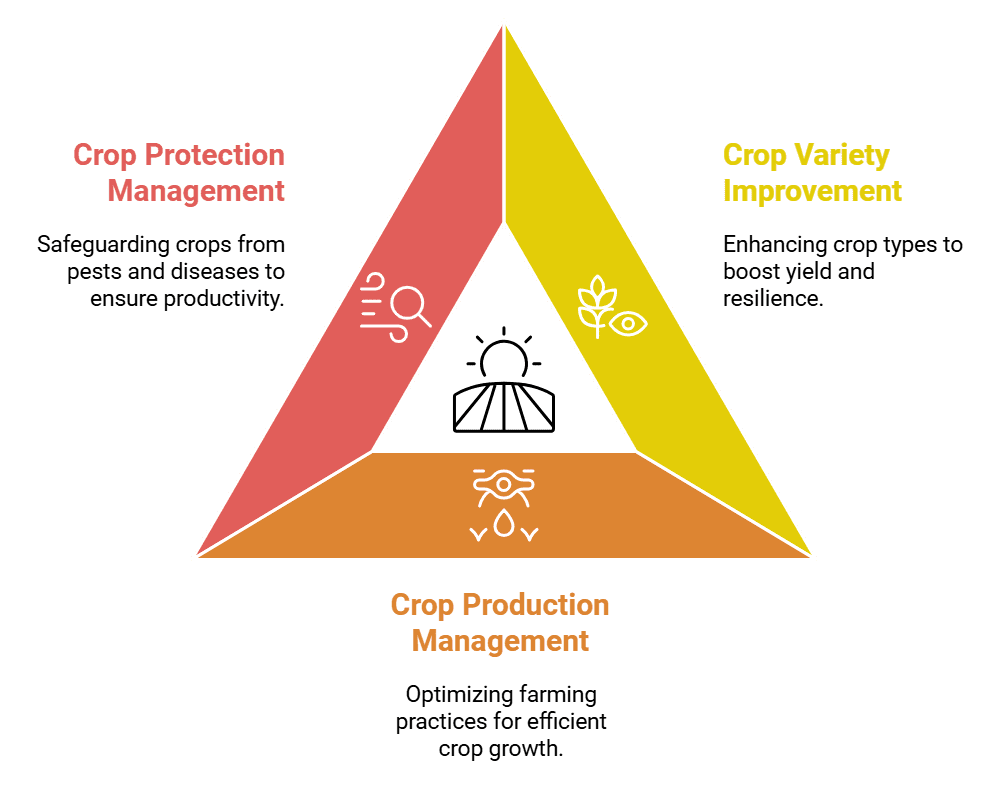
Crop Variety Improvement
Improving the genetic potential of crop varieties is the first and most important step to increase yield. Crop-variety improvement aims to develop varieties with the following characteristics:
- Higher yield.
- Better quality (grain quality, nutritional value).
- Resistance to biotic stresses (diseases, insects, pests) and abiotic stresses (drought, salinity, extreme temperatures).
- Desirable agronomic characters such as dwarfness, intensive branching, increased tillering and better response to fertilisers.
- Wider adaptability to stabilise production under varying climatic conditions.
- Early maturity (ripening) to escape adverse weather and allow multiple cropping.
- Better responsiveness to fertilisers and management practices.
Crop varieties are improved by plant breeding. Two common approaches in plant breeding are selection and hybridisation. Selection involves choosing the best plants from an existing population and propagating them. Hybridisation involves crossing two genetically different plants to combine desirable traits; in some cases this produces hybrid vigour (heterosis), resulting in higher yield.
Crop Production Management
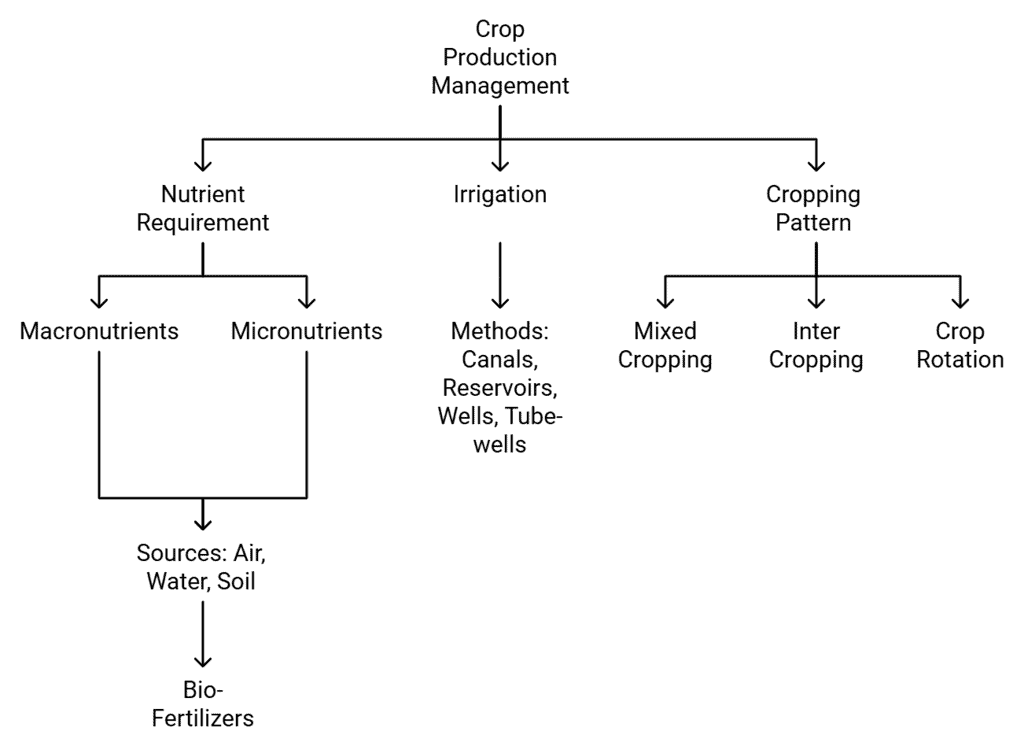
(i) Nutrient requirement
Plants require a range of elements for healthy growth. These are classified as:
- Macronutrients: Needed in large amounts. Examples: N, P, K, Ca, Mg, S.
- Micronutrients: Needed in trace amounts. Examples: Fe, Cu, Zn, B, Mo, Cl, Mn.
Sources of plant nutrients:
- Air: carbon and oxygen (used for photosynthesis and respiration)
- Water: hydrogen
- Soil: supply of N, P, K, Ca, Mg, S and micronutrients such as Fe, Mn, B, Zn, Mo, Cl
The most important nutrients often limiting plant growth are N, P and K (commonly referred to as NPK).
Fertilisers are substances added to soil to supply nutrients. They may be chemical (inorganic) fertilisers or organic manures. Balanced and judicious use of fertilisers increases yield but overuse can harm soil and environment.
Biofertilisers: Living organisms that enrich soil fertility by fixing atmospheric nitrogen or mobilising soil nutrients. Examples: Anabaena, Nostoc, Rhizobium, blue-green algae, Azolla. Biofertilisers reduce dependence on chemical fertilisers and help maintain soil health.
(ii) Irrigation
Irrigation is the method of supplying water to crops through canals, wells, tube-wells, tanks, and other means.
(iii) Cropping pattern
Choosing the right cropping pattern increases productivity and resource use efficiency. Common practices are:
- Mixed cropping: Growing two or more crops simultaneously on the same piece of land (e.g., mixed cultivation of radish and carrot).
- Intercropping: Growing two or more crops in an organised manner so that they benefit each other (e.g., maize + legume intercropping improves overall yield and soil fertility).
- Crop rotation: Growing different crops in succession on the same land across seasons/years to maintain soil fertility and reduce pests and diseases (e.g., cereal followed by legume).
Crop Protection Management
Crop protection covers measures to protect both growing and harvested crops from weeds, pests, insects and diseases. Management practices include:
- Growing resistant or tolerant crop varieties.
- Optimum time of sowing to avoid peak pest periods.
- Crop rotation and suitable cropping systems to interrupt pest life cycles.
- Deep summer ploughing to expose and kill insects, eggs and weeds.
- Use of biological control agents (predators, parasites and pathogens of pests).
- Judicious use of chemical pesticides when necessary, following recommended doses and safety precautions.
Organic Farming
Organic farming avoids the use of synthetic chemical fertilisers and pesticides. It relies on natural methods to maintain soil fertility and control pests. Key practices include:
- Crop rotation and mixed cropping to maintain soil health and reduce pest buildup.
- Green manuring: growing and ploughing in legumes or other plants to add organic matter and nitrogen to the soil.
- Composting and use of animal manure to supply nutrients and improve soil structure.
- Biological pest control and use of botanicals (plant-based extracts) to manage pests.
Organic farming helps conserve biodiversity, improves soil fertility and reduces chemical residues in food and environment, although it may need careful management to match the yields of intensive chemical agriculture.
Animal Husbandry
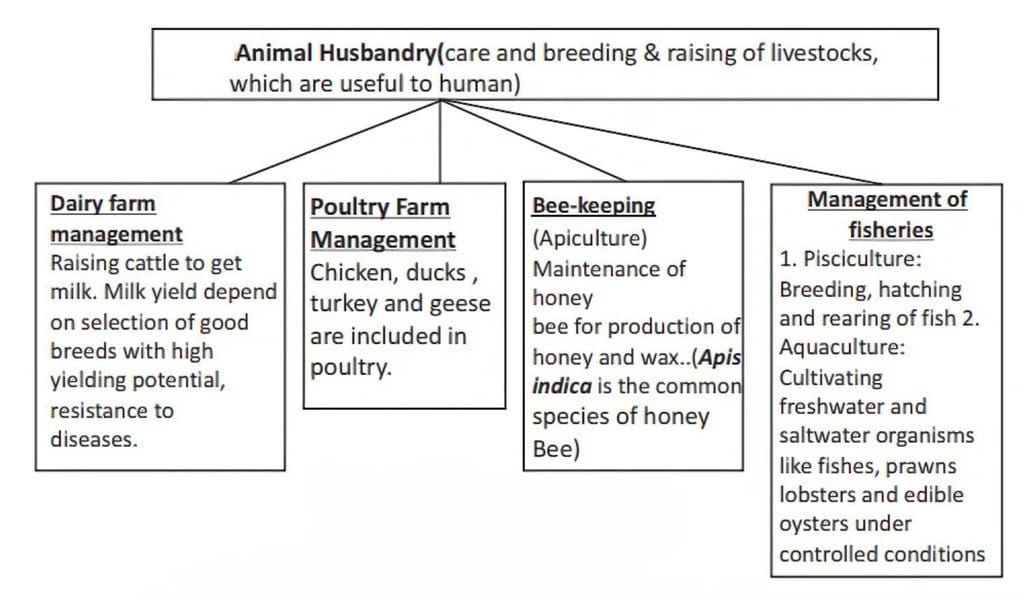
Animal husbandry is the care and breeding of domesticated animals for food, labour and other products. It is an important supplement to crop production and helps meet the demand for milk, meat, eggs, wool and hides. Important aspects include:
- Breed improvement: Selecting and breeding animals with higher productivity (milk yield, meat or egg production) and disease resistance.
- Feeding and nutrition: Providing balanced rations, quality fodder and concentrates suitable for the species and age.
- Housing and management: Proper shelter, hygiene, ventilation and space for animals to reduce stress and disease incidence.
- Health care: Regular vaccination, deworming and timely treatment of diseases; quarantine of new animals to prevent spread of infection.
- Dairy farming: Management of cows and buffaloes for milk production, and methods to improve milk quality and yield.
- Poultry farming: Rearing chickens and other birds for eggs and meat using improved breeds and management practices.
- Other enterprises: Beekeeping (apiculture), rabbitry, sheep and goat rearing, and pisciculture (fish farming) provide additional food and income.
FAQs on Introduction - Improvement in Food Resources
| 1. What are the different types of crops? |  |
| 2. How does crop variety improvement benefit agriculture? | |
| 3. What is crop production management? | |
| 4. What are the key practices in crop protection management? | |
| 5. What are the principles of organic farming? | |





