Important Notes: Order and Ranking

Order and ranking problems require determining the positions or ranks of people or objects arranged in a line, row, queue, or list. These problems commonly ask for a person's rank measured from one end, conversion of a rank from one end to the other, the total number in the row, the number of persons between two given persons, or positions after interchanges. Such problems appear frequently in competitive and scholastic aptitude tests because they test careful reading, positional reasoning and simple arithmetic.
Common questions asked in Exam
- The total number of persons and the position (rank) of a person from one side (left or right) are given; find the position from the other side.
- Positions of more than one person are given; ask for the number of persons between them or the total number in the row.
- Overlapping and non-overlapping conditions when ranks from both sides are given for one or two persons.
- Ordering by some attribute (age, height, marks) and asking for relative ranks in ascending/descending order.
Formulas
- Convert a rank from one side to the other:
If a person is rgiven from one end in a row of N persons, then the rank from the other end is \(N - (r_{\text{given}} - 1)\).
- Total when rank from both sides for the same person is given:
If a person's rank is R1 from the left and R2 from the right, then total number of persons is \(R_1 + R_2 - 1\).
- Total when ranks of two persons and the number between them are given (miscellaneous cases):
Let two persons have ranks R1 and R2 measured from the same fixed side, and suppose the number of persons between them is m. Two useful relations are:
(a) If positions R1 and R2 refer to two ends of a contiguous block and count is consistent without overlap, total can be estimated by \(R_1 + R_2 + m\) depending on context.
(b) For overlapping cases (when counts overlap), use \(R_1 + R_2 - (m + 2)\). Apply (b) only when the overlapping condition holds (see Overlapping vs Not overlapping below).
- Number of persons between two persons:
(a) Simple case (when N, total, is known): \( \text{Between} = N - (r_{\text{left}} + r_{\text{right}}) \).
(b) Overlapping case: \( \text{Between} = (r_{\text{left}} + r_{\text{right}}) - (N + 2) \).
- Rank of the middle person (quick trick):
To find the rank of the person exactly midway between two given ranks (measured from the same side), convert both ranks to the same side and take their average. The average gives the position of the middle person (if the number of persons between is odd so a unique middle exists).
Shortcut for maximum and minimum possible numbers in a row:
Preserved figure below illustrates the quick method to estimate maximum and minimum counts given partial ranks.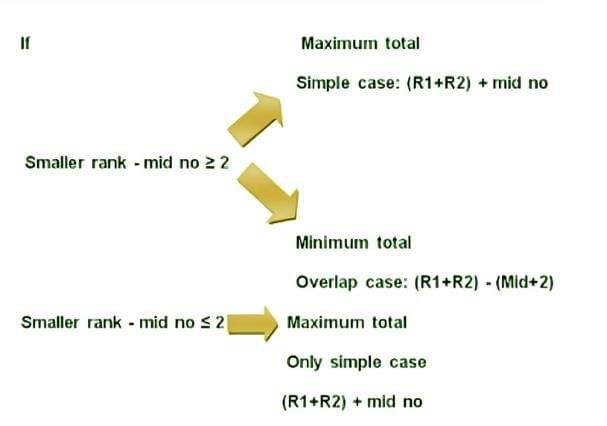
Note: "Mid no." refers to the number of the middle person when counting positions symmetrically around the centre.
Overlapping vs Not overlapping
- Overlapping case: When (left rank + right rank) > total number of persons. Here ranks from both sides refer to positions that cross each other and special adjustments (subtracting overlaps) are required.
- Not overlapping case: When total number of persons > (left rank + right rank). The ranks lie on different non-overlapping segments and direct subtraction formulas are used.
Solved Examples
Example 1: In a queue, Vijay is fourteenth from the front and Jack is seventeenth from the end, while Mary is exactly at the middle of Vijay and Jack. If Vijay be ahead of Jack and there be 48 persons in the queue, how many persons are there between Vijay and Mary?(a) 5
(b) 6
(c) 7
(d) 8
(e) None of these
Ans: (d)
Explanation: Number of persons between Vijay and Jack = 48 - (14 + 17) = 17.
Mary lies in the middle of these 17 persons, so Mary is at the 9th position counting from one end of that block.
Number of persons between Vijay and Mary = 9 - 1 = 8.
Example 2: Kunal ranked sixteenth from the top and twenty-ninth from the bottom among those who passed an examination. Six boys did not participate in the competition, and five failed in it. How many boys were there in the class?
(a) 35
(b) 45
(c) 50
(d) 55
(e) None of these
Ans: (d)
Explanation: Total students who passed = 16 + 29 - 1 = 44.
Total boys in class = Passed + Failed + Not participated = 44 + 5 + 6 = 55.
Example 3: In a queue of children, Ajay is fifth from the left and Sunil is sixth from the right. When they interchange their places among themselves, Ajay becomes thirteenth from the left. Then, what will be Sunil's position from the right?
(a) 8th
(b) 14th
(c) 15th
(d) 16th
(e) None of these
Ans: (b)
Explanation: After interchange Ajay's new position (13th from left) equals Sunil's earlier position (6th from right).
Number of children in the queue = 13 + 6 - 1 = 18.
Sunil's new position equals Ajay's earlier position, i.e., 5th from left.
Sunil's position from the right = 18 - 5 + 1 = 14th.
Example 4: Students line up in a queue in which Aman stands fifteenth from the left and Simran is seventh from the right. If they interchange their places, Simran would be fifteenth from the right. How many students are there in the queue?
(a) 21
(b) 22
(c) 28
(d) 29
(e) None of these
Ans: (d)
Explanation: After interchange Simran is fifteenth from the right and also fifteenth from the left (because she moved to Aman's earlier place which was 15th from left).
Thus number of students in the queue = 14 + 1 + 14 = 29.
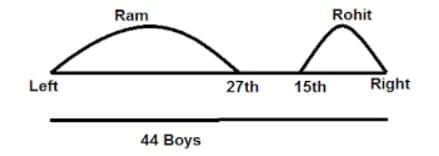
Example 5: Ram is in 27th place from left end in the row of 44 boys. Rohit is 15th from the right end in the same row .How many boys are there between them in the row?
(a) Eleven
(b) Ten
(c) Six
(d) Two
(e) None of these
Ans: (d)
Explanation: Total boys between them = 44 - (27 + 15) = 2.
Example 6: In a row of girls, Rita and Monika occupy the ninth place from the right end and tenth place from the left end, respectively. If they interchange their places, then Rita and Monika occupy seventeenth place from the right and eighteenth place from the left, respectively. How many girls are there in the row?
(a) 25
(b) 26
(c) 27
(d) Data inadequate
(e) None of these
Ans: (b)
Explanation: From the data after interchange, Rita's position becomes 17th from the right; Monika becomes 18th from the left.
Adding gives total = 17 + 9 = 26 (consistent with given positions and interchange).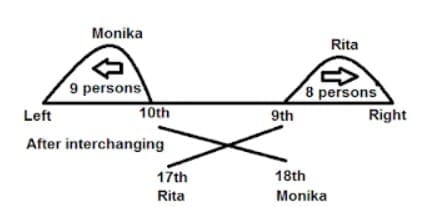
Example 7: Jai is 25th from left and Vijay is 24th from right. When they interchange their positions respectively then Vijay becomes 31st from right end. What will be Jai's position from left after interchanging?
(a) 25
(b) 26
(c) 27
(d) 28
(e) None of these
Ans: (e)
Explanation: From given change, the shift in Vijay's position implies additional positions introduced to the right side. Jai's new position from left after interchange = 25 + 6 + 1 = 32.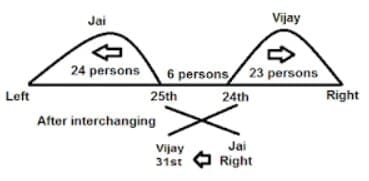 Example 8: Zombo correctly remembers that his father's birthday is before 29th July but after 24th July whereas his younger brother correctly remembers that their father's birthday is after 23rd July but before 28th July and his elder brother correctly remembers that their father's birthday is on an odd date. On which date of July is definitely their father's birthday?
(a) Twenty-five or Twenty-seven
(b) Twenty-seven
(c) Twenty-five
(d) Twenty-six
(e) None of these
Ans: (a)
Explanation: Zombo: birthday ∈ {25, 26, 27, 28} (before 29, after 24).
Younger brother: birthday ∈ {24? 25? 26? 27?} but strictly after 23 and before 28 ⇒ {24,25,26,27}.
Intersection with Zombo's set gives {25,26,27}.
Elder brother: date is odd ⇒ {25,27}. Thus definite possibilities: 25 or 27.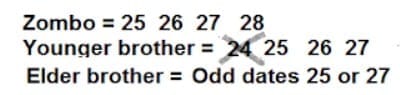
Example 9: Among Zojo, Yo, Xe, William and Vicky each scoring different marks in a test. Xe scored more than William but not as much as Vicky. Vicky scored more than Zojo, who scored less than Yo. Who scored second highest marks?
(a) Yo
(b) Zojo
(c) Xe
(d) Data inadequate
(e) None of these
Ans: (d)
Explanation: From the statements we can deduce a partial order: Vicky > Xe > William and Vicky > Zojo. Also Yo > Zojo. But the relative order of Yo and Xe (and Yo and Zojo) is not determined uniquely. Possibilities exist where Yo could be second or not second. Therefore data is inadequate.
Example 10: In a row of 40 girls, when Komal was shifted to her left by 4 places, her number from the left end of the row became 10. What was the place of Swati from the right end of the row if Swati was three places to the right of Komal's original position?
(a) 22
(b) 23
(c) 25
(d) 26
(e) None of these
Ans: (e)
Explanation: After Komal is shifted 4 places left, her new position from left is 10.
Therefore Komal's original position from left = 10 + 4 = 14.
Swati is 3 places to the right of Komal's original position ⇒ Swati's position from left = 14 + 3 = 17.
Number of girls to the right of Swati = 40 - 17 = 23.
Swati's position from the right = 23 + 1 = 24.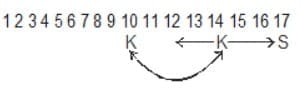
FAQs on Important Notes: Order and Ranking
| 1. How do I solve order and ranking questions quickly in GATE exams? |  |
| 2. What's the difference between linear order and circular arrangement in ranking problems? | |
| 3. How do I handle negative information in order and ranking logic puzzles? | |
| 4. Why do I keep making mistakes when there are multiple people with similar rank descriptions? | |
| 5. Can order and ranking questions appear with other logical reasoning concepts combined in GATE? | |