NCERT Solutions: A Letter to God

Oral Comprehension - Page 5
Q1. What did Lencho hope for?
Ans: Lencho was a farmer. He hoped for rain because his field of ripe corn needed only a shower. Without rain, the crops would fail and he would suffer a serious loss.
Q2. Why did Lencho say the raindrops were like 'new coins'?
Ans: Lencho compared the raindrops to 'new coins' because he believed they would help his crops grow and bring him prosperity. He imagined the big drops as ten-cent pieces and the smaller drops as five-cent pieces, showing his hope that the rain would bring a good harvest.
Q3. How did the rain change? What happened to Lencho's fields?
Ans: The rain began as a heavy shower but was soon accompanied by very large hailstones. A sudden hailstorm lasting about an hour struck the fields and caused great damage: the hailstones destroyed the corn crop, washed away the flowers, left the fields looking white as if covered with salt, and stripped every leaf from the trees. Lencho was deeply upset when he saw that the harvest had been ruined.
Q4. What were Lencho's feelings when the hail stopped?
Ans: After the hailstorm, Lencho felt an overwhelming sadness. He foresaw a bleak year for his family and feared they would not have enough food. He stood in the field in despair and told his sons that not even locusts would have done so much damage; he said, "A plague of locusts would have left more than this. The hail has left nothing. This year we will have no corn." That night he worried aloud that all their hard work had been for nothing and that his family would go hungry.
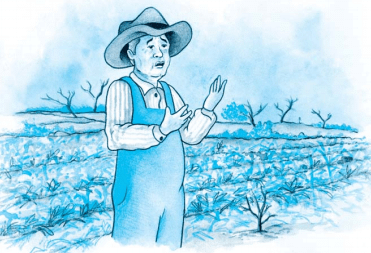 Lencho After Rain
Oral Comprehension - Page 6
Q1. Who or what did Lencho have faith in? What did he do?
Ans: Lencho had strong faith in God. After the hailstorm destroyed his crops, he wrote a letter to God asking for one hundred pesos to replant his field. The postmaster, moved by Lencho's faith, gathered money from his employees and added part of his own salary. He managed to collect just over half the requested amount and sent it to Lencho in an envelope, signing the letter simply as "God". When Lencho counted the money, he found only seventy pesos and accused the post office employees of taking the rest.
Q2. Who read the letter?
Ans: An employee first saw it and showed it to the postmaster, who read it.
Q3. What did the postmaster do then?
Ans: At first the postmaster laughed at what he thought was a foolish request, but on reading the letter he was moved by Lencho's faith and distress. He decided to help: he contributed part of his own salary, collected money from colleagues and friends and sent the collected amount to Lencho, signing the envelope as if it were from "God".
Oral Comprehension - Page 7
Q1. Was Lencho surprised to find a letter for him with money in it?
Ans: No. Lencho was not surprised to find the letter and the money because his faith in God was so strong that he expected God to respond to his plea.
Q2. What made him angry?
Ans: Lencho became angry after counting the money and discovering that he had received only seventy pesos instead of the one hundred pesos he had asked for. He was convinced that God would not make a mistake or withhold what he had requested, so he accused the post office employees of stealing the remaining thirty pesos. In his letter to God he stated that only seventy pesos had reached him, asked for the rest because he needed it urgently, and called the post office employees crooks.
Thinking about the Text
Q1. Who does Lencho have complete faith in? Which sentences show this?
Ans: Lencho had complete faith in God. The sentences that show this are as follows:
(a) But in the hearts of all who lived in that solitary house in the middle of the valley, there was a single hope: help from God.
(b) All through the night, Lencho thought only of his one hope: the help of God, whose eyes, as he had been instructed, see everything, even what is deep in one's conscience.
(c) "God," he wrote, "if you don't help me, my family and I will go hungry this year."
(d) He wrote 'To God' on the envelope, put the letter inside and, still troubled, went to town.
(e) God could not have made a mistake, nor could he have denied Lencho what he had requested.
(f) It said: "God: of the money that I asked for, only seventy pesos reached me. Send me the rest, since I need it very much."
Q2. Why does the postmaster send money to Lencho? Why does he sign the letter 'God'?
Ans: The postmaster was deeply touched by Lencho's firm belief in God and wanted to help him. To preserve Lencho's faith and to give him practical assistance, the postmaster contributed some of his own salary and collected money from others. He signed the envelope as 'God' so that Lencho would believe the money had truly come from a divine source and so his faith would remain unshaken.
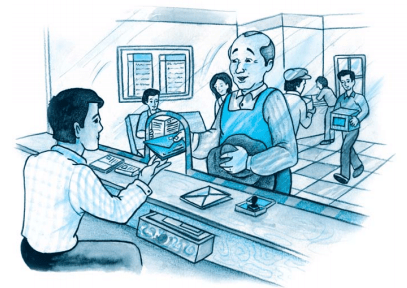
Q3. Did Lencho try to find out who had sent the money to him? Why/Why not?
Ans: No. Lencho did not try to find out who had sent the money because his faith in God was so complete that he never suspected anyone else could have sent it. He accepted the money as a reply from God.
Q4. Who does Lencho think has taken the rest of the money? What is the irony in the situation?
Ans: Lencho believed that the post office employees had taken the rest of the money. The irony is that these same employees were the ones who collected and sent the money to him. In other words, he blamed those who had actually helped him, which is the opposite of what one would expect.
Q5. Are there people like Lencho in the real world? What kind of a person would you say he is? You may select appropriate words from the box to answer the question.

Ans: Yes, there are people like Lencho. He is simple, sincere and deeply trusting. Although he could read and write, his faith was so strong that he accepted what he could not fully explain and did not question how the letter might reach God.
Q6. There are two kinds of conflict in the story: between humans and nature, and between humans themselves. How are these conflicts illustrated?
Ans: The conflict between humans and nature is shown by the hailstorm that destroyed Lencho's crops; the natural force ruined the harvest on which his family depended. The conflict among humans appears when Lencho suspects the post office employees of stealing the missing money even though those employees had helped him by collecting and sending funds. This shows a lack of trust among people despite acts of kindness.
Thinking about the Language
Q1. There are different names in different parts of the world for storms, depending on their nature. Can you match the names in the box with their descriptions below, and fill in the blanks? You may use a dictionary to help you.

(a) A violent tropical storm in which strong winds move in a circle: ____ c _____
(b) An extremely strong wind: _____ a _____
(c) A violent tropical storm with very strong winds: _____ p _____
(d) A violent storm whose centre is a cloud in the shape of a funnel: _____ n _____
(e) A violent storm with very strong winds, especially in the western Atlantic ocean: _____ r _____
(f) A very strong wind that moves very fast in a spinning movement and causes a lot of damage: _____ l _____
Ans:
(a) Cyclone
(b) Gale
(c) Typhoon
(d) Tornado
(e) Hurricane
(f) Whirlwind
Q2. Match the sentences in Column A with the meanings of 'hope' in Column B.
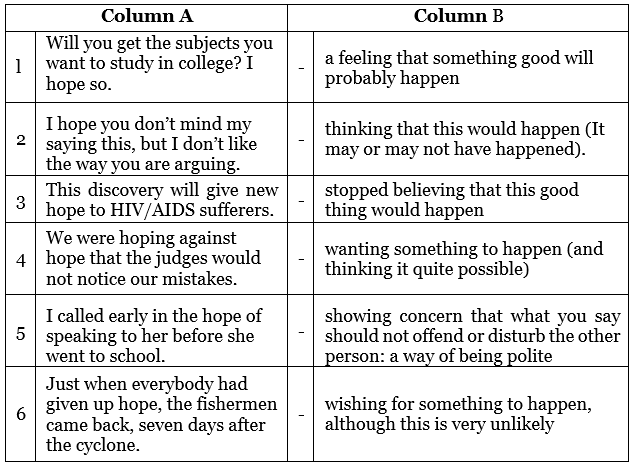
Ans:
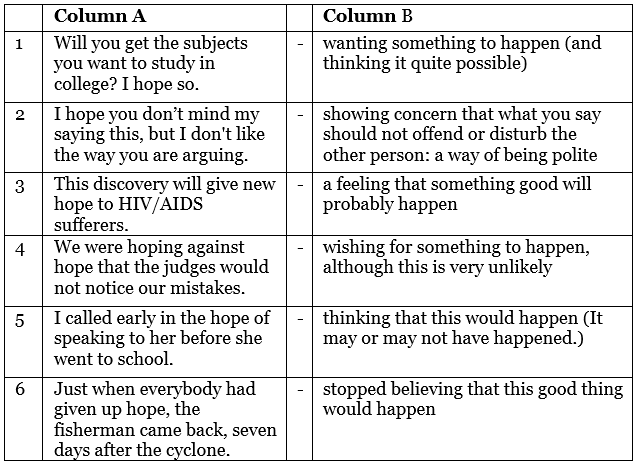
Q3. Join the sentences given below using who, whom, whose, which as suggested.
(a) I often go to Mumbai. Mumbai is the commercial capital of India. (which)
(b) My mother is going to host a TV show on cooking. She cooks very well. (who)
(c) These sportspersons are going to meet the President. Their performance has been excellent. (whose)
(d) Lencho prayed to God. His eyes see into our minds. (whose)
(e) This man cheated me. I trusted him. (whom)
Ans:
(a) I often go to Mumbai, which is the commercial capital of India.
(b) My mother, who cooks very well, is going to host a TV show on cooking.
(c) These sportspersons, whose performance has been excellent, are going to meet the President.
(d) Lencho prayed to God, whose eyes see into our minds.
(e) This man, whom I trusted, cheated me.
Q4. Find sentences in the extract with negative words, which express the following ideas emphatically.
(a) The trees lost all their leaves.
_________________________________________
(b) The letter was addressed to God himself.
_________________________________________
(c) The postman saw this address for the first time in his career.
_________________________________________
Ans:
(a) Not a leaf remained on the trees.
(b) It was nothing less than a letter to God.
(c) Never in his career as a postman had he seen that address.
Q5. In pairs, find metaphors from the extract to complete the table below. Try to say what qualities are being compared. One has been done for you.
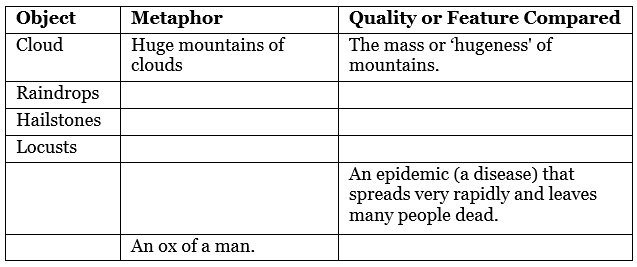
Ans:
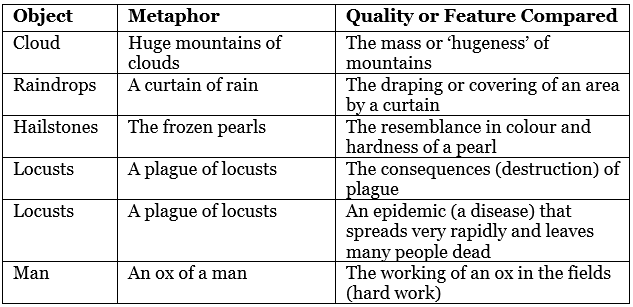
Although the postmaster and his colleagues performed a kind and generous act, Lencho wrongly blamed them for taking some of the money.
FAQs on NCERT Solutions: A Letter to God
| 1. What is the main message of "A Letter to God" and why does Lencho write to God? |  |
| 2. How does Lencho's character develop from the beginning to the end of the story? | |
| 3. Why do the postal workers decide to help Lencho by collecting money for him? | |
| 4. What does Lencho's reaction to the money he receives tell us about human nature and expectations? | |
| 5. How does the setting and the hailstorm function as more than just a backdrop in "A Letter to God"? | |





