NCERT Solutions - The Sound of Music

Part I - Thinking About the Text
I. Answer these questions in a few words or a couple of sentences each.
Q1: How old was Evelyn when she went to the Royal Academy of Music?
Ans: Evelyn was younger than seventeen years when she went to the Royal Academy of Music in London.
Q2: When was her deafness first noticed? When was it confirmed?
Ans: Evelyn's deafness was first noticed when she was eight. By the time she was eleven, her hearing loss was confirmed.
II. Answer each of these questions in a short paragraph (30 - 40 words).
Q1: Who helped her to continue with music? What did he do and say?
Ans: Ron Forbes helped her continue with music by tuning two large drums to different notes and he said "Don't listen the music through your ears, try to sense it some other way".
Q2: Name the various places and causes for which Evelyn performs.
Ans: Even with a hectic international schedule, Evelyn gives solo performances at regular concerts. Apart from those she gives free concerts in prisons and hospitals. She also gives high priority to classes for her young musicians.
III. Answer the question in two or three paragraphs (100 - 150 words).
Q1: How does Evelyn hear music?
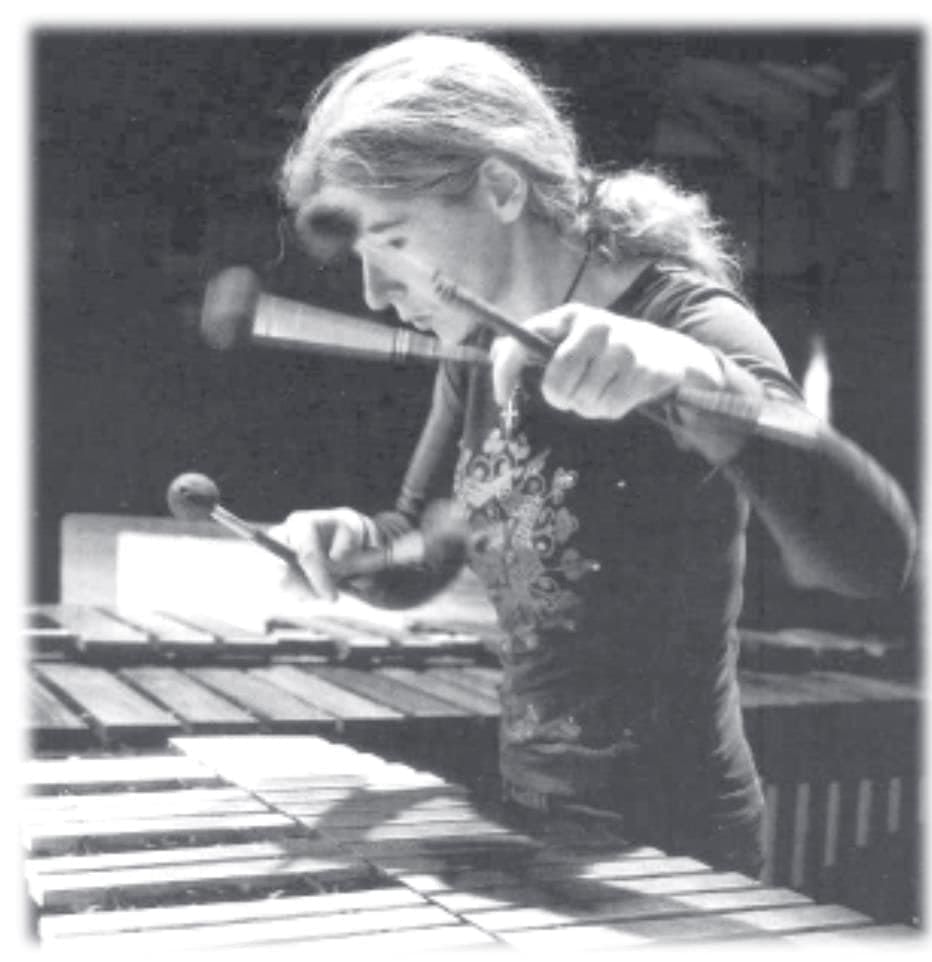
Ans: Evelyn became deaf by the age of eleven, but never gave up. Determined to live a normal life and pursue music, she kept going. Percussionist Ron Forbes noticed her talent and suggested she sense music differently, not through her ears. She soon felt the higher drum from the waist up and the lower one from the waist down. With repeated practice, she discovered she could sense different notes in various parts of her body. She trained herself to open up to sounds and vibrations. As she described, "It pours in through every part of my body. It tingles in the skin, my cheekbones and even in my hair." When playing the xylophone, she sensed vibrations through her fingertips. By leaning on drums, she felt the resonance inside her, and on wooden floors, she removed her shoes to let the vibrations travel through her bare feet.
Part II - Thinking About the Text
I. Tick the right answer.
Q1: The (shehnai, pungi) was a 'reeded noisemaker.' Tick the right answer
Ans: The pungi was a 'reeded noisemaker.'
Q2: (Bismillah Khan, A barber, Ali Bux) transformed the pungi into a shehnai.
Ans: A barber transformed the pungi into a shehnai.
Q3: Bismillah Khan's paternal ancestors were (barbers, and professional musicians).
Ans: Bismillah Khan's paternal ancestors were professional musicians.
Q4: Bismillah Khan learned to play the shehnai from (Ali Bux, Paigambar Bux, Ustad Faiyaaz Khan).
Ans: Bismillah Khan learned to play the shehnai from Ali Bux.
Q5: Bismillah Khan's first trip abroad was to (Afghanistan, U.S.A., Canada).
Ans: Bismillah Khan's first trip abroad was to Afghanistan.
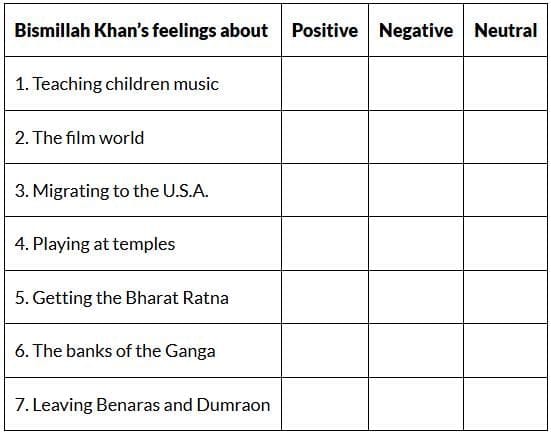
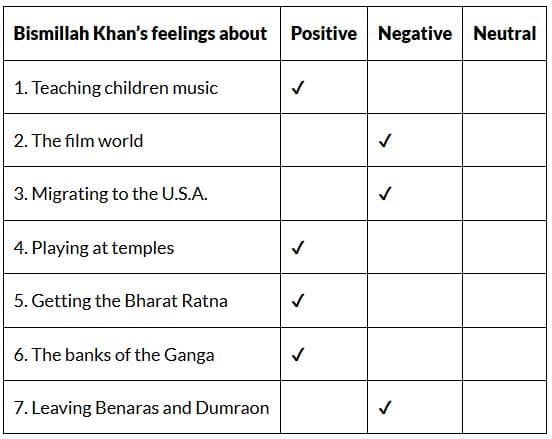
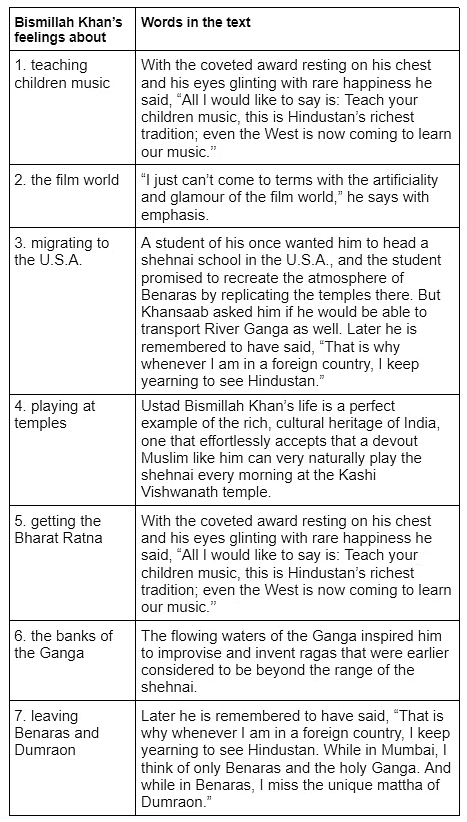
II. Find the words in the text which show Ustad Bismillah Khan's feelings about the items listed below. Then mark a tick (✔) in the correct column. Discuss your answers in class.
Ans:
Explanation:
III. Answer these questions in 30 - 40 words.
Q1: Why did Aurangzeb ban the playing of the pungi?
Ans: Emperor Aurangzeb banned the playing of the pungi in the royal residence because it produced a shrill and unpleasant sound. This instrument became a general term for similar reed instruments that produce noise.
Q2: How is a shehnai different from a pungi?
Ans: Shehnai is a pipe with a natural hollow stem that is longer and broader than the pungi. It has seven holes on its body. When it is played, the closing and opening of some of the holes produce soft and melodious sounds.
Q3: Where was the shehnai played traditionally? How did Bismillah Khan change this?
Ans: Traditionally, the shehnai was played in royal courts as part of a nine-instrument ensemble. It was primarily used in temples and during weddings. Ustad Bismillah Khan transformed the shehnai's role by introducing it to the classical music stage, showcasing its versatility and beauty beyond its traditional settings.
Q4: When and how did Bismillah Khan get his big break?
Ans: At the age of 14, Bismillah Khan attended the Allahabad Music Conference, where he received encouragement from Ustad Faiyaz Khan. His big break came in 1938 with the launch of All India Radio in Lucknow, where he quickly became a popular shehnai player.
Q5: Where did Bismillah Khan play the shehnai on 15 August 1947? Why was the event historic?
Ans: On 15 August 1947, Bismillah Khan played the shehnai from the Red Fort. It was a historic day as India gained independence on that day. He became the first Indian to greet the nation with his shehnai. He was the first Indian to greet the nation with his shehnai, performing Raag Kafi for an audience that included notable figures like Pandit Jawaharlal Nehru.
Q6: Why did Bismillah Khan refuse to start a shehnai school in the U.S.A.?
Ans: Bismillah Khan refused to start a shehnai school in the U.S.A. because he couldn't live outside India. Although his student promised to recreate the atmosphere of Benaras, including its temples, Bismillah jokingly asked if he could also bring the River Ganga, which was impossible. He always longed to return to India whenever he was abroad.
Q7: Find at least two instances in the text that tell you that Bismillah Khan loves India and Benaras.
Ans: Bismillah Khan deeply loved India, especially Benaras and Dumraon. In his early years, he often practised in solitude at the temples of Balaji and Mangala Maiya, and by the banks of the River Ganga in Benaras. The flowing Ganga inspired him to create new ragas for the shehnai. He refused to start a shehnai school in the U.S.A. because he couldn't live outside India. When his student offered to replicate Benaras' temples, Bismillah humorously asked if he could also bring the River Ganga, which was impossible.
Thinking About Language
I. Look at these sentences.
- Evelyn was determined to live a normal life.
- Evelyn managed to conceal her growing deafness from friends and teachers.
The italicised parts answer the questions: "What was Evelyn determined to do?" and "What did Evelyn manage to do?" They begin with a to-verb (to live, to conceal).
Complete the following sentences. Beginning with a to-verb, try to answer the questions in brackets.
Q1: The school sports team hopes __________ (What does it hope to do?)
Ans: The school sports team hopes to do better than last time.
Q2: We all want __________ (What do we all want to do?)
Ans: We all want to go on a vacation.
Q3: They advised the hearing-impaired child's mother __________(What did they advise her to do?)
Ans: They advised the hearing-impaired child's mother to take her to a specialist.
Q4: The authorities permitted us to __________ (What did the authorities permit us to do?)
Ans: The authorities permitted us to organise a charity event.
Q5: A musician decided to __________ (What did the musician decide to do?)
Ans: A musician decided to take India's music to the world.
II. From the text on Bismillah Khan, find the words and phrases that match these definitions and write them down. The number of the paragraph where you will find the words/ phrases have been given for you in brackets.
Q1: he home of royal people (1) __________
Ans: The home of royal people (1) the royal residence
Q2: the state of being alone (5) __________
Ans: The state of being alone (5) solitude
Q3: a part which is absolutely necessary (2) __________
Ans: A part which is absolutely necessary (2) indispensable
Q4: to do something not done before (5) __________
Ans: To do something not done before (5) invent
Q5: without much effort (13) __________
Ans: To do something without much effort (13) effortlessly
Q6: quickly and in large quantities (9) __________ and __________
Ans: Quickly and in large quantities (9) thick and fast
III. Tick the right Answer
Q1: When something is revived, it (remains dead/lives again).
Ans: When something is revived, it lives again.
Q2: When a government bans something, it wants it (stopped/started).
Ans: When a government bans something, it wants it stopped.
Q3: When something is considered auspicious (welcome it/avoid it).
Ans: When something is considered auspicious, welcome it.
Q4: When we take to something, we find it (boring/interesting).
Ans: When we take to something, we find it interesting.
Q5: When you appreciate something, you (find it good and useful/find it of no use).
Ans: When you appreciate something, you find it good and useful.
Q6: When you replicate something, you do it (for the first time/for the second time).
Ans: When you replicate something, you do it for the second time.
Q7: When we come to terms with something, it is (still upsetting/no longer upsetting).
Ans: When we come to terms with something, it is no longer upsetting.
IV. Consult your dictionary and complete the following table. The first one has been done for you.
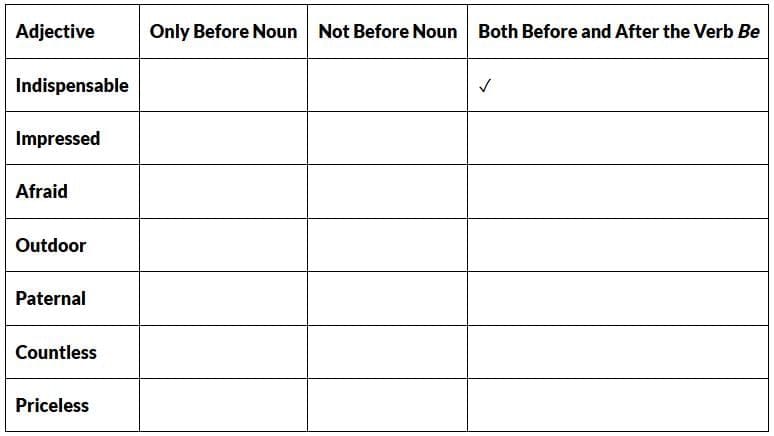
Use these words in phrases or sentences of your own.
Ans: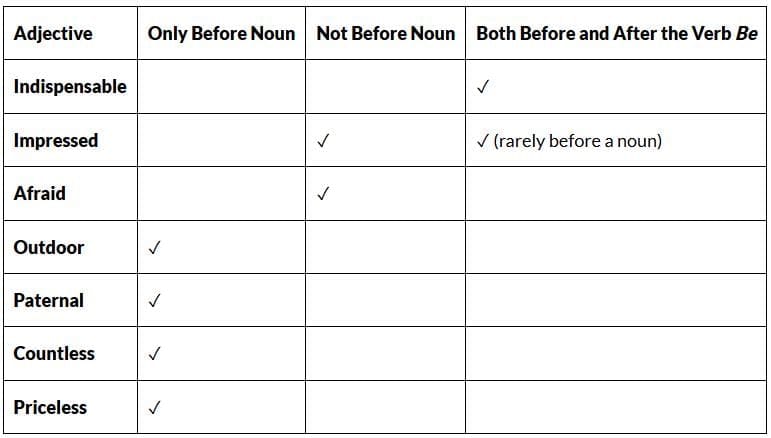
EXPLANATION:
1. Both Before and After the Verb Be
- Indispensable: Commonly used both attributively (before a noun) and predicatively (after be).
Example: An indispensable tool / The tool is indispensable. - Impressed: Typically used after the verb be, though it may rarely occur before a noun in certain formal contexts.
Example: The guests were impressed.
Rare before noun: Impressed listeners appreciated the performance. (less common)
2. Only After the Verb Be (Predicate Position)
- Afraid: This adjective is classified as predicative-only and does not occur before a noun in standard English.
Example: The child is afraid.
Incorrect: An afraid child.
3. Only Before a Noun (Attributive Position)
- Outdoor: Used only attributively to describe activities or items associated with the open air.
Example: Outdoor sports.
Incorrect: The sports are outdoor. - Paternal: Used attributively to refer to a fatherly relation or characteristic.
Example: Paternal instincts.
Predicative use is rare and uncommon in normal usage. - Countless: Primarily used attributively to describe a large, indefinite quantity.
Example: Countless opportunities.
Predicative usage (e.g., The opportunities are countless) is grammatically acceptable but less frequent. - Priceless: Commonly used before nouns to indicate great value.
Example: A priceless painting.
Though predicative usage such as The painting is priceless exists, the adjective is typically introduced to learners in its attributive form.
Some sentences using these adjectives are:
- She is indispensable for the successful completion of the project.
- Sunita was impressed by my singing.
- He is afraid of the dark.
- I enjoy the company of my paternal uncle.
- Gennie was showered with countless gifts.
- My grandmother gave me a priceless piece of advice.
Speaking:
I. Imagine the famous singer Kishori Amonkar is going to visit your school. You have been asked to introduce her to the audience before her performance. How would you introduce her?
Here is some information about Kishori Amonkar you can find on the Internet. Read the passage and make notes of the main points about:
- her parentage
- the school of music she belongs to
- her achievements
- her inspiration
- awards
Padma Bhushan Kishori Amonkar, widely considered the finest female vocalist of her generation, was born in 1931, daughter of another great artist, Smt. Mogubai Kurdikar. In her early years, she absorbed the approach and repertoire of her distinguished mother's teacher Ustad Alladiya Khan. As her own style developed, however, she moved away from Alladiya Khan's 'JaipurAtrauli gharana' style in some respects, and as a mature artist, her approach is usually regarded as an individual, if not unique, variant of the Jaipur model.
Kishori Amonkar is a thinker, besotted by what she calls the mysterious world of her raagas. She dissects them with the precision of a perfectionist, almost like a scientist, until the most subtle of shades and emotions emerge and re-emerge.
She is very much inspired by the teachings of the ancient Vedic sages, written at a time when vocal music was highly devotional in character. This soul-searching quality of her music, coupled with a very intellectual approach to raaga performance, has gained her quite a following in India and has helped to revive the study of khayal.
Significant awards bestowed on this artist include the Sangeet Natak Akademi Award (1985), the Padma Bhushan (1987), and the highly coveted Sangeet Samradhini Award (considered one of the most prestigious awards in Indian Classical Music) in 1997.
II. Use your notes on Kishori Amonkar to introduce her to an imaginary audience.
You may use one of the following phrases to introduce a guest:
I am honoured to introduce.../I feel privileged to introduce.../We welcome you...
Ans: I feel privileged to introduce you to one of the greatest female vocalists of her time, Kishori Amonkar. A recipient of the Padma Bhushan, she was born in 1931 to the legendary Smt. Mogubai Kurdikar. Kishori Amonkar is renowned for her deep exploration of ragas, meticulously unveiling their most nuanced expressions. Her artistry is profoundly influenced by the wisdom of Vedic sages. Throughout her illustrious career, she has received numerous prestigious awards, including the Sangeet Natak Akademi Award in 1985, the Padma Bhushan in 1987, and the esteemed Sangeet Samradhini Award in 1997
Writing:
"If you work hard and know where you're going, you'll get there," says Evelyn Glennie.
You have now read about two musicians, Evelyn Glennie and Ustad Bismillah Khan. Do you think that they both worked hard? Where did they want to 'go'? Answer these questions in two paragraphs, one on each of the two musicians.
Ans: If we work hard, no one can stop us from achieving our dreams, and we get there. Evelyn Glennie had a love for music in the deepest corners of her heart and worked hard to fulfil her dreams. She was deaf and often discouraged from her pursuit and love for music. It was her teacher, Ron Forbes, who encouraged her to pursue music and taught her to identify music vibrations from different parts of her body. She worked and climbed her way up to the Royal Academy of Music. She won various Academy Awards and in 1991 presented with the Soloist of the Year Award. With her determination, she not only excelled in the field but also brought laurels to her country.
Ustad Bismillah Khan had an inclination towards music from a very young age. He was given training in music by his uncle. He belonged to a family of musicians, and his pursuit was encouraged. He practised hard and invented ragas for shehnai that were considered beyond the scope. His contribution to Indian classical music was commendable, and he was awarded various national awards, including Bharat Ratna.
FAQs on NCERT Solutions - The Sound of Music
| 1. Who is Evelyn Glennie and why is she important in The Sound of Music chapter? |  |
| 2. What does The Sound of Music teach about disability and overcoming obstacles? | |
| 3. How does Evelyn Glennie perform percussion without being able to hear in The Sound of Music? | |
| 4. What are the key life lessons from Evelyn Glennie's story for Class 9 students? | |
| 5. How should students approach answering comprehension questions about The Sound of Music for exams? | |





