NCERT Solutions - The Snake and the Mirror

Think about the Text
I. Discuss in pairs and answer each question below in a short paragraph (30 - 40 words).
Q1: "The sound was a familiar one." What sound did the doctor hear? What did he think it was? How many times did he hear it? (Find the places in the text.) When and why did the sounds stop?
Ans: The doctor heard the familiar sound of rats running and scratching on the beam above his bed. He thought it was the usual movement of rats and heard it three times. The sounds stopped when the snake slid down and fell with a thud, which ended the scurrying noise.
Q2: What two "important" and "earth-shaking" decisions did the doctor take while he was looking into the mirror?
Ans: While looking into the mirror the doctor decided to shave every day and grow a thin moustache, and to keep an attractive, winning smile at all times. These small resolutions showed his wish to improve his appearance and social standing.
Q3: "I looked into the mirror and smiled," says the doctor. A little later he says, "I forgot my danger and smiled feebly at myself." What is the doctor's opinion about himself when:
(i) he first smiles, and
(ii) he smiles again? In what way do his thoughts change in between, and why?
Ans: (i) When he first smiles, he feels proud of his looks and pleased with his identity as a young bachelor doctor.
(ii) When he smiles again, his smile is weak and frightened because he is aware of the peril of the snake coiled on his arm. His thoughts change from vanity and light-hearted daydreaming to fear and a realisation of his immediate danger, which makes his second smile uneasy.
II. This story about a frightening incident is narrated in a humorous way. What makes it humorous? (Think of the contrasts it presents between dreams and reality. Some of them are listed below.
Write short paragraphs on each of these to get your answer.
Q1: (i) The kind of person the doctor is (money, possessions)
Ans: The doctor is poor and just starting his practice. He lives in a small rented, unelectrified room with few comforts and many rats. He has little money or possessions, which contrasts with his imaginative plans for a finer life.
(ii) The kind of person he wants to be (appearance, ambition)
Ans: The doctor wants to appear well groomed and successful. He imagines shaving daily, growing a thin moustache and keeping an attractive smile so that he will seem confident and desirable to patients and a prospective wife.
Q2: (i) The person he wants to marry
Ans: The doctor imagines marrying a well-established, wealthy woman doctor who is comfortable and not likely to chase after him. He pictures a fat, prosperous partner who will add security to his life.
(ii) The person he actually marries
Ans: In reality he marries a thin, active woman who can run fast. This contrast between his dream of a slow, complacent partner and the actual energetic wife creates a comic reversal of his expectations.
Q3: (i) His thoughts when he looks into the mirror
Ans: When he looks into the mirror his thoughts are cheerful and full of self-satisfaction; he approves of his smile and plans small changes to improve his appearance.
(ii) His thoughts when the snake is coiled around his arm
Ans: When the snake coils round his arm he becomes motionless and terrified. His body feels frozen, though his mind races; he feels the need to call on God and realises how close he is to death, so all his earlier vanity disappears.
Thinking about Language
I. Q1: Here are some sentences from the text. Say which of them tell you that the author:
(a) was afraid of the snake,
(b) was proud of his appearance,
(c) had a sense of humour,
(d) was no longer afraid of the snake.
1. I was turned to stone.
2. I was no mere image cut in granite.
3. The arm was beginning to be drained of strength.
4. I tried in my imagination to write in bright letters outside my little heart the words, 'O God'.
5. I didn't tremble. I didn't cry out.
6. I looked into the mirror and smiled. It was an attractive smile.
7. I was suddenly a man of flesh and blood.
8. I was after all a bachelor, and a doctor too on top of it!
9. The fellow had such a sense of cleanliness...! The rascal could have taken it and used it after washing it with soap and water.
10. Was it trying to make an important decision about growing a moustache or using eye shadow and mascara or wearing a vermilion spot on its forehead
Ans: (a) was afraid of the snake
- I was turned to stone.
- The arm was beginning to be drained of strength.
(b) was proud of his appearance
- I looked into the mirror and smiled. It was an attractive smile.
- I was, after all, a bachelor, and a doctor too, on top of it!
(c) had a sense of humour
- I tried in my imagination to write in bright letters outside my little heart the words, 'O God'.
- The fellow had such a sense of cleanliness...! The rascal could have taken it and used it after washing it with soap and water.
- Was it trying to make an important decision about growing a moustache or using eye shadow and mascara or wearing a vermilion spot on its forehead.
(d) was no longer afraid of the snake
- I was no mere image cut in granite.
- I was suddenly a man of flesh and blood.
- I didn't tremble. I didn't cry out.
II. Expressions used to show fear
Q1: Can you find the expressions in the story that tell you that the author was frightened? Read the story and complete the following sentences.
i. I was turned ___________________________________________________.
Ans: I was turned to stone.
ii. I sat there holding _______________________________________________.
Ans: I sat there holding my breath.
iii. In the light of the lamp I sat there like _______________________________.
Ans: In the light of the lamp, I sat there like a stone image in the flesh.
III. In the sentences given below, some words and expressions are italicised. They are variously mean that one
- is very frightened.
- is too scared to move.
- is frightened by something that happens suddenly.
- makes another feel frightened.
Match the meanings with the words/expressions in italics, and write the appropriate meaning next to the sentence. The first one has been done for you.
Q1. I knew a man was following me, I was scared out of my wits.
Ans: I knew a man was following me, I was scared out of my wits. (very frightened)
Q2. I got a fright when I realised how close I was to the cliff edge.
Ans: I got a fright when I realised how close I was to the cliff edge. (frightened by something that happens suddenly)
Q3. He nearly jumped out of his skin when he saw the bull coming towards him.
Ans: He nearly jumped out of his skin when he saw the bull coming towards him. (very frightened)
Q4. You really gave me a fright when you crept up behind me like that.
Ans: You really gave me a fright when you crept up behind me like that. (frightened by something that happens suddenly)
Q5: Wait until I tell his story - it will make your hair stand on end.
Ans: Wait until I tell his story - it will make your hair stand on end. (makes another feel frightened)
Q6. Paralysed with fear, the boy faced his abductors.
Ans: Paralysed with fear, the boy faced his abductors. (too scared to move)
Q7: The boy hid behind the door, not moving a muscle.
Ans: The boy hid behind the door, not moving a muscle. (too scared to move)
IV. Reported questions
Study these sentences:
- His friend asked, "Did you see the snake the next day, doctor?"
His friend asked the doctor whether/if he had seen the snake the next day. - The little girl wondered, "Will I be home before the TV show begins?
The little girl wondered if/whether she would be home before the TV show began. - Someone asked, "Why has the thief left the vest behind?"
Someone asked why the thief had left the vest behind.
The words if/whether are used to report questions which begin with: do, will, can, have, are, etc. These questions can be answered 'yes' or 'no'.
Questions beginning with why/when/where/how/which/what are reported using these same words.
The reporting verbs we use in questions with if/whether/why/when, etc. are: ask, inquire and wonder.
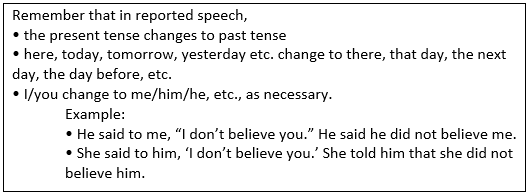
Report these questions using if/whether or why/when/where/how/which/what.
Remember that the italicised verbs change into the past tense.
Q1: Meena asked her friend, "Do you think your teacher will come today?"
Ans: Meena asked her friend if she thought her teacher would come that day.
Q2: David asked his colleague, "Where will you go this summer?"
Ans: David asked his colleague where he would go that summer.
Q3: He asked the little boy, "Why are you studying English?"
Ans: He asked the little boy why he was studying English.
Q4: She asked me, "When are we going to leave?"
Ans: She asked me when we were going to leave.
Q5: Pran asked me, "Have you finished reading the newspaper?"
Ans: Pran asked me if I had finished reading the newspaper.
Q6: Seema asked her, "How long have you lived here?"
Ans: Seema asked her how long she had lived there.
Q7: Sheila asked the children, "Are you ready to do the work?"
Ans: Sheila asked the children if they were ready to do the work.
FAQs on NCERT Solutions - The Snake and the Mirror
| 1. What is the main theme of "The Snake and the Mirror"? |  |
| 2. How does the protagonist react when he first sees the snake? | |
| 3. What role does the mirror play in the story? | |
| 4. What lesson does the protagonist learn by the end of the story? | |
| 5. How does the author create suspense in "The Snake and the Mirror"? | |





