NCERT Solutions - If I Were You

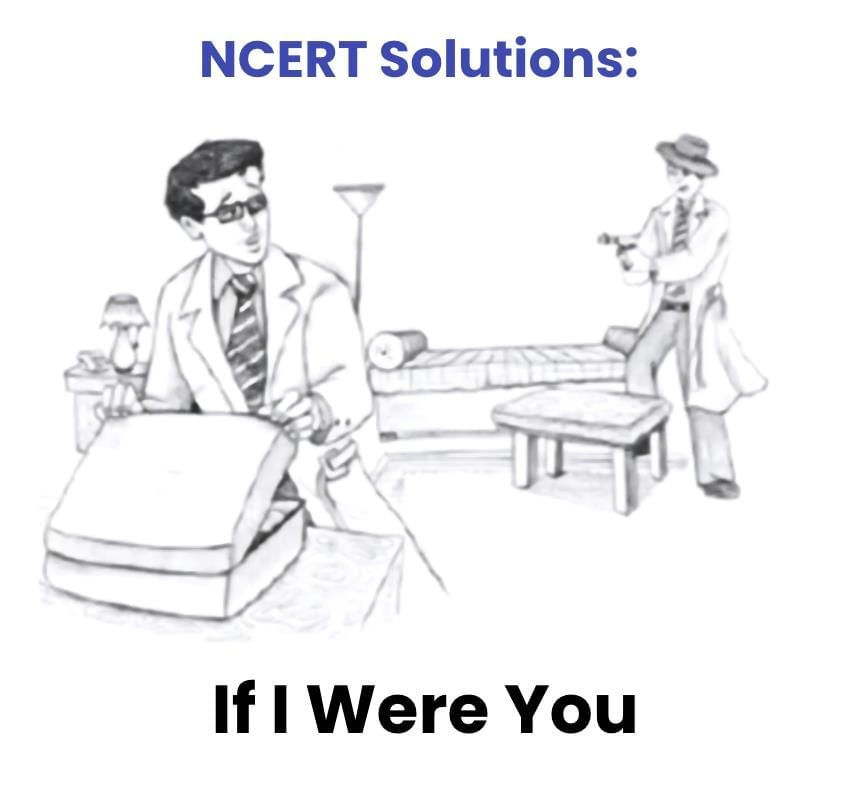
Thinking about the Text
I. Answer these questions.
Q.1. "At last a sympathetic audience."
(i) Who says this?
(ii) Why does he say it?
(iii) Is he sarcastic or serious?
Ans. (i) Gerrard says this line.
(ii) He says it when the intruder forces him to speak about himself; Gerrard frames the situation in theatrical terms, as if the intruder were an audience at a performance.
(iii) He is being sarcastic. He does not mean that the intruder is actually sympathetic; rather, Gerrard is mocking the situation and using an ironic, theatrical tone to hide his fear.
Q.2. Why does the intruder choose Gerrard as the man whose identity he wants to take on?
Ans. The intruder chooses Gerrard because he believes Gerrard lives alone and leads a quiet, mysterious life with few visitors. He thinks this will make it easier to assume Gerrard's identity without attracting attention from the police. Gerrard's habit of going away suddenly and the fact that he owns a car makes the intruder believe he can easily take over his life and stay hidden.
Q.3. "I said it with bullets."
(i) Who says this?
(ii) What does it mean?
(iii) Is it the truth? What is the speaker's reason for saying this?
Ans. (i) Gerrard says this.
(ii) It means that he claims to have used a gun to solve a dangerous situation - he is saying he shot someone when things went wrong.
(iii) It is not the truth; Gerrard invents this to frighten the intruder and to appear dangerous. He uses the claim as a bluff to protect himself and to gain time, hoping the intruder will be intimidated and less likely to kill him.
Q.4. What is Gerrard's profession? Quote the parts of the play that support your answer.
Ans. Gerrard is a playwright by profession. Several parts of the play reflect this.
Some of these are:
- "This is all very melodramatic, not very original, perhaps, but..."
- "At last, a sympathetic audience!"
- "In most melodramas, the villain is foolish enough to delay his killing long enough to be frustrated".
- "I said, you were luckier than most melodramatic villains."
- "That's a disguise outfit; false moustaches and whatnot".
- "Sorry, I can't let you have the props in time for rehearsal, I've had a spot of bother - quite amusing. I think I'll put it in my next play."
Q.5. "You'll soon stop being smart."
(i) Who says this?
(ii) Why does the speaker say it?
(iii) What, according to the speaker, will stop Gerrard from being smart?
Ans. (i) The intruder says this line.
(ii) The intruder says this to frighten Gerrard. He intends to intimidate him and assert control over the situation.
(iii) The speaker implies that Gerrard will stop being smart when he realises that the intruder means to kill him and take over his identity. In other words, fear of death and the immediate danger posed by the intruder will force Gerrard to stop making clever remarks or trying to outwit him.
Q.6. "They can't hang me twice."
(i) Who says this?
(ii) Why does the speaker say it?
Ans. (i) The intruder says this line.
(ii) He has already committed a murder and believes that he cannot be punished twice for the same crime. He feels fearless and ready to kill again, showing that he has nothing to lose. This is meant to frighten Gerrard and show his recklessness.
Q.7. "A mystery I propose to explain." What is the mystery the speaker proposes to explain?
Ans. The mystery Gerrard proposes to explain is why he lives as a mysterious man who keeps to himself. He tells the intruder that he is a criminal on the run and that he once got away with a murder; this explanation is part of Gerrard's calculated bluff. Gerrard uses this invented story to frighten the intruder and to hide his real situation by appearing dangerous and unpredictable.
Q.8. "This is your big surprise."
(i) Where has this been said in the play?
(ii) What is the surprise?
Ans. (i) This has been said twice in the play. On the first occasion, it is spoken by the intruder while revealing his plan to kill Gerrard. Secondly, it is spoken by Gerrard before he reveals his fictitious identity to the intruder.
(ii) The intruder's surprise is his plan to kill Gerrard and assume Gerrard's identity so that he can escape his own past. Gerrard's surprise is the dramatic, false identity and story he invents to frighten the intruder and to gain the upper hand in the situation.
Thinking about the Language
I. Consult your dictionary and choose the correct word from the pairs given in brackets.
(i) The (site, cite) of the accident was (ghastly/ghostly).
(ii) Our college (principle/principal) is very strict.
(iii) I studied (continuously/continually) for eight hours.
(iv) The fog had an adverse (affect/effect) on the traffic.
(v) Cezanne, the famous French painter, was a brilliant (artist/artiste).
(vi) The book that you gave me yesterday is an extraordinary (collage/college) of science fiction and mystery.
(vii) Our school will (host/hoist) an exhibition on cruelty to animals and wildlife conservation.
(viii) Screw the lid tightly onto the top of the bottle and (shake/shape) well before using the contents.
Ans. (i)The site of the accident was ghastly.
(ii) Our college principal is very strict.
(iii) I studied continuously for eight hours.
(iv) The fog had an adverse effect on the traffic.
(v) Cezanne, the famous French painter, was a brilliant artist.
(vi) The book that you gave me yesterday is an extraordinary collage of science fiction and mystery.
(vii) Our school will host an exhibition on cruelty to animals and wildlife conservation.
(viii) Screw the lid tightly onto the top of the bottle and shake well before using the contents.
II. The irony is when we say one thing but mean another, usually the opposite of what we say. When someone makes a mistake and you say, "Oh! That was clever!" that is irony. You're saying 'clever' to mean 'not clever'.
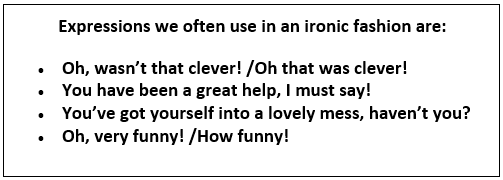
We use a slightly different tone of voice when we use these words ironically.
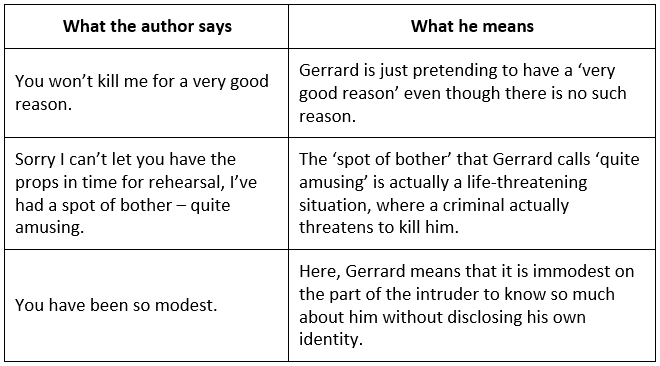
Read the play carefully and find the words and expressions Gerrard uses in an ironic way. Then say what these expressions really mean. Two examples have been given below. Write down three such expressions along with what they really mean.
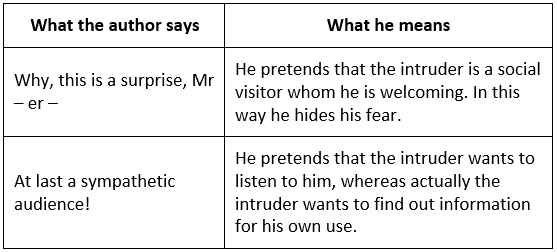
Ans.
FAQs on NCERT Solutions - If I Were You
| 1. Who is the main character in "If I Were You" and what is his profession? |  |
| 2. Why does the burglar come to Gerrard's house and what does he want? | |
| 3. How does Gerrard manage to overpower the burglar without physical force? | |
| 4. What is the twist ending of "If I Were You" and what does it reveal? | |
| 5. What are the main themes and literary devices used in "If I Were You" by Douglas Home? | |