NCERT Solutions - The Rattrap

Q1: Notice these expressions in the text. Infer their meanings from the context.
keep body and soul together: to manage to keep alive; to survive
hunger gleamed in his eyes: feeling so hungry that the expression shows on one's face
plods along the road: moving along the road slowly but deliberately, to walk with heavy feet
unwonted joy: unusual pleasure or happiness
impenetrable prison: impassable confinement
nodded a haughty consent: indifferent agreement
eased his way: moved himself slowly and carefully
fallen into a line of thought: agreement of thoughts
things have gone downhill: to decline or grow worse and worse
Q1: From where did the peddler get the idea of the world being a rattrap?
Ans: One day the peddler was thinking about his rattraps and how they worked. He suddenly compared the world to one of his rattraps: it offered comforts such as riches, food and shelter as baits in the same way that a rattrap offers cheese and pork. When someone reached for those baits, they found themselves trapped. This thought gave him the idea that the whole world-its lands and seas, its cities and villages-was like a large rattrap.
Q2: Why was he amused by this idea?
Ans: The peddler had often met with hostility and unkindness from people. The idea that the world itself was a rattrap allowed him to think ill of the world and to feel vindicated. It gave him a kind of grim pleasure to imagine that many people were already caught by life's temptations while others simply circled the bait. This sardonic thought amused him because it justified his own mistrust and bitterness towards people.
Q3: Did the peddler expect the kind of hospitality that he received from the crofter?
Ans: No. The peddler did not expect such hospitality from the crofter. He was used to being met by sour and unfriendly faces when he knocked on doors and asked for shelter; therefore the crofter's warm welcome surprised him.
Q4: Why was the crofter so talkative and friendly with the peddler?
Ans: The crofter was an old man living alone without wife or children. His life was monotonous and lonely, and he welcomed the presence of another person. He offered food and shelter because he craved company and conversation. His loneliness explains why he was so talkative and friendly with the peddler.
Q5: Why did he show the thirty kroner to the peddler?
Ans: The crofter was proud that his cow had produced enough milk to earn him thirty kronor from the creamery. The peddler had appeared doubtful when the crofter claimed this, so to reassure him and prove the truth of his statement the crofter produced and showed the thirty kronor.
Q6: Did the peddler respect the confidence reposed in him by the crofter?
Ans: No. The peddler betrayed the crofter's trust by stealing the thirty kronor. Later, however, his conscience was aroused during his stay with the Willmanssons and he resolved to return the money.
Q7: What made the peddler think that he had indeed fallen into a rattrap?
Ans: After stealing the crofter's money, the peddler felt unsafe walking on public roads and went into the woods to hide. The forest was dense and confusing, with trunks, branches and thickets everywhere. As he wandered deeper without finding a way out, the tangled woods began to seem like a giant trap closing around him. In that moment he believed he had truly fallen into a rattrap.
Q8: Why did the ironmaster speak kindly to the peddler and invite him home?
Ans: In the uncertain reflection of the furnace light, the ironmaster mistook the peddler for his old regimental comrade, Captain Von Stahle. Because of this apparent recognition and the peddler's miserable condition, the ironmaster wanted to help an old acquaintance and also sought company on Christmas Eve. For these reasons he spoke kindly and invited the peddler home.
Q9: Why did the peddler decline the invitation?
Ans: The peddler understood that the ironmaster had mistaken his identity. He also had the stolen money on him and feared that accepting hospitality in the ironmaster's house would expose him and be like stepping into the lion's den. Feeling guilty and afraid, he declined the invitation.
Q10: What made the peddler accept Edla Willmansson's invitation?
Ans: Edla Willmansson used a gentle, persuasive approach. She looked at the peddler with compassion and reassured him that no harm would come to him and that he could leave freely whenever he wished. Her warm and sincere manner gave him confidence, so he accepted her invitation.
Q11: What doubts did Edla have about the peddler?
Ans: When Edla fetched the peddler she noticed his frightened manner and thought he might have stolen something or even escaped from prison. She also doubted whether he was genuinely the educated man her father believed him to be, because of his appearance and behaviour.
Q12: When did the ironmaster realise his mistake?
Ans: The ironmaster realised his mistake the next morning at breakfast. The valet had bathed, shaved and clothed the peddler so that he no longer resembled the weary figure seen by the ironmaster in the furnace's reflection. This made the ironmaster understand that the previous evening's recognition had been an error caused by dim light and reflection.
Q13: What did the peddler say in his defence when it was clear that he was not the person the ironmaster had thought he was?
Ans: The peddler explained that he had never pretended to be someone he was not. He described himself simply as a poor trader who only wanted to sleep in the forge for the night. He said he had repeatedly declined any offer that implied he was the ironmaster's old comrade.
Q14: Why did Edla still entertain the peddler even after she knew the truth about him?
Ans: Even after learning his true identity, Edla insisted that the peddler remain for Christmas Eve so that he might enjoy a day of peace. She felt it would be improper to turn away a guest on Christmas, and she acted from compassion rather than from any mistake about his identity.
Q15: Why was Edla happy to see the gift left by the peddler?
Ans: When Edla opened the gift she found a small rattrap, three wrinkled ten-kronor notes and a letter. The peddler had returned the thirty kronor to its rightful owner and explained his change of heart. This showed that he was not a thief by nature but had been driven by circumstances; her kindness had moved him and led to his repentance. Edla was happy because his gesture proved that kindness can transform a person.
Q16: Why did the peddler sign himself as Captain von Stahle?
Ans: After being received kindly and treated with respect at the manor, the peddler carried himself with the dignity of a gentleman. The kindness and hospitality shown by Edla and her family had transformed his behaviour. Signing himself as Captain Von Stahle was his way of honouring that transformation and presenting himself with the dignity he felt inside.
Understanding the Text
Q1: How does the peddler interpret the acts of kindness and hospitality shown by the crofter, the ironmaster and his daughter?
Ans: The peddler interpreted each act of kindness according to its motive and effect on him:
- He believed the crofter was hospitable mainly out of a craving for company, so the crofter's kindness appeared self-motivated to the peddler.
- He thought the ironmaster's hospitality arose from a mistaken recognition and so saw it as limited and conditional.
- He perceived Edla's kindness as genuine warmth and compassion. Her behaviour touched him and awakened his conscience, prompting him to behave differently and to finally repay true goodness with sincere gratitude.
Q2: What are the instances in the story that show that the character of the ironmaster is different from that of his daughter in many ways?
Ans: Several details highlight the contrast between the ironmaster and his daughter:
- The ironmaster mistakes the peddler for an old comrade and acts impulsively to offer help. Edla, by contrast, observes the peddler's fear and suspects he may have stolen something.
- The ironmaster's compassion seems guided by social ties and appearances; he is quick to invite and then quick to feel deceived. Edla's compassion is steady and principled: she welcomes the peddler despite knowing his true identity and persuades her father to show mercy.
- When threatened with the law, the ironmaster nearly hands the peddler to the sheriff, but Edla's humane insistence changes the outcome. Her sensitivity and moral insight lead to the peddler's transformation, while the father's behaviour is more reactive and status-driven.
Q3: This narrative has many instances of unexpected reactions from the characters to others' behaviour. Pick out instances of these surprises.
Ans: Notable unexpected reactions include:
- The crofter's warm hospitality surprises the peddler, who is used to unfriendly treatment.
- The ironmaster's sudden invitation surprises the peddler, and the ironmaster himself is surprised the next morning when he realises his mistake.
- Edla's insistence that the peddler stay for Christmas, even after the truth is known, is unexpected by both her father and the peddler.
- The greatest surprise is the peddler's own change: instead of continuing in deceit, he returns the stolen money and leaves a thoughtful gift, showing gratitude and moral recovery.
Q4: What made the peddler finally change his ways?
Ans: Edla Willmansson's kindness and understanding were decisive. She treated the peddler with warmth, defended him when her father considered turning him out, and welcomed him to spend Christmas with them. Her compassion and respect stirred his conscience and revealed his better self. This humane treatment motivated him to abandon his dishonest ways and to return the stolen money.
Q5: How does the metaphor of the rattrap serve to highlight the human predicament?
Ans: The metaphor of the rattrap suggests that the world often presents tempting baits-wealth, comfort, shelter-that may seem attractive but can lead people into harmful situations when pursued indiscriminately. It highlights how pursuit of worldly pleasures or immediate relief can entrap individuals. The narrative shows that human rescue from such traps often comes through genuine kindness and moral guidance rather than mere punishment.
Q6: The peddler comes out as a person with a subtle sense of humour. How does this serve in lightening the seriousness of the theme and also endear him to us?
Ans: The peddler's subtle humour-especially his wry idea that the whole world is a rattrap-adds a lighter, self-aware tone to an otherwise serious theme. His ironic observations reveal his intelligence and help the reader sympathise with him despite his faults. His humour makes him more human and accessible, softening moral judgement and allowing readers to appreciate his eventual change of heart.
Talking about the Text
Q: Discuss the following in groups of four. Each group can deal with one topic. Present the views of your group to the whole class.
(i) The reader's sympathy is with the peddler right from the beginning of the account. Why is this so? Is the sympathy justified?
Ans: From the start the peddler is presented as a victim of circumstance rather than a purely evil character. Poverty and lack of social support push him into dishonest acts. He lacks friends and guidance, which explains his behaviour. Sympathy is justified because, in the end, he proves capable of recognising and responding to genuine kindness; his transformation shows that he is redeemable rather than irredeemable.
(ii) This narrative also focuses on human loneliness and the need to bond with others.
Ans: Loneliness is central to several characters. The peddler's moral decline is partly due to isolation; the crofter longs for company and therefore offers hospitality; the ironmaster and Edla both desire companionship on Christmas Eve. The narrative shows that friendship and humane connections can restore conscience and bring out the good in people.
(iii) Have you known/heard of an episode where a good deed or an act of kindness has changed a person's view of the world?
Ans: There are many such episodes where kindness transformed someone's life. For example, a bandit once disguised himself to rob a saint who refused to sell a prized horse. The saint still helped him when he pretended to be in distress. Touched by this genuine compassion, the bandit repented, returned the horse, and eventually became a respected ascetic. Such accounts illustrate how empathy and trust can lead to profound personal change.
(iv) The narrative is both entertaining and philosophical.
Ans: The narrative combines engaging plot elements-surprises, humour and dramatic twists-with deeper reflections on human nature. On the surface it reads like a moral tale with a satisfying ending; beneath that it offers a philosophical comment on temptation, human weakness and the power of kindness. This dual quality makes it enjoyable and thought-provoking.
Working with Words
Q1: The man selling rattraps is referred to by many terms such as "peddler, stranger" etc. Pick out all such references to him. What does each of these labels indicate of the context or the attitude of the people around him?
Ans:
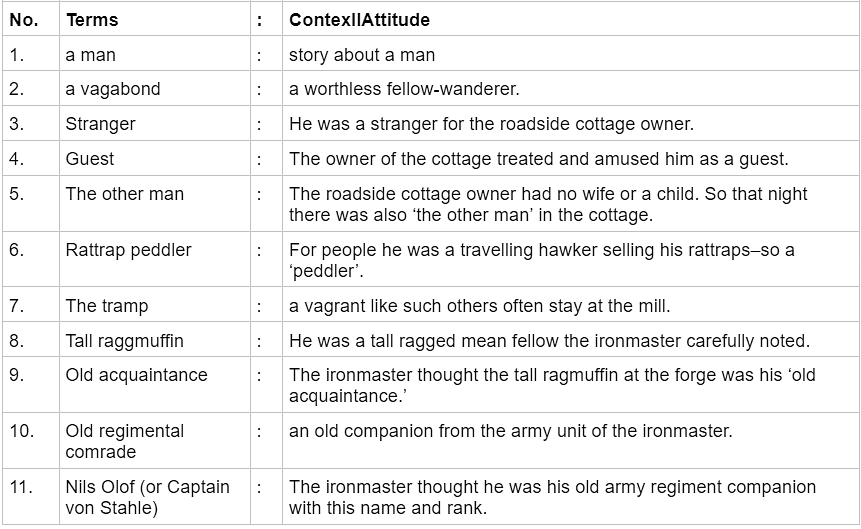
Q2: You came across the words, plod, trudge, stagger in the account. These words indicate movement accompanied by weariness. Find five other such words with a similar meaning.
Ans: Other words are lurch, stumble, slog, traipse, stomp.
Noticing Form
1. He made them himself at odd moments.
2. He raised himself.
3. He had let himself be fooled by a bait and had been caught.
4. ... a day may come when you may want to get a big piece of pork.
Notice how these reflexive pronouns have been used (pronoun + self)
In 1 and 4 the reflexive pronouns "himself" and "yourself" are used to convey emphasis.
In 2 and 3 the reflexive pronoun is used in place of the personal pronoun to signal that it refers to the same subject in the sentence.
Pick out other examples of the use of reflexive pronouns from the account and notice how they are used.
Ans: 1. As soon as anyone let himself be tempted to touch the bait, it closed in on him.
Here: The reflexive pronoun 'himself' refers back to the subject 'anyone' in the sentence.
2. Think of the people he knows who had let themselves be caught in the dangerous snare.
Here: The reflexive pronoun 'themselves' refers back to 'people'.
3. He had not come there to talk but only to warm himself and sleep.
Here: The reflexive pronoun 'himself' is used for emphasis.
4. He thought to go to the manor house would be like throwing himself voluntarily into the lion's den.
Here: The reflexive pronoun 'himself' adds emphasis to his imagined action.
5. You cannot show yourself there.
Here: The reflexive pronoun 'yourself' is used for emphasis.
Thinking about the Language
Q1: Notice the words in bold in the following sentence.
"The fire boy shovelled charcoal into the maw of the furnace with a great deal of clatter". This is a phrase that is used in the specific context of an iron plant.
Pick out other such phrases and words from the account that are peculiar to the terminology of ironworks.
Ans: Other such phrases and words include:
1. 'a hard regular thumping'
2. 'hammer strokes'
3. 'a large plant with smelter, rolling mill and forge'
4. 'pig iron'
5. 'coal dust'
6. 'put on the anvil'
Q2: Mjolis is a card game of Sweden.
Name a few indoor games played in your region. 'Chopar' could be an example.
Ans: Some indoor games are chess, ludo, table tennis, playing cards, billiards.
Q3: A crofter is a person who rents or owns a small farm especially in Scotland. Think of other uncommon terms for 'a small farmer' including those in your language.
Ans: Some other terms are peasant, ploughman, cultivator, krishak, kisan.
FAQs on NCERT Solutions - The Rattrap
| 1. What is the central theme of the story "Rattrap"? |  |
| 2. How does the rattrap seller view the world in the story? | |
| 3. What role does Edla play in the protagonist's transformation in the story? | |
| 4. How does the protagonist's perception of the world change by the end of the story? | |
| 5. What is the significance of the rattrap in the story? | |