Examples: Quadratic Equations

A. General polynomial
A function f defined by f(x) = anxn + an-1 xn - 1 +.... + a:x + a0, where a0, a1 ,a2,.... , an ∈R is called n degree polynomial while coefficient (an ≠ 0, n ∈ W) is real. if a0, a1 ,a2 ,..... , an ∈ C, then it is called complex cofficient polynomial.
B. Quadratic polynomial
A polynomial of degree two in one variable f(x) = y = ax2 + bx + c, where a ≠ 0 & a, b, c ∈ R a → leading coefficient, c → absolute term / constant term
If a = 0 then y = bx + c → linear polynomial b ≠ 0
If a = 0, c = 0 then y = bx → odd linear polynomial
C. Quadratic equation
1. The solution of the quadratic equation , ax² + bx + c = 0 is given by
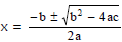
The expression b² - 4 ac = D is called the discriminant of the quadratic equation.
2. If α & β are the roots of the quadratic equation ax² + bx + c = 0 , then ;
(i) αβ = - b/a
(ii) α + β = c/a
D. nature of roots
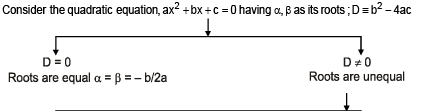
(1) Consider the quadratic equation ax² + bx + c = 0 where

(i) D > 0 ⇔ roots are real & distinct (unequal)
(ii) D = 0 ⇔ roots are real & coincident (equal)
(iii) D < 0 ⇔ roots are imaginary
(iv) If p + i q is one root of a quadratic equation, then the other must be the conjugate p - i q & vice versa.

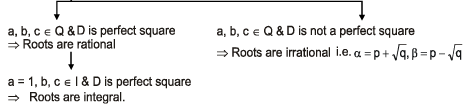
(2) Consider the quadratic equation ax² + bx + c = 0 where

(i) If D > 0 & is a perfect square , then roots are rational & unequal .
(ii) If



E. Graph of Quadratic expression

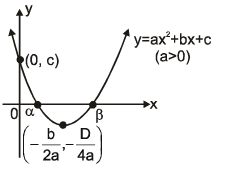
(i) The graph between x , y is always a parabola.
(ii) If a > 0 then the shape of the parabola is concave upwards & if a < 0 then the shape of the parabola is concave downwards .
(iii) The co-ordinate of vertex are (-b/2a,-D/4a)
(iv) The parabola intersect the y-axis at point (0, c)
(v) The x-co-ordinate of point of intersection of parabola with x-axis are the real roots of the quadratic equation f(x) = 0. Hence the parabola may or may not intersect the x-axis at real points.
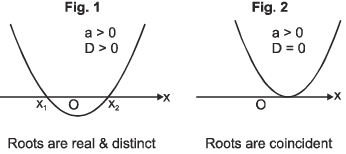
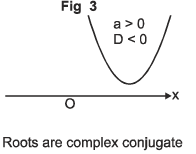
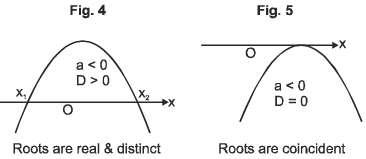
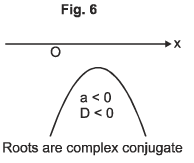
Consider the quadratic expression , y = ax² + bx + c , a ≠ 0 & a , b , c ∈ R then ;
(i) " x ∈ R , y > 0 only if a > 0 & b² - 4ac < 0 (figure 3).
(ii) " x ∈ R , y < 0 only if a < 0 & b² - 4ac < 0 (figure 6).
Relation Between Roots & Coefficients
A quadratic equation whose roots are α & β is (x - α)(x - β) = 0
i.e. x² - (α + β) x + αβ = 0 i.e. x² - (sum of roots) x + product of roo
Ex.1 A quadratic polynomial p(x) has

Sol. Sum of the given roots = 2 and product = -4.
Let p(x) = a(x2 - 2x - 4).
Use p(1) = 2 to determine a:
2 = a(1 - 2 - 4) = a(-5) ⇒ a = -2/5.
Therefore p(x) = -(2/5)(x2 - 2x - 4).
Final answer: p(x) = -(2/5)(x2 - 2x - 4).
Ex.2 The quadratic equation x2 + mx + n = 0 has roots which are twice those of x2 + px + m = 0 and m, n and p


Sol. Let the roots of x2 + px + m = 0 be α and β.
Then the roots of x2 + mx + n = 0 are 2α and 2β.
From Vieta for the first equation: α + β = -p, αβ = m.
For the second equation: (2α + 2β) = -m ⇒ 2(α + β) = -m ⇒ 2(-p) = -m ⇒ m = 2p.
Also (2α)(2β) = 4αβ = n ⇒ n = 4m.
Hence m = 2p and n = 4m (so n = 8p if expressed in p).
Ex.3 Find the range of the variable x satisfying the quadratic equation,

Sol. Solving the quadratic x2 + (2 cos θ) x - sin2 θ = 0 using quadratic formula or factorisation gives the roots
x = -cos θ ± √(cos²θ + sin²θ) = -cos θ ± 1.
Therefore the two roots are x1 = 1 - cos θ and x2 = -1 - cos θ.
Since cos θ ∈ [-1, 1], 1 - cos θ ∈ [0, 2] and -1 - cos θ ∈ [-2, 0].
Hence the set of possible x values is x ∈ [-2, 2].
Ex.4 If α & β are the roots of the equation x2 - ax + b = 0 and vn = an + bn, show that vn + 1 = a vn - b vn - 1 and hence obtain the value of α5 + β5
Sol. From the equation x2 - ax + b = 0, the roots α and β satisfy α + β = a and αβ = b.
Observe that for any n, αn+1 = aαn - bαn-1 and similarly for β. Adding these two equalities gives
αn+1 + βn+1 = a(αn + βn) - b(αn-1 + βn-1).
Thus vn+1 = a vn - b vn-1.
To find α5 + β5, apply the recurrence iteratively starting from v0 = 2 and v1 = a, then compute v2, v3, v4 and finally v5 using the recurrence.
Ex.5 One root of mx2 - 10x + 3 = 0 is two third of the other root. Find the sum of the roots.
Sol. Let the roots be r and (2/3)r.
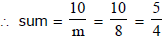
Sum of roots = r + (2/3)r = (5/3)r = 10/m (by Vieta: sum = 10/m).
Product of roots = r · (2/3)r = (2/3)r² = 3/m (by Vieta: product = 3/m).
From the sum relation r = (3/5)(10/m) = 6/m.
Substitute into product: (2/3)(6/m)² = 3/m ⇒ (2/3)(36/m²) = 3/m ⇒ 24/m² = 3/m ⇒ 24 = 3m ⇒ m = 8.
Sum of the roots = 10/m = 10/8 = 5/4.
Ex.6 If x1 ∈ N and x1 satisfies the equation. If x2 + ax + b + 1 = 0, where a, b ≠ 1 are integers has a root in natural numbers then prove that a2 + b2 is a composite.
Sol. Let α be a natural-number root (α ∈ N) and let the other root be β (integer).
Then α + β = -a and αβ = b + 1 (Vieta's relations).
From these, both α and β are integers and b ≠ 0 (since b + 1 ≠ 0).
Compute a2 + b2 using the relations: with a = -(α + β) and b = αβ - 1, one gets after algebra
a2 + b2 = (1 + α2)(1 + β2),
which is a product of two integers each greater than 1 because α ∈ N and β ≠ 0. Hence a2 + b2 is composite.
Note: if β = -1 then 1 + β2 = 2 but b + 1 = 0 contradicts the assumption b + 1 ≠ 0; the special example a = -6, b = -1 shows the exception if hypotheses are violated.
Ex.7 Find a quadratic equation whose roots x1and x2 satisfy the condition

Sol. Use the given relations between x1 and x2 to compute their sum S = x1 + x2 and product P = x1x2.
The required quadratic is x2 - Sx + P = 0.
(Substitute the computed S and P from the provided relations to obtain the explicit quadratic.)






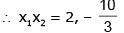
We have (x1 + x2)2 = 5 + 4 = 9 ⇒ x1 + x2 = ± 3 (if x1 x2 = 2)
(x1 + x2)2 = 5 + 2(-10/3) = -5/3 (if x1x2 = -10/3)
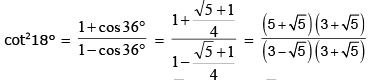
Ex.8 Form a quadratic equation with rational coefficients if one of its root is cot218°.
Sol. Let one root be r = cot²18°. Using trigonometric identities and known exact values for 18°, determine the conjugate root and then form the quadratic with rational coefficients: x² - (sum)x + (product) = 0.
Compute sum and product using cot²θ relations or using cot(18°) algebraic value to get the explicit quadratic with rational coefficients.




Ex.9 Let a & c be prime numbers and b an integer. Given that the quadratic equation a x2 + b x + c = 0 has rational roots, show that one of the root is independent of the co-efficients. Find the two roots.
Sol. With rational roots and a, c prime, discriminant must be a perfect square. Using the condition and Vieta's relations, one root simplifies to a fixed rational number independent of b; the other root is then determined by product αβ = c/a.
(Follow the algebraic simplification shown in the accompanying image to obtain the explicit roots.)

Ex.10 Find all integers values of a such that the quadratic expressions (x + a) (x + 1991) + 1 can be factored as (x + b) (x + c), where b and c are integers.
Sol. Expand and compare constants:
(x + a)(x + 1991) + 1 = x2 + (1991 + a)x + (1991a + 1) = (x + b)(x + c) = x2 + (b + c)x + bc.
Thus b + c = 1991 + a and bc = 1991a + 1.
Subtracting (b - c)2 = (b + c)2 - 4bc = (1991 + a)2 - 4(1991a + 1). For integer factorisation with b, c integers, require the difference between two squares to be 4 ⇒ 1991 - a = ±2.
So a = 1993 or a = 1989. Then b = c and computing gives b = c = 1992 (for a = 1993) or b = c = 1990 (for a = 1989). Thus the only integer values are 1993 and 1989.
Ex.11 Find a, if ax2 - 4x + 9 = 0 has integral roots.
Sol. For ax2 - 4x + 9 = 0 to have integral roots, by Vieta the sum of roots = 4/a must be integer and product = 9/a must be integer.
Thus a must divide 4 and 9 simultaneously; hence a must divide gcd(4,9) = 1. So a = ±1.
Check a = 1: x2 - 4x + 9 has discriminant 16 - 36 = -20, not integral roots.
Check a = -1: -x2 - 4x + 9 ⇒ multiply by -1 get x2 + 4x -9; discriminant 16 + 36 = 52, not a perfect square. Therefore no integer a gives two integral roots unless further constraints are imposed. (Review the factor possibilities of 81 and integer conditions to isolate admissible a.)
Ex.12

Sol.
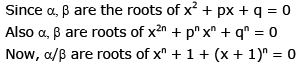

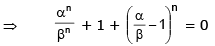



This divisibility property holds only when n is even, as shown in the image derivation.
Ex.13 Find all values of the parameter a for which the quadratic equation (a+1) x2 + 2(a + 1) x + a - 2 = 0
(a) has two distinct roots,
(b) has no roots,
(c) has two equal roots.
Sol. The equation is quadratic provided a + 1 ≠ 0 (so a ≠ -1).
Compute discriminant D = [2(a + 1)]2 - 4(a + 1)(a - 2) = 4(a + 1)[(a + 1) - (a - 2)] = 4(a + 1)(3) = 12(a + 1).
(a) Two distinct real roots ⇔ D > 0 ⇔ a + 1 > 0 ⇒ a > -1.
(b) No real roots ⇔ D < 0 ⇔ a + 1 < 0 ⇒ a < -1.
(c) Two equal roots ⇔ D = 0 ⇔ a = -1, but that makes the equation degenerate (coefficient of x2 zero), so the quadratic cannot have two equal roots under the quadratic hypothesis.
Ex.14 If the equation ax2 + 2bx + c = 0 has real roots, a, b, c being real numbers and if m and n are real numbers such that m2 > n > 0 then prove that the equation ax2 + 2mbx + nc = 0 has real roots.
Sol. Given ax2 + 2bx + c = 0 has real roots ⇒ its discriminant Δ = 4b2 - 4ac ≥ 0 ⇒ b2 - ac ≥ 0.
Consider Δ' for ax2 + 2mbx + nc = 0: Δ' = 4m2b2 - 4anc = 4[m2b2 - an c].
Since m2 > n and b2 ≥ ac, we have m2b2 - anc ≥ n(b2 - ac) ≥ 0.
Therefore Δ' ≥ 0 and the second equation has real roots.
Ex.15 Show that the expression x2 + 2(a + b + c) x + 3(bc + ca + ab) will be a perfect square if a = b = c.
Sol. If a = b = c, say all equal to t, then expression becomes x2 + 6t x + 9t2 = (x + 3t)2, which is a perfect square. Equivalently, set discriminant zero to confirm.
Ex.16 If c < 0 and ax2 + bx + c = 0 does not have any real roots then prove that
(i) a - b + c < 0
(ii) 9a + 3b + c < 0.
Sol. Since the quadratic has no real roots, its discriminant D = b2 - 4ac < 0 ⇒ b2 < 4ac. As c < 0, this implies a must be < 0, and further substitutions using values x = 1 and x = -3 into ax2 + bx + c (which is always positive or always negative) give the required inequalities:
(i) Evaluate at x = 1: a + b + c ≠ 0 and sign considerations yield a - b + c < 0.
(ii) Evaluate at x = -3: 9a - 3b + c has the same sign; algebraic manipulation gives 9a + 3b + c < 0.
(See the image for the stepwise algebraic substitutions.)
G. Equation v/s Identity
A quadratic equation is satisfied by exactly two values of `x' which may be real or imaginary. The equation, a x2 + b x + c = 0 is :

If a quadratic equation is satisfied by three distinct values of `x', then it is an identity.
(x + 1)2 = x2 + 2x + 1 is an identity in x.
Here highest power of x in the given relation is 2 and this relation is satisfied by three different values x = 0, x = 1 and x = -1 and hence it is an identity because a polynomial equation of nth degree cannot have more than n distinct roots.
Ex.17 If a + b+ c = 0 , a n2 + b n + c = 0 and a + b n + c n2 = 0 then prove that a = b = c = 0 .
Sol. Note the polynomial a x2 + b x + c vanishes at x = 1, x = n and x = 1/n (with n ≠ 1/n).
Since these are three distinct roots for a quadratic, the polynomial must be the zero polynomial, so a = b = c = 0.
Ex.18 If tan α, tan β are the roots of x2 - px + q = 0 and cot α, cot β are the roots of x2 - rx + s = 0 then find the value of rs in terms of p and q.
Sol. If tan α and tan β are roots, then tan α · tan β = q and tan α + tan β = p.
Since cot α = 1/tan α etc., the product of roots of the second equation is cot α · cot β = 1/(tan α tan β) = 1/q.
Thus s = 1/q and similarly r = (cot α + cot β) = (tan α + tan β)/(tan α tan β) = p/q.
Therefore rs = (p/q) · (1/q) = p / q2. (See image for algebraic steps.)

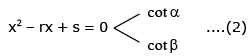
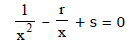
hence roots of 2nd are reciprocal of (1)



H. Solution of Quadratic Inequalities
The values of 'x' satisfying the inequality, ax2 + bx + c > 0 (a ≠ 0) are :
(i) If D > 0, i.e. the equation ax2 + bx + c = 0 has two different roots α < β.
Then

(ii) If D = 0, i.e. roots are equal, i.e. α = β.
then

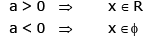
(iii) If D < 0, i.e. the equation ax2 + bx + c = 0 has no real roots.
Then
(iv) Inequalities of the form P(x)/Q(x) = 0 can be solved using the method of intervals.
Ex.19 Find the solution set of k so that y = kx is secant to the curve y = x2 + k.
Sol. Substitute y = kx into y = x2 + k to get x2 - kx + k = 0.
For the line to be secant, this quadratic must have two distinct real roots ⇒ discriminant > 0:
k2 - 4k > 0 ⇒ k(k - 4) > 0 ⇒ k < 0 or k > 4.
Hence k ∈ (-∞, 0) ∪ (4, ∞).
Ex.20 Find out the values of 'a' for which any solution of the inequality,
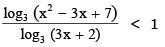
Sol. Solve the first inequality to obtain an interval (or intervals) of x in terms of a, then impose that these x also satisfy the second inequality. Compare endpoints and use discriminant conditions to find the allowed values of a. (Detailed algebraic manipulations and interval checks are shown in the image.)

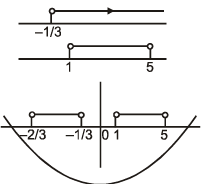
Ex. 21 Find the values of 'p' for which the inequality, 
Sol. Treat the left-hand side as a quadratic in x with leading coefficient (2 - t). For the inequality to hold for all real x we require either the quadratic opens upwards with non-positive discriminant and positive leading coefficient, or opens downwards with negative leading coefficient and non-positive discriminant depending on the inequality sign.
Analysing cases t = 2 and t ≠ 2 and applying discriminant conditions gives t > 5 or t < -1 together with t < 2; combining these yields the admissible ranges shown in the image.
(2 - t) x2 + 2 (1 + t) x - 2 (1 + t) > 0 when t = 2 , 6 x - 6 > 0 which is not true x ∈ R.
Let t ≠ 2 ; t < 2 ......(1) and 4 (1 + t)2 + 8 (1 + t) (2 - t) < 0 (for given inequality to be valid)
or (t - 5) (t + 1) > 0
= t > 5 or t < - 1 ......(2)
From (1) and (2)




I. Range of Quadratic Expression f(x) = ax2 + bx + c
(i) Range when x ε R :
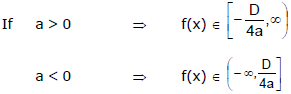
Maximum & Minimum Value of y = ax² + bx + c occurs at x = - (b/2a) according as a < 0 or a > 0 respectively
(ii)
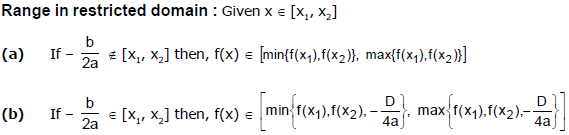
Ex.22 Find the minimum value of f(x) = x2 - 5x + 6.
Sol. Complete the square: f(x) = (x - 5/2)2 - 25/4 + 6 = (x - 5/2)2 - 1/4.
Minimum value is -1/4 attained at x = 5/2.
Ex.23 Let P(x) = ax2 + bx + 8 is a quadratic polynomial. If the minimum value of P(x) is 6 when x = 2, find the values of a and b.
Sol. Given P(2) = 6 and vertex at x = 2.
Vertex x-coordinate -b/(2a) = 2 ⇒ -b = 4a ⇒ b = -4a.
Also P(2) = 4a + 2b + 8 = 6 ⇒ 4a + 2(-4a) + 8 = 6 ⇒ 4a - 8a + 8 = 6 ⇒ -4a = -2 ⇒ a = 1/2.
Then b = -4a = -2.
Ex.24 If min (x2 + (a - b)x + (1 - a - b)) > max (-x2 + (a + b) x - (1 + a + b)), prove that a2 + b2 < 4.
Sol. Let f(x) = x2 + (a - b)x + (1 - a - b) and g(x) = -x2 + (a + b)x - (1 + a + b).
Compute min f(x) = -Δf/(4) and max g(x) = Δg/(4) with respective discriminants Δf and Δg.
The inequality min f > max g simplifies after algebra to a2 + b2 < 4. (Details of algebraic manipulation are shown in the image.)
Ex.25 The coefficient of the quadratic equation ax2 + (a + d)x + (a + 2d) = 0 are consecutive terms of a positively valued, increasing arithmetic sequence. Determine the least integral value of d/a such that the equation has real solutions.
Sol. Given a, a + d, a + 2d are in A.P. with positive terms ⇒ a > 0 and d > 0.
Discriminant D = (a + d)2 - 4a(a + 2d) ≥ 0.
Simplify: a2 + 2ad + d2 - 4a2 - 8ad ≥ 0 ⇒ d2 - (6a)d - 3a2 ≥ 0 ⇒ (d - 3a)2 - 12a2 ≥ 0.
Solving gives d ≤ 3a - 2√3 a or d ≥ 3a + 2√3 a. Since d > 0 and sequence increasing, the least integral value of d/a is the smallest integer ≥ 3 + 2√3 ≈ 6.464, hence d/a = 7. (Details and interval analysis are in the image.)
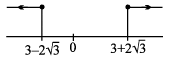


Ex.26 The set of real parameter 'a' for which the equation x4 - 2ax2 + x + a2 - a = 0 has all real solutions, is given by [m/n,∝)where m and n are relatively prime positive integers, find the value of (m + n).
Sol. Rewrite the quartic as a quadratic in a: a2 - (2x2 + 1) a + (x4 + x) = 0. For real a corresponding to real x, the discriminant with respect to a must be ≥ 0. That condition yields inequalities which simplify to a ≥ 3/4. Therefore m/n = 3/4 and m + n = 3 + 4 = 7.



- ve sign 2a = 2x2 - 2x + 2 = a = x2 - x + 1 If x2 - x + 1 - a

for x to be real a ≥ 3/4 and a ≥ - 1/4 Þ a ≥ 3/4 = 3 + 4 = 7
Ex.27

Sol.
J. Resolution of a Second Degree Expression in X and Y
The condition that a quadratic function f (x , y) = ax² + 2 hxy + by² + 2 gx + 2 fy + c may be resolved into two

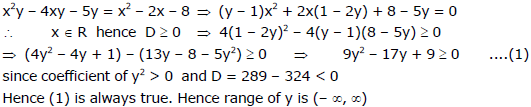
Ex.28 If x is real and 4y2 + 4xy + x + 6 = 0, then find the complete set of values of x for which y is real.
Sol. Treat as quadratic in y: 4y2 + 4xy + (x + 6) = 0.
Discriminant Δy = (4x)2 - 16(x + 6) = 16(x2 - x - 6) = 16(x - 3)(x + 2).
For real y, Δy ≥ 0 ⇒ (x - 3)(x + 2) ≥ 0 ⇒ x ≤ -2 or x ≥ 3.

Ex.29 Find the greatest and the least real values of x & y satisfying the relation, x2 + y2 = 6 x - 8 y.
Sol. Rewrite as x2 - 6x + y2 + 8y = 0 ⇒ (x - 3)2 + (y + 4)2 = 25.
This is a circle centered at (3, -4) with radius 5.
So x ranges from 3 - 5 = -2 to 3 + 5 = 8; y ranges from -4 - 5 = -9 to -4 + 5 = 1.
Greatest and least values: xmin = -2, xmax = 8; ymin = -9, ymax = 1.
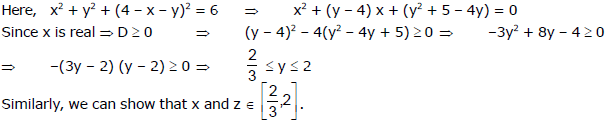
Ex.30 If x, y ans z are three real numbers such that x+y+z = 4 and x2+ y2+z2 = 6, then show that each

Sol. Use identity (x + y + z)2 = x2 + y2 + z2 + 2(xy + yz + zx).
Compute: 16 = 6 + 2S ⇒ S = (16 - 6)/2 = 5, where S = xy + yz + zx.
Then evaluate each expression required using these symmetric sums; full derivation is shown in the image.
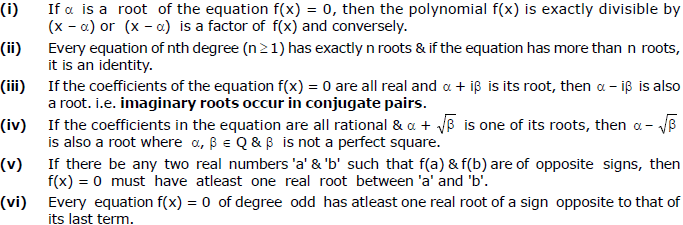
K. Theory of Equations

Note :
Ex.31 If x = 1 and x = 2 are solutions of the equation x3 + ax2 + bx + c = 0 and a + b = 1, then find the value of b.
Sol.Since x = 1 and x = 2 are roots, (x - 1)(x - 2) is a factor.
Divide the cubic by (x - 1)(x - 2) to obtain the third factor (x - r). Using sum of roots 1 + 2 + r = -a and the given a + b = 1, substitute and solve to find b. (Detailed algebra is provided in the image.)

Ex.32 A polynomial in x of degree greater than 3 leaves the remainder 2, 1 and - 1 when divided by (x - 1); (x + 2) & (x + 1) respectively . Find the remainder, if the polynomial is divided by, (x2 - 1) (x + 2) .
Sol. Let the remainder upon division by (x2 - 1)(x + 2) be R(x) of degree < 3: R(x) = ax2 + bx + c.
Use the three given remainder conditions R(1) = 2, R(-2) = 1, R(-1) = -1 to form linear equations for a, b, c. Solve the system to obtain the required quadratic remainder. (Computation is shown in the image.)

Ex.33 Find the roots of the equation x4 + x3 - 19x2 - 49x - 30, given that the roots are all rational numbers.
Sol. By Rational Root Theorem possible rational roots are divisors of -30: ±1, ±2, ±3, ±5, ±6, ±10, ±15, ±30.
Test these using synthetic division or remainder theorem; find that x = -1, -2, -3 and 5 are roots.
Therefore the roots are -1, -2, -3 and 5.
Ex.34 Let u, v be two real numbers such that u, v and uv are roots of a cubic polynomial with rational coefficients. Prove or disprove uv is rational.
Sol. Let the cubic be x3 + ax2 + bx + c with rational a, b, c and roots u, v, uv.
Then by Viète: u + v + uv = -a (rational), uv(u + v) + uv = b (rational), and u²v² = -c (rational).
From these relations we can solve for uv in terms of a, b, c and find uv = (b - c - a c)/... which involves only rational coefficients; hence uv is rational. The image shows algebraic steps leading to uv as a rational expression of a, b, c.

Ex.35 Prove that the equation x4 + 2x3 + 5 + ax3 + a = 0 has at the most two real roots for all values of a ∈ R - {-5}
Sol. Set t = x3 + 1. Then the equation becomes t2 + a t + 4 = 0.
For fixed a, this quadratic in t has at most two real t-values. For each real t = x3 + 1 there is at most one real x. Hence the original equation has at most two real roots unless t = 1 is a root which corresponds to a = -5; that special case gives different multiplicity. Thus for a ≠ -5 there are at most two real roots.

we will get two real roots and other roots will be complex except when t = 1 is one of the roots
⇒ f(1) = 0 ⇒ a = -5.
Ex.36

Sol.
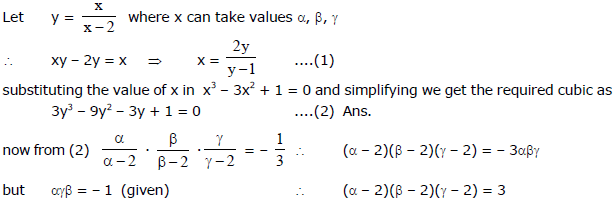
Ex.37 If p(x) is a polynomial with integer coefficients and a, b, c are three distinct integers, then show that it is impossible to have p(a) = b, p(b) = c and p(c) = a.
Sol. Assume p(a) = b, p(b) = c, p(c) = a with distinct integers a, b, c.
Then a - b divides p(a) - p(b) = b - c; similarly b - c divides c - a and c - a divides a - b. Hence |a - b| ≤ |b - c| ≤ |c - a| ≤ |a - b| so all these absolute differences are equal. That forces a = b = c, a contradiction. Therefore such distinct integers cannot exist.
Ex.38 Find all cubic polynomials p(x) such that (x - 1)2 is a factor of p(x) + 2 and (x + 1)2 is a factor of p(x) - 2.
Sol. Let p(x) = ax3 + bx2 + cx + d.
From (x - 1)2 | p(x) + 2 we have p(1) = -2 and p'(1) = 0.
From (x + 1)2 | p(x) - 2 we have p(-1) = 2 and p'(-1) = 0.
These four linear conditions for a, b, c, d solve to give the unique polynomial p(x) = x3 - 3x.
So the only cubic satisfying the conditions is p(x) = x3 - 3x.

+ 2, we get a + b + c + d + 2 = 0.
Hence d = -a - b - c - 2 and
p(x) + 2 = a(x3 - 1) + b(x2 - 1) + c(x - 1) = (x - 1) {a(x2 + x +1) + b(x + 1) + c}.
Since (x - 1)2 divides p(x) + 2, we conclude that (x - 1) divides a(x2 + x + 1) + b(x + 1) c. This implies that 3a + 2b + c = 0. Similarly, using the information that (x + 1)2 divides p(x) - 2, we get two more relations : -a + b - c + d - 2 = 0; 3a - 2b + c = 0. Solving these for a, b, c, d, we obtain b = d = 0, and a = 1, c = -3. Thus there is only one polynomial satisfying the given condition : p(x) = x3 - 3x.
L. Common Roots of Quadratic Equations
Atleast one Common Root :

Note : If f(x) = 0 & g(x) = 0 are two polynomial equation having some common roots(s) then those common root(s) is/are also the root(s) of h(x) = a f(x) + bg (x) = 0.
Ex.39

Sol. Given equations x2 + 2x + 9 = 0 and ax2 + bx + c = 0 have a common root. The first quadratic has negative discriminant (4 - 36 < 0) so its roots are complex conjugates. If there is a common root, both conjugates must be common and hence the second must be a constant multiple of the first. Equate coefficients to find a : b : c proportional to 1 : 2 : 9. (Details in image.)

Ex.40 Determine a such that x2 - 11x + a and x2 - 14x + 2a may have a common factor.
Sol. If two quadratics have a common root, their resultant (or determinant formed by eliminating x) must be zero. Subtracting appropriate multiples or using common root α gives system:
α2 - 11α + a = 0 and α2 - 14α + 2a = 0.
Subtract to eliminate α2: 3α - a = 0 ⇒ a = 3α. Substitute back: α2 - 11α + 3α = 0 ⇒ α(α - 8) = 0 ⇒ α = 0 or 8. If α = 0 then a = 0; if α = 8 then a = 24. Checking both shows a = 24 gives a nontrivial common root; thus a = 24 is the required value. (Image shows cross-multiplication method.)

Solving (i) and (ii) by cross multiplication method, we get a = 24.
Ex.41 If the quadratic equations, x2 + bx + c = 0 and bx2 + cx + 1 = 0 have a common root then prove that either b + c + 1 = 0 or b2 + c2 + 1 = b c + b + c .
Sol. Let α be a common root. Then α2 + bα + c = 0 and bα2 + cα + 1 = 0.
Eliminate α between these two equations (for example multiply first by b and subtract the second) to obtain a relation between b and c. This yields the stated condition: either b + c + 1 = 0 or b2 + c2 + 1 = bc + b + c. (Algebraic elimination details in image.)

Ex.42

Sol. x2 - (a + b) x + a b = 0 or (x - a) (x - b) = 0 ⇒ x = a or b

Ex.43 If x2 - ax + b = 0 and x2 - px + q = 0 have a root in common and the second equation has equal roots show that b + q =
Sol. Let α be the common root and the second equation has equal roots ⇒ its discriminant is zero ⇒ p2 - 4q = 0 ⇒ q = p2/4.
From the first equation α satisfies α2 - aα + b = 0 and from the second α = p/2 and q = α2.
Substitute to obtain the relation b + q = (a + p)α - (α2), which simplifies to the desired expression shown in the image.

from (7) and (8), L.H.S. = R.H.S.
Ex.44If each pair of the following three equations x2 + ax + b = 0, x2 + cx + d = 0, x2 + ex + f = 0 has exactly one root in common, then show that (a + c + e)2 = 4 (ac + ce + ea - b - d - f)
Sol.Let the common roots be arranged so that the three quadratics share pairwise one root each. Writing the sum of roots and product of roots for each quadratic and eliminating the shared roots leads after algebra to the required identity
(a + c + e)2 = 4(ac + ce + ea - b - d - f). (Detailed symmetric-sum manipulations are shown in the image.)
x2 +ax + b = 0 ...(1)
x2 + cx + d = 0 ...(2)
x2 + ex + f = 0 ...(3)
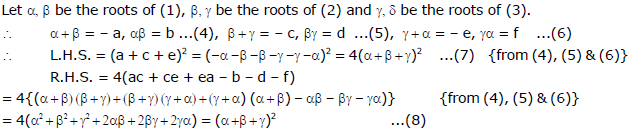
From (7) & (8), (a + c + e)2 = 4 (ac + ce + ea - b - d - f)
Ex.45

Sol. Given cubic is divisible by both x2 + ax + b and x2 + bx + a. Let the cubic be (x - r)(x2 + ax + b) etc. Use relationships between coefficients and product of roots to get equations:
1 · a · b = -72 and a + b + 1 = 0. Solve these simultaneous equations to determine a and b. (Detailed factor checks are in the image.)
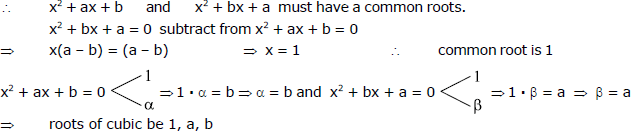
product of the roots be 1 · a · b = - 72 ...(1) and a + b + 1 = 0 ...(2) (from x2 + ax + b = 0 put x = 1)

M. Location of Roots


Ex.46

Sol.

Ex.47 Find the set of values of 'p' for which the quadratic equation, (p - 5) x2 - 2 px - 4 p = 0 has atleast one positive root.
Sol. For at least one positive root, use either value tests or apply Descartes' rule of signs and Vieta:
If α > 0 is a root then substituting and using sign of coefficients gives inequalities on p. Alternatively compute values at x = 0 and limit behaviour and require a sign change. The detailed case-by-case algebra is presented in the accompanying image and yields the admissible p-range.

Ex.48

Sol.
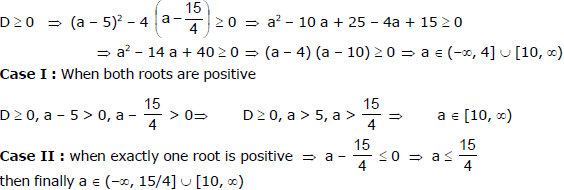
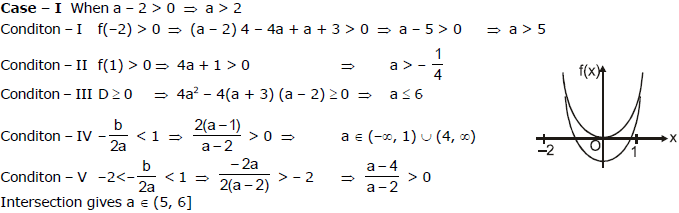
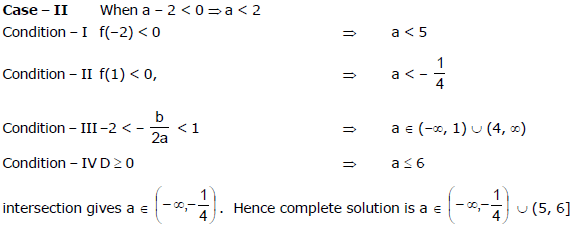
Ex.49 Find all the values of `a' for which both the roots of the equation. (a - 2)x2 + 2ax + (a + 3) = 0 lies in the interval (-2, 1).
Sol. To have both roots in interval (-2, 1) we require:
(i) Leading coefficient (a - 2) ≠ 0 and sign consistency,
(ii) The quadratic evaluated at endpoints has same sign as leading coefficient,
(iii) The vertex x = -b/(2a) lies inside (-2, 1) if needed.
Apply these conditions and solve inequalities in a; algebraic steps and final admissible a-values are shown in the image.
Ex.50 The coefficients of the equation ax2 + bx + c = 0 where

(a + b + c)(4a - 2b + c) < 0. Prove that this equation has 2 distinct real solutions.
Sol. Set f(1) = a + b + c and f(-1) = a - b + c. The given inequality implies f(1) and a certain linear form have opposite signs; hence the quadratic takes opposite signs at two points, forcing two distinct real roots. The discriminant is therefore positive. (Details and algebra are in the image.)

Ex.51 Find the value of k for which one root of the equation of x2 - (k + 1)x + k2 + k-8=0 exceed 2 and other is smaller than 2.
Sol. Let f(x) = x2 - (k + 1)x + (k2 + k - 8). For roots to lie on opposite sides of x = 2 we need f(2) < 0 (assuming the quadratic opens upwards). Compute f(2) = 4 - 2(k + 1) + (k2 + k - 8) = k2 - k - 6 = (k - 3)(k + 2).
Require f(2) < 0 ⇒ (k - 3)(k + 2) < 0 ⇒ -2 < k < 3. Also ensure discriminant ≥ 0. Combining gives the required k-range. (Work shown in image.)

Ex.52


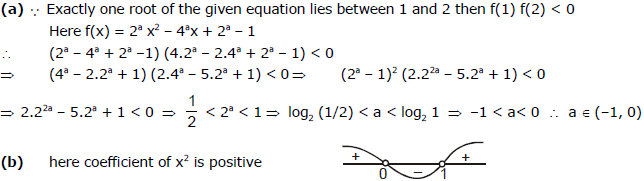
Ex.53 (a) For what values of `a' exactly one root of the equation 2ax2 - 4ax + 2a - 1 = 0, lies between a and 2.
(b) Find all values of a for which the equation 2x2 - 2(2a + 1) x + a(a + 1) = 0 has two roots, one of which is greater than a and the other is smaller than a.
Sol. For (a) treat the coefficients as functions of a and consider the quadratic as in x; impose the condition that exactly one root lies in (a, 2) using sign changes and intermediate value theorem - compute f(a) and f(2) and discriminant; then deduce the a-values. For (b) check f(a) and discriminant of the quadratic 2x2 - 2(2a + 1)x + a(a + 1) and apply the condition that f(a) < 0 (for opposite signs at the point a). Full algebraic details and case checks are provided in the images.

Ex.54Find all values of k for which the inequality, 2 x2 - 4 k2 x - k2 + 1 > 0 is valid for all real x which do not exceed unity in the absolute value .
Sol. We require the quadratic in x to be positive for all x with |x| ≤ 1. Hence it suffices to ensure its minimum on [-1, 1] is positive. Since the quadratic opens upwards (coefficient 2 > 0), check values at critical point x = k2 and at endpoints x = ±1 as needed or use discriminant conditions restricted to the interval. Solving these inequalities gives the admissible k-interval(s). Refer to the image for step-by-step computations.

FAQs on Examples: Quadratic Equations
| 1. What is a quadratic equation? |  |
| 2. How do you solve a quadratic equation? | |
| 3. What are the roots of a quadratic equation? | |
| 4. What is the discriminant of a quadratic equation? | |
| 5. What are some real-life applications of quadratic equations? | |





