Introduction to the Constitution of India & Preamble


What is the Constitution of India?
The Constitution of India is the supreme law of the land and the cornerstone of India's democratic system. It provides the legal and institutional framework for governance, defines the powers of different organs of government, sets out the rights and duties of citizens, and expresses the basic values and objectives of the nation.
The Constitution was adopted on 26 November 1949 and came into force on 26 January 1950. At the time of adoption it was the longest written constitution in the world, originally containing 395 Articles, 22 Parts, and 8 Schedules. Following many amendments, including the 105th Amendment (2021), the Constitution presently contains about 448 Articles, 25 Parts, and 12 Schedules, and it continues to be the living document that guides India's polity and public law.
Historical Background
Constituent Assembly
- The Constituent Assembly was set up in December 1946 under the Cabinet Mission Plan to frame the Constitution for independent India.
- It initially had 389 members; after the partition of India its membership reduced to 299.
- The Assembly met for the first time on 9 December 1946. Dr. Sachchidanand Sinha acted as temporary Chairman and Dr. Rajendra Prasad was later elected President of the Constituent Assembly.
- The Drafting Committee, charged with preparing the text of the Constitution, was formed on 29 August 1947 and was chaired by Dr. B.R. Ambedkar, who is widely regarded as the principal architect of the Indian Constitution.
Key Figures Involved in Drafting
- Dr. B.R. Ambedkar - Chairman of the Drafting Committee; led preparation of the final text and detailed provisions.
- Jawaharlal Nehru - Introduced the Objectives Resolution that shaped the Preamble and the guiding ideals of the Constitution.
- Sardar Vallabhbhai Patel - Oversaw integration of princely states and committees on provincial constitutions.
- Other important contributors: B.N. Rau (Chief Drafting Officer), K.M. Munshi, and Alladi Krishnaswamy Ayyar.
Timeline of Adoption and Enforcement
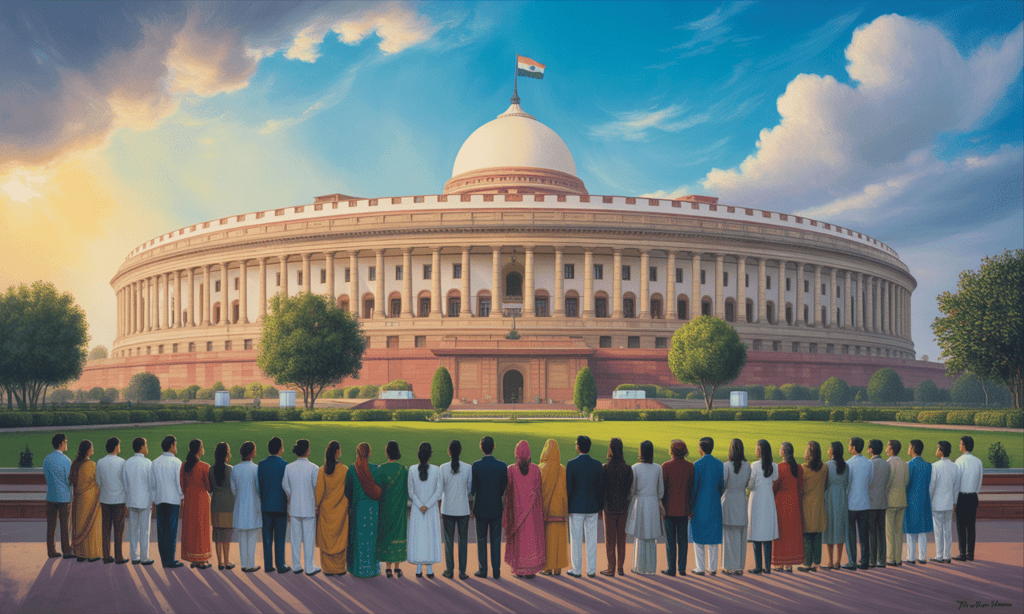
- Adopted: 26 November 1949 (now observed as Constitution Day)
- Enforced: 26 January 1950 (Republic Day)
Influences on the Indian Constitution
- Government of India Act, 1935: Provided administrative structure, federal features and emergency provisions.
- U.S. Constitution: Inspired the concept of Fundamental Rights and judicial review.
- British Constitution: Contributed parliamentary system, rule of law, and legislative procedures.
- Irish Constitution: Influenced the Directive Principles of State Policy.
- Canadian Constitution: Influenced the federal structure balancing central and provincial powers.
- Australian Constitution: Influenced the idea of a concurrent list of legislative powers.
- German (Weimar) Constitution: Provided models for emergency provisions.
Salient Features of the Indian Constitution
- World's Longest Written Constitution
The Constitution was originally extensive in length and detail to cover a vast and diverse country. It combines features of both federal and unitary systems and accommodates varied legal traditions and social needs.
- Federal with Unitary Bias
India is a quasi-federal state where powers are distributed between the Union and States under the Seventh Schedule. At the same time, the Constitution contains unitary features that allow the Centre to act strongly in times of emergency or national need.
- Division of powers: Union List, State List, Concurrent List (Seventh Schedule).
- Unitary features: single citizenship, strong central law-making power on key subjects, and emergency provisions.
- Parliamentary Democracy
India follows the Westminster model where the executive is accountable to the legislature. The President is the constitutional head of state, while the Prime Minister and Council of Ministers exercise real executive authority and are responsible to the Lok Sabha.
- Legislature is bicameral at the Union level: Lok Sabha (House of the People) and Rajya Sabha (Council of States).
- The executive is collectively responsible to the Lok Sabha.
- Fundamental Rights (Articles 12-35)
These are justiciable rights guaranteeing personal liberty, equality, freedom of expression, and other civil liberties. Citizens can approach courts for enforcement. The main categories include:
- Right to Equality, Right to Freedom, Right against Exploitation, Right to Freedom of Religion, Cultural and Educational Rights, and Right to Constitutional Remedies.
- Directive Principles of State Policy (Articles 36-51)
These are guidelines for the State to establish socio-economic justice, such as provisions for free education, equitable distribution of resources, and welfare measures. They are non-justiciable but influential in policy-making.
- Fundamental Duties (Article 51A)
Introduced by the 42nd Amendment (1976) on the recommendations of the Swaran Singh Committee. There are eleven duties that promote responsible citizenship, respect for the Constitution, protection of the environment, and national values.
- Independent Judiciary
• Supreme Court (Article 124): Acts as the final interpreter of the Constitution.
• High Courts (Article 214): Ensure justice is served at the state level.
• Judicial Review: Grants courts the power to examine laws and executive actions, preventing violation - Secularism
The State maintains neutrality in religious matters and affords equal respect and protection to all religions. The Indian model of secularism guarantees freedom of belief and worship to every citizen.
- Socialism
India's constitutional vision includes reducing income and social inequalities and promoting welfare policies to secure socio-economic justice.
- Universal Adult Suffrage (Article 326)
Every citizen who is 18 years of age or older has the right to vote, irrespective of caste, creed, gender, religion, or education-this ensures political equality.
- Amendability
The Constitution provides for amendment under Article 368. Amendments may be by simple majority, special majority, or special majority with state ratification depending on the subject matter. However, the Basic Structure Doctrine (Kesavananda Bharati v. State of Kerala, 1973) limits Parliament's power to amend the fundamental features of the Constitution.
- Emergency Provisions
Special provisions allow the Centre to meet extraordinary situations:
- National Emergency (Article 352) - declared in case of war, external aggression, or armed rebellion.
- State Emergency/President's Rule (Article 356) - when governance in a state cannot be carried on according to the Constitution.
- Financial Emergency (Article 360) - when the financial stability or credit of India is threatened.
Structure of the Constitution
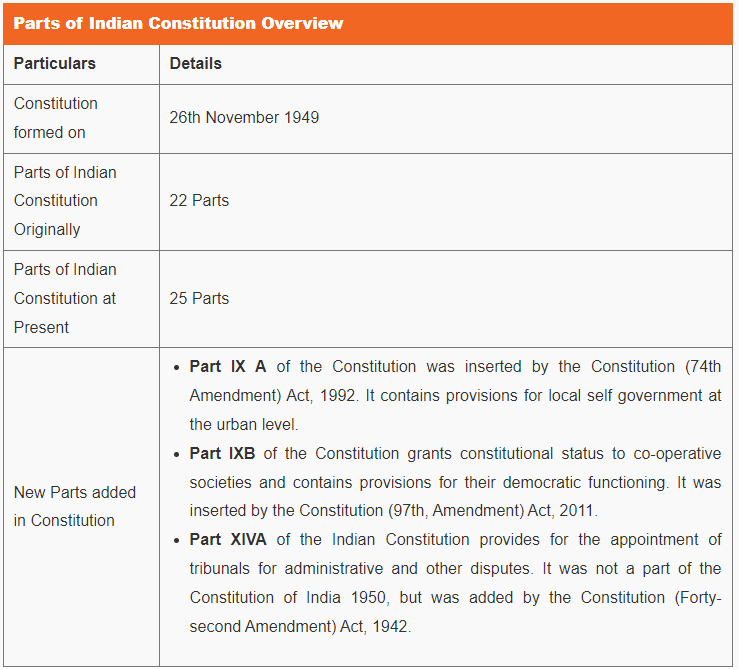
- Parts: The Constitution is divided into Parts dealing with themes such as the Union, States, Fundamental Rights, Directive Principles, etc. It originally had 22 Parts; new Parts have been added by amendments and it now has around 25 Parts.
- Schedules: The Schedules are annexures containing detailed lists and statutory forms; there are 12 Schedules at present.
- Articles: The Constitution contains over 450 Articles in its present form (originally 395).
- Preamble: The introductory statement expressing the philosophy and basic objectives of the Constitution.
List of Parts
The Constitution is organised into Parts that group provisions by subject matter. New Parts have been inserted by amendments such as Part IX-A (Municipalities), Part IX-B (Co-operative Societies), and Part XIV-A (Tribunals). These insertions increased the total number of Parts to 25.
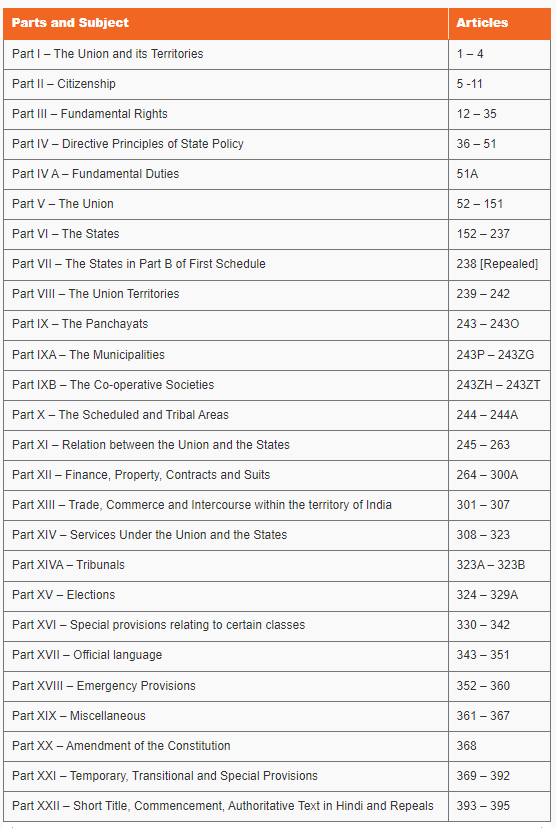
Try yourself: Which part of the Indian Constitution deals with Official Language?
Schedules of the Constitution
The Schedules contain supplementary and technical details that support the main text of the Constitution. They were meant to organise complex lists and make the Constitution easier to use. Originally there were 8 Schedules in 1950; new Schedules were added later to take the total to 12.
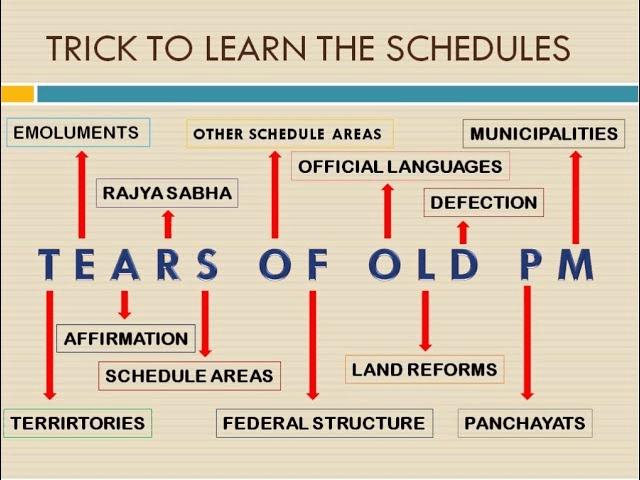
First Schedule: Lists the States and Union Territories of India.
- Contains the names and territories of States and Union Territories as recognised in the Constitution.
Second Schedule: Contains provisions relating to the emoluments and allowances of high constitutional offices and officials.
- Includes details about the President of India, Governors, Speakers and Deputy Speakers of Houses, Chairmen and Deputy Chairmen of Councils, Judges of the Supreme Court and High Courts, and the Comptroller & Auditor General of India.
Third Schedule: Forms of Oaths and Affirmations.
- Prescribes the oath or affirmation for Union and State Ministers, Members of Parliament, Judges, and other constitutional positions.
Fourth Schedule: Allocation of seats in the Rajya Sabha (Council of States).
Fifth Schedule: Administration and control of Scheduled Areas and Scheduled Tribes.
- Contains provisions for governance and safeguards for tribal areas.
Sixth Schedule: Special provisions for administration of tribal areas in Assam, Meghalaya, Tripura, and Mizoram.
Seventh Schedule: Division of legislative powers between the Centre and the States; it contains three lists:
- List I: Union List
- List II: State List
- List III: Concurrent List
Eighth Schedule: Lists recognised languages of India. It currently enumerates 22 languages such as Assamese, Bengali, Gujarati, Hindi, Kannada, Kashmiri, Konkani, Maithili, Malayalam, Marathi, Nepali, Oriya (Odia), Punjabi, Sanskrit, Sindhi, Tamil, Telugu, Urdu, and others including Bodo, Dogri, Santhali.
Ninth Schedule: Contains laws which the State wished to protect from judicial review, originally to secure land-reform measures and abolition of zamindari.
- Added by the First Amendment (1951) to protect land reform and agrarian laws from challenge on the ground of violation of Fundamental Rights. The Supreme Court in later judgments (notably I.R. Coelho v. State of Tamil Nadu, 2007) clarified that laws added to the Ninth Schedule after 24 April 1973 may be open to judicial scrutiny in light of the Basic Structure Doctrine.
Tenth Schedule: Provisions relating to disqualification on grounds of defection (the Anti-defection law).
- Added by the 52nd Amendment Act (1985).
Eleventh Schedule: Specifies powers, authority and responsibilities of Panchayats (29 matters).
- Added by the 73rd Amendment (1992) to strengthen local self-government.
Twelfth Schedule: Specifies powers, authority and responsibilities of Municipalities (18 matters).
- Added by the 74th Amendment (1992) to strengthen urban local bodies (Article 243W).
Try yourself: What is the number of Schedules in Constitution of India?
The Preamble
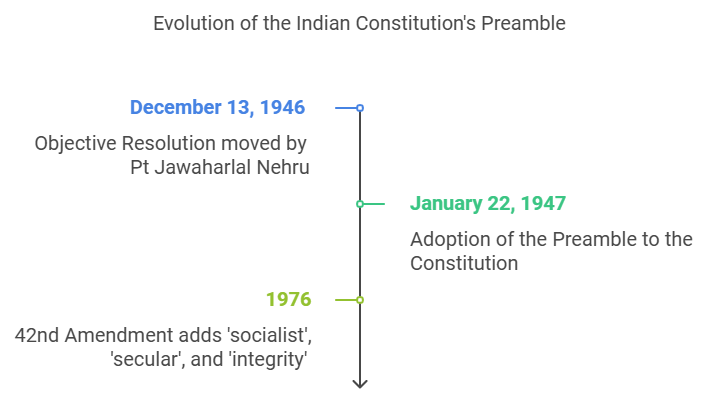
The Preamble expresses the guiding values and objectives of the Constitution. It was based on the Objectives Resolution moved by Pt. Jawaharlal Nehru on 13 December 1946; the Preamble itself was adopted on 22 January 1947 and forms the introductory statement to the Constitution.
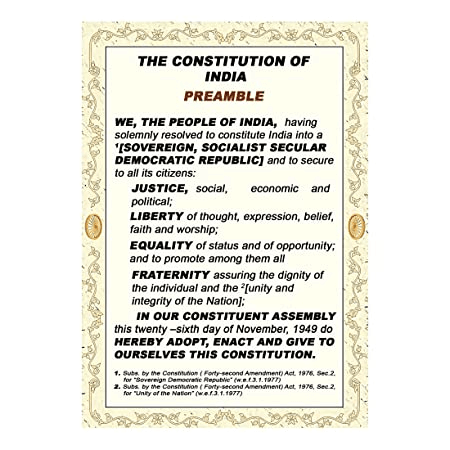
- The concept of a Preamble is borrowed from the Constitution of the United States. The Preamble summarises the essence and philosophy of the Constitution. Nani A. Palkhivala described the Preamble as the "identity card of the Constitution".
- The words "Socialist", "Secular" and "Integrity" were added by the 42nd Amendment (1976).
Purpose and Functions of the Preamble
- The Preamble reveals the source of authority of the Constitution: We, the people of India - indicating popular sovereignty.
- It declares the nature of the polity: a Sovereign Socialist Secular Democratic Republic.
- It states the objectives the Constitution seeks to secure for every citizen: Justice (social, economic and political), Liberty (of thought, expression, belief, faith and worship), Equality (of status and opportunity), and Fraternity assuring dignity and unity of the nation.
- It gives the date of adoption: 26 November 1949.
Text of the Preamble
We, the people of India, having solemnly resolved to constitute India into a Sovereign Socialist Secular Democratic Republic and to secure to all its citizens:
- Justice, social, economic and political;
- Liberty, of thought, expression, belief, faith and worship;
- Equality, of status and of opportunity;
- Fraternity assuring the dignity of the individual and the unity and integrity of the Nation;
- In our Constituent Assembly, this twenty-sixth day of November 1949, do hereby adopt, enact and give to ourselves this Constitution.
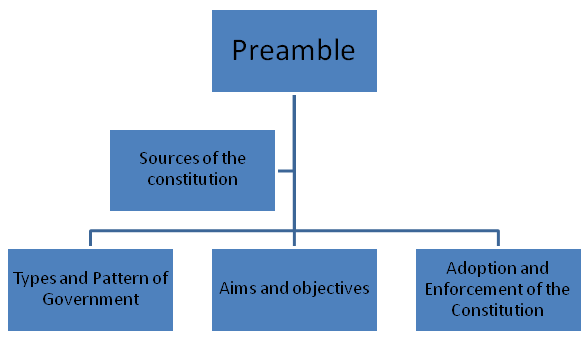
Four Key Functions of the Preamble
- Indicates that the Constitution draws its authority from the people.
- Declares the fundamental objectives and ideals of the Constitution (sovereignty, socialism, secularism, democracy, republicanism).
- Sets out the goals of justice, liberty, equality and fraternity for the citizens.
- Makes explicit the adoption date and the Constituent Assembly's role in adopting the Constitution.
Keywords Used in the Preamble
- Sovereign: India is independent and supreme in its internal and external affairs.
- Socialist: The term, added in 1976, indicates commitment to social and economic equality; India follows a model of democratic socialism.
- Secular: The State treats all religions with equal respect and does not have an official state religion.
- Democratic: Authority derives from the people and government is constituted through free and fair elections.
- Republic: The head of state is not hereditary; the President is an elected constitutional head.
Landmark Cases Relating to the Preamble and Basic Structure
- Berubari Union (1960): Early view that the Preamble is not a source of power but reflects the spirit of the Constitution.
- Golaknath (1967): Held that Parliament could not amend Fundamental Rights (later clarified by Kesavananda Bharati).
- Kesavananda Bharati (1973): Held that the Preamble is part of the Constitution and introduced the Basic Structure Doctrine, ruling that Parliament cannot amend the essential features of the Constitution.
- Minerva Mills (1980): Reaffirmed the Basic Structure Doctrine and emphasised the balance between Fundamental Rights and Directive Principles.
Amenability of the Preamble
- The Supreme Court in Kesavananda Bharati v. State of Kerala (1973) held that the Preamble is part of the Constitution and may be amended by Parliament, but any amendment cannot alter the basic features of the Constitution.
- The Preamble has been amended once by the 42nd Constitutional Amendment (1976), which added the words 'Socialist', 'Secular', and 'Integrity'. The Court considered these additions clarificatory in nature.
Try yourself: Which country has the Lengthiest written Constitution?
Parts of the Constitution
The Constitution is organised into Parts, each dealing with a major theme or institutional structure. Parts help in systematising the extensive content of the Constitution.
- At commencement (1950): 22 Parts, 395 Articles, and 8 Schedules.
- Later insertions such as Part IX-A (Municipalities), Part IX-B (Co-operatives), and Part XIV-A (Tribunals) increased the count to approximately 25 Parts, with about 448 Articles and 12 Schedules in current form.
- When new Articles are added, they are often labeled alphabetically (for example, Article 21A) to preserve numbering and avoid renumbering the whole document.
The Union and Its Territory
Article 1 declares: "India, that is Bharat, shall be a Union of States." This means:
- India is a single, indivisible political entity; it is not a mere federation of states by agreement.
- States do not have the right to secede from the Union.
- The federal character is indestructible in the sense that the Constitution provides mechanisms for reorganisation and alteration of state boundaries while preserving the Union.
Special Status of Jammu & Kashmir
- Article 370 provided special autonomous status to Jammu & Kashmir; the State had its own Constitution and laws that required state concurrence for application of many Union laws.
- Article 370 became operative in the early 1950s; the separate Constitution of Jammu & Kashmir came into force on 26 January 1957.
- In 2019, Parliament repealed many provisions of Article 370 and reorganised the State into two Union Territories: Jammu and Kashmir and Ladakh, effective 31 October 2019.
Over the years India's map and internal organisation have changed through acts of Parliament and constitutional amendments. The States Reorganisation Act (1956) reshaped states primarily on a linguistic basis and abolished the earlier Part A/ B/ C/ D classification.
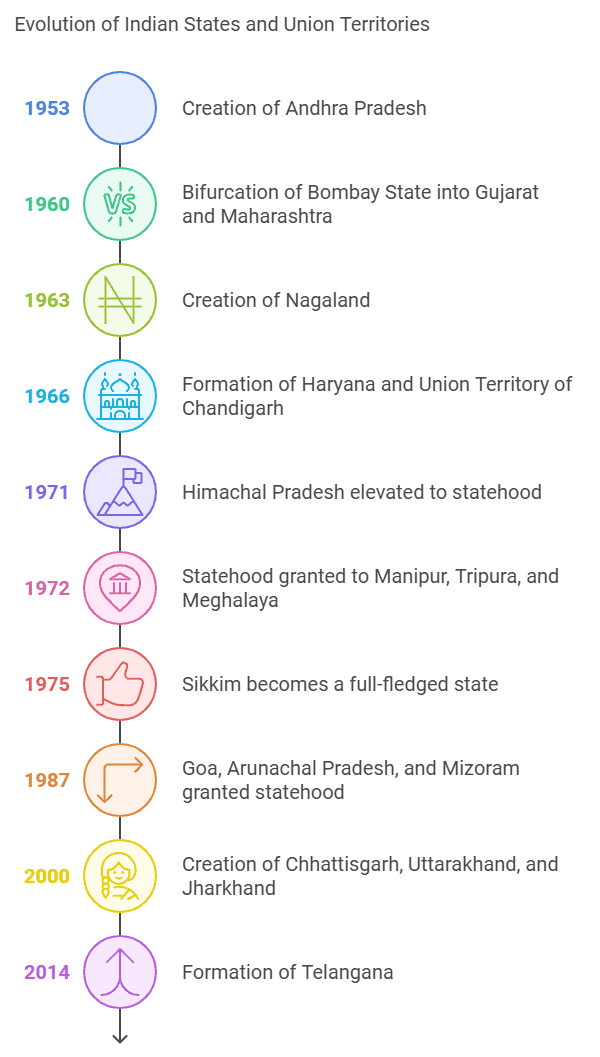
- 1960: Bombay State was bifurcated into Gujarat and Maharashtra.
- 1963: Nagaland became a State.
- 1966: Haryana was carved out of Punjab; Chandigarh became a Union Territory.
- 1971-1975: Himachal Pradesh, Manipur, Tripura, Meghalaya attained statehood; Sikkim became an Associate State and later (1975) a full State.
- 1987: Goa, Arunachal Pradesh and Mizoram became States.
- 2000: Chhattisgarh, Uttarakhand (Uttaranchal) and Jharkhand were created.
- 2014: Telangana was created as a separate State.
Addition of States to India
- The power to create new States rests with Parliament under the Constitution; there is no constitutional provision for secession of any territory from India.
- Examples: Sikkim joined India and became a State on 16 May 1975 after a plebiscite; Telangana was created by Parliament in 2014.
Citizenship of India
Citizenship denotes the legal membership of an individual in the State, carrying both rights and duties. Citizens are entitled to Fundamental Rights and political rights such as voting; non-citizens (aliens) are denied certain civic rights.
At the commencement of the Constitution (26 January 1950), Articles 5-11 defined who were to be treated as Indian citizens on that date. Subsequent acquisition, termination, and regulation of citizenship were provided by statute: the Citizenship Act, 1955 and its amendments.
Key Provisions (Articles 5-11)
- Articles 5-11 deal with the citizenship status of persons domiciled in India at the commencement of the Constitution.
- They determined who would be citizens of India by birth, domicile, and connection with India at the commencement date.
Features of Indian Citizenship
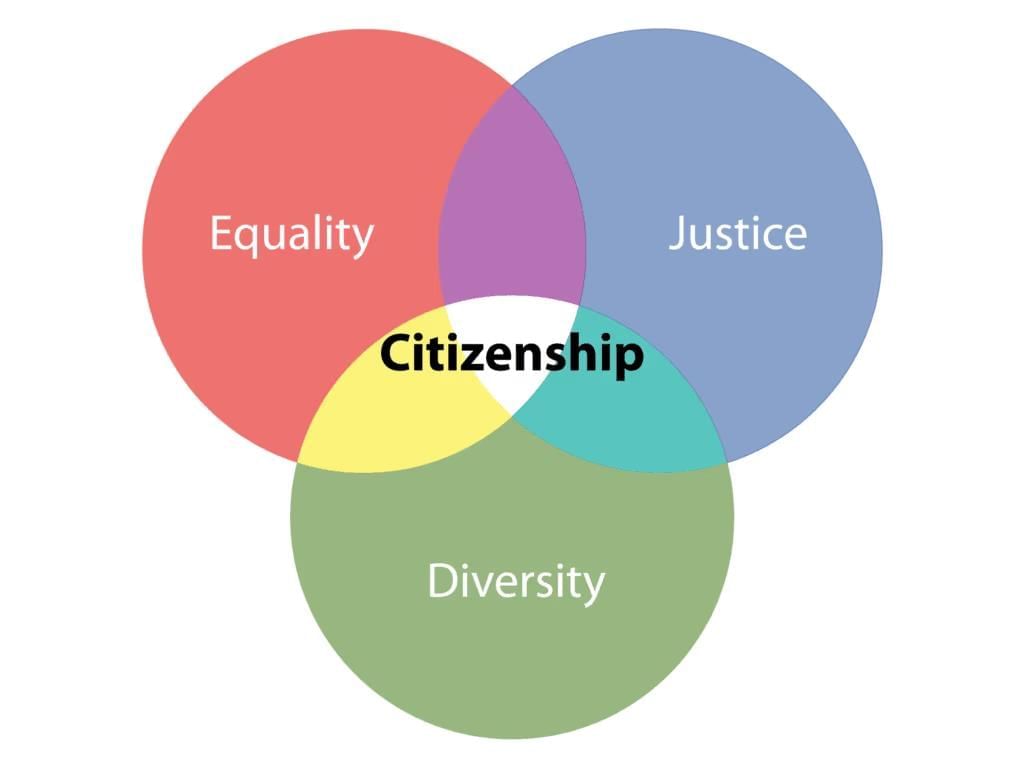
- Single Citizenship: India follows a single citizenship model-every person is a citizen of India irrespective of state of domicile.
- No Dual Citizenship: The Constitution does not recognise dual citizenship. Holding citizenship of another country may lead to loss of Indian citizenship under statutory rules.
- Equal Rights: All citizens enjoy constitutional rights equally across the territory, subject to some special provisions for certain regions or tribal areas.
Acquisition of Citizenship
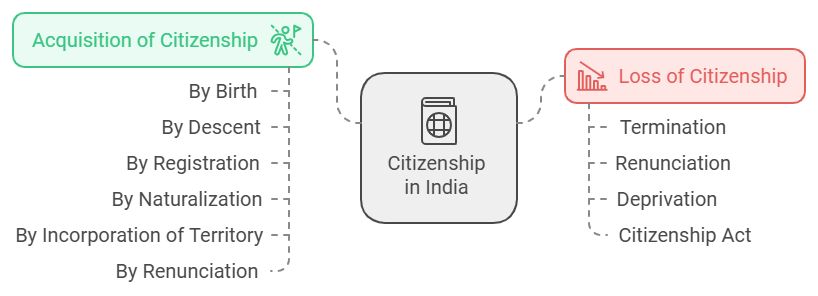
- While Articles 5-11 fixed initial citizenship at commencement, the Citizenship Act, 1955 specifies modes by which citizenship may be acquired:
- By Birth; By Descent; By Registration; By Naturalisation; By Incorporation of Territory; By Renunciation
- Parliament is empowered to legislate the detailed rules for acquisition and termination of citizenship.
Loss of Citizenship
- Termination: An Indian citizen automatically loses citizenship if they voluntarily acquire citizenship of another country.
- Renunciation: A person may voluntarily renounce Indian citizenship in accordance with the law.
- Deprivation: Citizenship can be cancelled by the Government for reasons such as fraud, disloyalty, or other statutory grounds.
The Citizenship Act, 1955 and Key Amendments
The Citizenship Act, 1955 implements constitutional provisions on citizenship and has been amended several times to address demographic and security concerns.
- 1986 Amendment: Made citizenship by birth more restrictive in response to illegal immigration concerns (notably from Bangladesh).
- 2003 Amendment: Introduced the concept of Overseas Citizen of India (OCI).
- 2015 Amendment: Consolidated PIO (Person of Indian Origin) and OCI schemes into the OCI category for administrative simplification.
- 2019 Amendment (CAA): Reduced residency requirements and provided a pathway to citizenship for certain persecuted religious minorities (Hindus, Sikhs, Jains, Buddhists, Parsis, Christians) from Pakistan, Afghanistan and Bangladesh who entered India before 31 December 2014. This amendment is statutory and has been subject to public debate and litigation.
Overseas Citizenship of India (OCI)
- OCI status is available to foreign citizens of Indian origin except nationals of Pakistan and Bangladesh (subject to statutory exclusions).
- Benefits include a lifetime multiple-entry visa to India, exemption from registration with foreigners' regional registration offices (FRRO) for long-term stays, and permission to live and work in India subject to conditions.
- Limitations: OCI is not full citizenship-OCI holders cannot vote, hold public office, or occupy certain government positions. OCI is a long-term residency and travel status rather than political citizenship.
Limitations and Practical Considerations
- Citizenship law is a mixture of constitutional provisions and statutory rules. While the Constitution sets broad principles, Parliament legislates detailed procedures for acquisition and termination.
- Issues of citizenship often intersect with concerns about migration, national security, and human rights; hence amendments and judicial review play important roles in shaping the law.
Try yourself: The solemn resolution in the preamble of our constitution is made in the name of
FAQs on Introduction to the Constitution of India & Preamble
| 1. What is the Preamble to the Indian Constitution and why is it important for CLAT? |  |
| 2. What are the key words added to the Preamble during the 42nd Amendment and what do they mean? | |
| 3. How many objectives are mentioned in the Preamble and what does each one represent? | |
| 4. Is the Preamble enforceable in courts and can it be amended like other parts of the Constitution? | |
| 5. What is the difference between the Preamble and the fundamental rights, and how do they work together? | |