A few days ago, while helping my younger brother with his civics homework, I faced many questions, such as: Why isn't the president considered the true leader? Why can't all leaders be ministers? Why do we need party elections instead of allowing individuals to compete directly? I managed to answer several of his questions, but some made me really think hard. The idea of the Parliament and the Union Executive seems straightforward, yet it has many complexities. This prompted me to explore the rules and laws that govern the executive branch of our country. Now, let's examine these provisions to better understand how the executive branch of the government operates.
Parliamentary form of Government
The Union Executive in India consists of the President, Vice-President, Prime Minister, Council of Ministers and Attorney-General. It functions under a parliamentary system where real executive power lies with the Council of Ministers.
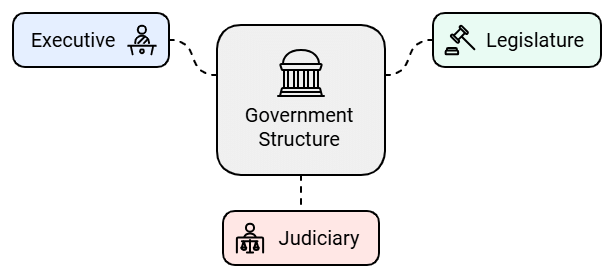
Parliamentary Government: India follows a parliamentary form of government in which the executive is accountable to the legislature. This system is also called Cabinet Government because executive authority is concentrated in the Cabinet. The Executive is a part of the Legislature.
Reasons for adopting the parliamentary system:
Familiarity: The leaders were accustomed to this form of government.
Responsibility: It is considered more responsible as the executive is answerable to the legislature, which in turn is answerable to the citizens.
Prevention of Authoritarianism: This system helps prevent authoritarian rule.
Diverse Representation: It ensures representation from a diverse group of people.
Alternative Government: This system allows for the possibility of an alternate government.
Roles:
Head of State: In this system, the head of state, such as the President, holds a ceremonial position and is a nominal executive.
Real Executive: The Prime Minister is the real executive and the Head of Government.
Characteristics:
Majority Rule: There is a rule of the majority party.
Opposition: There is always a Parliamentary Opposition to check the actions of the ruling government.
Civil Servants: Civil servants are independent in this system.
Comparative notes: The parliamentary system is distinct from a presidential system in which the President is both Head of State and Head of Government and is directly accountable to the electorate rather than the legislature.
International examples: Britain, Canada and Japan follow parliamentary systems; India's model was largely inspired by the British system.
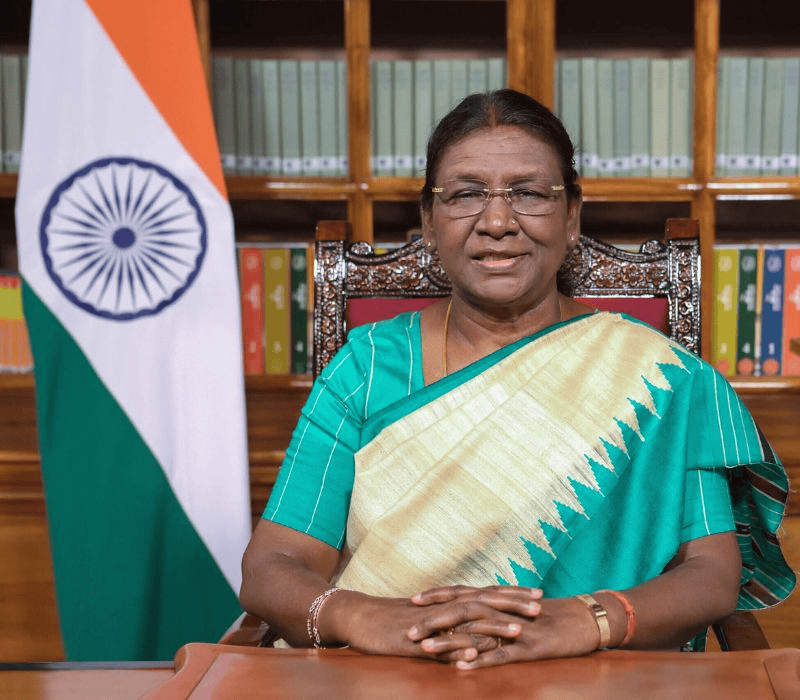
The President (Article 52)
Droupadi Murmu
Position: Article 52 provides for a President of India. The President is the constitutional Head of the Union and the nominal executive; all executive actions of the Union are formally taken in the President's name.
Limits of executive action: The executive cannot lawfully exercise powers not authorised by the Constitution or by statute. The Supreme Court in Ram Jawaya Kapoor v. State of Punjab held that where the executive engages in activities beyond its constitutional or statutory competence (for example, taking over proprietary rights without legislative authority), such acts are ultra vires and invalid.
Separation of powers: The Constitution separates the organs of government, but functions overlap; the President's actions are normally exercised on the aid and advice of the Council of Ministers.
Qualifications (Article 58)
A person is eligible to be elected President if the person is an Indian citizen, has completed 35 years of age, and is qualified for election as a member of the House of the People (Lok Sabha).
A person is disqualified if he or she holds any office of profit under the Union or a State or any local or other authority subject to the control of the Government of India, subject to exceptions made by law.
Condition of President's Office (Article 59)
The President cannot be a member of either House of Parliament or of a State Legislature; if already a member, he must resign from that membership on assuming the Presidency.
The President cannot hold any other office of profit.
The President is entitled to official residence, salary, allowances and privileges as determined by Parliament, and these emoluments cannot be reduced during his term of office.
Official residence, emoluments and allowances
The President is provided with official accommodation and state facilities such as an official state car and free medical facilities. The official residence is Rashtrapati Bhavan. It is the largest residence of any head of state worldwide, showcasing the importance of the President in the largest democracy on the globe.
Historical figures of salary changes are noted: Rs. 10,000 (1951), Rs. 15,000 (1985), Rs. 20,000 (1989), Rs. 50,000 (1998), Rs. 1,50,000 (2008), and Rs. 5,00,000 (2016). These figures reflect past revisions; current emoluments are fixed by law.
MULTIPLE CHOICE QUESTION
Try yourself: Which of the following is a characteristic of a Parliamentary Government?
A
The Executive is not accountable to the legislature.
B
The President holds all executive powers.
C
The Prime Minister is the real head of state.
D
Civil servants are not independent.
Correct Answer: C
- In a Parliamentary Government, the Prime Minister is the actual head of state and holds executive powers. - The President in this system is a ceremonial head of state. - The Executive is accountable to the legislature in a Parliamentary Government. - Civil servants are independent in a Parliamentary system.
Report a problem
Election of the President (Article 54 and Article 55)
The President is elected by an Electoral College consisting of the elected members of both Houses of Parliament and of the elected members of the Legislative Assemblies of the States (Article 54).
The election uses proportional representation by means of the single transferable vote, and voting is by secret ballot (Article 55(3)).
The value of votes of MLAs and MPs is calculated to maintain parity between States and the Union.
Disputes regarding the election (Article 71)
Disputes relating to the election of the President are to be investigated and decided by the Supreme Court. The decision of the Court is final.
Actions taken by a person in the office of President, even if their election is later declared void, are generally treated as valid. Parliament may frame laws to govern the procedure for resolving such disputes.
The election of a person as President or Vice President cannot be challenged because of any vacant positions among the members of the electoral college that elects them.
Oath by the President (Article 60)
Every President or person discharging the functions of the President must make an oath or affirmation before the Chief Justice of India or the senior most judge of the Supreme Court available, pledging to preserve, protect and defend the Constitution and to devote themselves to the service and welfare of the people.
Term of Office (Article 56 and Article 62)
The President holds office for a term of five years from the date on which he or she enters upon office.
The President continues to hold office until a successor assumes charge. A vacancy in the office must be filled by election as soon as possible and in any case within six months of the vacancy (Article 62).
A President may resign by writing to the Vice-President; removal is by impeachment (Article 61) or as otherwise provided by the Constitution.
Any resignation from the President to the Vice President must also be reported to the Speaker of the Lok Sabha by the Vice President.
Procedure for Impeachment (Article 61)
A President may be removed for violation of the Constitution by the process of impeachment. During impeachment, the President has the right to appear and be represented.
Impeachment is initiated in either House by a resolution supported by at least one-fourth of the members of that House, and the charges must be passed by a two-thirds majority of that House.
After impeachment is initiated in one House, the other House investigates the charges; if it confirms the charges by a two-thirds majority, the President is removed with effect from the date the resolution is passed.
Privileges and Immunities (Article 361)
Article 361 gives the President immunity from legal proceedings while in office. The President cannot be questioned by any court for actions done while performing official duties. No criminal case can be started against the President during their term.
No court can order the arrest or imprisonment of the President while in office.
The President's conduct can be examined only under Article 61 (impeachment), when either House of Parliament appoints a body to investigate.
This immunity does not stop cases against the Government of India or Governors.
Powers of the President - Overview
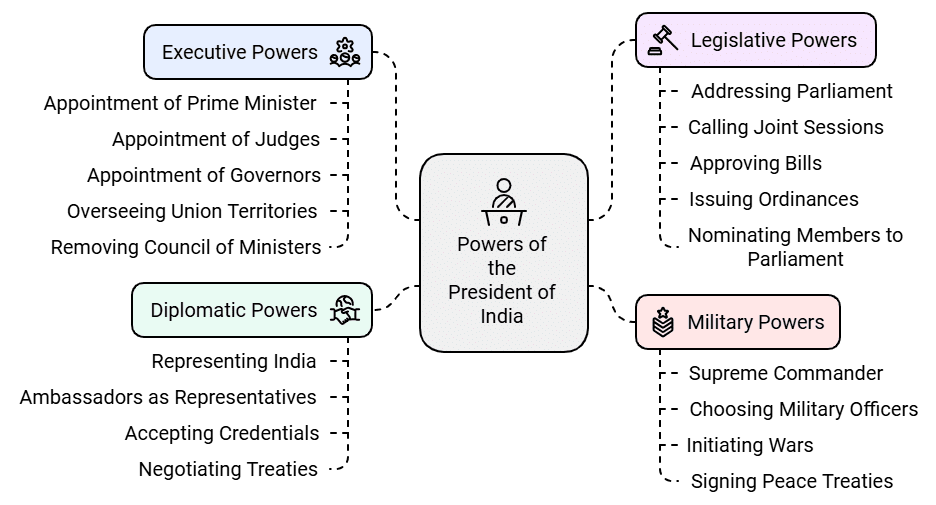
The President's constitutional powers are wide-ranging and may be classified as executive, military, diplomatic, legislative, financial and judicial (including clemency).
Executive powers (Article 53)
All executive powers of the Union are vested in the President and are normally exercised by him through subordinate officers in accordance with the Constitution.
The President appoints the Prime Minister and, on the Prime Minister's advice, the other members of the Council of Ministers.
The President makes key constitutional appointments: judges of the Supreme Court and High Courts, Governors of States, the Attorney-General of India, the Comptroller and Auditor General, and members of the Election Commission, among others.
The President administers the Union territories through appointed administrators, ChiefCommissioners and Lieutenant Governors, where applicable.
Military powers
The President is the Supreme Commander of the Armed Forces of the Union under Article 53. In practice, military command is exercised through the government and defence authorities acting under constitutional control.
The President receives and appoints senior officers and signs declarations of war and peace treaties on the advice of the Council of Ministers.
Diplomatic powers
The President represents India in international relations. Ambassadors and HighCommissioners are accredited as the President's representatives, and the President receives credentials from foreign envoys.
Treaties and international agreements are negotiated by the Executive in the President's name and, as required, must be placed before Parliament for approval where legislation or parliamentary action is necessary.
Legislative powers
The President summons and prorogues Parliament and addresses it at the start of the first session each year and after each general election.
The President's assent is required for any bill passed by Parliament to become law; he can assent, withhold assent, or reserve the bill for consideration.
Money bills must originate in the Lok Sabha and require the President's assent.
The President can call a joint sitting of both Houses to resolve legislative deadlocks.
The President can promulgate ordinances under Article 123 when both Houses are not in session and immediate action is necessary; such ordinances have the force of law but must be laid before Parliament after it reconvenes and expire thereafter in specified circumstances.
The President can nominate members to both Houses of Parliament where the Constitution permits nomination.
MULTIPLE CHOICE QUESTION
Try yourself: What is the process for the removal of the President of India if they are found to have violated the Constitution?
A
A resolution signed by one-third of the members of either House of Parliament.
B
A resolution signed by one-fourth of the members of either House of Parliament.
C
A resolution signed by two-thirds of the members of either House of Parliament.
D
A resolution signed by half of the members of either House of Parliament.
Correct Answer: B
- The process for the removal of the President of India if they are found to have violated the Constitution involves a resolution signed by one-fourth of the members of either House of Parliament. This resolution must be approved by a two-thirds majority of the house where it originated, followed by an investigation by the other house.
Report a problem
Ordinance-making power (Article 123) - key conditions
An ordinance may be promulgated by the President only when Parliament is not in session and the President is satisfied that immediate action is necessary.
An ordinance has the force of law, but it must be presented to Parliament when it reconvenes; it will cease to operate at the expiry of six weeks from the reassembly of Parliament unless approved.
The President may withdraw an ordinance at any time, and an ordinance inconsistent with the Constitution is invalid.
Financial and audit functions
The President receives reports from the Finance Commission and is custodian of the Contingency Fund of India for unforeseen expenditure at the Union level.
The President causes the audit of governmental accounts and places financial matters before Parliament as required by the Constitution and law.
Judicial and clemency powers (Article 72)
The President has the power to grant pardons, reprieves, respites, remissions or to commute sentences in respect of offences against Union laws, and in particular in cases involving death sentences and court-martial sentences.
Although clemency is an executive power, the Supreme Court has held that the exercise of pardoning power is amenable to judicial review on limited grounds (for example, to ensure compliance with constitutional norms), and several cases have clarified the scope and limits of review: Maru Ram v. Union of India, Dhananjay Chatterjee v. State of West Bengal, Kehar Singh v. Union of India, and Epuru Sudhakar illustrate the jurisprudence governing the pardoning power.
Pardons are normally exercised on the advice of the Council of Ministers; while the executive nature of the power gives it a discretionary character, courts may examine the process and scrutiny applied to the decision to prevent arbitrariness and protect the Rule of Law.
Position of the President - constitutional practice and amendments
Originally, the President had some scope to act according to his own judgment and also to seek advice of the Council of Ministers.
The 42nd Amendment (1976) emphasised that the President shall act on the advice of the Council of Ministers, strengthening the binding nature of that advice.
The 44th Amendment (1978) clarified that the President may return advice to the Council of Ministers for reconsideration once; if the Council reiterates the same advice, the President is bound to act on it.
MULTIPLE CHOICE QUESTION
Try yourself: What is the mechanism through which the President can grant pardons in India?
A
The President can grant pardons solely based on his own judgment.
B
The President must act on the advice of the Council of Ministers.
C
The President can grant pardons without any limitations.
D
The President must seek approval from the Supreme Court before granting pardons.
Correct Answer: B
- The President of India must act on the advice of the Council of Ministers when granting pardons. - This advice is mandatory and must be followed by the President in pardoning decisions.
Report a problem
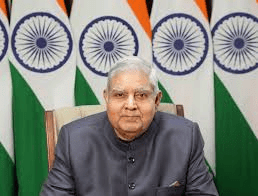
The Vice-President (Article 63)
The Vice-President of India is provided for by Article 63.
Jagdeep Dhankar
Functions of the Vice-President
Chairman of the Rajya Sabha: The Vice-President is the ex-officio Chairman of the Council of States (Rajya Sabha).
Casting vote: The Vice-President may cast a deciding vote in the Rajya Sabha in case of a tie.
The Vice-President is elected by members of both Houses of Parliament through proportional representation by single transferable vote.
Ceremonial role and representation: The Vice-President represents the Council of States at ceremonial occasions and protects the rights and privileges of the Rajya Sabha members.
Goodwill missions: The Vice-President may undertake official goodwill assignments abroad on behalf of the nation.
Acting President: The Vice-President discharges the functions of the President when the President is unable to perform duties because of absence, illness or other reasons, and acts as President in the event of a vacancy until a new President is elected (usually the office is filled within six months).
MULTIPLE CHOICE QUESTION
Try yourself: Who serves as the ex-officio Chairman of the Rajya Sabha?
A
Vice-President
B
President
C
Prime Minister
D
Speaker of Lok Sabha
Correct Answer: A
The Vice-President of India serves as the ex-officio Chairman of the Rajya Sabha. Here are some key points:
The Vice-President automatically becomes the Chairman of the Rajya Sabha upon election.
The role includes presiding over the sessions of the Rajya Sabha.
He ensures the orderly conduct of business in the House.
The Vice-President does not vote in the Rajya Sabha, except to break a tie.
Report a problem
The Council of Ministers (Article 74)
Article 74 provides for a Council of Ministers to aid and advise the President; the Prime Minister is the head of the Council.
Composition: The Council consists of Cabinet Ministers, Ministers of State and Deputy Ministers (where appointed), headed by the Prime Minister.
President's role: The President acts in accordance with the advice of the Council of Ministers; if the President returns advice for reconsideration, the Council must reconsider, and if the same advice is again tendered, the President is bound to act on it.
Collective responsibility: The Council of Ministers is collectively responsible to the Lok Sabha; it must enjoy the confidence of the majority of the Lok Sabha to remain in office.
Size of the Ministries
Before 2003 there was no constitutional ceiling on the number of ministers. The Constitution (Ninety-first Amendment) Act, 2003 introduced a limit: the total number of ministers in the Council of Ministers of the Union shall not exceed 15% of the total number of members of the Lok Sabha. Similar provisions apply to State governments relative to their assemblies, with certain exceptions for very small legislatures.
Anti-defection rules and party splits
The Tenth Schedule contains the anti-defection law. Under the provisions of disqualification (Articles 102(2) and 191(2) apply to members of Parliament and State Legislatures respectively), a member may be disqualified for voluntarily giving up membership of a political party or for defying party directives on voting.
Historically, the law contained an exception for a split (one-third of members), but subsequent changes and judicial interpretation narrowed that protection. Presently, the recognised exceptions are tightly circumscribed and generally treated as merger situations requiring a larger fraction (two-thirds) of members to effect a lawful change without attracting disqualification.
Non-member ministers
Article 75 permits the appointment of ministers who are not members of Parliament, but such a minister must obtain membership of either House within six months of appointment or cease to be a minister.
Convicted persons and ministerial office
The Supreme Court in the B.R. Kapoor v. State of Tamil Nadu (Ms. J. Jayalalithaa case) held that a person convicted and sentenced to imprisonment for two years or more is not eligible to be appointed as Chief Minister if disqualification follows under law; constitutional provisions require that a minister be a member of the legislature and satisfy disqualification criteria.
Dissolution of Parliament
Lok Sabha normally lasts five years (Article 83(2)), but it may be dissolved earlier by the President on the advice of the Prime Minister. Fresh elections are then held to constitute a new Lok Sabha.
Collective responsibility and individual ministerial responsibility
Collective responsibility: The whole Council of Ministers is collectively responsible to the Lok Sabha; they act and are responsible as a group for government policy and decisions.
Individual responsibility: Each minister is individually responsible for the work and conduct of his or her department and must answer to the legislature for departmental administration; serious failures may require ministerial resignation.
Appointment of Prime Minister
The President appoints as Prime Minister the leader of the party or coalition that commands a majority in the Lok Sabha. The Prime Minister is the real head of the executive and leads the Council of Ministers (Articles 75 and related provisions).
Constitutional duties of the Prime Minister
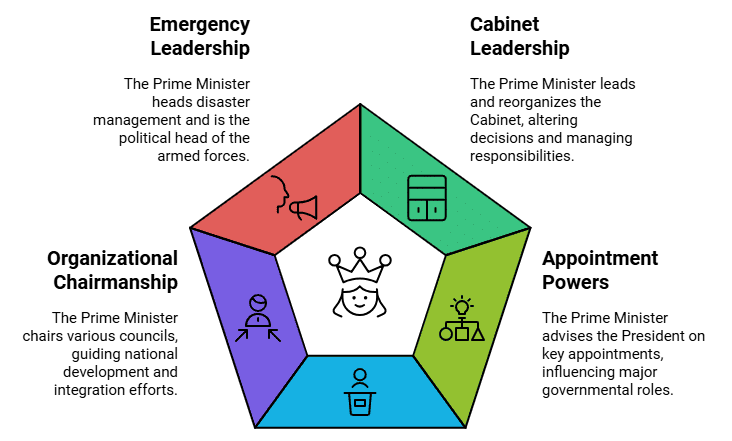
The Prime Minister advises the President, appoints ministers, and allocates portfolios.
The Prime Minister presides over Cabinet meetings, guides decision-making, and may advise dissolution of the Lok Sabha.
The Prime Minister represents the government in Parliament and leads the majority in the Lok Sabha.
The Prime Minister advises appointments to constitutional and high offices such as the CAG, Attorney-General, UPSC, Election Commission, and Finance Commission.
The Prime Minister chairs or coordinates national bodies like NITI Aayog and the Inter-State Council, and plays a key role in national policy and disaster management.
MULTIPLE CHOICE QUESTION
Try yourself: Who appoints the Prime Minister of India?
A
The President of India
B
The Lok Sabha
C
The Chief Justice of India
D
The Cabinet Ministers
Correct Answer: A
- The Prime Minister of India is appointed by the President of India based on the rules outlined in the Constitution.
Report a problem
Dismissal of a Minister
A minister may cease to hold office on death, resignation, or removal by the President on the advice of the Prime Minister. Ministers must also vacate office if they lose their seat in Parliament within prescribed time limits.
Article 75 provides that ministers hold office during the pleasure of the President, which in practice means they serve while the Council of Ministers enjoys parliamentary confidence.
Dismissal of the Cabinet
The Cabinet as a whole ceases to function when the Prime Minister resigns, dies, or when the government loses majority support in the Lok Sabha, or if the Prime Minister advises dissolution of the Lok Sabha and it is dissolved.
The Attorney-General of India (Article - 78)
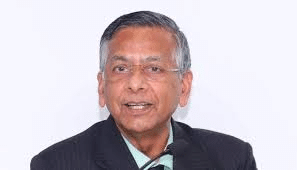
Articles 78 deal with the Attorney-General for India, the chief legal advisor to the Government of India.
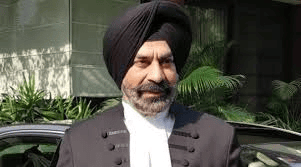
R. Venkataramani
Term and appointment
The Attorney-General is appointed by the President and holds office at the President's pleasure.
Qualification
To be Attorney-General a person must be qualified to be appointed as a judge of the Supreme Court.
Functions and duties (Article 76(2) and 76(3))
The Attorney-General advises the Government of India on legal matters referred to him by the President and performs other legal duties assigned by the President.
The Attorney-General appears on behalf of the Government of India in the Supreme Court and in reference matters under Article 143; he may represent the Union in the High Courts as the government requires.
MULTIPLE CHOICE QUESTION
Try yourself: What are the conditions under which a Minister of the Lok Sabha can be removed from his post?
A
Upon self-resignation
B
Dismissal by the Prime Minister
C
Dismissal by the President for unconstitutional acts
D
Losing eligibility to be a member of Parliament
Correct Answer: C
- A Minister of the Lok Sabha can be removed from his post if dismissed by the President for unconstitutional acts as per Article 75(2).
Report a problem
The Union Executive is a central organ of Indian democracy. It combines constitutional authority with political responsibility. The Constitution provides the structure, powers and limits required to produce a strong, accountable and responsible executive that must work in accordance with constitutional principles and democratic scrutiny.
State Executive
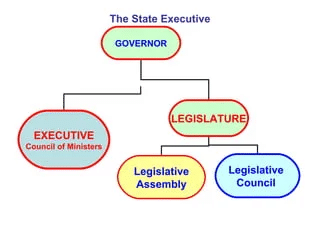
The State Executive consists of the Governor, the Chief Minister and the Council of Ministers; it mirrors the Union Executive under a parliamentary system at the state level while maintaining the unitary bias of the Constitution where necessary.
The Governor is the constitutional head of the State and acts as a link between the State government and the Central government; executive actions of the State are done in the Governor's name.
The Governor (Article 153)
Article 153 stipulates that every State shall have a Governor; the Governor is a nominal head analogous to the President at the Union level.
The Governor's term is five years, and the office is filled by appointment of the President (Article 155).
The 7th Constitutional Amendment (1956) provided for the possibility of the same person being Governor of two or more states.
Appointment, tenure and removal
Appointment: The Governor is appointed by the President by warrant under his hand and seal.
Tenure: The Governor holds office during the pleasure of the President for a term of five years but continues until a successor is appointed.
Resignation: The Governor may resign by writing to the President.
Removal: The Governor can be removed by the President; in the exercise of this power the Central Government must not act arbitrarily - the Supreme Court in B.P. Singhal v. Union of India (2010) held that while the Governor holds office at the pleasure of the President, removal must not be for extraneous considerations and may be subject to judicial review to prevent mala fide or arbitrary action.
Qualifications (Article 157)
The Governor must be an Indian citizen and at least 35 years of age.
Conditions of office
The Governor must not hold any office of profit or be a member of Parliament or a State Legislature at the same time; allowances and privileges are determined by Parliament and cannot be diminished during the Governor's term.
Oath (Article 159)
Before taking office, the Governor must take an oath before the Chief Justice of the High Court (or the seniormost judge available) affirming to preserve, protect and defend the Constitution, to carry out the office faithfully, and to devote himself to the service and welfare of the State's people.
Can the Governor be dismissed arbitrarily?
The Constitution provides that the Governor holds office at the President's pleasure. However, the Supreme Court has ruled in B.P. Singhal that the power of removal cannot be exercised in an arbitrary or mala fide manner; reasons that are extraneous to the functioning of constitutional machinery cannot justify removal.
Powers of the Governor - categories
The Governor's powers are similar in kind to those of the President but operate at the State level: executive, legislative, financial and pardoning powers, together with ordinance-making power.
Executive powers
Article 154 vests the executive power of the State in the Governor, to be exercised by him directly or through subordinate officers.
The Governor appoints the Chief Minister and, on the Chief Minister's advice, the Council of Ministers. The Governor also appoints the Chairman and members of the State Public Service Commission, the State Election Commissioner, the Advocate-General of the State, the Chief Justice and judges of the High Court (as applicable in consultation), district judges and vice-chancellors.
Under Article 356, if the Governor reports failure of constitutional machinery in the State, the President may impose President's Rule on the recommendation of the Council of Ministers; during such emergency the Governor acts with expanded executive authority as representative of the President.
Financial powers
No money bill can be introduced in the State Legislature without the Governor's prior recommendation.
The Governor has access to the State Contingency Fund for meeting unforeseen expenditure and ensures presentation of the budget and financial statements to the Legislature.
Legislative powers
The Governor summons and prorogues the State Legislature and ensures that there is no more than six months' gap between sessions.
The Governor addresses the State Legislature at the commencement of the first session each year and after every general election to the Assembly.
The Governor may give or withhold assent to bills passed by the State Legislature, return ordinary bills for reconsideration (but not money bills), or reserve certain bills for the consideration of the President.
Pardoning power (Article 161)
The Governor can grant pardons, reprieves, respites, remissions, or commute sentences in respect of offences against State laws, except in cases where the sentence is that of a court-martial or certain other exclusions; the Governor cannot grant pardon in death penalty cases where only the President has such power.
Ordinance-making power (Article 213)
When the State Legislature is not in session and immediate action is necessary, the Governor may promulgate ordinances having the force of law; such ordinances must be laid before the State Legislature when it reassembles and will cease to operate under conditions specified by the Constitution.
The Governor cannot issue ordinances in matters where the bill would have to be reserved for consideration by the President or when the State Legislature already has a statute on the subject requiring reservation for the President's assent.
MULTIPLE CHOICE QUESTION
Try yourself: What is the term of office for a Governor in India?
A
3 years
B
4 years
C
5 years
D
6 years
Correct Answer: C
- The term of office for a Governor in India is 5 years as per the Constitution.
Report a problem
Chief Minister (Article 164)
The Chief Minister is the real executive of the State, analogous to the Prime Minister at the Union level.
Qualifications
The Chief Minister must be a citizen of India, be a member of the State Legislature, and be at least 25 years old. A non-legislator may be appointed, but must get elected to the State Legislature within six months or cease to hold office.
Appointment
The Governor appoints as Chief Minister the leader of the majority party or the coalition that commands majority support in the State Legislative Assembly (Article 164).
In a hung assembly the Governor may appoint a person who can prove majority support; if no one can, the Governor may invite the largest single party or coalition to form the government.
Term of office
The Chief Minister's tenure is not fixed and depends on retaining the confidence of the majority of the Legislative Assembly. The Chief Minister may be removed by a successful vote of no-confidence in the Assembly.
Oath, salary and allowances
The Chief Minister takes an oath from the Governor to uphold the Constitution and carry out duties faithfully.
Article 164(5) gives the State Legislature the power to determine the salary and allowances of the Chief Minister and other ministers.
The State Council of Ministers (Article 163)
The State Council of Ministers, headed by the Chief Minister, exercises executive authority in the state and is collectively responsible to the State Legislative Assembly.
Maximum size
The number of ministers in a State Council of Ministers shall not exceed 15% of the total strength of the Legislative Assembly, and must not be fewer than twelve ministers (constitutional limits and transitional arrangements apply).
Anti-defection and party splits
The anti-defection provisions of the Tenth Schedule apply to State Legislatures as well as Parliament; provisions that earlier recognised splits have been narrowed by amendment and judicial interpretation so that unlawful defections attract disqualification.
Advocate-General (Article 165)
The Advocate-General is the highest law officer of a State, appointed by the Governor and holding office at the Governor's pleasure.
Qualifications: the Advocate-General must be qualified to be appointed as a judge of a High Court.
Functions: advise the Government of the State on legal matters, perform duties assigned by the Governor, and represent the State in legal proceedings in courts in the State. The Advocate-General may attend the State Legislature and speak but not vote.
MULTIPLE CHOICE QUESTION
Try yourself: Who appoints the Advocate-General for the State?
A
The Chief Minister
B
The President of India
C
The Governor of the State
D
The Prime Minister
Correct Answer: C
- The Advocate-General for the State is appointed by the Governor of the state. - The Governor also decides the salary of the Advocate-General. - To qualify for this role, an individual must be eligible to become a Judge of the High Court.
Report a problem
Protection of the Governor (Article 361)
Article 361 provides that the Governor is not answerable to any court for the exercise of his functions and that no criminal proceedings can be instituted against the Governor during the Governor's term of office. Civil proceedings against the Governor in respect of acts done in a personal capacity are possible subject to procedural conditions.
The structure of Union and State Executives reflects a quasi-federal Constitution: the President is the nominal head at the national level while the Governor is the nominal head in States. Executive powers are exercised by elected political leaders-Prime Minister and Chief Ministers-subject to constitutional checks, collective responsibility and judicial review. These arrangements ensure democratic accountability and help preserve the constitutional balance between the Centre and the States.
1. What are the eligibility conditions to become the President of India?
Ans. To be eligible for the office of the President of India, a candidate must be a citizen of India, at least 35 years old, and qualified to be a member of the Lok Sabha (House of the People). Additionally, the candidate should not hold any office of profit under the Government of India or any State Government.
2. What are the primary powers of the President of India?
Ans. The President of India has several key powers, including executive powers (appointing the Prime Minister and other ministers), legislative powers (summoning and proroguing Parliament, giving assent to bills), judicial powers (granting pardons, reprieves or respites), and emergency powers (proclaiming a national emergency or a state emergency).
3. What role does the Vice President play in the Union Executive?
Ans. The Vice President of India serves primarily as the ex-officio Chairman of the Rajya Sabha (Council of States) and assists in ensuring the smooth functioning of the house. Additionally, the Vice President can act as President in the absence of the President due to various reasons, such as resignation or illness.
4. How is the Prime Minister of India appointed?
Ans. The Prime Minister of India is appointed by the President. Typically, the President appoints the leader of the political party that has won the most seats in the Lok Sabha elections. If no party has a clear majority, the President may invite the leader who is likely to garner the support of other parties to form the government.
5. What is the role of the Council of Ministers in the Union Government?
Ans. The Council of Ministers, headed by the Prime Minister, is responsible for formulating and implementing government policy. The Council advises the President in the exercise of their powers and is collectively responsible to the Lok Sabha, meaning they must maintain the confidence of the majority of its members to remain in office.
Viva Questions, Previous Year Questions with Solutions, video lectures, mock tests for examination, Objective type Questions, ppt, Sample Paper, Summary, Free, study material, Union and State Executive, past year papers, Important questions, Union and State Executive, MCQs, shortcuts and tricks, practice quizzes, Extra Questions, Semester Notes, pdf , Union and State Executive, Exam;