The Root: Types, Regions & Modifications | Biology Class 11 - NEET PDF Download
| Table of contents |

|
| What are Roots? |
|
| Types of Roots |
|
| Regions of Roots |
|
| NEET Previous Year Questions- The Root |
|
What are Roots?
Roots are the vital underground structures that are present in all vascular plants, typically found underground, that serves several essential functions. These functions include anchoring the plant in the soil, absorbing water and essential mineral nutrients from the soil, storing food and nutrients, and sometimes even participating in gas exchange.
In some plant species, roots may grow above the ground, known as aerial roots, which can serve additional functions such as support and nutrient absorption. Roots are a fundamental component of a plant's structure and are critical for its growth, stability, and overall survival.
They serve multiple functions such as:
- Anchoring the plant in the ground.
- Absorbing important nutrients, minerals, and water from the soil.
- Storing food.
They play a crucial role in the overall growth and development of plants by providing support, nourishment, and storage capacity.
 Roots (underground)
- However, not all plants have their roots underground, some plants have their roots growing above the ground. These are called aerial roots.
 Aerial roots in Mangrove plant
 - Alike underground roots, these aerial roots are also responsible for absorbing nutrients, anchoring, and affixing the plant by supporting them to the structures such as nearby walls, rocks, trellises, etc.
- Few examples of plants with aerial roots are– Bonsai, Banyan Tree, Mangroves, etc.


Types of Roots
Roots are of three types:
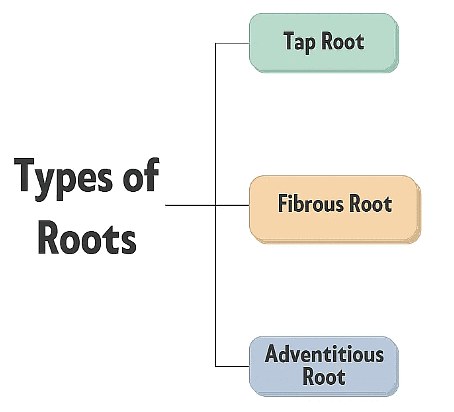
Let us discuss all these types in detail:
(a) Tap Roots
A taproot system is a type of root system found in many plants, where the main root, known as the taproot, grows deep into the soil and gives rise to smaller lateral roots.
The taproot system develops from the radicle of the germinating seed. The radicle elongation leads to the primary root formation which then bears the lateral roots of several orders called secondary, and tertiary roots.
The primary root and its branches constitute the Tap root system.
It is also called the normal root system.
The taproot is the true root that produces many lateral roots endogenously that grow obliquely.
The taproot system is present in dicotyledonous plants.
For example, carrot, radish, turnip, and beet are examples of plants with taproot systems. Trees like mango, neem, and banyan also have taproot systems.

Important Terms:
Lateral roots: The taproot gives rise to smaller lateral roots that grow horizontally from the main root. These lateral roots spread out in various directions and help in the absorption of water and nutrients from the upper layers of the soil.
Root branches: The lateral roots may further branch out into even smaller roots, forming a complex network of roots that help in the absorption of water, minerals, and other nutrients from the soil.
Advantages:
The Taproot system offers several advantages to plants. The deep penetration of the taproot allows the plant to access water and nutrients from deeper layers of the soil, making it more efficient in absorbing resources compared to other types of root systems. The taproot also provides stability and prevents the plant from toppling over in strong winds or adverse weather conditions.
(b) Fibrous Root System
- Fibrous roots are a type of root system found in monocotyledonous plants, such as wheat.
- In these plants, the primary root, which initially emerges from the seed during germination, is short-lived and is quickly replaced by a large number of roots that arise from the base of the stem.
- Fibrous roots are bushy roots in which thin, moderately branching roots grow from the stem.
- These roots spread out in a dense and tangled manner, forming what is known as a "fibrous root system.
- Unlike a taproot system, where a single main root grows deep into the soil and gives rise to smaller lateral roots, fibrous roots do not have a dominant main root. Instead, they are relatively equal in size and length, and they branch extensively in all directions.
- This network of roots allows the plant to efficiently absorb water and nutrients from a larger area of soil, as well as anchor the plant securely in the ground.
- The fibrous root system is typically shallow, extending only a few centimeters or inches into the soil, depending on the plant species. This makes it well-suited for plants that grow in environments with shallow soil, such as grasses, where the primary function of the roots is to anchor the plant and take up surface-level nutrients.
- Additionally, fibrous roots are capable of regenerating quickly if damaged, which allows the plant to recover from disturbances or stresses in the environment.
- Rice, wheat, maize, marigold, banana and all monocotyledons are some examples of the fibrous root system.
The roots that originate from the base of the stem are:
(c) Adventitious Roots
- The root system that develops from any part of the plant body other than the radicle is called the adventitious root system.
- Adventitious roots can emerge from various plant parts, such as stems, leaves, or even aerial parts, and they exhibit unique features and functions.
- These roots play a crucial role in providing support to the plant, aiding in nutrient uptake, and adapting to changing environmental conditions
- This root system serves various purposes like mechanical support and vegetative propagation.
- Some examples include the banyan tree, maize, oak tree, and horsetails.
Sweet potato is modified:

Regions of Roots
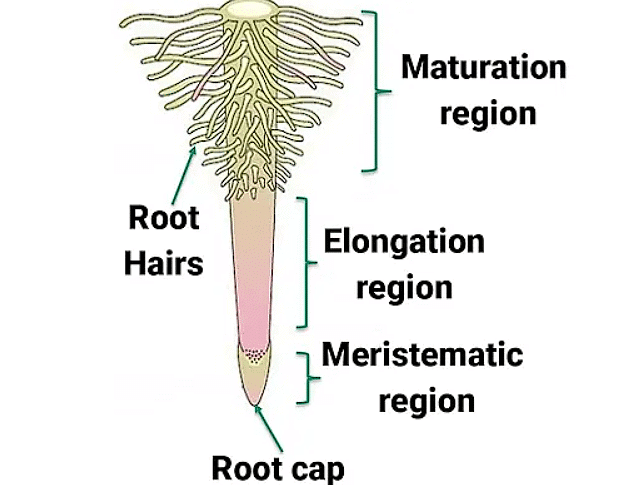
The regions of a root refer to the different zones or sections along the length of a root that exhibit distinct characteristics in terms of cell activity, differentiation, and function. These regions include:
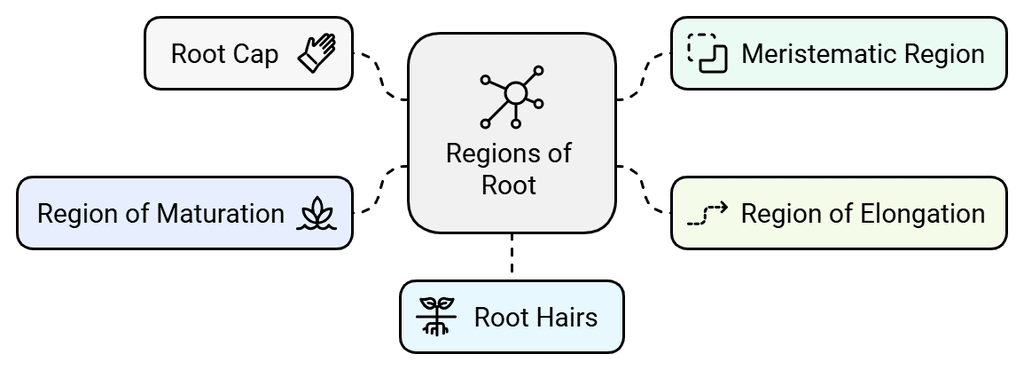 Regions of Root
- Root Cap: The root cap is a thimble-like structure that covers the apex of the root. It protects the delicate tip of the root as it grows through the soil.
- Meristematic Region: Located a few millimeters above the root cap, the meristematic region is where active cell division takes place. The cells in this region are small, thin-walled, and have dense protoplasm. They continuously divide, contributing to the growth of the root.
- Region of Elongation: The cells proximal to the meristematic region undergo rapid elongation and enlargement, resulting in the elongation of the root in length. This region is called the region of elongation, and it is responsible for the primary growth of the root.
- Region of Maturation: As the cells of the elongation zone continue to differentiate and mature, they form the region of maturation, which is proximal to the region of elongation. In this region, the cells differentiate into different types of root tissues and structures.
- Root Hairs: Some of the epidermal cells in the region of maturation form root hairs, which are delicate, thread-like structures that protrude from the surface of the root. Root hairs have a large surface area and are responsible for absorbing water and minerals from the soil, playing a crucial role in nutrient uptake.
NEET Previous Year Questions- The Root
Q. Pneumatophores are found in:
(a) The vegetation which is found in marshy and saline lake.
(b) The vegetation which found in acidic soil.
(c) Xerophytes
(d) Epiphytes
Ans: (a) The vegetation which is found in marshy and saline lake.
- Pneumatophores are found in the vegetation which is found in marshy and saline lake.
- These specialized aerial roots that help plants to breathe air in an area of waterlogged soil.
- Lenticels present on the surface of these roots helps in taking up air into spongy tissue which in turn spread oxygen throughout the plant as needed.
- It is a type of root that grow negatively geotropic for taking in oxygen from the air.
- They are pencil-like roots that stick up out of the dense, wet ground like snorkels.
To test your knowledge related to topic "Roots", you just read, attempt the tests given below:
|
181 videos|360 docs|149 tests
|
FAQs on The Root: Types, Regions & Modifications - Biology Class 11 - NEET
| 1. What are the main functions of roots in plants? |  |
| 2. What are the different types of roots found in plants? | |
| 3. What are the different regions of roots and their significance? | |
| 4. How do root modifications help plants adapt to their environment? | |
| 5. What types of root systems can be commonly observed in plants? | |

|
22.5K Views |

|
4.77/5 Rating |

|
Dec 22, 2024 Last updated |

|
Explore Courses for NEET exam
|
|
Regions & Modifications | Biology Class 11 - NEET
,shortcuts and tricks
,Regions & Modifications | Biology Class 11 - NEET
,The Root: Types
,ppt
,The Root: Types
,Semester Notes
,MCQs
,Summary
,practice quizzes
,mock tests for examination
,video lectures
,study material
,Regions & Modifications | Biology Class 11 - NEET
,Exam
,Free
,past year papers
,Important questions
,Sample Paper
,Previous Year Questions with Solutions
,Viva Questions
,Objective type Questions
,The Root: Types
,Extra Questions
;




The Root: Types, Regions & Modifications Free PDF Download
Importance of The Root: Types, Regions & Modifications
The Root: Types, Regions & Modifications Notes
The Root: Types, Regions & Modifications NEET Questions
Study The Root: Types, Regions & Modifications on the App
|
© EduRev
|
Education Revolution
|


|


