Growth & its Phases, Rates, Conditions, Processes


When we talk about growth, we describe a measurable and orderly sequence of changes in an organism. Imagine a tiny seedling emerging from the soil and gradually becoming a mature plant with roots, stems, leaves, flowers and seeds. Growth in plants involves increases in size, mass and complexity together with changes in structure and function as cells become specialised.
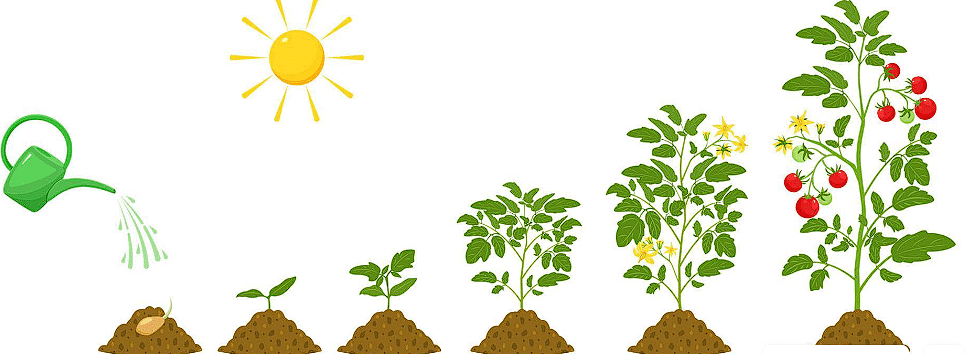 Growth
 What is Growth and Development in Plants?
Growth is a biological process that refers to an increase in size, mass and complexity of an organism over time. In plants, growth results from cell division and cell enlargement and leads to greater structural organisation.
Differentiation is the process by which undifferentiated or less-specialised cells acquire specific forms and functions (for example, cells becoming xylem, phloem, epidermis or guard cells). Differentiation is essential for forming the tissues and organs of a plant.
Development is the combined outcome of growth and differentiation. Development produces the complex body plan of a plant and includes formation of roots, stems, leaves, flowers, fruits and seeds.
Example: Seed Germination
- Seed germination is the initial stage of a plant's growth following dormancy.
- Germination begins only when environmental conditions (water, oxygen, temperature, sometimes light) are favourable.
- Under unfavourable conditions seeds remain dormant; when conditions return to suitable values, metabolic activity resumes and the embryo grows out of the seed coat.
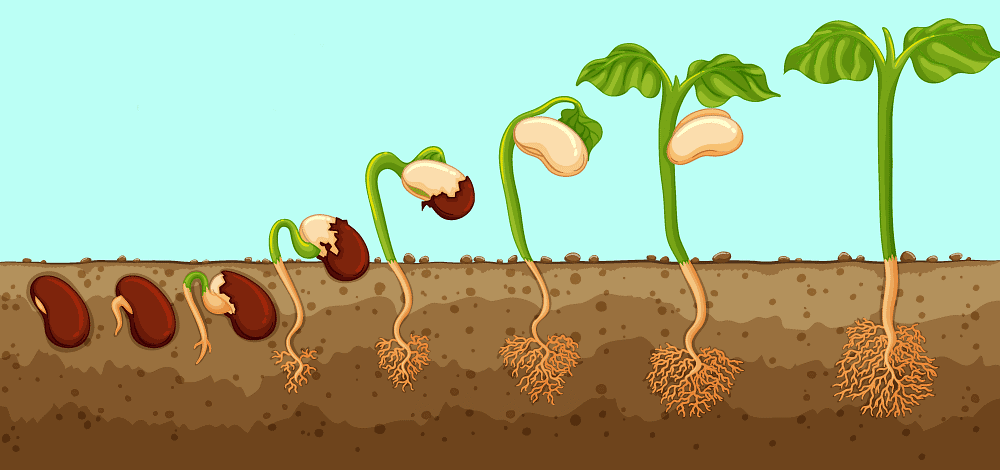 Seed Germination
Characteristics of Growth
(i) Plant Growth is Generally Indeterminate
- Many plants show indeterminate or open growth, which means they continue to grow throughout their life by producing new cells at meristematic regions.
- Meristems are regions of actively dividing, undifferentiated cells located at specific positions: apical meristems at shoot and root tips, and lateral meristems (vascular cambium and cork cambium) in stems and roots of woody plants.
- Cells produced by meristems may keep dividing or may differentiate; as they differentiate they generally lose the capacity to divide.
- Primary growth (from apical meristems) increases plant length; secondary growth (from lateral meristems) increases girth or thickness.
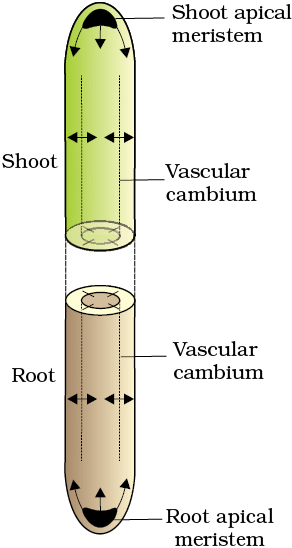 Locations of Root, Shoot and Vascular Cambium
(ii) Growth is Measurable
- Cellular growth is primarily due to an increase in protoplasm and water uptake, but direct measurement of protoplasm is difficult; therefore growth is measured by observable parameters.
- Common parameters used to measure growth include increase in fresh weight, dry weight, length, area, volume and cell number.
- Length is suited to linear organs such as roots, stems and pollen tubes.
- Area is useful for dorsiventral (flat) organs such as leaves.
- Volume may be used for roughly three-dimensional organs but is less common.
- Cell number helps quantify growth when changes are mainly by cell division rather than cell enlargement.
- The choice of parameter depends on the organ and the scientific or agricultural question being asked.
Phases of Growth
Growth does not occur at a constant rate throughout an organ or organism. Instead it proceeds in characteristic phases in a longitudinal axis from the apical tip.
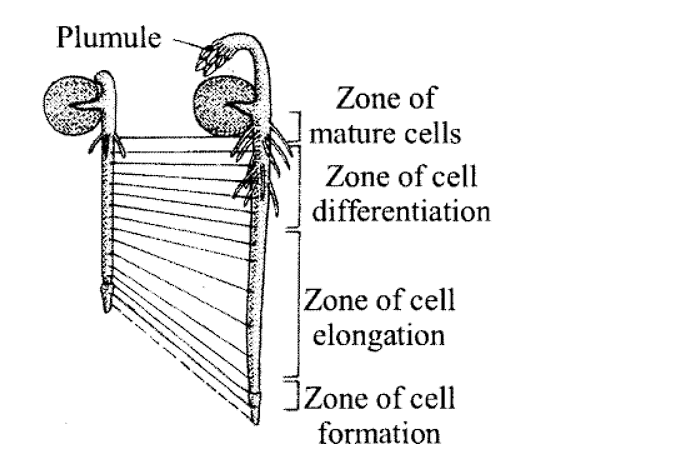 Phases of Growth
- Meristematic phase: This is the zone nearest the tip (root or shoot apex) where cells are actively dividing. Cells here have dense cytoplasm, prominent nuclei, thin primary cell walls and numerous plasmodesmata. This phase increases cell number and forms the basic tissues of the plant.
- Elongation phase: Cells produced by the meristem enter the elongation zone where they greatly increase in size. Enlargement is caused by vacuolation, water uptake and synthesis of new wall material. This phase produces most of the increase in organ length.
- Maturation phase: Cells in this region attain final size, thicken their walls, and undergo protoplasmic specialisation to form permanent, functioning cell types (for example, xylem, phloem, epidermis, cortex). This phase establishes the functional tissues.
Growth Rates
Growth rate is the increase in some measure of size per unit time. Growth may follow different mathematical patterns depending on how daughter cells behave after division.
 Diagrammatic representation of : (a) Arithmetic (b) Geometric growth and (c) Stages during embryo development showing geometric and arithematic phases
(i) Arithmetic Growth
- In arithmetic growth (linear growth), after mitosis one daughter cell continues to divide while the other differentiates. Thus increase in size of the organ is roughly constant per unit time.
- An example is steady linear elongation of a root or stem segment.
- When the length of the organ is plotted against time, the graph is approximately a straight line.
The arithmetic growth equation can be written as:
\(L_t = L_0 + rt\)
where \(L_t\) is length at time \(t\), \(L_0\) is initial length and \(r\) is the constant growth (elongation) rate per unit time.
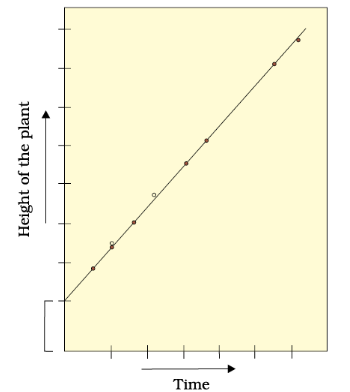 Arithmetic Growth Graphical Representation
(ii) Geometrical (Exponential) Growth
- Geometrical or exponential growth begins with a lag phase, then a period of rapid increase where both daughter cells retain the capacity to divide. This produces exponential increase in size or cell number.
- With limited resources, exponential growth slows and reaches a stationary phase; in natural conditions, many organs and populations show this pattern.
- When plotted versus time this growth produces a sigmoid (S-shaped) curve: lag → exponential (log) → deceleration → stationary.
The exponential growth equation can be written as:
\(W_t = W_0 e^{rt}\)
where \(W_t\) is the size (weight, number or other quantity) at time \(t\), \(W_0\) is the initial size and \(r\) is the growth rate. The base \(e\) denotes natural logarithms.
 Geometric Growth Graphical Representation
Quantitative Comparison of Growth
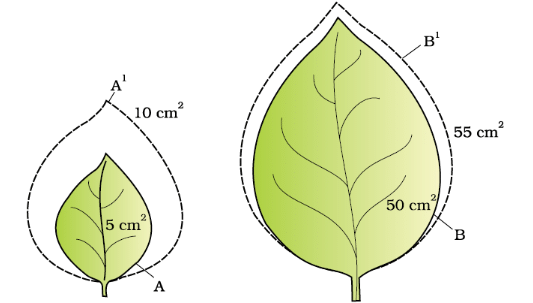 Diagrammatic comparison of absolute and relative growth rates. Both leaves A and B have increased their area by 5 cm2 in a given time to produce A1 , B1 leaves.
- Absolute growth rate: Total increase in a dimension (for example, mm per day or g per day). It describes raw increase without reference to the initial size.
- Relative growth rate: Growth expressed relative to the size at a particular time (for example, increase per unit initial mass per unit time). This allows comparison of growth between individuals or tissues that differ in initial size.
Conditions Required for Growth
- Water: Essential for cell enlargement because turgor (internal water pressure) drives expansion of cell walls. Water is also a medium for metabolic reactions and transport of solutes.
- Oxygen: Required for aerobic respiration which supplies ATP and metabolic energy needed for biosynthesis and division.
- Nutrients: Macro-elements (N, P, K, Ca, Mg, S) and micro-elements (Fe, Mn, Zn, Cu, B, Mo, Cl) are necessary for building protoplasm, enzymes and structural components. Nutrient deficiency limits growth.
- Optimum temperature: Each species has an optimum temperature range for enzyme activity and membrane function; temperatures outside this range reduce growth or cause injury.
- Light and other environmental signals: Light regulates photosynthesis, photomorphogenesis and flowering. Gravity, humidity and other cues influence orientation and developmental responses (for example, phototropism and gravitropism).
Differentiation, Dedifferentiation and Redifferentiation
- Differentiation: Cells derived from meristems specialise by altering cell-wall structure, cytoplasmic composition and organelle complement to perform particular functions (for example, xylem elements develop lignified secondary walls and lose protoplasm to conduct water).
- Dedifferentiation: Under certain conditions (wounding, in vitro culture or hormonal signals) specialised cells can revert to a less specialised, dividing state and give rise to new meristematic tissue (for example, formation of interfascicular cambium or cork cambium from parenchyma).
- Redifferentiation: After dedifferentiation, new meristematic cells may divide and then differentiate again to form specialised tissues. Examples in woody plants include formation of cork by cork cambium, formation of secondary xylem (wood) and changes in pith parenchyma into sclereids.
- Tumours in plants: Tumours or galls are localised regions of uncontrolled cell division caused by injury, infection (for example, Agrobacterium tumefaciens) or genetic changes; they represent abnormal growth regulation.
- Parenchyma cells in tissue culture: In plant tissue culture, parenchyma cells stimulated to divide form a mass of undifferentiated cells called callus. Callus can be induced to regenerate shoots and roots by applying appropriate hormones, demonstrating dedifferentiation and redifferentiation.
- Open differentiation: Cells arising from the same meristem can follow different differentiation pathways depending on their final position and local signals. For example, cells nearer a root tip become root-cap cells whereas cells displaced to the outside become epidermis.
Growth and development in plants are governed by a combination of intrinsic cellular programmes (cell division patterns, hormonal control) and extrinsic environmental conditions (water, nutrients, temperature, light). Understanding the phases, rates and conditions of growth helps in agriculture, forestry and plant biotechnology where controlled growth and regeneration are important.
FAQs on Growth & its Phases, Rates, Conditions, Processes
| 1. What is the difference between growth and development in plants? |  |
| 2. What are the characteristics of plant growth? | |
| 3. What are the phases of plant growth? | |
| 4. How is growth rate calculated in plants? | |
| 5. What is a growth curve in plants? | |





