Glycolysis & Fermentation


Glycolysis and fermentation are essential pathways for energy extraction from glucose. Glycolysis is the first step of cellular respiration occurring in the cytoplasm, breaking down glucose into pyruvate. Fermentation occurs under anaerobic conditions, converting pyruvate into either lactic acid or ethanol. These processes are fundamental for understanding both aerobic and anaerobic respiration in living organisms.
1. Glycolysis (EMP Pathway)
1.1 Definition and Discovery
- Term Origin: Greek words - glycos (sugar) + lysis (splitting)
- Alternative Name: EMP Pathway (Embden-Meyerhof-Parnas pathway)
- Scientists: Gustav Embden, Otto Meyerhof, and J. Parnas gave the scheme
- Location: Occurs in the cytoplasm of the cell
- Universality: Present in all living organisms
- Role in Anaerobic Organisms: Only process in respiration for anaerobic organisms
1.2 Overall Process
- Net Reaction: Glucose (6C) undergoes partial oxidation → 2 molecules of pyruvic acid (3C each)
- Total Steps: Chain of 10 reactions controlled by different enzymes
- Oxygen Requirement: Does not require oxygen (anaerobic process)
- Energy Release: Less than 7% of energy in glucose is released
1.3 Starting Substrates in Plants
- Primary Source: Glucose derived from sucrose (end product of photosynthesis) or storage carbohydrates
- Sucrose Conversion: Enzyme invertase converts sucrose → glucose + fructose
- Entry into Pathway: Both glucose and fructose enter glycolytic pathway
- Phosphorylation: Enzyme hexokinase converts glucose → glucose-6-phosphate and fructose → fructose-6-phosphate
- Isomerization: Glucose-6-phosphate isomerizes to fructose-6-phosphate
- Common Pathway: After phosphorylation, metabolism of glucose and fructose is same
2. Detailed Steps of Glycolysis
2.1 ATP Utilization Steps (Energy Investment Phase)
Two molecules of ATP are consumed in the preparatory phase:
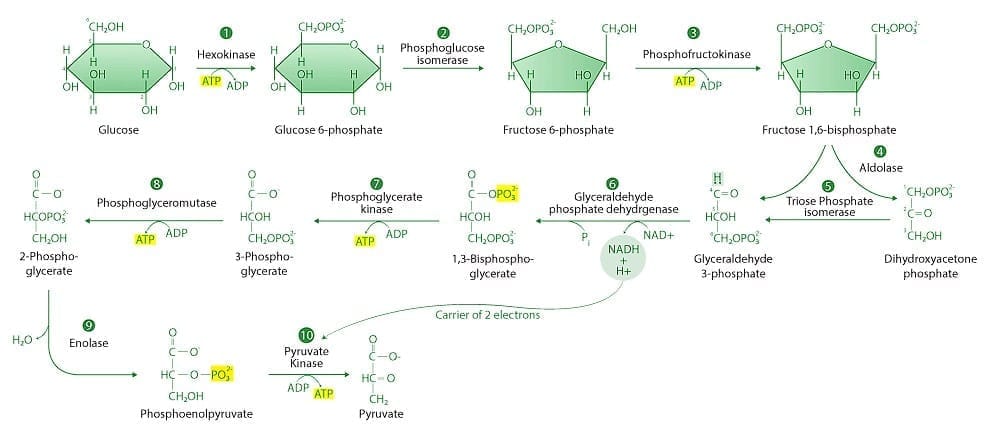
- Step 1: Glucose (6C) → Glucose-6-phosphate (6C) [ATP utilized, enzyme: hexokinase]
- Step 2: Glucose-6-phosphate (6C) → Fructose-6-phosphate (6C) [Isomerization]
- Step 3: Fructose-6-phosphate (6C) → Fructose-1,6-bisphosphate (6C) [ATP utilized]
2.2 Cleavage Phase
- Step 4:Fructose-1,6-bisphosphate (6C) splits into:
- Dihydroxyacetone phosphate (DHAP) (3C)
- 3-phosphoglyceraldehyde (PGAL) (3C)
- Note: Both triose phosphates are interconvertible; DHAP converts to PGAL for further metabolism
2.3 Oxidation and ATP Generation (Energy Payoff Phase)
Each PGAL molecule (2 per glucose) undergoes the following reactions:
- NADH Formation Step: 3-phosphoglyceraldehyde (PGAL) + NAD+ + inorganic phosphate → 1,3-bisphosphoglycerate (BPGA) + NADH + H+
- PGAL is oxidized (2 hydrogen atoms removed)
- 2 redox-equivalents transferred to NAD+
- Total per glucose: 2 NADH + 2H+ formed
- First ATP Synthesis:1,3-bisphosphoglycerate (BPGA) → 3-phosphoglyceric acid (PGA) + ATP
- Energy yielding step
- Total per glucose: 2 ATP synthesized
- Step 8: 3-phosphoglyceric acid (PGA) → 2-phosphoglycerate (2-PG)
- Step 9: 2-phosphoglycerate → Phosphoenolpyruvate (PEP) + H₂O
- Second ATP Synthesis:Phosphoenolpyruvate (PEP) → Pyruvic acid (3C) + ATP
- Total per glucose: 2 ATP synthesized
2.4 Net ATP Calculation
- ATP Consumed: 2 ATP (during glucose and fructose-6-phosphate phosphorylation)
- ATP Produced: 4 ATP (2 during BPGA → PGA; 2 during PEP → Pyruvate)
- Net ATP Gain per Glucose: 4 - 2 = 2 ATP
- NADH Produced: 2 NADH + 2H+
2.5 End Product
- Key Product: Pyruvic acid (Pyruvate) (3C molecule, 2 molecules per glucose)
- Metabolic Fate: Depends on cellular need and oxygen availability
3. Fermentation
3.1 Definition and Conditions
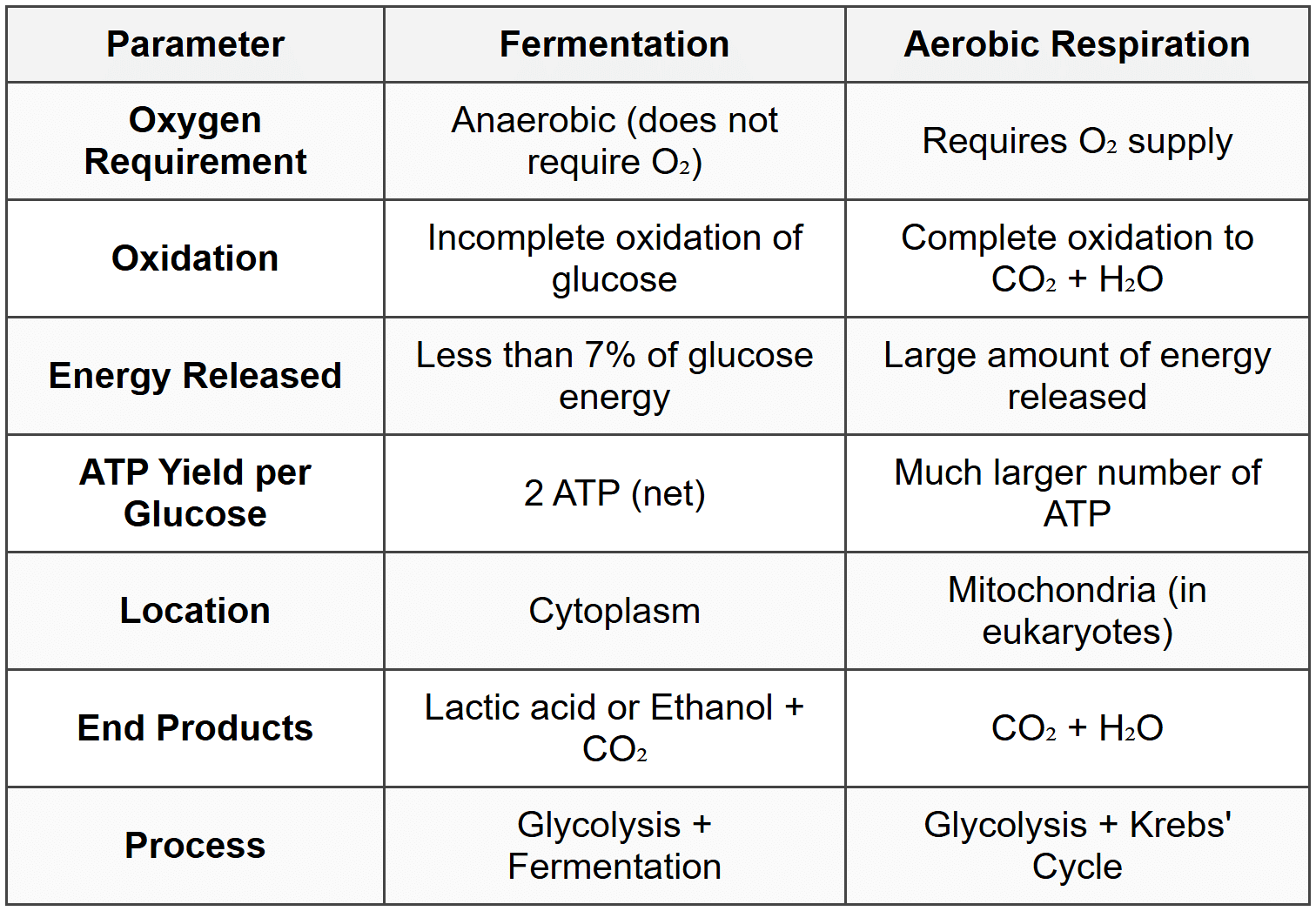
- Definition: Incomplete oxidation of glucose under anaerobic conditions
- Occurrence: Many prokaryotes and unicellular eukaryotes
- Starting Point: Pyruvic acid (product of glycolysis)
- Oxygen Requirement: Does not require oxygen
3.2 Types of Fermentation
3.2.1 Alcoholic Fermentation
- Organism: Yeast and some bacteria
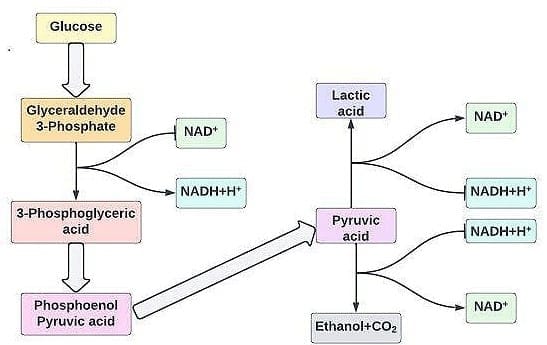
- Reaction: Pyruvic acid → CO₂ + Ethanol
- Enzymes Involved:
- Pyruvic acid decarboxylase: Pyruvic acid → Acetaldehyde + CO₂
- Alcohol dehydrogenase: Acetaldehyde + NADH + H+ → Ethanol + NAD+
- NAD⁺ Regeneration: NADH + H+ is reoxidized to NAD+
- Toxicity Limit: Yeasts poison themselves when alcohol concentration reaches about 13%
- Maximum Natural Fermentation Concentration: Approximately 13% alcohol in naturally fermented beverages
- Higher Concentrations: Obtained through distillation processes
3.2.2 Lactic Acid Fermentation
- Organisms: Some bacteria, animal muscle cells during oxygen inadequacy
- Reaction: Pyruvic acid + NADH + H+ → Lactic acid + NAD+
- Enzyme: Lactate dehydrogenase catalyzes the reaction
- Example: Muscle cells during exercise when oxygen is inadequate for cellular respiration
- NAD⁺ Regeneration: NADH + H+ is reoxidized to NAD+
3.3 Energy Yield in Fermentation
- Energy Released: Less than 7% of energy in glucose is released
- ATP Trapping: Not all released energy is trapped as high-energy bonds of ATP
- Net ATP per Glucose: 2 ATP (same as glycolysis, no additional ATP from fermentation steps)
- Calculation: ATP synthesized (4) - ATP utilized (2) = 2 ATP net gain
- Hazardous Products: Either acid (lactic acid) or alcohol (ethanol) produced
3.4 Common Reducing Agent
- Reducing Agent: NADH + H+ in both alcoholic and lactic acid fermentation
- Reoxidation: NADH + H+ is reoxidized to NAD+ during fermentation
- Importance: Regeneration of NAD+ allows glycolysis to continue in absence of oxygen
4. Metabolic Fate of Pyruvate - Three Major Pathways
- Pathway 1: Lactic Acid Fermentation (anaerobic conditions, some bacteria, muscle cells)
- Pathway 2: Alcoholic Fermentation (anaerobic conditions, yeast, some bacteria)
- Pathway 3: Aerobic Respiration (Krebs' Cycle) (requires O₂, complete oxidation of glucose to CO₂ + H₂O in mitochondria)
- Determining Factor: Cellular need and oxygen availability
5. Comparison: Fermentation vs Aerobic Respiration
6. Key Trap Alerts for NEET
- Trap 1: Students often confuse net ATP with gross ATP. Remember: Glycolysis produces 4 ATP but consumes 2 ATP, so net gain = 2 ATP
- Trap 2: NADH is produced during glycolysis (PGAL → BPGA step), NOT during fermentation. Fermentation only reoxidizes NADH to NAD+
- Trap 3: Both glucose and fructose are phosphorylated by hexokinase (not different enzymes), and after conversion to fructose-6-phosphate, their pathways are identical
- Trap 4: Fermentation itself does NOT produce ATP. The 2 net ATP comes only from glycolysis. Fermentation regenerates NAD+ to keep glycolysis running
- Trap 5: Yeast cells die at approximately 13% alcohol concentration - this limits natural fermentation. Higher alcohol content requires distillation
- Trap 6: Per glucose molecule, 2 PGAL are formed, so 2 NADH are produced, 4 ATP are synthesized (gross), and 2 pyruvate molecules are formed
- Trap 7: Glycolysis occurs in cytoplasm in ALL organisms (prokaryotes and eukaryotes). Only aerobic respiration (Krebs' cycle) requires mitochondria in eukaryotes
Glycolysis and fermentation are critical energy-yielding pathways that function under both aerobic and anaerobic conditions. Glycolysis produces 2 net ATP and 2 NADH per glucose molecule and is universal across all life forms. Fermentation regenerates NAD+ to sustain glycolysis when oxygen is unavailable, though it yields significantly less energy compared to complete aerobic oxidation. Understanding the specific enzymes, intermediates, and energy calculations is essential for NEET preparation.
FAQs on Glycolysis & Fermentation
| 1. What is fermentation? |  |
| 2. How does fermentation produce alcohol? | |
| 3. What is lactic acid fermentation? | |
| 4. Which microorganisms are involved in alcohol fermentation? | |
| 5. What are the applications of fermentation? | |





