The Calvin Cycle & The C4 Pathway | Biology Class 11 - NEET PDF Download
| Table of contents |

|
| Introduction |
|
| What is Calvin Cycle? |
|
| Stages of C3 Cycle |
|
| Products of C3 Cycle |
|
| Key Points on C3 Cycle |
|
| C4 Pathway (Hatch and Slack Pathway) |
|

Introduction
Photosynthesis is the biochemical process that occurs in all green plants or autotrophs producing organic molecules from carbon dioxide (CO2). These organic molecules contain many carbon-hydrogen (C–H ) bonds and are highly reduced compared to CO2.
There are two stages of Photosynthesis:
- Light-Dependent Reactions: As the name suggests, it requires light and mainly occurs during the daytime.
- Light-Independent Reactions: It is also called the dark reaction or Calvin cycle or C3 cycle. This reaction occurs both in the presence and absence of sunlight.
Calvin Cycle
“Calvin cycle or C3 cycle is defined as a set of chemical reactions performed by the plants to reduce carbon dioxide and other compounds into glucose.”
What is Calvin Cycle?
Calvin cycle is also known as the C3 cycle or light-independent or dark reaction of photosynthesis. However, it is most active during the day when NADPH and ATP are abundant. To build organic molecules, the plant cells use raw materials provided by the light reactions:- Energy: ATP provided by cyclic and noncyclic photophosphorylation, which drives the endergonic reactions.
- Reducing power: NADPH provided by photosystem I is the source of hydrogen and the energetic electrons required to bind them to carbon atoms. Much of the light energy captured during photosynthesis ends up in the energy-rich C—H bonds of sugars.
Plants store light energy in the form of carbohydrates, primarily starch and sucrose. The carbon and oxygen required for this process are obtained from CO2, and the energy for carbon fixation is derived from the ATP and NADPH produced during the photosynthesis process.
The conversion of CO2 to carbohydrate is called Calvin Cycle or C3 cycle and is named after Melvin Calvin who discovered it. The plants that undergo the Calvin cycle for carbon fixation are known as C3 plants.
Calvin Cycle requires the enzyme ribulose-1,5-bisphosphate carboxylase/oxygenase commonly called RuBisCO. It generates the triose phosphates, 3-phosphoglycerate (3-PGA), glyceraldehyde-3P (GAP), and dihydroxyacetone phosphate (DHAP), all of which are used to synthesize the hexose phosphates fructose-1,6-bisphosphate and fructose 6-phosphate.
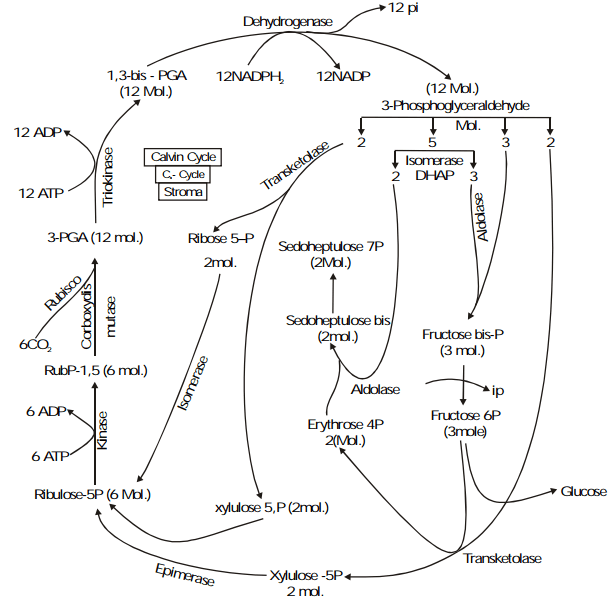
C3 Cycle Diagram
The Calvin cycle diagram below shows the different stages of Calvin Cycle or C3 cycle that include carbon fixation, reduction, and regeneration.Stages of C3 Cycle
Calvin cycle or C3 cycle can be divided into three main stages:- Carbon Fixation: The key step in the Calvin cycle is the event that reduces CO2.
CO2 binds to RuBP in the key process called carbon fixation, forming two-three carbon molecules of phosphoglycerate. The enzyme that carries out this reaction is ribulose bisphosphate carboxylase/oxygenase, which is very large with a four-subunit and present in the chloroplast stroma. This enzyme works very sluggishly, processing only about three molecules of RuBP per second (a typical enzyme process of about 1000 substrate molecules per second). In a typical leaf, over 50% of all the protein is RuBisCO. It is thought to be the most abundant protein on the earth. - Reduction: It is the second stage of Calvin cycle. The 3-PGA molecules created through carbon fixation are converted into molecules of simple sugar – glucose.
This stage obtains energy from ATP and NADPH formed during the light-dependent reactions of photosynthesis. In this way, Calvin cycle becomes a pathway in which plants convert sunlight energy into long-term storage molecules, such as sugars. The energy from the ATP and NADPH is transferred to the sugars.
This step is known as reduction since electrons are transferred to 3-PGA molecules to form glyceraldehyde-3 phosphate. - Regeneration: It is the third stage of the Calvin cycle and is a complex process that requires ATP. In this stage, some of the G3P molecules are used to produce glucose, while others are recycled to regenerate the RuBP acceptor.
Products of C3 Cycle
- One molecule of carbon is fixed at each turn of the Calvin cycle.
- One molecule of glyceraldehyde-3 phosphate is created in three turns of the Calvin cycle.
- Two molecules of glyceraldehyde-3 phosphate combine together to form one glucose molecule.
- 3 ATP and 2 NADPH molecules are used during the reduction of 3-phosphoglyceric acid to glyceraldehyde-3 phosphate and in the regeneration of RuBP.
- 18 ATP and 12 NADPH are consumed in the production of 1 glucose molecule.
Key Points on C3 Cycle
- C3 cycle refers to the dark reaction of photosynthesis.
- It is indirectly dependent on light and the essential energy carriers are products of light-dependent reactions.
- In the first stage of the Calvin cycle, the light-independent reactions are initiated and carbon dioxide is fixed.
- In the second stage of the C3 cycle, ATP and NADPH reduce 3PGA to G3P. ATP and NADPH are then converted into ATP and NADP+.
- In the last stage, RuBP is regenerated. This helps in more carbon dioxide fixation.
Biochemical reactions of Calvin cycle are as follows:
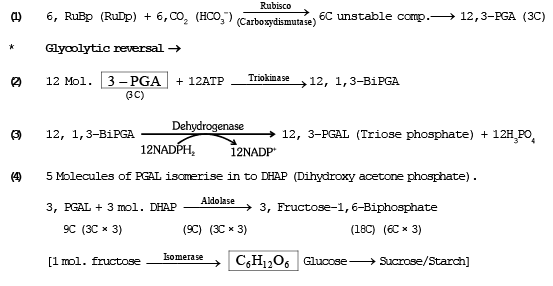
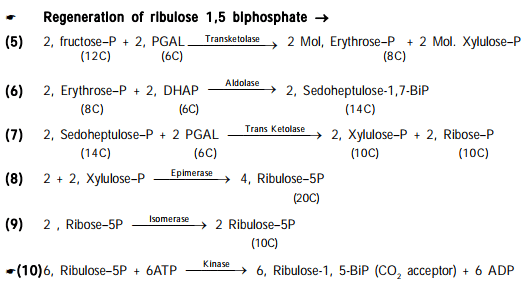
Calvin Cycle/C3 – Cycle /Reductive Pentose Phosphate Pathway: in chloroplast stroma
C4 Pathway (Hatch and Slack Pathway)
- Every photosynthetic plant follows Calvin cycle, but in some plants, there is a primary stage to the Calvin Cycle known as C4 pathway.
- Plants in tropical desert regions commonly follow the C4 pathway.
- Here, a 4-carbon compound called oxaloacetic acid (OAA) is the first product by carbon fixation.
- Such plants are special and have certain adaptations as well.
- The C4 pathway initiates with a molecule called phosphoenolpyruvate (PEP) which is a 3-carbon molecule.
- This is the primary CO2 acceptor and the carboxylation takes place with the help of an enzyme called PEP carboxylase.
- They yield a 4-C molecule called oxaloacetic acid (OAA).
- Eventually, it is converted into another 4-carbon compound known as malic acid. Later, they are transferred from mesophyll cells to bundle sheath cells.
- Here, OAA is broken down to yield carbon dioxide and a 3-C molecule.
- The CO2 thus formed, is utilized in the Calvin cycle, whereas 3-C molecule is transferred back to mesophyll cells for regeneration of PEP.
- Corn, sugarcane and some shrubs are examples of plants that follow the C4 pathway.
- Calvin pathway is a common pathway in both C3 plants and C4 plants, but it takes place only in the mesophyll cells of the C3 Plants but not in the C4 Plants.
|
169 videos|401 docs|136 tests
|
FAQs on The Calvin Cycle & The C4 Pathway - Biology Class 11 - NEET
| 1. What is the Calvin Cycle? |  |
| 2. What are the stages of the C3 Cycle? | |
| 3. What are the products of the C3 Cycle? | |
| 4. What are some key points to know about the C3 Cycle? | |
| 5. How does the C4 Pathway (Hatch and Slack Pathway) differ from the Calvin Cycle? | |




Extra Questions
,The Calvin Cycle & The C4 Pathway | Biology Class 11 - NEET
,ppt
,Free
,past year papers
,mock tests for examination
,shortcuts and tricks
,practice quizzes
,Sample Paper
,Exam
,Summary
,study material
,The Calvin Cycle & The C4 Pathway | Biology Class 11 - NEET
,Previous Year Questions with Solutions
,Viva Questions
,The Calvin Cycle & The C4 Pathway | Biology Class 11 - NEET
,Important questions
,MCQs
,Semester Notes
,video lectures
,Objective type Questions
;



The Calvin Cycle & The C4 Pathway Free PDF Download
Importance of The Calvin Cycle & The C4 Pathway
The Calvin Cycle & The C4 Pathway Notes
The Calvin Cycle & The C4 Pathway NEET Questions
Study The Calvin Cycle & The C4 Pathway on the App
|
© EduRev
|
Education Revolution
|


|




within 7 days!