Cockroach: Morphology & Anatomy (Only in NEET, Not in NCERT)

Introduction
- Cockroaches are insects belonging to the class Insecta in the phylum Arthropoda.
- They vary in colour from brown or black to, in some tropical species, bright yellow, red or green.
- Body size ranges from about 1⁄4 inch to 3 inches (≈0.6 to 7.6 cm) depending on species; common household cockroaches often measure 34-53 mm in length.
- Cockroaches have long antennae, well-developed legs for running and a flattened body with a shield-like extension of the thoracic dorsum that partly covers the head.
- They are primarily nocturnal omnivores, preferring damp, sheltered sites and feeding on a wide variety of organic matter.
- Many species are well adapted to human habitats and are considered pests; they can mechanically contaminate food and may act as vectors of some pathogens.
Morphology of Cockroach
The body of a cockroach is externally divided into three major regions: head, thorax and abdomen. The body is protected by a tough external skeleton, the exoskeleton, made of chitin. Cockroaches show bilateral symmetry and a segmented arrangement of appendages. Sexual dimorphism is often present: males typically have longer bodies and wings that extend beyond the abdomen, while females may have shorter wings and a broader abdomen.
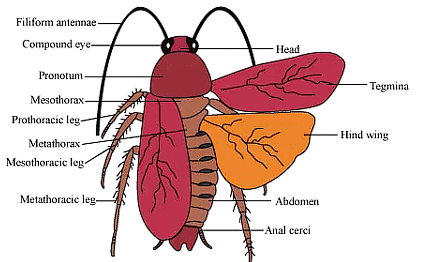
Head
- Shape and orientation: The head is somewhat triangular and is set at a right angle to the body axis, permitting a wide range of movement due to a flexible neck.
- Segments and mobility: Formed by the fusion of several segments, the head is mobile and bears most sensory organs.
- Compound eyes: A pair of large compound eyes are present on the dorsal surface of the head.
- Antennae: A single pair of long, thread-like antennae arises from membranous sockets anterior to the eyes. They carry many sensory receptors for touch, odour and humidity.
- Mouthparts: The mouthparts are of the biting and chewing type and include a labrum (upper lip), a pair of mandibles, a pair of maxillae (each with a maxillary palp), and a labium (lower lip) bearing labial palps.
- Hypopharynx: A median, tongue-like lobe called the hypopharynx lies within the mouth region and assists in food manipulation.
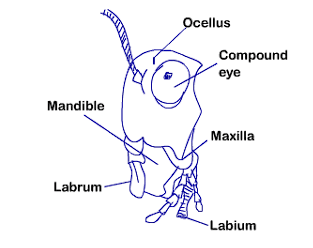 Head of Cockroach
Thorax
The thorax is composed of three segments: prothorax, mesothorax and metathorax. Each segment bears a pair of walking legs. Wings arise from the mesothorax and metathorax.
- The head is joined to the thorax by a short extension of the prothorax often referred to as the neck.
- Each thoracic segment bears one pair of walking legs, adapted for rapid running.
- The first pair of wings (forewings or tegmina) arise from the mesothorax; these are opaque, leathery and serve to protect the hind wings and abdomen when at rest.
- The second pair of wings (hind wings) arise from the metathorax; these are membranous and used for flight where flight occurs.
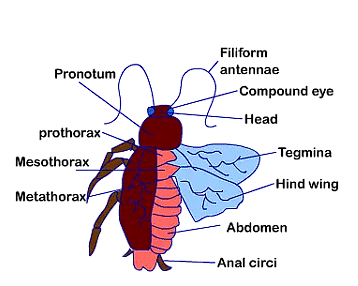
Abdomen
- The abdomen consists of ten segments externally in both sexes.
- Female abdomen: The 7th sternum is often boat-shaped; the 7th-9th sterna form a genital or brood pouch that contains the female gonopore, openings of the spermathecae and collateral glands.
- Male abdomen: The male genital pouch lies at the posterior end of the abdomen, bounded dorsally by the 9th and 10th terga and ventrally by the 9th sternum; it contains the male genital pore and associated structures.
- Anal structures: Both sexes bear a pair of jointed filamentous appendages called anal cerci on the 10th segment. Males additionally possess a pair of short, thread-like anal styles which are absent in females.
Anatomy of Cockroach
The internal organisation of the cockroach includes specialised systems for digestion, circulation, respiration, excretion, nervous control and reproduction. These systems show adaptations for terrestrial life and enable the insect's generalised feeding, high mobility and survival in varied habitats.
Digestive System
The alimentary canal is a straight tube divided into three regions: foregut, midgut and hindgut. Functional specialisations and associated glands occur at segmental junctions.
- Foregut: Begins at the mouth and includes the pharynx (a short muscular tube) and the oesophagus, which opens into a thin-walled sac called the crop for temporary food storage.
- The crop is followed by the gizzard or proventriculus, a muscular grinding chamber lined with a thick cuticle; it bears chitinous teeth or plates (typically six) to mechanically crush food.
- The entire foregut is lined internally by cuticle continuous with the external exoskeleton.
- At the foregut-midgut junction are 6-8 blind tubules called hepatic (gastric) caeca that secrete digestive enzymes and increase digestive surface area.
- Midgut: The main site of digestion and absorption; the midgut epithelium is not cuticularised and contains digestive cells.
- At the midgut-hindgut junction are a ring of about 100-150 Malpighian tubules (thin, filamentous, yellowish tubules) functioning in excretion and osmoregulation by removing waste from the haemolymph.
- Hindgut: Differentiated into ileum, colon and rectum; the rectum opens to the exterior via the anus and is involved in water and ion reabsorption.
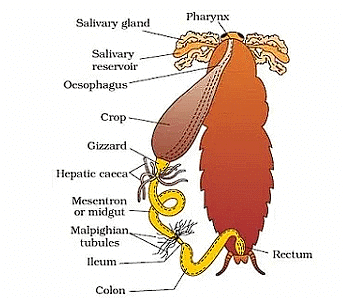 Alimentary canal of cockroach
Blood Vascular System
- The cockroach has an open circulatory system. Vessels are limited and blood (haemolymph) bathes internal organs in body cavities called haemocoels.
- Haemolymph consists of colourless plasma and cells called haemocytes.
- The dorsal heart is an elongated muscular tube running along the mid-dorsal line of thorax and abdomen.
- The heart is divided into chamber-like regions with lateral openings or ostia. Haemolymph from the sinuses enters the heart via ostia and is pumped anteriorly into the head region and body sinuses.
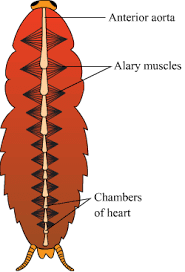 Open circulatory system of cockroach
Respiratory System
Respiration is by a tracheal system consisting of an external series of openings, spiracles, connected to internal tubular air passages (tracheae) that branch into finer tracheoles delivering oxygen directly to tissues. Gas exchange occurs primarily by diffusion at the level of tracheoles.
- There are typically 10 pairs of spiracles along the lateral body surface (two thoracic pairs and eight abdominal pairs).
- Tracheae are reinforced by spiral thickenings (taenidia) to prevent collapse; tracheoles are delicate and reach individual cells.
- Tracheal ventilation may be aided by abdominal movements in active insects to increase gas exchange efficiency.
Nervous System
The nervous system is bilaterally symmetrical and ventrally placed. It is formed of an anterior supra-oesophageal ganglion (brain) and a longitudinal nerve cord with segmental ganglia.
- The brain (supra-oesophageal ganglion) supplies nerves to the compound eyes, antennae and foregut structures.
- Three fused thoracic ganglia control locomotory functions of the legs and wings; typically there are three thoracic ganglia and six abdominal ganglia (segmentally arranged but often fused).
- Ganglia are connected by paired longitudinal nerve cords (connectives) and give rise to peripheral nerves supplying muscles and sense organs.
- Ganglia act as local processing centres capable of reflex actions; many behaviours are coordinated by thoracic ganglia independent of the brain.
- Cockroaches can survive for some time after decapitation because many vital reflexes and metabolic functions are maintained by the thoracic and abdominal ganglia; survival without a head may last several days provided water and suitable conditions are available.
Sense Organs
- Antennae: Primary olfactory and tactile organs; they detect odours, humidity and air currents.
- Compound eyes: Each composed of many units called ommatidia (about 2000 in some species). Each ommatidium samples part of the visual field and the brain integrates these to give a mosaic image. This mosaic vision is effective in detecting movement and functioning in low light, though spatial resolution is limited.
- Maxillary and labial palps: Chemosensory and tactile appendages associated with the mouthparts; help in tasting and manipulating food.
- Anal cerci: Sensory appendages at the posterior that detect air movements and vibrations, providing early warning of approaching predators.
Excretory System
- Excretory and osmoregulatory functions are mainly performed by the Malpighian tubules, which remove nitrogenous wastes and solutes from the haemolymph into the gut.
- Nitrogenous waste is largely converted into uric acid, a relatively insoluble compound, and eliminated with the faeces; hence cockroaches are uricotelic.
- The rectum reabsorbs water and ions, concentrating waste to conserve body fluids.
Reproductive System
Cockroaches are dioecious - males and females are separate. Reproductive organs are internal and show region-specific arrangements in the abdomen.
Male Reproductive System
- Testes: A pair of testes are present, typically located in the 4th to 6th abdominal segments; each testis is composed of several follicles.
- Sperm ducts (vas deferens): Transport sperm from testes to seminal vesicles and then to the ejaculatory duct.
- Seminal vesicle: Stores sperm, often forming bundles or spermatophores that are transferred during mating.
- Male gonopore: The ejaculatory duct opens ventral to the anus.
- Accessory glands: Mushroom-shaped accessory glands in the 6th-7th abdominal segments produce seminal fluids that assist sperm transfer and may form the spermatophore matrix.
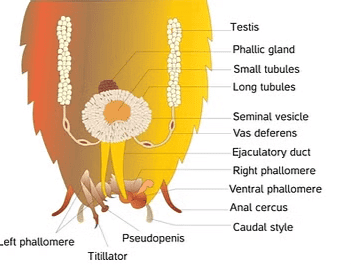 Reproductive System of Male Cockroach
Female Reproductive System
- Ovaries: Females possess two large ovaries located in the 2nd-6th abdominal segments; each ovary is made up of several ovarioles (commonly eight) where oogenesis occurs.
- Oviducts: Oviducts from each ovary unite to form a median vagina that opens into the genital chamber or brood pouch.
- Spermathecae: A pair of spermathecae (sperm storage organs) open into the genital chamber and allow delayed fertilisation.
- Ootheca: Fertilised eggs are enclosed in a protective capsule called an ootheca, dark reddish to blackish-brown and about 8 mm long in many species.
- Egg production: Females typically produce several oothecae (commonly around 9-10 in some species), each containing a characteristic number of eggs (about 14-16 in many pest species), though numbers vary among species.
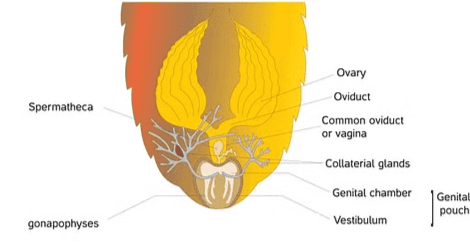 Reproductive System of Female Cockroach
Development
- Cockroaches undergo paurometabolous development (incomplete metamorphosis): eggs hatch into nymphs that resemble small adults and grow through successive moults.
- Nymphs moult multiple times (commonly around 13 instars in some species) before reaching the adult form.
- Wing pads appear in the later nymphal stages; only adults possess fully developed wings.
Economic Importance
- Wild species: Many cockroach species live in natural habitats and have little or no direct economic impact.
- Pest species: Several species adapted to human dwellings contaminate food, spoil stored products and cause nuisance by odours and allergens.
- Public health: Cockroaches mechanically carry and disseminate bacteria, protozoan cysts and other pathogens on body parts and in faeces, and may aggravate allergic conditions such as asthma.
Summary
Cockroaches are generalized insects with a chitinous exoskeleton, three-part body plan (head, thorax, abdomen) and well-developed appendages. Their internal organisation - including a tripartite alimentary canal with associated glands, an open circulatory system, tracheal respiration, Malpighian tubule excretion and a segmented nervous system with paired ganglia - reflects adaptations to terrestrial life and omnivorous feeding. Reproduction is sexual with species-specific strategies for egg protection and nymphal development. Some species are important household pests and vectors of mechanical contamination.
FAQs on Cockroach: Morphology & Anatomy (Only in NEET, Not in NCERT)
| 1. What are the main body parts and external features of a cockroach that I need to know for NEET? |  |
| 2. How is a cockroach's digestive system structured and what are its main organs? | |
| 3. What's the difference between tracheal and circulatory systems in cockroaches? | |
| 4. Where are the reproductive organs located in male and female cockroaches and what do they produce? | |
| 5. How does a cockroach's nervous system work and where is the brain located? | |





