NCERT Solution (Miscellaneous) - Relations and Functions

Ques 1: The relation f is defined by 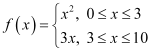 The relation g is defined by
 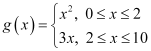 Show that f is a function and g is not a function.
Ans: The relation f is defined as 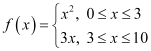
It is observed that for
0 ≤ x < 3, f(x) = x2
3 < x ≤ 10, f(x) = 3x
Also, at x = 3, f(x) = 32 = 9 or f(x) = 3 × 3 = 9
i.e., at x = 3, f(x) = 9
Therefore, for 0 ≤ x ≤ 10, the images of f(x) are unique.
Thus, the given relation is a function.
The relation g is defined as 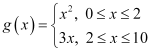
It can be observed that for x = 2, g(x) = 22 = 4 and g(x) = 3 × 2 = 6
Hence, element 2 of the domain of the relation g corresponds to two different images i.e., 4 and 6. Hence, this relation is not a function.
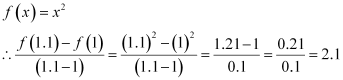
Ques 2: If f(x) = x2, find  .
.
Ans:
Ques 3: Find the domain of the function 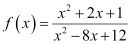
Ans: The given function is 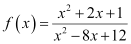 .
.
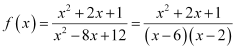
It can be seen that function f is defined for all real numbers except at x = 6 and x = 2.
Hence, the domain of f is R - {2, 6}.
Ques 4: Find the domain and the range of the real function f defined by 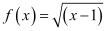 .
.
Ans: The given real function is  .
.
It can be seen that  is defined for (x - 1) ≥ 0.
i.e., 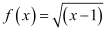 is defined for x ≥ 1.
Therefore, the domain of f is the set of all real numbers greater than or equal to 1 i.e., the domain of f = [1, ).
).
As x ≥ 1 ⇒ (x - 1) ≥ 0 ⇒ 
Therefore, the range of f is the set of all real numbers greater than or equal to 0 i.e., the range of f = [0, ).
).
Ques 5: Find the domain and the range of the real function f defined by f (x) = |x - 1|.
Ans: The given real function is f (x) = |x - 1|.
Since the absolute value is defined for every real number, the domain of f is the set of all real numbers.
∴ Domain of f = R.
Also, |x - 1| is always non-negative for every real x. For any non-negative real number y, one can find x = 1 ± y such that |x - 1| = y. Hence every non-negative real number occurs as a value of f.
Therefore, the range of f is the set of all non-negative real numbers, that is [0, ∞).
Ques 6: Let 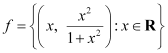 be a function from R into R. Determine the range of f.
Ans:
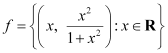

The range of f is the set of all second elements. It can be observed that all these elements are greater than or equal to 0 but less than 1.
[Denominator is greater numerator]
Thus, range of f = [0, 1)
Ques 7: Let f, g: R → R be defined, respectively by f(x) = x +1, g(x) = 2x - 3. Find f + g, f - g and f/g.
Ans: f, g: R → R is defined as f(x) = x + 1, g(x) = 2x - 3
(f + g) (x) = f(x) + g(x) = (x +1) + (2x - 3) = 3x - 2
∴(f+ g) (x) = 3x - 2
(f - g) (x) = f(x) - g(x) = (x + 1) - (2x - 3) = x + 1 - 2x + 3 = - x + 4
∴ (f - g) (x) = -x + 4
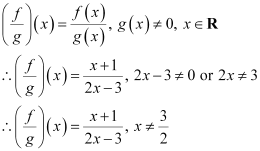
For the quotient, (f/ g)(x) = (x + 1)/(2x - 3). This is defined for all real x except where the denominator is zero, that is for x ≠ 3/2.
Ques 8: Let f = {(1, 1), (2, 3), (0, -1), (-1, -3)} be a function from Z to Z defined by f(x) = ax + b, for some integers a, b. Determine a, b.
Ans: f = {(1, 1), (2, 3), (0, -1), (-1, -3)}
f(x) = ax + b
(1, 1) ∈ f
⇒ f(1) = 1
⇒ a × 1 + b = 1
⇒ a + b = 1
(0, -1) ∈ f
⇒ f(0) = -1
⇒ a × 0 + b = -1
⇒ b = -1
Substitute b = -1 into a + b = 1 to get a - 1 = 1, so a = 2.
Thus, the respective values of a and b are 2 and -1.
Ques 9: Let R be a relation from N to N defined by R = {(a, b): a, b ∈ N and a = b2}. Are the following true?
(i) (a, a) ∈ R, for all a ∈ N
(ii) (a, b) ∈ R, implies (b, a) ∈ R
(iii) (a, b) ∈ R, (b, c) ∈ R implies (a, c) ∈ R.
Justify your answer in each case.
Ans: R = {(a, b): a, b ∈ N and a = b2}
(i) The statement is false. A relation is reflexive only if for every a we have a = a2, which is not true in general. For example, for a = 2, 2 ≠ 22 = 4, so (2, 2) ∉ R. Thus the given statement is not true.
(ii) The statement is false. Symmetry would require that whenever a = b2 then also b = a2, which need not hold. For instance, (9, 3) ∈ R since 9 = 32, but (3, 9) ∉ R because 3 ≠ 92. Hence the relation is not symmetric.
(iii) The statement is false. Transitivity would require that from a = b2 and b = c2 it follows that a = c2, but this does not hold in general. For example, (9, 3) ∈ R and (16, 4) ∈ R, yet (9, 4) ∉ R because 9 ≠ 42. Thus the relation is not transitive.
Ques 10: Let A = {1, 2, 3, 4}, B = {1, 5, 9, 11, 15, 16} and f = {(1, 5), (2, 9), (3, 1), (4, 5), (2, 11)}. Are the following true?
(i) f is a relation from A to B
(ii) f is a function from A to B.
Justify your answer in each case.
Ans: A = {1, 2, 3, 4} and B = {1, 5, 9, 11, 15, 16}
∴A × B = {(1, 1), (1, 5), (1, 9), (1, 11), (1, 15), (1, 16), (2, 1), (2, 5), (2, 9), (2, 11), (2, 15), (2, 16), (3, 1), (3, 5), (3, 9), (3, 11), (3, 15), (3, 16), (4, 1), (4, 5), (4, 9), (4, 11), (4, 15), (4, 16)}
It is given that f = {(1, 5), (2, 9), (3, 1), (4, 5), (2, 11)}
(i) A relation from A to B is any subset of A × B. Each ordered pair of f has its first element in A and its second element in B, so f ⊆ A × B. Therefore f is a relation from A to B.
(ii) A function from A to B must assign to each element of A exactly one image in B. Here the element 2 of A appears twice with two different images 9 and 11. Hence f does not assign a unique image to 2 and so f is not a function.
Ques 11: Let f be the subset of Z × Z defined by f = {(ab, a + b): a, b ∈ Z}. Is f a function from Z to Z: justify your answer.
Ans: The relation f is defined as f = {(ab, a + b): a, b ∈ Z}
We know that a relation f from a set A to a set B is said to be a function if every element of set A has a unique image in set B.
Consider a = 2, b = 6 and also a = -2, b = -6. Then both pairs (2·6, 2 + 6) and ((-2)·(-6), (-2) + (-6)) belong to f, that is (12, 8) and (12, -8) are in f.
Thus the same first element 12 is associated with two different second elements 8 and -8. Therefore f is not a function from Z to Z.
Ques 12: Let A = {9, 10, 11, 12, 13} and let f: A → N be defined by f(n) = the highest prime factor of n. Find the range of f.
Ans: A = {9, 10, 11, 12, 13}
f: A → N is defined as
f(n) = The highest prime factor of n
Prime factor of 9 = 3
Prime factors of 10 = 2, 5
Prime factor of 11 = 11
Prime factors of 12 = 2, 3
Prime factor of 13 = 13
∴f(9) = The highest prime factor of 9 = 3
f(10) = The highest prime factor of 10 = 5
f(11) = The highest prime factor of 11 = 11
f(12) = The highest prime factor of 12 = 3
f(13) = The highest prime factor of 13 = 13
The range of f is the set of all f(n), where n ∈ A.
∴Range of f = {3, 5, 11, 13}
FAQs on NCERT Solution (Miscellaneous) - Relations and Functions
| 1. What are relations and functions in mathematics? |  |
| 2. How do you determine if a relation is a function? | |
| 3. What is the difference between a one-to-one function and an onto function? | |
| 4. How do you find the domain and range of a function? | |
| 5. Can a relation be both reflexive and symmetric but not transitive? | |





