Chemistry Exam  >  Chemistry Notes  >  Physical   >  The Collision Theory of Bimolecular Gaseous Reaction

The Collision Theory of Bimolecular Gaseous Reaction

The Collision Theory of Bimolecular Gaseous Reaction.

The reaction between two species takes place only when they are in contact i.e. the reactant species must be collide before they react.
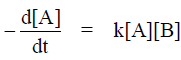
Consider the bimolecular elementary reaction.

A + B → P


rate  

The Collision Theory of Bimolecular Gaseous Reaction


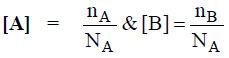
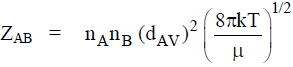
The rate of reaction to be proportional to the rate of collision i.e. the mean sped of the molecules, their collision cross-section (σ) and the number of densities of A and B. Using kinetic theory of gases, the rate of bimolecular collisions per second per cm-3 between unlike molecule is given by  
The Collision Theory of Bimolecular Gaseous Reaction


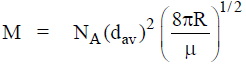
Where nA & nare number of A and B molecules, dAV is the average collision diameter defined as The Collision Theory of Bimolecular Gaseous Reactionand � is the reduced mass defined as The Collision Theory of Bimolecular Gaseous Reaction

 ZAB = collision frequency The detailed analysis of the bimolecular collisions leads to the result that the number of collision per second per cm3 between molecules A and B is given by 

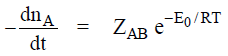
rate = ZAB e-E0 / RT = no. of collision

where E0 = Energy generated by collision then the rate of relative collision is given by
 The Collision Theory of Bimolecular Gaseous Reaction
The Collision Theory of Bimolecular Gaseous Reaction
∴    The Collision Theory of Bimolecular Gaseous Reaction
The Collision Theory of Bimolecular Gaseous ReactionThe Collision Theory of Bimolecular Gaseous Reaction

let              The Collision Theory of Bimolecular Gaseous Reaction

then    The Collision Theory of Bimolecular Gaseous Reaction     ...(1)

we know that               The Collision Theory of Bimolecular Gaseous Reaction

then            The Collision Theory of Bimolecular Gaseous Reaction  ...(2)

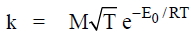
The collision theory can be generalized by introducing the steric factor, P, into the equatiohn for the bimolecular rate constant.
Then The Collision Theory of Bimolecular Gaseous Reaction

 

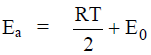
Relation between Ea and E0
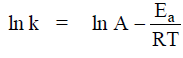
By between equation; k = Ae-Ea / RT
By collision theory, The Collision Theory of Bimolecular Gaseous Reaction

Taking natural log we get ln

The Collision Theory of Bimolecular Gaseous Reaction                    ...(1)


ln k = ln P + ln M + ln  The Collision Theory of Bimolecular Gaseous Reaction                   ...(2)

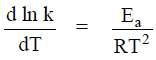
Different iate both equation (1) and (2) with respect to T we get

 The Collision Theory of Bimolecular Gaseous Reaction
The Collision Theory of Bimolecular Gaseous Reaction                     .....(1a)
and

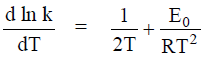
 The Collision Theory of Bimolecular Gaseous Reaction
The Collision Theory of Bimolecular Gaseous Reaction
The Collision Theory of Bimolecular Gaseous Reaction                       ...(2a)

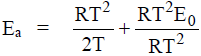
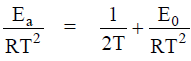
Comparing equation (1a) & (2a) we get
 The Collision Theory of Bimolecular Gaseous Reaction
The Collision Theory of Bimolecular Gaseous Reaction
The Collision Theory of Bimolecular Gaseous Reaction                  ...(3)

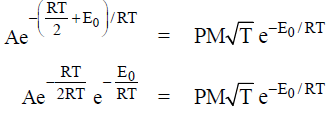
The expression for Arrhenius pre-exponential factor using collision theory We know that

k = Ae-Ea / RT                            [by Arrhenius equation]

The Collision Theory of Bimolecular Gaseous Reaction[by collision theory]
then 

 The Collision Theory of Bimolecular Gaseous Reaction    ...(1)
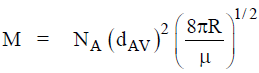
We know that

 The Collision Theory of Bimolecular Gaseous Reaction
The Collision Theory of Bimolecular Gaseous Reaction...(1)


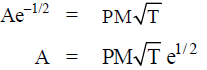
The Collision Theory of Bimolecular Gaseous Reaction

then The Collision Theory of Bimolecular Gaseous Reaction                                 ...(2)

The document The Collision Theory of Bimolecular Gaseous Reaction is a part of the Chemistry Course Physical Chemistry.
All you need of Chemistry at this link: Chemistry

FAQs on The Collision Theory of Bimolecular Gaseous Reaction

1. What is the collision theory of bimolecular gaseous reaction?
The collision theory of bimolecular gaseous reaction states that for a reaction to occur between two gaseous molecules, they must collide with sufficient energy and proper orientation. It suggests that the rate of a reaction is directly proportional to the number of collisions that have sufficient energy to overcome the activation energy barrier.
2. How does the collision theory explain reaction rates?
According to the collision theory, the rate of a reaction depends on the frequency of collisions between reactant molecules and the fraction of collisions with sufficient energy to initiate the reaction. Higher collision frequency and a greater fraction of high-energy collisions result in a faster reaction rate.
3. What factors influence the effectiveness of collisions in bimolecular gaseous reactions?
Several factors can influence the effectiveness of collisions in bimolecular gaseous reactions. These include the concentration of reactant molecules, temperature, surface area, pressure, and the presence of catalysts. Higher concentrations, temperatures, and surface areas increase the likelihood of effective collisions, while catalysts can lower the activation energy barrier.
4. How does temperature affect the collision theory of bimolecular gaseous reactions?
Temperature plays a crucial role in the collision theory of bimolecular gaseous reactions. Increasing the temperature increases the kinetic energy of the reacting molecules, leading to more frequent and energetic collisions. This results in a higher reaction rate as more collisions have sufficient energy to overcome the activation energy barrier.
5. Can the collision theory explain all types of chemical reactions?
The collision theory is primarily applicable to bimolecular gaseous reactions, where the reaction rate is determined by collisions between two gaseous molecules. However, it may not fully explain more complex reactions involving multiple steps or reactions in condensed phases. In such cases, other theories like transition state theory or rate-determining steps may be more appropriate.
Explore Courses for Chemistry exam
Get EduRev Notes directly in your Google search
Related Searches
Previous Year Questions with Solutions, Exam, Summary, mock tests for examination, Free, study material, The Collision Theory of Bimolecular Gaseous Reaction, pdf , Sample Paper, practice quizzes, video lectures, Viva Questions, Important questions, MCQs, past year papers, ppt, Semester Notes, Objective type Questions, Extra Questions, shortcuts and tricks, The Collision Theory of Bimolecular Gaseous Reaction, The Collision Theory of Bimolecular Gaseous Reaction;