The Gupta Period: Trade, Art & Culture, Economic Development

The Gupta Period
The Gupta period in Indian history is often termed the Golden Age of India. It was a time of relative political stability, economic prosperity, flourishing arts, and renewed intellectual activity. Industry and trade prospered, agriculture expanded through irrigation and settlement, and both internal and external trade were important features of the economy.
Overview and Political Succession
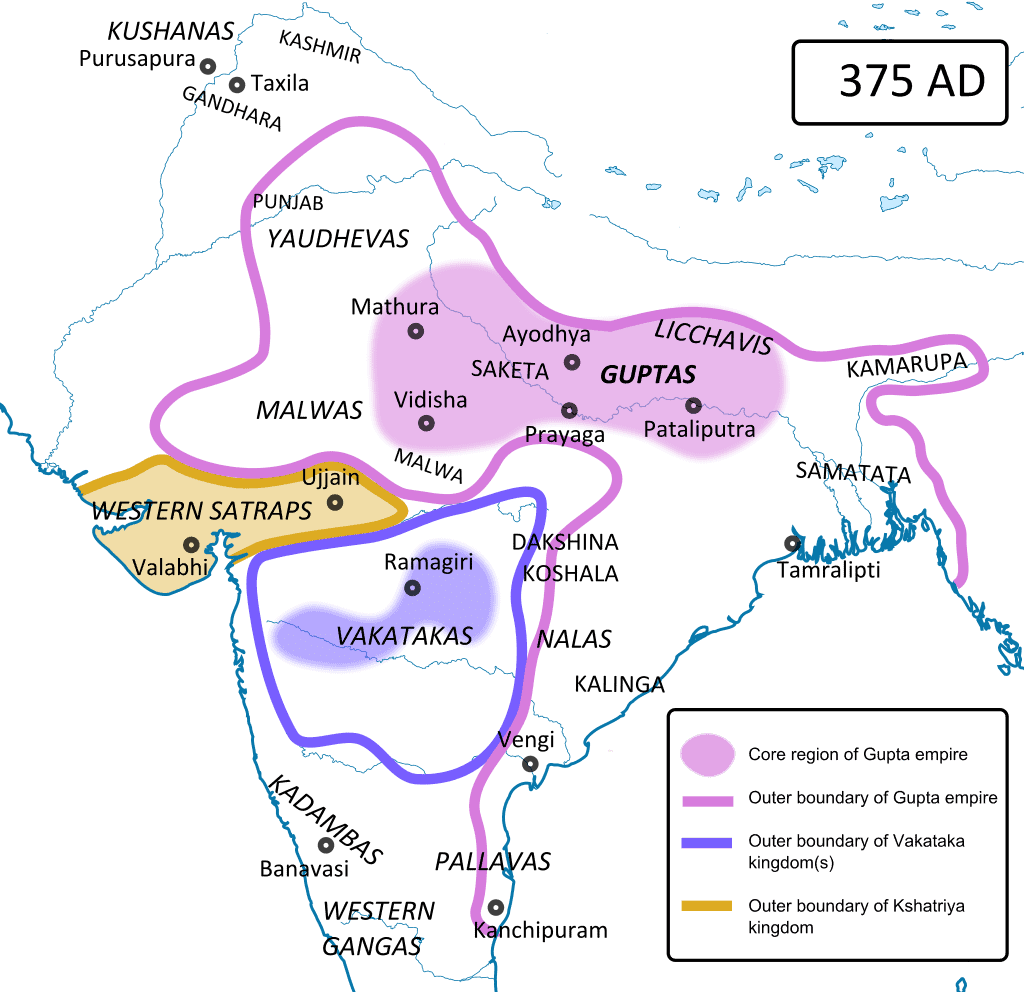
- The Gupta Empire was an ancient Indian polity that lasted from the early fourth century CE to the late sixth century CE. At its height (approximately 319-467 CE) large parts of the Indian subcontinent came under Gupta rule.
- The dynasty was founded by Sri Gupta. Important rulers in succession include Chandragupta I, Samudragupta, Chandragupta II (Vikramaditya), Kumaragupta, and Skandagupta. The dynasty continued to exist in diminished form after Skandagupta's reign.
- Peace and internal stability under the Guptas encouraged the growth of trade, crafts, and cultural life. Changes in long-distance trade - including the decline of Roman demand for eastern goods - also affected the Gupta economy.
Travel Accounts and Contemporary Observations
- Fa-Hien (Fa-Hsien), the Chinese Buddhist pilgrim who visited India in the early fifth century CE, provides important eyewitness information on social and economic conditions. He noted prosperous cities, charitable patronage to Buddhist establishments, and administrative arrangements that facilitated travel.
- Fa-Hien specifically observed that Magadha (part of the Gupta dominion) had numerous towns and wealthy patrons who supported Buddhism and gave alms and donations.
Trade and Agriculture - Background
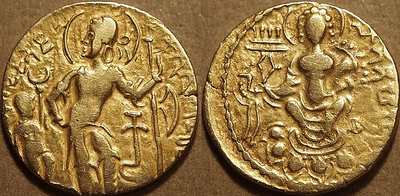
Under the Guptas a large number of gold coins were issued. These coins are commonly referred to in their inscriptions as dinaras and are notable for regularity of size and weight and for several typological varieties.
- Gupta coins often portray kings and demonstrate royal interest in both war a11nd art. In metal content the Gupta gold was not as pure as the earlier Kushan gold issues but was nevertheless standardised for widespread use in high-value transactions.
- Gold coinage met obligations of the state such as payment of officers in the army and administration and was used in large purchases such as land acquisition.
- After the conquest of Gujarat, the Guptas issued significant numbers of silver coins for local exchange; silver had earlier been important under the Western Kshatrapas.
- The relative scarcity of Gupta copper coins compared to Kushan times suggests that low-value transactions may still have relied heavily on barter or regionally varying media of exchange.
- Long-distance trade showed some decline compared to earlier centuries. Until about 550 CE India traded with the eastern Roman Empire (Byzantium), exporting silk among other commodities.
- Around the mid-6th century CE the eastern Roman (Byzantine) world acquired knowledge of Chinese silk production, which reduced dependence on Indian intermediaries and affected Indian silk exports.
- From some local evidence it appears that groups of specialised artisans (for example, silk weavers from Lata in Gujarat) migrated and sometimes left their traditional occupations for others when economic conditions changed.
- In several regions, notably parts of central India (modern Madhya Pradesh), the expansion of cultivated land involved the emergence of priestly landholders (Brahmana beneficiaries) who obtained land grants and brought virgin land under cultivation; this process affected local peasants and tribal cultivators.
Try yourself: The word Dinara used for the gold coins in the Gupta inscription is derived from
Trade & Commerce during the Gupta Period
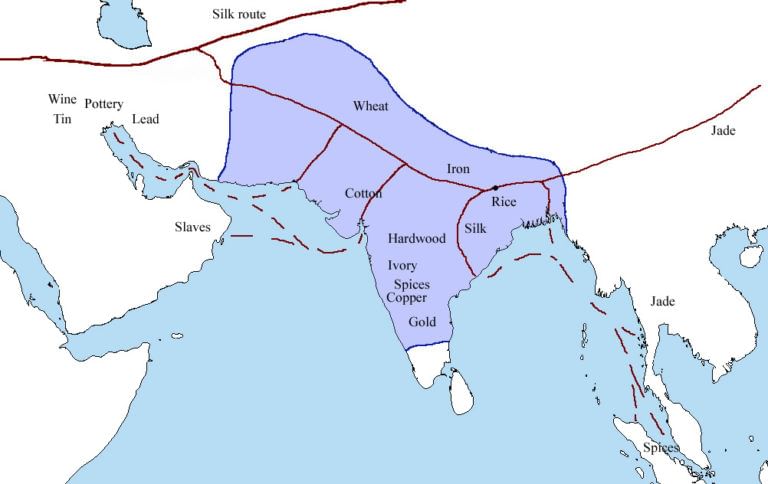
Both internal and foreign trade flourished during the Gupta period. Trade moved along established land routes and increasingly by sea. Principal internal commodities included cloth, food grains, spices, salt, bullion, and precious stones.
- Trade was carried on by roads and rivers. Important inland cities and administrative or commercial centres included Broach (Bharuch), Ujjayini, Prayag, Banaras (Kashi), Gaya, Pataliputra, Vaishali, Tamralipti, Kausambhi, Mathura, and Peshawar. These places were connected by public highways and riverine links; the state provided various facilities and security for travellers and traders.
 Gupta Empire Trade
- River traffic on the Ganges, Brahmaputra, Narmada, Godavari, Krishna, and Kaveri carried large volumes of goods inland; important ports for sea trade included Tamralipti, Kavripatnam, Kalyan, Broach, and Cambay.
- Foreign trade extended to Southeast Asia, China, and the Mediterranean world. India exported pearls, precious stones, cloth (including muslin), perfumes, spices, indigo, medicinal drugs, coconuts, and ivory articles; imports included gold, silver, tin, lead, Chinese silk, and horses.
- With the expansion of trade and industry, various economic activities and specialised producers arose. Traders and merchant groups played a major role in the economy.
- Contemporary sources record the existence of guilds (sreni, nigama, kaulika). A guild was a corporate body of traders, merchants, artisans, or workers with internal rules, a head, and the capacity to protect members' interests and regulate production and trade.
- Guilds undertook commercial functions including local banking, holding endowments, settling disputes among members, issuing trade instruments (hundis), and sometimes organising collective commercial ventures.
Agriculture and Agrarian Structure during the Gupta Period
Agriculture benefited from irrigation works, expansion into new lands, and grants of land to religious and social functionaries.
- Alongside state and private cultivators, religious institutions - including Brahmin beneficiaries, Buddhist viharas, and Jain sanghas - were granted wastelands and cultivated them as endowments.
- Village communities maintained rules: cultivators were responsible for the protection of crops; those who damaged crops could be punished. Fields were frequently fenced and demarcated.
- Major crops included rice, wheat, barley, peas, lentils, pulses, sugarcane, and oilseeds. Regional specialities are noted in contemporary literature.
- Poets and scholars such as Kalidasa remark that the south was famed for spices like pepper and cardamom, while Varahamihira gives practical advice on planting fruit trees.
- The Paharpur copper plate inscription (and similar administrative records) indicates the king's claim to ultimate ownership of land; even grants left certain sovereign rights reserved to the ruler.
- Administrative officers kept records of land: an officer called ustapala recorded district-level land transactions while village accountants maintained village records and assessments.
Art and Crafts during the Gupta Period
The late ancient and Gupta centuries represent a high point for Indian arts, urban crafts, and technological specialisation.
- Comparative evidence indicates a sharp rise in the number and specialisation of artisans. Whereas earlier texts listed a limited range of occupations, contemporary writings record many more craft and trade categories.
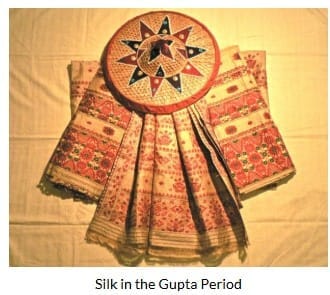
- Works in metals, stone carving, ivory, and terracotta became more refined. Specialised crafts included cloth manufacture, silk weaving, metalwork, jewellery, and the production of luxury items.
- There were at least eight crafts associated with the working of precious and base metals and stones (gold, silver, lead, tin, copper, brass, iron, and gem work).
- Technological progress in iron manufacture is visible in archaeological layers, with certain regions (for example, parts of Telangana in Andhra) noted for advanced ironworking.
- Mathura was known for specialised cloth types (e.g., sataka) and for sculptural and terracotta production; terracottas were common urban luxury art objects.
- The use of improved devices, such as the oil-press wheel, increased production of oil and related products.
- Inscriptional evidence mentions a wide range of artisans: weavers, goldsmiths, dyers, metalworkers, ivory workers, jewellers, sculptors, smiths, and perfumers. Many donated to religious establishments and participated in monastery construction.
- Coin-minting was an important craft; coins of gold, silver, copper, bronze, lead, and tin are attested. Some moulds show the capacity to strike several coins at a time. Evidence even exists for the production of imitation Roman coins for local use.
- Urban crafts were supported by guild organisation which sometimes acted as banking agents and custodians of endowments.
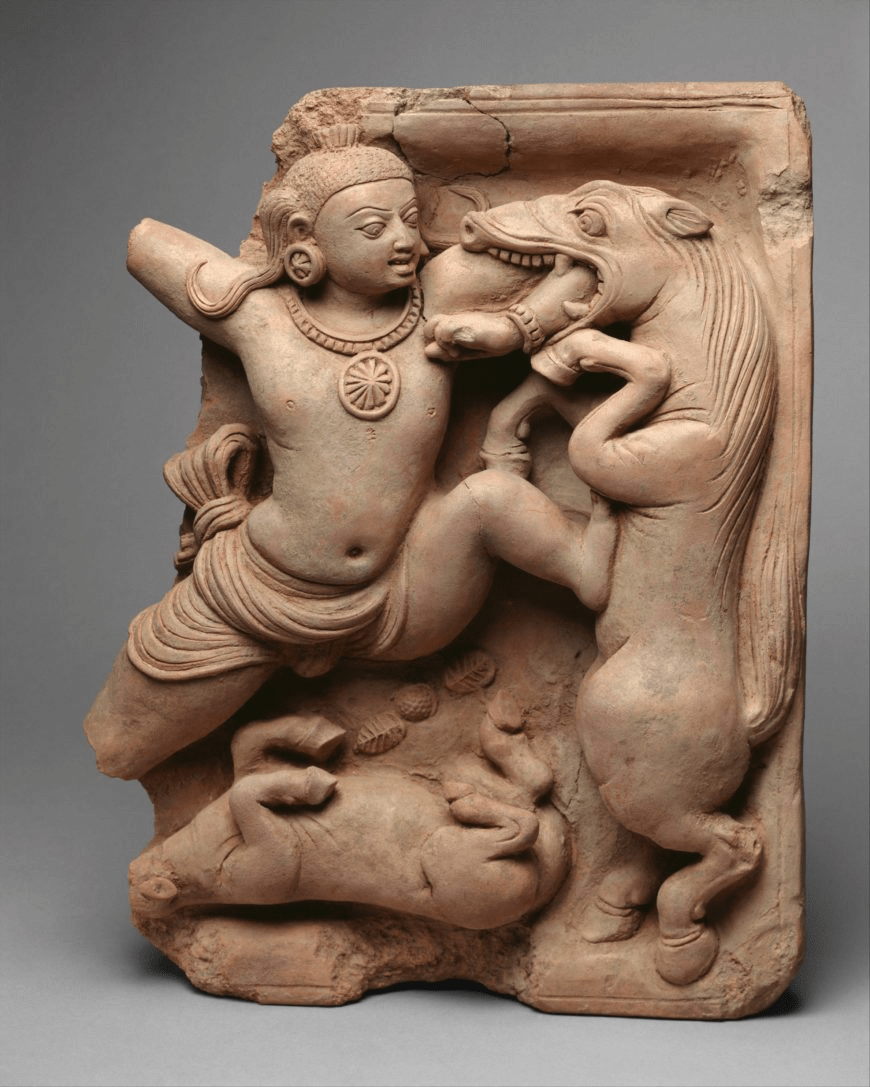 An Artefact of Terracotta during the Gupta Age
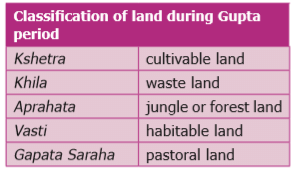
Classification of Land
- Epigraphic and administrative sources (for example the Poona plates associated with Prabhavati Gupta) demonstrate systems of land survey and classification.
- Kshetra: Land regarded as especially fertile or capable of producing a range of crops.
- Khila: Land left fallow or uncultivated for three years.
- Aprahata: Unclaimed jungle or waste land.
- Vasti: Habitable land or land with settlements.
- Gapatha Sarah: Pastoral or grazing land.
Land Tenure and Endowments
- Bhumichidranyaya: A customary rule that conferred ownership rights on a person who reclaimed and made barren land cultivable; such land was often granted tax exemptions.
- Aprada Dharma: A right to enjoy the produce of a landholding but without the power to make a further gift of the land.
- Nivi Dharma Aksayena: A perpetual endowment whose income the donee could enjoy in perpetuity but which the donee could not alienate.
- Nivi Dharma: A land endowment granted in perpetuity.
- High sacrificial fees (dakshina) recorded in some inscriptions (for example, related to Queen Naganika) point to substantial wealth generated in part by maritime commerce.
- Numismatic and literary evidence (for instance, coin types in Andhra and accounts in the Periplus of the Erythraean Sea) testify to lively maritime commerce during and before the Gupta era.
Economic Development through Trade & Commerce
The most important economic development of the period was thriving external trade - especially maritime contacts with the Roman/Byzantine world, Southeast Asia, and China - alongside active inland commerce.
- Early trade had relied heavily on land routes, but movements of peoples (Sakas, Parthians, Kushans) and political disruptions made some overland routes insecure, encouraging the growth of sea routes.
- From the beginning of the Common Era maritime trade expanded rapidly once sailors learned to exploit the monsoon winds; sea voyages between the coasts of western India and ports on the Arabian Sea became quicker and more regular.
- Principal western ports included Broach (Bharuch) and Sopara; eastern ports included Arikamedu and Tamralipti. Broach is repeatedly emphasised in sources as a major commercial entrepôt.
- Two principal routes connected the north-west frontier with the western seaboard: one running directly south via Taxila to the lower Indus and thence to Broach, the other known as the Uttarapatha (northern route) which linked Taxila with routes across central Asia and the Silk Route.
- Indian intermediaries dominated the silk trade between China and the West at various periods, exporting muslin, spices, and luxury textiles as well as acting as middlemen in the Silk Route commerce.
- Favourable balances of trade with the Mediterranean noted by classical writers (for example, Pliny) contributed to a bullion inflow into India and the circulation of gold coinage comparable to Roman standards. Vima Kadphises and later rulers of the Kushan realm issued gold coins modelled on Roman types, facilitating exchange.
- Coromandel ports participated in trade with Southeast Asia; literary, religious, and epigraphic evidence points to growing Indian mercantile activity and cultural influence in that region.
- The Periplus of the Erythraean Sea lists typical Indian exports: precious and semi-precious stones (diamonds, pearls, sapphires, onyx, carnelian), fine cotton cloths, muslin, certain Chinese silks, spices (pepper, malabathrum), aromatics and medicinal products (spikenard, costus), and luxury timber products. Imports at ports such as Barygaza included wines, metals (copper, tin, lead), glassware, perfumes, and coins.
Conditions Caused by Wars with the Hunas and Others
Conflicts in the later Gupta period, particularly with the Hunas (Hephthalites) and other invaders, disrupted political unity and economic stability and contributed to the decline of centralized Gupta power.
- Chandragupta II was the first among the principal Guptas to issue significant silver coinage after defeating the Saka (Western Kshatrapa) satraps of Ujjain; nevertheless barter continued alongside currency in many parts of the economy.
- Industries and crafts remained organised under guild structures. Inscriptions from places such as Vaisali mention guilds (naigama, sreni) of bankers (sresthis), traders (sarthavaha), and artisans (kulika).
- Guilds often acted as bankers: specific guilds such as the Tailikanikaya (oil-pressers) are recorded as receiving money, and other guilds accepted deposits, managed trusts, and held endowments, sometimes registered formally.
- Guilds could possess property, enforce internal discipline, settle disputes, issue hundis (trade instruments), and had presidents known as prathawa or pravana. Some guilds maintained armed retainers, which limited royal authority and required legal regulation by the state.
- Prices, weights, and measures varied regionally and were not uniformly fixed across the empire; local variations persisted in land measures and commodity prices.
- Sea routes, though important, were not uniformly safe; travellers such as Fa-Hien comment on dangers along Central Asian land routes and difficulties faced by merchants in some stretches.
- Indian ports maintained maritime relations with Sri Lanka, Persia, Arabia, East Africa, the Byzantine Empire, China, and island polities in the Indian Ocean; trade with China increased during the Gupta era, with Chinese silk (referred to in some sources as chinanshuka) finding a market in India.
- Trade with the West declined somewhat with the fall of the western Roman world but was later revived under the Byzantine emperors, resulting in renewed long-distance commerce.
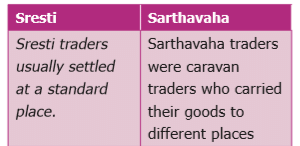 Guilds
Conclusion
During the Gupta period Indian ports maintained regular relations with Sri Lanka, Persia, Arabia, East Africa, Byzantium, China, and the islands of the Indian Ocean. Maritime trade and inland commerce together sustained urban centres, guilds, and specialised crafts. Agriculture expanded through irrigation and land grants, though social and economic changes - including the rise of powerful landholders and disruptions from external invasions such as the Hunas - eventually contributed to the weakening of central authority. The period remains notable for its economic dynamism, coinage, guild organisation, and cultural achievements.
To practise questions on the topic "Gupta Period", attempt the tests given below:
FAQs on The Gupta Period: Trade, Art & Culture, Economic Development
| 1. What were the main trade routes during the Gupta period and how did they boost economic development? |  |
| 2. Why is Gupta art and architecture considered the golden age of Indian culture? | |
| 3. How did the Gupta period contribute to advances in mathematics, astronomy, and literature? | |
| 4. What role did agriculture and craftsmanship play in Gupta economic prosperity? | |
| 5. Which religious and cultural patronage policies made the Gupta period significant for art, literature, and monument construction? | |





