Land Revenue ,Administration, Society, Art & Architecture: The Cholas

Land Revenue and Administration
Land Revenue
The principal source of royal income in the Chola state was land revenue. According to available records, the revenue demand was commonly fixed at one-third of the produce. Payments were made both in kind (grain and other produce) and in cash, depending on local practice and the nature of produce.
Key features of Chola land revenue administration included the following.
- All land was surveyed and classified according to quality and use; classifications determined the assessment.
- There were periodical revisions of revenue assessment to reflect changes in cultivation, irrigation, or productivity.
- The primary responsibility for revenue collection lay with the village assemblies. The village community as a whole was made jointly responsible for paying the entire amount due to the king's officers.
| Term / Phrase | Meaning / Function |
|---|---|
| Tiruvakya-Kelvi | Verbal orders (a form of administrative instruction) |
| Olainayamak | Chief Secretary (senior administrative officer) |
| Vidaiyadhikari | Despatch-clerk (official in charge of issuing orders and correspondence) |
| Peruvalis | Main trunk road (major highway or thoroughfare) |
| Mun-rukai-mahasenani | Literally, "the great army with three limbs" (a senior military designation) |
| Velaikkaras | Royal bodyguard of the monarch |
| Vari | Revenue department |
| Dharmasanam | Court of justice (judicial assembly) |
| Archaka | Worshipping priest (temple officiant) |
| Kudumbus | Wards (administrative subdivisions within a settlement) |
| Samvatsara Variyam | Annual committee (an annual supervisory body) |
| Tottavariyam | Garden committee |
| Eri-variyam | Tank committee (responsible for irrigation tanks) |
| Panchavara-variyam | Standing committee |
| Pon-variyam | Gold committee (supervision of gold or treasury matters) |
| Variyapperumakkal | Members of a committee |
| Perumakkal | Member of the Mahasabha (senior member of a large assembly) |
| Nyayattar | Judicial committee (settles legal disputes) |
| Alungnum | Executive committee of an Ur (village executive body) |
| Siraf | Meeting point and mercantile centre for sailors and merchants; an Indian Ocean trading hub |
| Udasina | Ascetics or foreigners (reference to wandering ascetics or foreign ascetics) |
Revenue Survey, Classification and Collection
The Chola state maintained systematic land surveys and classifications that formed the basis of assessment. Assessment took into account factors such as soil quality, irrigation facilities and type of crop. The collection of revenue was generally administered through village institutions: the village assembly appointed officials and committees to collect, account for and remit revenue to the state. On occasion, the crown conducted revisions to update assessments and rectify errors.
Administration
Territorial Division
For administrative convenience the Chola empire was organised in a hierarchical territorial structure:
- Mandalams - larger provinces (the empire was commonly divided into eight mandalams).
- Valanadus and Nadus - intermediate divisions or districts within provinces.
- Kurram or Kottam - sub-divisions grouping several villages.
- The village was the lowest and most important unit of administration.
| Points To Be Remembered |
|---|
|
Local Self-government
Local self-government was a central feature of Chola administration. The system operated from the village level up to the mandalam. Local institutions had genuine authority over many civic and fiscal matters.
- The village assemblies were primarily known as the Ur and the Sabha (also called Mahasabha).
- The Ur was a general assembly that included the adult population of the village and handled a wide range of communal affairs.
- The Sabha or Mahasabha was the assembly primarily of Brahmin inhabitants; it had distinct functions, especially in villages with significant Brahmin settlements.
- For formation of the Mahasabha, the village was often divided into thirty wards. Each ward nominated representatives to the Mahasabha subject to eligibility rules.
The qualifications for nomination to ward representation were specified in inscriptions and include these criteria:
- Ownership of about one and a half acres of land (a measure of economic standing).
- Residence in a house built on one's own site (stability of residence).
- Age between thirty-five and seventy years.
- Knowledge of at least one Veda and its Bhasyas (indicating ritual and scriptural learning).
- Neither the nominee nor any of his relations should have been convicted of a crime or received punishment.
- Persons who had served on any of the committees for the preceding three years, and those who had failed to submit accounts when required, were excluded from nomination.
| Uttaramerur Inscriptions - Important Points |
|---|
|
Village Committees and Functions
The village assemblies appointed specialised committees to handle distinct functions. These committees enabled decentralised management of local affairs and reduced the administrative burden on the central state.
- Typical committees included: annual supervision committee, charity committee, tank committee, garden committee, justice committee, gold committee, wards committee, fields committee, temple committee and ascetic committee.
- These committees supervised maintenance of roads and irrigation works, looked after communal assets, supervised temple management and charities, and managed local finances and records.
- In practice, the assemblies looked after welfare activities, local infrastructure (including tanks and channels), and communal security; they also appointed officials to implement decisions and maintain accounts.
- There are inscriptional references to collective taxation by residents to fund temple worship or other community services; this shows fiscal initiative at local level.
Functions and Responsibilities of Village Assemblies
- Maintenance and repair of public works: roads, tanks, irrigation channels and village commons.
- Supervision of agricultural matters, including distribution and management of water for irrigation.
- Appointment and oversight of local officers and functionaries responsible for collection of revenue and other administrative duties.
- Settlement of petty disputes and local policing duties; assemblies detected crimes and administered punishments in minor cases.
- Management of temples, conduct of worship, and allocation of funds for ritual and charitable purposes.
Justice
Administration of justice in Chola times operated at multiple levels, combining customary community institutions with royal courts.
- In rural areas, village courts and caste panchayats handled civil and minor criminal disputes according to local custom and community norms.
- The judicial committee of the Mahasabha, the Nyayattar, settled both civil and criminal disputes within its jurisdiction.
- In urban centres and for more serious cases, there were regular courts presided over by judges appointed by the king.
- Evidence included documentary records, witnesses and customary law; at times trials by ordeal were also used where other forms of proof were lacking.
Significance and Legacy
The Chola system combined a strong central authority with a well-developed network of local self-government. Village assemblies exercised fiscal, administrative and judicial powers, enabling effective local management. These institutions are widely regarded by historians as important early examples of decentralised governance in South Asia and are often seen as antecedents of later forms of local self-rule.
Key terms to remember:
- Ur - general village assembly.
- Sabha / Mahasabha - assembly of Brahmin inhabitants with specialised responsibilities.
- Nyayattar - judicial committee of the Mahasabha.
- Vari - revenue department; land revenue was a principal source of state income.
- Mandalams, Valanadus, Nadus - administrative divisions from province to district levels.
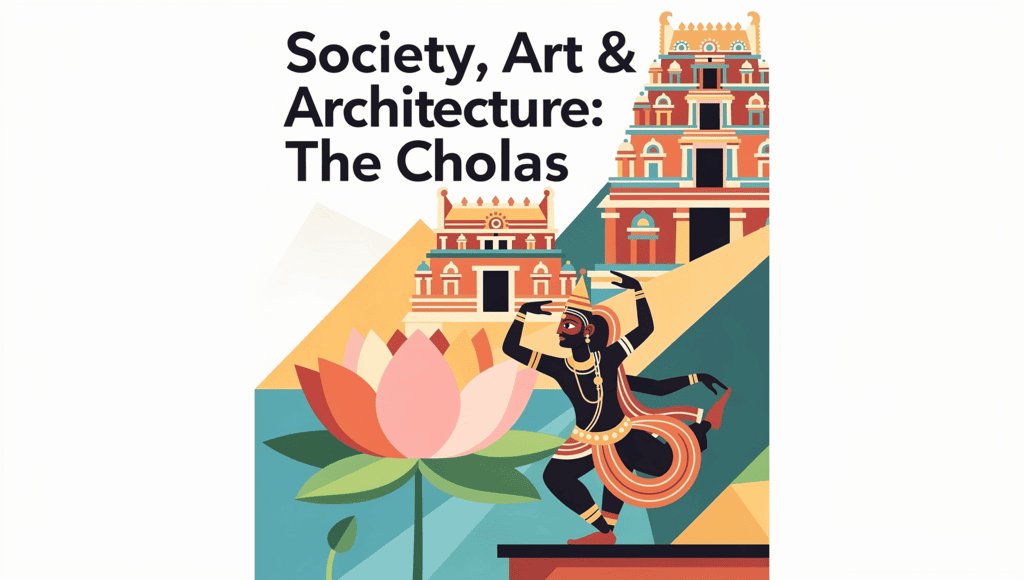
Society
The social order of the Chola period rested on the broad framework of varna-ashrama dharma, but in practice local customs, occupational groups and hereditary castes played a dominant role. The society displayed both continuity with earlier southern traditions and distinctive regional developments that affected class, gender relations, village institutions and cultural life.
General social features
- The Chola social system accepted the ideals of varna and ashrama, yet different varnas and castes generally lived in close proximity and co-operated in social and economic life.
- Inter-caste marriages occurred in some contexts and contributed to the proliferation and differentiation of occupational groups.
- There was no widespread practice of purdah; women participated relatively freely in social and religious activities.
- Sati was not widely practised; it appears to have been confined to certain royal or elite contexts rather than being a general social rule.
- Women could inherit and own property in their own right and took part in arts such as music, dance and drama.
- The Devadasi system existed: women proficient in music and dance often became attached to temples to perform daily services and festival rituals; in some sources they are referred to as devaradiyar or talichderi pendir.
- Prostitution was present in urban centres as noted in contemporary records.
Caste, occupational groups and social status
- The caste system functioned largely as a hereditary occupational organisation; each caste (jati) was associated with particular jobs and customary rights.
- The Brahmanas were socially influential as the learned and priestly class; as a recognition of their services many villages were granted to Brahmanas and exempted from taxes - such grants are referred to as brahmadeyas or chaturvedi magalams.
- Among non-Brahmanas, the Vellalas constituted a powerful and influential agricultural landholding group; they enjoyed privileges including exemption from certain local dues.
- The Kamala group (a privileged non-Brahman class) is attested in inscriptions but they were not permitted to perform Vedic rites.
- The Paraiyars (an occupationally defined community) lived in separate settlements called cheris and had distinct burial or cremation grounds; they occupied a low social position in caste hierarchy.
- A mixed-origin group referred to as Rathakaras (born of high-class husband and lower-class wife) is attested in the records, indicating social mobility and complexity in marital alliances.
- Two important social-economic groupings in the south were the Valangai (right-hand) and the Idangai (left-hand) factions. The Valangai, largely composed of agricultural castes, generally enjoyed greater privileges than the Idangai, which included several artisan and trade groups.
Village administration and local corporations
- Local self-governing institutions - often called ur or village assemblies and sometimes described as village corporations in inscriptions - exercised significant authority over village land, resources and internal management.
- Such bodies were usually left undisturbed by the central government in matters of internal administration, and they could pass collective decisions for the welfare and interest of the village community.
- Epigraphic records include decisions prescribing penalties for those who acted against the village or its temples, labelling offenders as gramadrohins (traitors to the village).
- Records also show royal confirmation and protection of local grants; for example, in A.D. 1090 Kulottunga exempted villages granted to Buddhist viharas at Nagapattana from the payment of royal dues.
Points To Be Remembered
|
State, military and maritime power
- The Chola state maintained effective military forces and a strong navy which enabled overseas expeditions and secured maritime trade routes across the Bay of Bengal; this naval capacity underpinned both commercial and political power.
- Rajendra Chola's campaigns northwards culminated in temporary control or influence over parts of the Gangetic delta; he commemorated these successes by adopting the title Gangaikonda and by founding Gangaikonda Cholapuram as a new capital.
- Contemporary and near-contemporary foreign accounts and local inscriptions together provide evidence for the Cholas' maritime contacts with Southeast Asia, including patronage and diplomatic contacts with rulers in the Malay archipelago.
Position of women
- Women generally enjoyed relatively secure social status: they could hold and inherit property and participate in religious and cultural life.
- Marital practices varied: monogamy was the norm among ordinary people while polygamy was more common among the royal and aristocratic classes.
- Dowry as a systematic social institution is not prominently attested for the period; girls were commonly married at a young age (often in early adolescence), and many marriages followed Vedic rites.
- Women were active in performing arts; those attached to temples (Devadasis) served both daily rituals and festival occasions and contributed to temple culture and music-dance traditions.
Scholars, literature and intellectual life
- Several notable scholars and poets flourished in the Chola cultural milieu. Among them, Trutakadevara is credited with the work Jiwanachintamani.
- Kamban (often anglicised as Kamban) composed the Kamba Ramayanam, a Tamil rendition of the Ramayana regarded as a masterpiece of Tamil literature.
- Other important Tamil works of the period include Sulamani by Tolamokti and Kalingatuppani by Jayagodar.
- The Buddhist scholar Buddhamitra wrote a text named Rasoliyan.
- During the reign of Parantaka I, Venkatamadhava is known to have written a commentary on the Rigveda, and Keshavaswamina authored the Sanskrit work Nanartharanov.
Art and Architecture
- The Cholas developed and consolidated the Dravidian temple architectural tradition inherited from the Pallavas and Pandyas, refining both the structural plan and sculptural programme of temples.
- There was a steady transition from structures of brick and wood to more permanent stone architecture; granite and dressed stone became principal materials for large temples.
- Chola temples are especially noted for their massive vimana (the tower over the sanctum), extensive enclosed and open courtyards, and richly carved sculptural decoration.
- In later Dravidian temple complexes, the monumental gopurams (gateway towers) grew in height and ornamentation, sometimes dwarfing the central vimana when viewed from a distance.
Notable temples and examples
- The early Chola phase includes important temples such as the Vijayalaya Choleswara, the Nagesvara temple, the Koranganatha temple and the Muvarakovintha (Muvarkovil) group of shrines; these display early experiments in Dravidian design and stone construction.
- The Koranganatha temple at Srinivasanallur (often dated to the reign of Parantaka I) is regarded as an exemplary monument of the initial phase of Chola Dravida temple art.
- Rajaraja I constructed the grand temple at Tanjore generally known as the Rajarajesvara (Brihadeeswarar Temple), a monumental granite temple noted for its scale, architectural proportion and sculptural detail.
- Rajendra Chola built a large Shiva temple at Gangaikonda Cholapuram, the capital he founded after his northern campaigns.
- Rajendra II constructed the Airavatesvara temple at Darasuram, while Kulottunga III built the Kampaharesvara temple at Tribhuvanam.
Sculpture, bronzes and temple art
- Chola sculpture ranges from large-scale stone reliefs and free-standing images to exquisite metalwork. The lost-wax (cire-perdue) technique was used to cast fine bronze images.
- Chola bronzes, especially representations of Nataraja (Shiva as Cosmic Dancer), are celebrated for their grace, balance and technical excellence and remain among the finest achievements of Indian metalwork.
- Temple walls and pillars carried elaborate narrative and iconographic sculpture illustrating episodes from Hindu mythology, local legends and royal achievement.
Construction techniqueS
- Large Chola temples required significant civil-engineering skills: quarrying and transporting heavy blocks (especially granite), dressing and laying masonry, complex joinery for stone elements and methods to erect tall vimanas and gopurams.
- Foundations had to be prepared carefully to bear massive superstructures; drainage, courtyards and access routes were integrated into temple complexes to manage crowds and processional functions.
- Stonemasons, master builders (often called sthapatis) and specialist sculptors worked together; inscriptions sometimes record the names and guilds of craftsmen, payments to them and the organisation of temple workshops.
Religious tolerance and patronage
- Chola rulers patronised multiple religious traditions. Inscriptions and records indicate royal support for Saiva and Vaishnava temples as well as for Buddhist establishments in and beyond the subcontinent.
- Rajaraja's assistance to the Sailendra king of Java and Kulottunga's grants to Buddhist viharas are examples of cross-regional religious and diplomatic contacts.
The Chola period combined an organised village society rooted in hereditary occupations and local institutions with an expansive state whose military and naval strength enabled regional dominance and overseas contacts. Temple architecture and sculpture reached high levels of achievement, reflecting advanced technical skills, organised patronage and a rich religious life. Women participated actively in cultural forms and enjoyed property rights in many contexts, while local corporations and brahmadeya grants shaped rural administration and landholding patterns.
FAQs on Land Revenue ,Administration, Society, Art & Architecture: The Cholas
| 1. What was the significance of land revenue in Chola administration? |  |
| 2. How did the Cholas administer land revenue collection? | |
| 3. What were the benefits of the Chola land revenue administration? | |
| 4. How did the Cholas ensure fair land revenue assessment? | |
| 5. Did the Cholas have any measures to prevent corruption in land revenue administration? | |





