The Mughal Empire (1526-40) and (1555-1857)


Introduction
The Mughal emperors of India traced their ancestry to two prominent Central Asian ruling lineages. The dynasty's founder combinedTimurid and Mongol blood: on his father's side he was a descendant of Timur and on his mother's side of Genghis Khan. Early Mughal politics were shaped by losses and gains in Central Asia and Afghanistan, financial pressures, threats from neighbouring powers and invitations from Indian rulers, all of which prompted a decisive move into the Indian subcontinent.
- Babur, the founder of the Mughal dynasty in India, was related to Timur through his father and to Genghis Khan through his mother.
- Babur initially succeeded his father as ruler of Fergana (in present-day Uzbekistan) but soon lost his Central Asian kingdom.
- Facing financial difficulties and the risk of Uzbek pressure on Kabul, and receiving encouragement from Rana Sanga of Mewar, Babur shifted his focus to India, beginning the Mughal presence on the subcontinent.
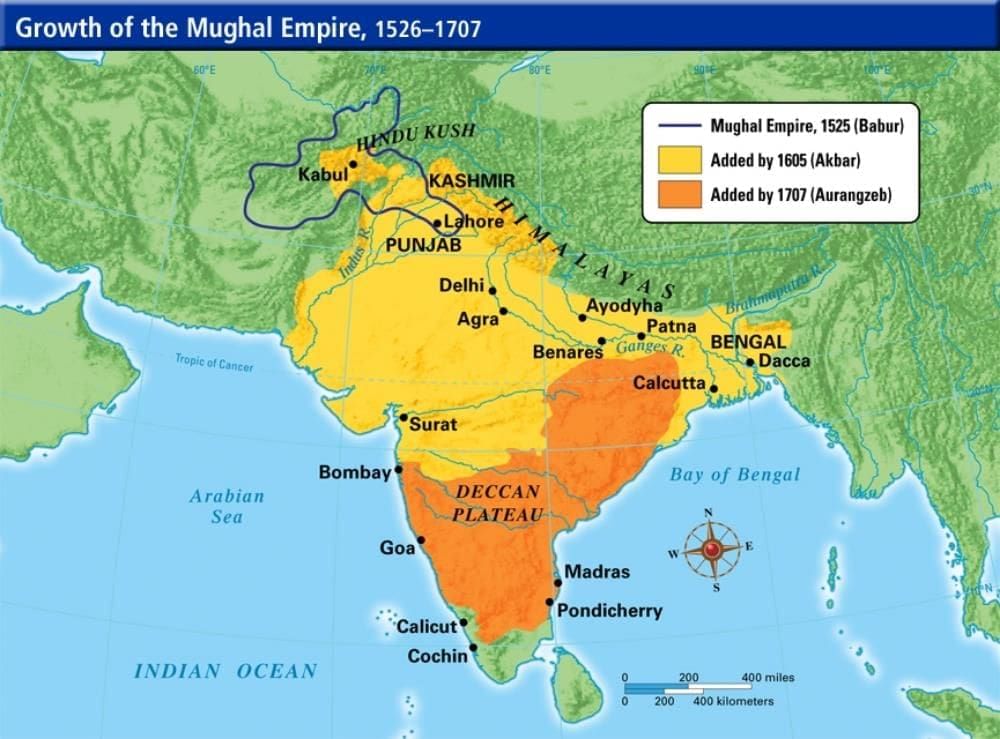 Growth of Mughal Empire
Babur (1526-1530)
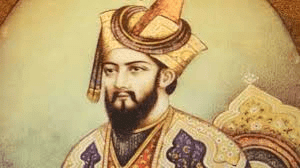 Babur
Babur- First major victory: Defeated Ibrahim Lodi at the First Battle of Panipat in 1526, establishing the Mughal foothold in north India.
- Secured the Punjab and routed Afghan chiefs, consolidating early Mughal power.
- Khanua (16 March 1527): Defeated the Rajput confederacy under Rana Sanga (Sangram Singh) at the Battle of Khanua.
- Chanderi (1528): Captured the fortress of Chanderi from the Rajput chief Medini Rai.
- Battle of Ghaghra (c.1529): Defeated remaining Afghan forces under Mahmud Lodi in Bihar, further consolidating control.
- Left a detailed personal record in his autobiography, the Tuzuk-i-Baburi (commonly called the Baburnama), written in his Turkic mother tongue; it is a primary source for his life and early Mughal policy.
Significance of Babur's Advent in India
- Laid the foundation of the Mughal state in India; his victories removed immediate Afghan and Sultanate challenges and opened the way for political consolidation.
- Introduced and popularised modern battlefield tactics in the Indian context: effective use of gunpowder, cavalry and artillery combined with mobility and field fortifications.
- Designed and promoted garden planning based on the Char-Bagh (four-part Persian garden) concept, influencing Mughal landscape architecture.
- Constructed mosques and public works in places like Panipat and Sambhal; incorporated Kabul and Gandhara into the early dominions of the empire.
- Contributed to the enhancement of foreign trade and contacts through improved political stability in territories under his control.
- Assumed the title of Padshah, signalling sovereign imperial status.
Humayun (1530-1540 & 1555-1556)
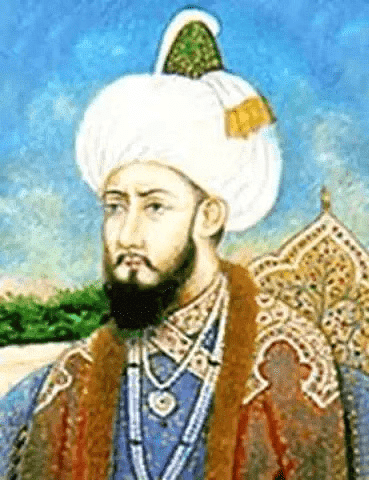 Humayun
- Accession: Became emperor at Agra on 29 December 1530.
- Divided large parts of the empire among brothers and relatives, confirming regional possessions: Kamran Mirza in Kabul and Kandahar, Askari at Sambhal, and Hindal at Alwar and Mewat.
- Secured the strategic fortress of Kalinjar, important for control of northern India.
- Battle of Dauhria (1532): Defeated Afghan forces.
- Faced the rise of Sher Shah Suri, who defeated Humayun at Chausa (1539) and Kanauj (1540), driving Humayun into exile.
- Exile and return: Spent nearly fifteen years (1540-1555) in exile, primarily in Persia; received refuge and assistance at the court of Shah Tahmasp I and later returned to India to reclaim the throne in 1555.
- Shortly after regaining the throne Humayun died in an accident (a fall) in 1556, leaving a young successor.
Sher Shah Suri (1540-1545)
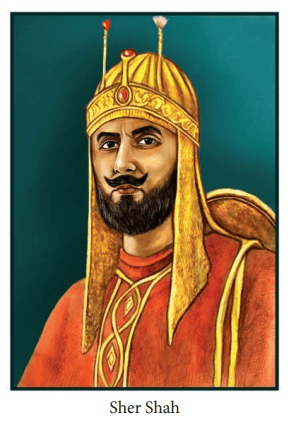
- Founder and period: Founder of the Suri dynasty; ruled from 1540-1545 after displacing Humayun.
- Architectural and cultural works: Constructed the Purana Qila (Old Fort) and its mosque in Delhi and the Mausoleum at Sasaram; patronage of literature continued under his rule.
- Central administration (continuity and key offices): Maintained Sultanate-style central offices including Diwan-i-Wizarat/Wazir (finance/revenue), Diwan-i-Ariz (army), Diwan-i-Rasalat (foreign affairs), Diwan-i-Insha (communications) and Barid (intelligence).
- Division of empire and local administration: Divided empire into sarkars; each sarkar had a Shiqdar (law and order) and a Munsif (judge). Sarkars were divided into parganas administered by officials such as Shiqdar, Amin, Fotedar and Karkuns; the mauza (village) was the lowest unit.
- Administrative units and revenue officers: Employed iqtas, Amils (revenue collectors) and Qanungos (record keepers) to manage land revenue.
- Land revenue reforms: Introduced systematic land survey and assessment with scheduled crop rates (rai), implemented zabti-i-har-sal (annual assessment), classified cultivable land (good, middling, poor) and fixed the state's share at about one-third of produce, payable in cash or kind; introduced legal instruments such as patta (document of land grant/possession) and qabuliyat (deed of agreement).
- Currency: Introduced the copper coin called the Dam, which persisted in various forms for centuries.
- Communications and trade: Constructed the Shahi Road, later the Grand Trunk (GT) Road, connecting eastern and north-western frontiers; established sarais (rest houses) at intervals which served travellers, postal needs and later became market nuclei.
- Military and administrative practices: Introduced organised practices such as horse branding and maintained a personal royal force (Khasa), adopting certain precedents from earlier Sultanate practice.
- Legacy: Sher Shah's revenue, coinage and road systems influenced later Mughal administration and became reference points for subsequent reforms.
Try yourself: Who was the most formidable enemy of Humayun?
Akbar (1556-1605)
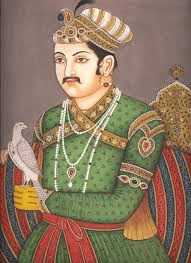 Akbar
AkbarAkbar's reign consolidated Mughal power in northern and central India and laid the administrative, fiscal and cultural foundations of the empire as it expanded to its greatest extent under later rulers.
- Accession: Akbar was crowned at Kalanaur. At the time of his accession the empire faced internal and external challenges.
- The Hemu crisis (1556): Hemu, the former minister of the Suris, established control over Delhi and assumed the title Vikramaditya. The Mughal army under Bairam Khan defeated and killed Hemu at the Second Battle of Panipat (1556), securing Akbar's throne.
- Bairam Khan (1556-1560): Acted as Akbar's guardian and regent; his concentration of power and arbitrary conduct led to his removal and return to courtly retirement in 1560.
Conquests and Territorial Expansion
- Malwa taken from Baz Bahadur in 1561.
- Ajmer (fort seized) in 1562.
- Marwar chieftain Chandrasen submitted in 1563.
- Chittor besieged by Akbar in 1567 and taken in 1568 after intense resistance.
- Forts at Ranthambhor surrendered in 1569; Marwar and Bikaner recognised Mughal suzerainty by 1570.
- Battle of Haldighati (1576): Conflict with Rana Pratap Singh of Mewar; Rana Pratap continued guerrilla resistance though Mughal military pressure persisted.
- Expedition to Gujarat (1572) and capture of Surat (1573).
- Bihar and Bengal campaigns in 1574-75 subdued Afghan resistance.
- Annexations in the northwest and north: parts of Kabul (after 1586), Kashmir (1586) and Sindh (c.1593) were brought under Mughal control; Kandahar was recovered from Persia in 1594.
- Asirgarh fort taken in 1601 and Khandesh incorporated.
Administration, Revenue and Military Reforms
- Mansabdari system: A centralised system of ranks (mansabs) used to organise nobility and the military; each mansabdar held a rank expressed as zat (personal rank) and sawar (cavalrymen to be maintained), and received land assignments (jagirs) for upkeep of troops.
- Revenue reforms: Systematisation of revenue assessment and collection progressed under his reign, with later consolidation under ministers such as Raja Todar Mal who developed measures to standardise measurement, crop rates and assessment (bandobast).
- Central bureaucracy: Strengthened central departments for finance, military, correspondence and intelligence with clearer roles for officers.
Religious Policy and Cultural Measures
- Policy of tolerance: Promoted Sulh-i-kul (universal peace) and religious conciliation aimed at securing loyalty across communities.
- Religious debates and synthesis: Instituted the Ibadat Khana at Fatehpur Sikri for debates and later propounded an eclectic doctrine known as Din-i-Ilahi, emphasising moral values rather than formal conversion.
- Protections and legal changes: Ordered (1562) that non-combatants and families should not be enslaved during wars; abolished the pilgrim tax (1563) and the jizya (1564) as part of conciliatory measures.
- Translations and patronage: Set up a translation department to render Sanskrit and other texts into Persian, broadening the Mughal court's cultural and administrative reach.
- Social regulations: Issued regulations on animal slaughter and public conduct at various times (e.g., restrictions introduced around 1583).
- Cultural patronage: Encouraged painting, architecture and literature; the Mughal school of miniature painting advanced under royal patronage and Fatehpur Sikri was built as a monumental capital reflecting syncretic architecture.
Religious and Social Movements during Akbar's Time
- Dadu movement in Gujarat emphasised a non-sectarian devotion to the supreme reality beyond rigid communal markers.
- Satnami movement: Founded by Birbhan, rejected caste hierarchies, idol worship and emphasised moral conduct.
- Narayanian and Dharma movements in Maharashtra stressed devotion to a single supreme being and challenged caste formalism.
- Reactionary orthodox movements were led by figures like Shaikh Ahmad Sirhindi among Muslims and Raghunandan among orthodox Hindus, who sought to preserve traditional identities while responding to the changing religious climate.
Try yourself: Who was not the Nine Jewels(Navaratna) of Akbar's Court?
Jahangir (1605-1627)
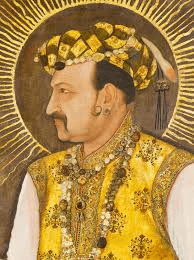 Jahangir
- Accession and title: Prince Salim ascended as Jahangir (meaning "Conqueror of the World") in 1605 after the death of his father, Akbar.
- Regime and court culture: Jahangir is noted for refined court culture, patronage of painting and garden architecture and for commissioning court chronicles.
- Art and technique: Patronised Pietra Dura inlay work in architecture and promoted Mughal painting; used pictorial devices such as the halo in royal portraits.
- Administration: Instituted judicial aids such as the Zanjir-i-Adal (a public forum for seeking royal justice) at Agra Fort.
- Political events: Faced revolt by his son Khusrau, who was defeated and punished; Guru Arjan of the Sikhs was executed during Jahangir's reign after being implicated in politics.
- Nur Jahan's influence: Jahangir's wife Nur Jahan exercised considerable power - she was titled Padshah Begum, had coins struck in her name and placed relatives in high positions (e.g., her father became Itimad-ud-Daulah).
- European contact and trade: English envoys such as Captain Hawkins (1608-11) and Sir Thomas Roe (1615-19) sought trading privileges; Roe secured farmans that led to English factories at Surat, Agra, Ahmedabad and Broach.
- Military: Dealt with conflicts in the Deccan and coastal regions, including challenges from naval and regional powers like Malik Amber in Ahmednagar.
- Record: Jahangir wrote an autobiography, the Tuzuk-i-Jahangiri, which provides a detailed account of his reign and policies.
- Administrative change: Modified elements of the mansabdari system (the du-aspah-sih-aspah alteration) to enable nobles to maintain large military contingents under certain conditions.
Try yourself: Who was not the Nine Jewels(Navaratna) of Akbar's Court?
Shah Jahan (1628-1658)
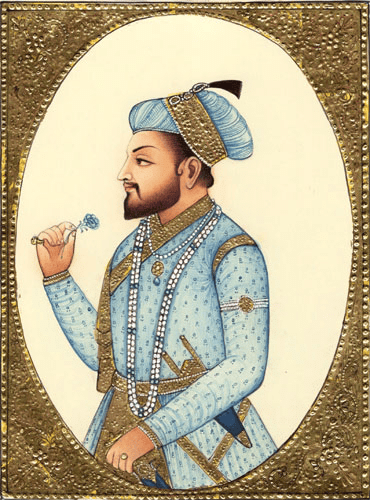 Shah Jahan
- Early reign and challenges: The first years of Shah Jahan's reign saw rebellions (for example by the Bundela chief Juhar Singh and Khan Jahan Lodi).
- Foreign trade and Europeans: Continued presence of European merchants and growing foreign accounts of the court; travellers like Bernier, Tavernier and Manucci recorded aspects of Mughal administration, wealth and courtly life.
- Naval and coastal policy: Expelled the Portuguese from Hugli (1632), curbing their regional influence.
- Deccan and southern policy: The Nizam Shahi kingdom of Ahmadnagar was incorporated; in 1636 Shah Jahan appointed Aurangzeb as viceroy in the Deccan and divided the Deccan into four subahs (Khandesh, Berar, Telangana, Ahmadnagar).
- Kandahar and frontier policy: Took control of Kandahar in 1639 when Ali Mardan Khan surrendered it, but the city was later reclaimed by Persia (1649).
- Sieges and southern wars: Launched decisive operations against southern sultanates such as Golconda and Bijapur (sieges in the 1650s).
- Succession crisis: When Shah Jahan fell sick in September 1657, his sons were posted across the empire (Dara Shikoh in Agra, Shuja in Bengal, Aurangzeb in the Deccan, Murad in Gujarat), leading to a succession war which culminated in Aurangzeb's victory.
- Architecture: Shah Jahan's reign is noted for the high point of Mughal architecture, including monumental works such as the Taj Mahal, and for refined courtly patronage of arts and music.
Aurangzeb (1658-1707)
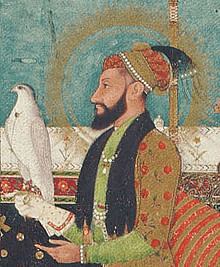 Aurangzeb
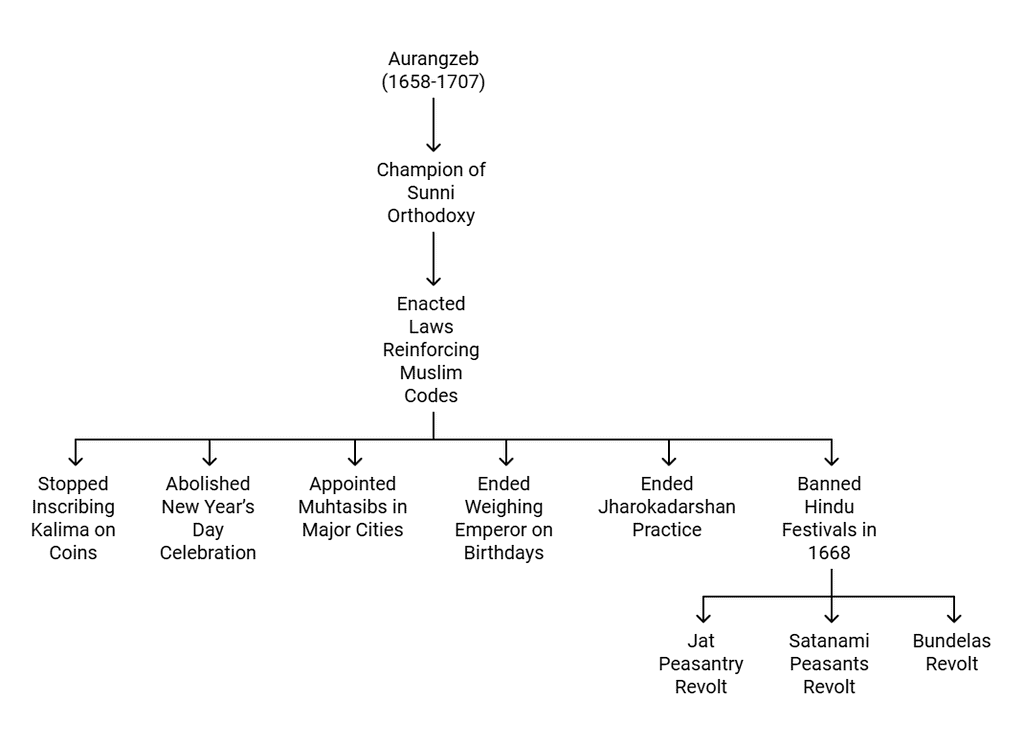
- Religious policy: Positioned himself as the champion of Sunni orthodoxy; introduced stricter enforcement of Islamic law and practices, issuing ordinances to align court and state more closely with perceived Quranic injunctions (notably from 1659 onwards).
- Administrative and ceremonial changes: Stopped certain court practices such as inscribing the Kalima on coins and abolished some royal ceremonial customs like the birthday weighing and Jharokadarshan.
- Enforcement institutions: Appointed Muhtasibs in major cities to supervise public morality and adherence to legal prescriptions.
- Impact on non-Muslims: Introduced restrictions on public observance of some Hindu festivals and patronage, and reintroduced the jizya in certain areas; these measures contributed to disaffection among some sections of society.
- Revolts and militarised resistance: Faced significant uprisings such as the Jat revolt under Gokula (1679-80), the Satnami uprisings, and the persistent challenge of the Marathas and regional chiefs in the Deccan.
- Deccan wars: Prolonged campaigns in the Deccan absorbed resources and attention and contributed to the long-term strain on Mughal military and fiscal capacity.
Facts To be Remembered
- Akbar's foster mother was Maham Anaga.
- Akbar suppressed a rebellion by Uzbek nobles early in his reign.
- The new capital of Rana Pratap after his losses was Chavand.
- Chandrasen of Marwar resorted to guerrilla warfare against Akbar.
- During Akbar's reign important texts such as the Singhasan Battisi, the Atharva Veda and portions of the Bible were translated into Persian.
- The Kabul-Ghazni-Qandhar line was an important north-western communication and defence axis under the Mughals.
- Peasant proprietors who owned and cultivated their land were termed Khudkasht.
- India's estimated population at the beginning of the 17th century was about 125 million.
- Rajputs constituted the largest group of Hindu nobility under Akbar; among them the Kachhwahas were especially prominent.
- By Aurangzeb's time Hindus formed about 33% of the nobility, with Marathas making up a significant portion of Hindu nobles.
- Jahangir was noted for the fashion of wearing expensive pierced ear-jewels among the nobility.
- Chettis were a notable trading community from South India active in Mughal India.
- The fifth Sikh Guru, Arjan Das, instituted a system of voluntary offerings at the rate of one-tenth of income from his followers.
- Taxes that were prohibited during the Mughal era were known as abwabs.
- Famous musicians at Shah Jahan's court included Jagannath and Janardan Bhatta.
- Poet Bihari Lal composed the Satsai, a collection of about 700 couplets (dohas).
- An important historical work from Shah Jahan's time is the Amal-i-Salih by Mohammad Salih.
- Mirza Hossain Ali composed devotional songs in Bengali addressing the Goddess Kali.
- The Sufi-poet Amir Khusrau celebrated the subcontinent's cultural richness in memorable couplets.
Mughal Empire at a Glance
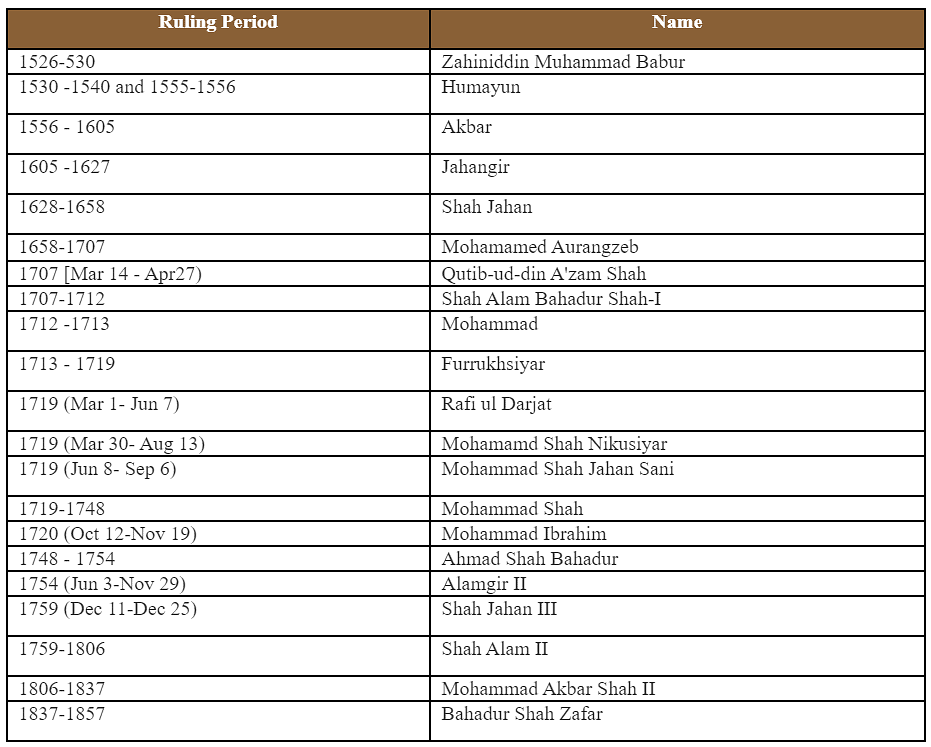
- Chronology: The Mughal imperial period begins with Babur's victory at Panipat (1526), is interrupted by Sher Shah Suri's rule (1540-45), restored under Humayun (1555) and reaches its zenith under rulers such as Akbar, Jahangir, Shah Jahan and Aurangzeb before gradual decline in the 18th century.
- Administration: Characterised by a centralised bureaucracy, the mansabdari military-administrative system, a revenue apparatus based on land assessment and local officials (Amils and Qanungos), and a network of subahs, sarkars and parganas for provincial governance.
- Revenue and economy: Agrarian revenue was the backbone of state finance; systems of regular assessment, surveyed crop rates and institutional instruments such as pattas and qabuliyats became key to fiscal policy. Long-distance trade expanded under Mughal security and infrastructure (roads, sarais, ports).
- Military: Utilised cavalry, artillery and organised infantry under the mansabdari system; effective use of gunpowder weaponry helped establish and maintain Mughal dominance early on.
- Culture and society: Persianate court culture, patronage of the arts (painting, architecture, music and literature), translation movements and the syncretic policies of rulers like Akbar shaped a distinct Mughal cultural synthesis.
- Infrastructure: Road networks (notably the Shahi/Grand Trunk Road), caravanserais, and coinage reforms (e.g., Sher Shah's Dam, later Mughal silver and gold standards) enhanced communication and commerce.
- Decline and legacy: Administrative overstretch, fiscal pressures from prolonged warfare (especially in the Deccan), regional revolts, European commercial and military rise and succession struggles contributed to gradual political decline after Aurangzeb. The Mughal legacy remained visible in administrative practices, legal norms, architecture and cultural life across South Asia.
FAQs on The Mughal Empire (1526-40) and (1555-1857)
| 1. Who founded the Mughal Empire and when did it actually start ruling India? |  |
| 2. Why did the early Mughal Empire collapse between 1540 and 1555? | |
| 3. What were the main reasons the Mughal Empire finally fell in 1857? | |
| 4. How did Akbar's policies make the Mughal Empire so powerful and stable? | |
| 5. What was the mansabdari system and why did it matter for Mughal military strength? | |