Machine Input Output - Introduction and Examples (with Solutions)

Machine Input-Output
In machine input-output, the basic problem is the problem of time. You can usually understand the underlying logic if you are not bound by time, but the challenge in competitive tests is to find the rule rapidly and apply it to obtain the final output. This chapter explains standard patterns, illustrates worked examples, and provides strategies to reach the output quickly and accurately.
Solved Examples
Directions: Consider the following steps for given input and read the instructions to reach to the last step.
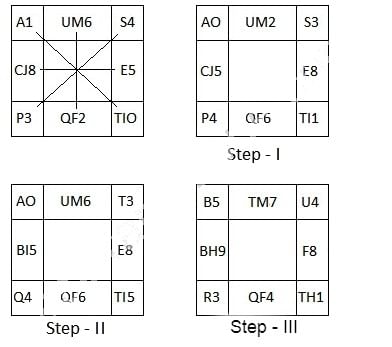
Instructions:
- Step-I: Interchange the alphabets in input as arrows mentioned.
- Step-II: (i) If both letters are consonants and the number is less than 6, then the consonants change to the previous letter in the English alphabetical series.
(ii) If there is one vowel and one consonant, then add 4 to the number.
(iii) If there is a single consonant, then the consonant changes to the next letter in the English alphabetical series. - Step-III: Step III has been derived using a special pattern taking similar (but not exactly identical) features of both Step I and Step II.
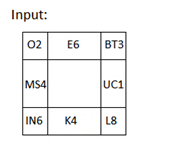
Q1: What is the sum of all numbers in step II of given input?
(a) 42
(b) 40
(c) 33
(d) 36
(e) 43
Ans: (a)
Q2: In last step, which of the following letter/s occur more than 1 time?
(a) C
(b) P
(c) N
(d) Both T and F
(e) Both N and T
Ans: (e)
Q3: Which of the following represents the second element in 3rd row in step III?
(a) L4
(b) M4
(c) L6
(d) N4
(e) M3
Ans: (b)
Q4: What is the addition of numbers which are with L and LR in step II?
(a) 7
(b) 5
(c) 6
(d) 3
(e) 4
Ans: (a)
Q5: What is the addition of numbers which are with N, BT and TC in step III?
(a) 17
(b) 13
(c) 16
(d) 15
(e) 19
Ans: (d)
General Pattern-Type (Linear Rearrangement of Numbers and Words)
Directions (Q1 - Q5): Study the information given below carefully and answer the following questions:
When a machine is given an input which includes a line of words and numbers, the output received is arranged in a particular manner. Given below is an illustration of input along with the steps followed to get its output.
Input: 34 lights ink 56 78 online defeat 99 orange range 87 22
Step I: 22 34 lights ink 56 78 online 99 orange range 87 defeat
Step II: 34 22 lights 56 78 online 99 orange range 87 defeat ink
Step III: 56 34 22 78 online 99 orange range 87 defeat ink lights
Step IV: 78 56 34 22 99 orange range 87 defeat ink lights online
Step V: 87 78 56 34 22 99 range defeat ink lights online orange
Step VI: 99 87 78 56 34 22 defeat ink lights online orange range
And step VI is the final step of the above input. Now, based on the same pattern, find the output for the input given below.
Input: 67 54 thankful message listing 23 45 known booklist 90 quit 88
Explanation:
Step I:
→ Place smallest number (23) at front
→ Place last word (booklist is alphabetically smallest) at end23 67 54 thankful message listing 45 known 90 quit 88 booklist
Step II:
→ Next smallest number (45) next to 23
→ Next smallest word (known) at end (after booklist)45 23 67 54 thankful message listing 90 quit 88 booklist known
Step III:
→ Next number (54) next to 45 23
→ Next word (listing) at end54 45 23 67 thankful message 90 quit 88 booklist known listing
Step IV:
→ Next number (67) next to 54 45 23
→ Next word (message) at end67 54 45 23 thankful 90 quit 88 booklist known listing message
Step V:
→ Next number (88) next to 67 54 45 23
→ Next word (quit) at end88 67 54 45 23 90 thankful booklist known listing message quit
Step VI (final):
→ Last number (90) next
→ Last word (thankful) at end90 88 67 54 45 23 booklist known listing message quit thankful
Q 1. How many steps will be required to get the final output?
- Three
- Eight
- Seven
- Six
- Five
Ans: Six
Q 2. Which of these will be the 3rd step?
- 54 45 23 67 thankful message 90 quit 88 booklist known listing
- 45 23 54 67 thankful message 90 quit known listling booklist 88
- 23 67 54 thankful message listing 45 known 90 quit 88 booklist
- 23 67 54 thankful message listing 45 known 90 quit 88 booklist
- 54 45 23 67 thankful 90 quit 88 message booklist known listing
Ans: 54 45 23 67 thankful message 90 quit 88 booklist known listing
Q 3. What will be the 4th element from left in the 2nd step of the output?
- Thankful
- 45
- 54
- Quit
- Booklist
Ans: 54
Q 4. Which element will be sixth to the left of the 2nd element from right in Step VI?
- 23
- 88
- 45
- Booklist
- Listing
Ans: 45
Q 5. What is the position of the word "known" in Step II?
- Right end of the line
- Left end of the line
- Second element from the left end of the line
- Second element from the right end of the line
- None of the above
Ans: Right end of the line
Approach, Techniques and Shortcuts
- Identify categories: Separate numbers and words first. Many patterns treat numbers and words as different groups and move them independently.
- Determine ordering rule: Check whether numbers are being ordered ascending/descending or placed alternately from smallest to largest. Check whether words are ordered alphabetically or reversed alphabetically when moved to ends.
- Track positions: For step-by-step transformations, write the intermediate line and track only the element(s) that move; do not rewrite everything mentally-this saves time.
- Look for paired moves: Often one number is moved to the front and one word to the end in the same step. Identify such paired operations to project future steps quickly.
- Use elimination: When asked for a specific element position in an intermediate step, count positions from the nearest known fixed end (left or right) to minimise movement tracking.
- Practice common templates: Templates include (a) smallest/largest number to front, alphabetically smallest/largest word to end, (b) alternate number-word moves, (c) grouping numbers in ascending order on the left and words in a specific order on the right.
FAQs on Machine Input Output - Introduction and Examples (with Solutions)
| 1. What exactly is machine input output and how does it work in bank exams? |  |
| 2. How do I identify the pattern in machine input output problems? | |
| 3. What are the different types of machine input output questions asked in SBI PO? | |
| 4. Why do I keep getting machine input output questions wrong despite understanding the concept? | |
| 5. Can you explain with a simple example how machine input output works step-by-step? | |