NCERT Solutions - Kings, Farmers and Town

Answer in 100-150 words
Q1: Discuss the evidence of craft production in Early Historic cities. In what ways is this different from the evidence from Harappan cities?
Ans: Archaeological finds from Early Historic towns show clear evidence of specialised craft production, although large-scale excavations are limited because many sites are still inhabited. The important kinds of evidence include:
- Fine Pottery: High-quality pottery such as Northern Black Polished Ware indicates specialised ceramic production and an aesthetic demand for fine serving vessels.
- Diverse Artefacts: Ornaments, tools, weapons, vessels and figurines made of gold, silver, copper and bronze point to skill in metalwork and jewellery making.
- Donor Inscriptions: Inscriptions record the names and professions of washermen, weavers, carpenters, goldsmiths, ironsmiths and others, showing the presence of many specialised occupations in towns.
- Guilds of Craftsmen and Artisans: References to organised groups or guilds suggest collective procurement of raw materials, co-operative production and shared marketing of products.
Difference from Harappan evidence: The Harappan civilisation is known from extensive excavations, which reveal planned urban layouts, standardised weights and measures, dedicated workshop areas, large-scale bead-making and seal production, and widespread evidence of standardised pottery. Early Historic evidence tends to emphasise a greater diversity of craft materials and guild organisation visible in texts and inscriptions, but lacks the same level of systematic urban planning and standardisation that Harappan excavations show.
Q2: Describe the salient features of Mahajanapadas.
Ans: Mahajanapadas were large states that existed between the 6th and 4th centuries BCE. Buddhist and Jain texts list sixteen of them. Their main features were:
- Governance: Many were monarchies ruled by powerful kings, while some were republican polities where decision-making involved assemblies of elites or people. In some states economic resources were jointly controlled by ruler and subjects.
- Capitals and Fortifications: Each Mahajanapada had a capital city, usually protected by fortifications. Forts safeguarded economic resources and provided defence.
- Dharmashastra Compilation: Brahmins began compiling Dharmashastras in this period; these texts outlined rules of morality and duties, including guidance relevant to kings and administrators.
- Taxation: The king's principal duty was tax collection from farmers, traders and craftsmen. Rulers also accepted donations and gifts that formed part of state revenue.
- Warfare: Raiding and plunder of neighbours for wealth were accepted instruments of state policy in many areas.
- Military and Officials: Over time Mahajanapadas maintained full-time armies and administrative officials. Soldiers were often recruited from the peasantry.
Q3: How do historians reconstruct the lives of ordinary people?
Ans: Ordinary people rarely left written records, so historians use a variety of indirect sources to reconstruct their lives:
- Remains of houses and pottery help us understand living conditions, household organisation and everyday activities.
- Inscriptions and scriptures provide information about relations between rulers and subjects, taxes, land grants and social expectations that affected common people.
- Changing tools used by craftsmen and farmers show technological changes and how work was organised.
- Folk traditions and oral histories often preserve memories of social customs, festivals and occupations that illuminate ordinary lives.
By combining these material, textual and oral sources, historians form a fuller, though sometimes tentative, picture of how most people lived, worked and were governed.
Q4: Compare and contrast the list of things given to the Pandyan chief (Source 3) with those produced in the village of Danguna (source 8). Do you notice any similarities and differences?
Ans: Similarities:
- Both lists draw on products from natural resources such as animals, plants and minerals.
- Both mention agricultural products, for example fruits and flowers, suggesting the importance of produce in local economies.
Differences:
- Items presented to the Pandyan chief are often luxurious and exotic, including rare animals, spices and medicinal plants; these reflect tribute and ceremonial exchange.
- The Danguna list emphasises practical, local resources such as grass, animal hides, charcoal and products exempted from taxes, showing a focus on village subsistence, crafts and everyday economy rather than courtly gifts.
Overall, the Pandyan list reflects elite consumption and long-distance trade connections, while the Danguna list reflects local production and the village economy.
Q5: List some of the problems faced by the epigraphists.
Ans: Epigraphists face several practical and interpretative problems when working with inscriptions:
- Many inscriptions are damaged, weathered or fragmentary, so key words or sections may be missing, making decipherment difficult.
- Inscriptions are often composed from the creators' viewpoint and may be biased; epigraphists must interpret such texts critically and corroborate them with other evidence.
- Symbolic language, formulaic expressions and local idioms can make literal interpretation hard and require careful contextual reading.
- Faded or lightly incised inscriptions are hard to read without special lighting or tracing techniques.
- Changes in script or language over time, or the use of multiple scripts in the same region, add another layer of difficulty in reading and dating inscriptions.
Write a short essay (about 500 words) on the following:
Q6: Discuss the main features of the Mauryan administration. Which of these elements are evident in the Asokan inscriptions that you have studied?
Ans: The Mauryan administration combined centralised authority with organised provincial control and a bureaucracy that managed the empire's extensive resources. The principal features include:
- Capital and centres of power: Pataliputra was the imperial capital. Other important political and administrative centres were Taxila, Ujjain, Tosali and Suvamagiri, which helped govern distant provinces.
- Committees and sub-committees: As reported by Megasthenes, the imperial administration had committees and several specialised sub-committees responsible for defence and services. The six sub-committees are often listed as:
(i) The first sub-committee looked after the navy.
(ii) The second sub-committee managed transport and communications.
(iii) The third sub-committee was responsible for the infantry.
(iv) The fourth sub-committee attended to horses.
(v) The fifth sub-committee oversaw chariots.
(vi) The sixth sub-committee handled elephants. - Roads and communications: A strong network of roads and means of communication was established to maintain control, move troops and facilitate trade.
- Dhamma and welfare: Asoka emphasised moral principles or Dhamma as a unifying policy. He appointed officers, usually called Dhamma Mahamatras, to promote welfare, moral behaviour and harmony.
Evidence in Asokan inscriptions: Many of these administrative elements are reflected directly in Asokan edicts. For example:
- The edicts proclaim the king's concern for welfare and social conduct, giving prominence to Dhamma as a guiding policy.
- Asoka refers to the appointment of officers to oversee welfare and moral instruction, which corresponds to the Dhamma Mahamatras mentioned by historians.
- The inscriptions record royal orders about planting shade trees, digging wells and establishing medical facilities for humans and animals - concrete examples of state-led welfare and public works.
- Edicts are found across a wide geographical area, which demonstrates a concern for communication with diverse subjects and the existence of administrative networks linking the capital with provinces.
Thus, Asokan inscriptions not only state administrative ideals but also provide tangible evidence of welfare measures, administrative officers and the empire's effort to communicate a common policy across its territories.
Q7: This is a statement made by one of the best-known epigraphists of the twentieth century, D.C. Sircar: "There is no aspect of life, culture, activities of the Indians that is not reflected in inscriptions." Discuss.
Ans: Inscriptions are an important source of information about ancient India. They are writings engraved on materials such as stone, metal or pillars, and were meant to record important events, ideas and activities. The statement by D.C. Sircar highlights the wide range of information that inscriptions provide about different aspects of life.
Firstly, inscriptions are very useful for understanding political history. They mention the names, titles and genealogies of rulers, which help in constructing a chronological framework. Many inscriptions also describe the achievements of kings, such as victories in wars and expansion of territories. For example, the inscriptions of Ashoka provide details about his rule and policies.
Secondly, inscriptions give valuable information about administration. They mention various officials and their responsibilities, showing how the state was organised. References to officers and administrative centres indicate the existence of a structured system of governance. They also show how rulers communicated their orders and ideas to people living in different regions.Inscriptions also reflect the social and economic life of the time. Many inscriptions record donations made by individuals such as merchants, artisans, women and religious teachers. These inscriptions reveal the presence of different occupations and social groups in towns and villages. Land grant inscriptions provide information about agriculture, taxation and relations between rulers and subjects.
Another important aspect is the information about religion and culture. Inscriptions often mention religious beliefs, practices and ideals. For instance, Ashoka's inscriptions describe his policy of Dhamma, which emphasised moral values such as respect for elders, kindness and religious tolerance. This gives insight into the ethical and cultural values of society.
In addition, inscriptions sometimes refer to important historical events. They may describe wars, conquests and other significant developments. For example, Ashoka's inscriptions mention the Kalinga war and express his regret over the destruction caused by it. This helps historians understand both the event and its impact.
However, inscriptions also have certain limitations. They usually present the viewpoint of rulers or donors and may exaggerate achievements. They rarely provide direct information about the everyday lives of common people. Moreover, many inscriptions are damaged or incomplete, making them difficult to interpret.
In conclusion, inscriptions are a rich source that provide information about political, administrative, social, economic and cultural aspects of ancient India. Therefore, the statement that inscriptions reflect almost every aspect of life is largely true. At the same time, they need to be used carefully along with other sources to get a complete picture of the past.
Q8: Discuss the notions of kingship that developed in the post-Mauryan period.
Ans: After the Mauryan period, the idea of kingship underwent important changes. Rulers began to adopt new ways to establish and strengthen their authority. These changes reflected both political needs and social developments.
One important feature was the idea of divine kingship. Many rulers claimed a special connection with gods to increase their status. For example, the Kushana rulers used the title Devaputra (son of god), suggesting that they had divine support. This helped them gain respect and obedience from their subjects.
Another important aspect was the use of royal imagery and public display. Kings promoted their power through grand sculptures, coins and inscriptions. Large statues of rulers and richly designed coins highlighted their strength and authority. These visual representations made the king's presence felt even in distant regions.
The role of court literature and inscriptions also became significant. Rulers employed poets and scholars to compose praises of their achievements. These writings, known as prashastis, described kings as powerful, generous and sometimes equal to gods. For example, the Prayaga Prashasti of Samudragupta presents him as a great conqueror and an ideal ruler. Such texts helped in spreading royal prestige.
Another key development was the rise of samantas or feudatories. These were powerful local chiefs who were granted land and authority by the king. In return, they provided military and political support. However, over time, some samantas became strong enough to challenge the authority of the king, leading to a more decentralised system of power.
Thus, kingship in the post-Mauryan period became more elaborate and symbolic. It combined divine ideas, public display, literary praise and the support of local elites. Overall, the concept of kingship shifted from a centralised system to one where power was shared with regional authorities, while still maintaining the image of a powerful and divine ruler.
Q9: To what extent were agricultural practices transformed in the period under consideration?
Ans: Agricultural practices underwent significant changes from around 600 BCE onwards. These changes were influenced by the growth of states, increasing demand for revenue and the need to produce more food.
One major transformation was the increased use of the plough. In fertile river valleys such as the Ganga and the Kaveri, iron-tipped ploughshares were used to turn the soil more effectively. This led to higher productivity, especially in the cultivation of crops like rice.
Another important development was the use of different tools based on regional conditions. In areas with hard or uneven land, such as hilly regions, farmers used tools like the spade or practised hoe agriculture. This shows that agricultural practices were not uniform but adapted to local environments.
The growth of irrigation systems was also a key change. Farmers and rulers invested in wells, tanks and canals to ensure a regular water supply. This reduced dependence on rainfall and helped increase agricultural output. In some cases, irrigation works were organised collectively or supported by rulers.
These changes led to an increase in production, which supported the growth of towns and states. At the same time, they resulted in social differences in rural society. There were small farmers, large landowners and landless labourers. Terms like grihapati were used for wealthy householders who controlled land and resources. The control over land became an important source of power and status. Village administration also became more organised, with some positions becoming hereditary. However, these developments were not uniform across all regions, and different methods of cultivation continued to exist.
In conclusion, agricultural practices were transformed to a considerable extent through new tools, irrigation methods and better organisation. These changes increased production but also led to greater social inequalities in rural society.
Map work
Q10: Compare Maps 1 and 2, and list the mahajanapadas that might have been included in the Mauryan Empire. Are any Asokan inscriptions found in these areas?
Ans:
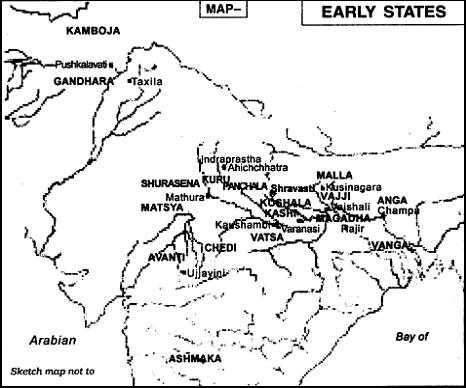 Mauryan Empire
Based on the two maps, the Mahajanapadas that were likely included within the Mauryan Empire are:
- Magadha (the core region of Maurya power)
- Anga
- Vanga
- Kosala
- Vatsa
- Avanti
- Kuru and Panchala
- Matsya
- Vidarbha
- Asmaka
- Gandhara and Kamboja in the north-west (to the extent the empire extended there)
Asokan inscriptions are indeed found across many of these regions, showing the wide reach of Mauryan authority and communication. Well-known examples include edicts and rock inscriptions in:
- Bihar and Uttar Pradesh (core Magadha area and neighbouring regions)
- Odisha (Kalinga region - e.g., Dhauli and Jaugada)
- Gujarat (e.g., Girnar)
- Uttarakhand (e.g., Kalsi)
- North-west frontier (e.g., Shahbazgarhi and Mansehra in present-day Pakistan)
These inscriptions confirm that Asoka's messages and administrative concerns reached a large portion of the subcontinent and its frontiers.
Project
Q11: Collect newspapers for one month. Cut and paste all the statements made by government officials about public works. Note what the reports say about the resources required for such projects, how the resources are mobilised and the objective of the project. Who issues these statements, and how and why are they communicated? Compare and contrast these with the evidence from inscriptions discussed in this chapter. What are the similarities and differences that you notice?
Ans: (This question needs to be attempted by the students themselves. Some hints are given below for students.)
Government Statements
- Highway Expansion: Announced by the Transport Minister; projects often combine government funds with private investment through public-private partnerships.
- Water Supply Improvement: Declared by the Water Resources Department; funded from state budgets and sometimes supported by international loans or grants.
- School Renovation: Announced by the Education Minister; generally financed by the education budget and local community contributions or corporate social responsibility funds.
Resource Mobilisation
- Public-Private Partnerships
- Government funding from central or state budgets
- International loans, grants and multilateral funding
Objectives
- Infrastructure development and connectivity
- Provision of basic amenities (clean water, sanitation, education)
- Economic growth and employment generation
Issuers
- Government ministers and department heads
- Communication channels: Press releases, conferences, official websites and social media announcements
Similarities:
- Both modern statements and ancient inscriptions announce public works and record the ruler or authority's involvement.
- Both describe resource requirements and methods of mobilisation, for example grants or allocations for specific projects.
- Both set out objectives such as welfare, improved infrastructure or public good.
Differences:
- Medium: Modern announcements appear in newspapers, broadcast and online media; ancient communications were carved on stone or metal and placed in public locations.
- Detail and accessibility: Modern reports tend to be timely, detailed and widely accessible; inscriptions were concise, durable and aimed at a long-term public record rather than frequent updates.
- Frequency: Modern governments issue frequent updates; inscriptions are permanent records and therefore rarer and less frequent.
Conclusion: The goals of public communication - announcing projects, explaining resources and asserting responsibility - are continuous themes across time. What has changed are the media, the level of detail, and the speed and reach of communication.
Q12: Collect five different kinds of currency notes and coins in circulation today. For each one of these, describe what you see on the obverse and the reverse (the front and the back). Prepare a report on the common features as well as the differences in terms of pictures, scripts and languages, size, shape and any other element that you find significant. Compare these with the coins shown in this chapter, discussing the materials used, the techniques of minting, the visual symbols and their significance and the possible functions that coins may have had.
Ans: (This question needs to be attempted by the students themselves. Some hints are given below for students.)
United States Dollar (USD):
- Obverse: On the front side, there is a portrait of a notable figure, such as George Washington or Abraham Lincoln, along with the denomination of the note.
- Reverse: The back side features various symbols and landmarks, like the Great Seal of the United States or images representing American history.
- Common Features: The notes are rectangular in shape and primarily printed on cotton-linen blend paper. They include security features like watermarks, security threads, and color-shifting ink.
- Differences: The images and symbols vary depending on the denomination, but all notes feature the same basic design elements and security features.
Euro (EUR):
- Obverse: The front side of Euro banknotes features windows and gateways with bridges and arches, symbolizing openness and cooperation.
- Reverse: The back side depicts different periods in European architectural history, such as Gothic, Renaissance, and Baroque styles.
- Common Features: Euro banknotes are rectangular and made of pure cotton paper. They also include various security features like holograms, raised print, and microprinting.
- Differences: Each denomination has its own color and design theme, but they all follow a similar architectural motif.
Japanese Yen (JPY):
- Obverse: Japanese Yen banknotes typically feature portraits of notable figures from Japanese history, such as Emperor Meiji or Natsume Sōseki.
- Reverse: The back side often showcases scenes from Japanese culture, landscapes, or important historical events.
- Common Features: Yen banknotes are rectangular and made of cotton paper. They include security features like holograms, metallic strips, and latent images.
- Differences: The images and colors vary between denominations, but they all incorporate elements of Japanese culture and history.
Indian Rupee (INR):
- Obverse: Indian Rupee notes usually feature images of Mahatma Gandhi, along with the denomination and the Reserve Bank of India seal.
- Reverse: The back side depicts various Indian landmarks, cultural symbols, or wildlife scenes.
- Common Features: Rupee notes are rectangular and made of cotton paper. They include security features like watermarks, security threads, and intaglio printing.
- Differences: Each denomination has its own color scheme and design elements, reflecting different aspects of Indian culture and heritage.
British Pound Sterling (GBP):
- Obverse: Pound Sterling banknotes often feature portraits of British monarchs, such as Queen Elizabeth II, and historical figures like Winston Churchill.
- Reverse: The back side showcases images of British landmarks, cultural symbols, or historical events.
- Common Features: Pound Sterling banknotes are rectangular and made of polymer. They include security features like transparent windows, holograms, and tactile features.
- Differences: The designs vary between denominations, but they all incorporate elements of British history and culture.
Comparison with Coins from History Chapter:
- Materials: Modern coins are typically made of metals like copper, nickel, or zinc, whereas ancient coins might have been made of silver, gold, or bronze.
- Minting Techniques: Modern coins are often minted using advanced machinery, whereas ancient coins might have been struck by hand.
- Visual Symbols: Both modern and ancient coins feature symbols representing political authority, religious beliefs, or cultural identity.
- Significance: Coins from both eras serve(d) as a medium of exchange, a symbol of authority, and a means of propagating political or cultural messages.
FAQs on NCERT Solutions - Kings, Farmers and Town
| 1. What was the relationship between kings and farmers in early medieval India? |  |
| 2. How did towns develop during the medieval period covered in CBSE History Class 12? | |
| 3. What role did irrigation systems play in supporting farmers and agricultural growth? | |
| 4. Why did some towns decline while others prospered in medieval India? | |
| 5. What were the main differences between the lives of farmers, merchants, and rulers in medieval society? | |