Answer in 100-150 words
Q1: Explain with examples what historians mean by the integration of cults.
Ans: Between the tenth and seventeenth centuries, religious life in India showed a pattern historians call the integration of cults. This means many local and regional deities and practices were absorbed into broader classical traditions rather than remaining wholly separate. Two related processes made this possible. First, Brahminical ideas spread beyond elite circles; scriptures and ritual knowledge were simplified or retold in accessible forms so that women and Shudras could engage with them. Second, Brahminical traditions themselves were reshaped by popular beliefs and practices, producing new regional forms of worship.
Examples make this clear:
(i) The Jagannatha temple at Puri: Jagannatha is recognised as a form of Vishnu, yet the cult has distinct rituals and local customs that differ from classical Vaishnavism.
(ii) Local village deities and kul devatas: Tribal and rural communities often made images of gods and goddesses in wood or stone; over time many of these figures were identified with major gods such as Vishnu or Shiva or were incorporated as forms of the Goddess. These processes created a layered religious world where popular and classical traditions coexisted and influenced one another.
Q2: To what extent do you think the architecture of mosques in the subcontinent reflects a combination of universal ideals and local traditions?
Ans: Islamic architecture brought certain universal elements to mosques in the subcontinent, such as orientation towards Mecca, the use of a mihrab (prayer niche) and a minbar (pulpit), and emphasis on communal prayer space. At the same time, local building materials, climatic needs and indigenous aesthetic forms produced distinctive regional variations. For example, a thirteenth-century mosque in Kerala uses a shikhara-like roof rather than a dome, reflecting local temple roof forms. The Shah Hamdan Mosque in Kashmir employs local timber and a facade reminiscent of regional wooden architecture. In Bengal, brick mosques developed rounded roofs suited to local materials and techniques, as in the Atia Mosque. Thus, mosque architecture in India was a fusion: it preserved core Islamic ideals while adopting local forms, crafts and materials to create buildings that were both functional and regionally rooted.
Q3: What were the similarities and differences between the be-shari'a and ba-shari'a sufi traditions?
Ans: Shari'a denotes Islamic law derived from the Qur'an, Hadith and juristic tradition. Within Sufism two broad orientations emerged in relation to Shari'a. Be-shari'a Sufis criticised or downplayed the legalistic and external aspects of religion; they emphasised inward spirituality, asceticism and direct mystical experience, at times rejecting strict observance of formal law. Ba-shari'a Sufis accepted and respected Shari'a while insisting that legal observance needed to be complemented by inner purification and devotion. Similarities: both groups pursued spiritual transformation, used practices such as remembrance of God (dhikr) and valued personal piety and moral reform. Differences: be-shari'a Sufis prioritised mystical experience even when it conflicted with orthodox practice; ba-shari'a Sufis sought to reconcile Shari'a and tariqa (the mystical path), arguing that outward law and inward spirituality should go together.
Q4: Discuss the ways in which the Alvars, Nayanars and Virashaivas expressed critiques of the caste system.
Ans: The Alvars (Vaishnava) and Nayanars (Shaiva) of South India, active from the sixth century onwards, composed devotional hymns in Tamil and travelled widely. Their movement was socially inclusive: bhakti drew followers from Brahmins to artisans and those treated as untouchables, challenging the exclusive religious authority of Brahmins. By emphasising devotion as the primary means to salvation, they undermined claims that ritual status alone determined access to God.
Virashaivism (or Lingayatism) in twelfth-century Karnataka, led by Basavanna (1106-68), gave a sharper social critique. Basavanna and his followers rejected caste hierarchies and rituals that marked people as impure. They promoted equality, wore the linga as a symbol of direct relation to Shiva, and supported social reforms such as opposing child marriage and allowing widow remarriage. Together, these movements criticised caste-based exclusion and offered alternative religious identity grounded in devotion and ethical conduct rather than birth alone.
Q5: Describe the major teachings of either Kabir or Baba Guru Nanak, and the ways in which these have been transmitted.
Ans: Kabir: Kabir was a poet-saint whose verses appealed to both Hindus and Muslims. His main teachings included:
(i) God is formless (nirankar) and one, though people use many names.
(ii) He rejected idol worship and ritual formalism.
(iii) He criticised religious hypocrisy in both Hindu and Muslim communities.
(iv) He denounced caste discrimination and stressed equality.
(v) He combined Sufi devotion to God with Hindu practices of remembering God, and he upheld the dignity of labour.
Kabir expressed these ideas in simple vernacular verses that circulated orally and later in written collections called kabir bani. His couplets were transmitted through singers, devotional communities and compilations, influencing later bhakti literature and popular religious practice.
Guru Nanak and his teachings
Guru Nanak (born 1469, Talwandi/Nankana Sahib) founded the Sikh tradition. His key teachings included:
(i) Rejection of blind ritual and of exclusive claims of any single scripture or priestly class.
(ii) Emphasis on one formless God (nirakar) and constant remembrance of the divine name (naam japna).
(iii) Ethical living, honest work and sharing with others (kirat karna, naam japna, vand chhakna).
(iv) Equality of all people, including women.
Guru Nanak composed hymns (shabads) in Punjabi and other local idioms; these hymns were sung in congregations and later included in the Guru Granth Sahib, which preserved and transmitted his teachings to later generations.
Write a short essay (About 250-300 words) on the following
Q6: Discuss the major beliefs and practices that characterized Sufism.
Ans: Sufism is the mystical dimension of Islam that came to have a wide following in the subcontinent. Its central concern was the direct, personal experience of God rather than merely formal observance of religious law. Sufis emphasised inner purification, love of God and self-surrender as the way to spiritual realisation. They practised zikr (remembrance of God), meditation and devotional music or poetry to cultivate a loving awareness of the divine.
(i) Sufis often gave precedence to personal experience over literalist readings of scripture; spiritual insight, they held, could transform ritual observance into a living relationship with God. This widened the religious space for many who felt excluded by strict orthodoxy.
(ii) Simplicity and humility were prized; many Sufis lived ascetic lives or voluntarily accepted poverty as a spiritual discipline. At the same time, some Sufi orders combined active social engagement with mysticism.
(iii) Music and poetry were central to many Sufi practices: qawwali and sama (listening) served as means of ecstasy and remembrance. Although classical jurisprudence often discouraged music, Sufis regarded it as a legitimate path to divine love.
(iv) Service to humanity was a consistent theme. Many Sufi saints ran hospices, fed the poor and practised communal kitchens (langar), seeing social service as an expression of love for God.
(v) Sufism promoted spiritual equality and inclusiveness. Sufi khanqahs (lodges) and dargahs (shrines) became centres where people of different backgrounds met, fostering social bonds across religious and caste lines. These features made Sufism a powerful and adaptable force in medieval Indian society, contributing both to devotional life and to social cohesion.
Q7: Examine how and why rulers tried to establish connections with the traditions of the Nayanars and the sufis.
Ans: Rulers sought links with devotional traditions for political, social and religious reasons. In South India, Chola kings (ninth to thirteenth centuries) patronised Nayanars and Alvars by granting land, building temples and supporting temple rituals. This patronage produced monumental temple architecture (for example, Chidambaram, Tanjavur and Gangaikondacholapuram) and magnificent bronze icons. By associating themselves with popular saints and temples, rulers gained sacred legitimacy, public support among farmers and townspeople, and a visible sign of their wealth and power.
This is manifested by the following facts:
(i) Chola patronage of Bhakti saints and temple construction strengthened links between religious centres and royal authority.
(ii) Temples became centres of economic and social activity, attracting donations and reinforcing the ruler's status.
(iii) Artistic production, such as bronze sculpture, flourished under royal support, further legitimising kingship.
Sufi Tradition and the rulers of Delhi Sultanate and Mughals: In North India, rulers of the Delhi Sultanate and later the Mughals cultivated relations with Sufi saints. Sufis provided moral authority and a bridge to the largely non-Muslim population; their emphasis on compassion and service made them acceptable to diverse groups. Political rulers benefited from Sufi endorsement because it helped stabilise rule without imposing rigid Shari'a uniformly. Many rulers also endowed dargahs and participated in patronage, which enhanced their public image and fostered social harmony. Thus both in the south and the north, rulers used connections with devotional traditions to secure legitimacy and popular support.
Q8: Analyse, with illustrations, why bhakti and sufi thinkers adopted a variety of languages in which to express their opinions.
Ans: Bhakti and Sufi thinkers chose the languages of ordinary people so their message reached wide audiences beyond courtly or scholarly circles. Though Sanskrit and Persian were languages of elites, the majority of villagers spoke regional languages and dialects; communicating in those tongues made devotion accessible and popular.
This is shown by examples:
(i) Early Bhakti hymns in Sanskrit were used in temples, but travelling bhaktas like the Nayanars and Alvars composed and sang in Tamil so villagers could understand and participate.
(ii) In North India, saints such as Kabir and Ravidas wrote in vernaculars close to Hindavi or Braj, while Guru Nanak and Baba Farid used Punjabi. Their choice of local languages helped their teachings spread through oral performance and song.
(iii) Sufi devotional music and sama were performed in local tongues such as Hindustani; some Sufi saints also composed in regional languages and Punjabi verses of Baba Farid were later incorporated into the Guru Granth Sahib.
(iv) Other saints composed in Kannada, Marathi and Telugu, reflecting regional literary cultures. By using vernaculars, Bhakti and Sufi teachers created devotional literature and practices that ordinary people could understand, remember and transmit, making these movements socially transformative.
Q9: Read any five of the sources included in this chapter and discuss the social and religious ideas that are expressed in them.
Ans: Sources from the Bhakti and Sufi periods reveal a range of social and religious ideas:
(i) Architecture (temples, mosques, monasteries): These buildings reflect religious beliefs, ritual practices and patronage patterns. Surviving structures and ruins show how communities organised devotion, pilgrimage and learning.
(ii) Devotional compositions by Bhakti and Sufi saints: Hymns and poems are sources for popular religiosity, village life, and values such as devotion, equality and moral conduct rather than elite ritual performance.
(iii) Hagiographies and biographies of saints: These accounts, often composed later, describe a saint's life and miracles and provide insight into contemporary values, community conflicts and inter-religious interactions. Stories about Kabir's death, for example, indicate both rivalry and shared devotion among Hindus and Muslims.
(iv) Institutional records and temple inscriptions: Grants, land records and inscriptions illuminate the economic role of temples and shrines, their social influence and the relationship between rulers and religious centres.
(v) Folk traditions and performing arts: Dance, painting, qawwali and oral lore express themes of universal brotherhood, love of God and social critique. Together these sources show a religious world shaped by devotional fervour, social inclusiveness, and interaction between elite and popular traditions.
Map work
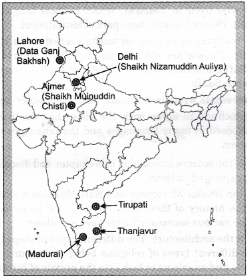
Q10: On an outline map of India, plot three major sufi shrines and three places associated with temples (one each of a form of Vishnu, Shiva and the goddess.)
Ans:
Projects (Choose one)
Q11: Choose any two of the religious teachers/thinkers/saints mentioned in this chapter, and find out more about their lives and teachings. Prepare a report about the area and the times in which they lived, their major ideas, how do we know about them, and why you think they are important?
Ans: Following are the two saints of the Bhakti movement who are described as follows:
Guru Nanak: Guru Nanak (born 15 April 1469 in Talwandi, now Nankana Sahib) was the founder of the Sikh tradition and the first of the ten Sikh Gurus. He came from a Khatri family and travelled widely across South Asia and beyond. His teachings stressed:
Equality of humans: He rejected discrimination by caste, creed or status and taught the spiritual equality of all people.
Universal message: Nanak addressed both Hindus and Muslims, urging ethical living and warning against exploitative behaviour.
Equality of women: He advocated equal status for women and questioned practices that demeaned them.
His hymns (shabads) in Punjabi were preserved and transmitted by his followers and later compiled into the Guru Granth Sahib, which keeps his teachings central to Sikh religious life.
Namdev: Namdev (c. 1270-1350) was a Marathi saint-poet from Maharashtra who wrote in Marathi and also composed in other regional languages. He belonged to a tradition of devotional poets who brought religious ideas to ordinary people in their own tongue. Namdev's songs emphasised devotion to God, the importance of a moral life, and the dignity of labour. His verses travelled widely through oral performance and were influential in both Maharashtra and Punjab; some of his compositions are preserved in Sikh scripture as well. Namdev's life and poems show how regional bhakti saints helped to forge wider devotional networks across India.
Q12: Find out more about practices of pilgrimage associated with the shrines mentioned in this chapter. Are these pilgrimages still undertaken? When are these shrines visited? Who visits these shrines? Why do they do so? What are the activities associated with these pilgrimages?
Ans: Pilgrimage remains an important practice for many communities connected to Bhakti and Sufi traditions.
(i) Sikh pilgrimages: Sikhs visit Amritsar (Golden Temple) and Anandpur Sahib, especially on festivals such as Baisakhi. Pilgrims attend prayers, take part in the langar (community kitchen) and visit gurdwaras for devotional singing. Nankana Sahib draws pilgrims on Guru Nanak's birth anniversary; pilgrims travel by road, rail or air.
(ii) Hindu pilgrimages: Places such as Haridwar (Kumbh/Ardh Kumbh) and Pushkar are visited for ritual baths, donations, ancestral rites and festivals. These pilgrimages occur at fixed intervals (for example, Kumbh every twelve years) and attract large numbers of devotees.
(iii) Sufi pilgrimages: Shrines such as the dargahs of Nizamuddin Auliya (Delhi) and Muinuddin Chishti (Ajmer) continue to draw devotees from across India and abroad for urs (death anniversaries) and other occasions. Visitors offer chadar (cloth) and donations, listen to qawwali and participate in communal meals.
(iv) Who attends and why: Pilgrims include local worshippers, regional devotees and international visitors who come for devotion, fulfil vows, seek blessings or participate in communal worship. Activities commonly include prayer, singing, donation, ritual feeding (langar), and participation in festivals that reinforce religious identity and communal bonds