NCERT Solutions - International Organisations

Q1: Mark correct or wrong against each of the following statements about the veto power:
(a) Only the permanent members of the Security Council possess the veto power.
(b) It's a kind of negative power.
(c) The Secretary General uses this power when not satisfied with any decision.
(d) One veto can stall a Security Council resolution.
Ans:
(a) Correct
(b) Correct
(c) Wrong
(d) Correct
Q2: Mark correct or wrong against each of the following statements about the way the UN functions:
(a) All security and peace related issues are dealt within the Security Council.
(b) Humanitarian policies are implemented by the main organs and specialised agencies spread across the globe.
(c) Having consensus among five permanent members on security issues is vital for its implementation.
(d) The members of the General Assembly are automatically the members of all other principal organs and specialised agencies of the UN.
Ans:
(a) Correct
(b) Wrong
(c) Correct
(d) Wrong
Q3: Which among the following would give more weightage to India's proposal for permanent membership in the Security Council?
(a) Nuclear capability
(b) It has been a member of the UN since its inception.
(c) It is located in Asia.
(d) India's growing economic power and stable political system.
Ans: (d) India's growing economic power and stable political system.
India's economic emergence and democratic stability are key criteria highlighted in UNSC reform debates for new permanent members.
Q4: The UN agency concerned with the safety and peaceful use of nuclear technology is:
(a) The UN Committee on Disarmament
(b) International Atomic Energy Agency
(c) UN International Safeguard Committee
(d) None of the above.
Ans: (b) International Atomic Energy Agency
The IAEA, established in 1957, promotes peaceful nuclear energy use and prevents military applications through inspections.
Q5: WTO is serving as the successor to which of the following organisations:
(a) General Agreement on Trade and Tariffs
(b) General Arrangement on Trade and Tariffs
(c) World Health Organisation
(d) UN Development Programme
Ans: (a) General Agreement on Trade and Tariff
The WTO, set up in 1995, directly succeeded the GATT (post-WWII trade agreement) to regulate global trade rules.
Q6: Fill in the blanks:
(a) The prime objective of UN is _________
(b) The highest functionary of the UN is called ________
(c) The UN Security Council has ______________ permanent and _________ non permanent members.
(d) ______________ is the present UN Secretary General.
Ans:
(a) to maintain peace and security
(b) Secretary General
(c) 5, 10
(d) Antonio Guterres
Q7: Match the principal organs and agencies of the UN with their functions:
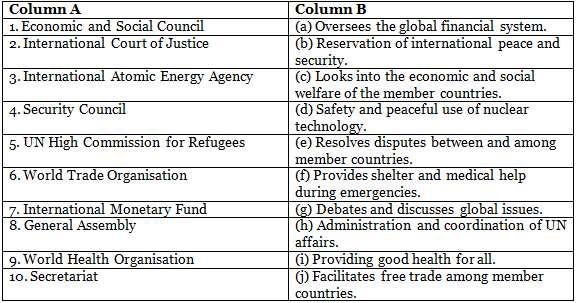 Ans:
Ans: 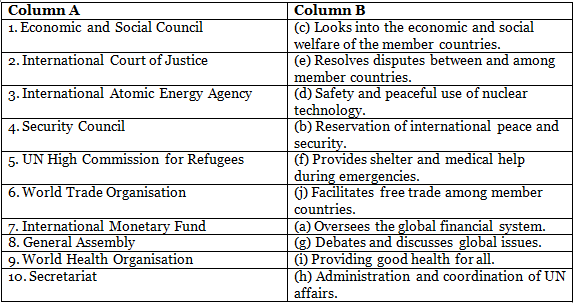
Q8: What are the functions of Security Council?
Ans: Its main function is to maintain peace and security in the world and the other functions are as follows:
- The Security Council recommends methods to adjust disputes among nations.
- Security Council can take military action if required.
- Security Council elects the judges of International Court of Justice and appoints the Secretary General by recommending to the General Assembly.
- Security Council can apply economic sanction also to stop any aggression.
- The Security Council can investigate the disputes in case a friction arises.
Q9: As a citizen of India, how would you support India's candidature for the permanent membership of Security Council? Justify your proposal.
Ans: As a citizen of India, we may support India's candidature for the permanent membership of Security Council in the following manner:
- India is the most populous country in the world with one-fifth of world's population.
- India is the world's largest democracy.
- India's economic emergence on the World Stage.
- India is a regular financial contributor to the UN.
- India signifies a growing importance in world affairs in conduct of its foreign policy.
- India has actively participated in all the initiatives of the UN.
Q10: Critically evaluate the difficulties involved in implementing the suggested reforms to reconstruct the UN.
Ans: The following are the challenges in implementing the suggested reforms to reconstruct the UN:
- Determining how large an economic and military power should qualify to become a UNSC member.
- Deciding the level of budget contribution required for membership.
- There is no guarantee that a Council member will be effective in respecting democracy and human rights.
- Questioning why equitable representation should be decided solely by geography rather than by levels of economic development.
- Debate over giving more seats to members of the developing world.
All the above-mentioned criteria have been adopted but not universally accepted. Hence, these difficulties exist.
Q11: Though the UN has failed in preventing wars and related miseries, nations prefer its continuation. What makes the UN an indispensable organisation?
Ans:
- Interdependence and globalisation are not possible without international organisations such as the UN.
- To enforce cooperation on issues like poverty, unemployment, environmental degradation, and crime rate.
- To provide financial assistance to developing countries to stabilise the global economy, the UN and its specialised agencies are essential.
- The UN works as a forum to solve international disputes among nations and find the best possible solutions.
- Hence, though the UN has failed in preventing wars and related miseries, nations require its continuation due to the above reasons to promote international peace and understanding.
Q12: "Reforming the UN means restructuring of the Security Council". Do you agree with this statement? Give arguments for or against this position.
Ans: Yes, we agree with the statement because the Security Council plays a crucial role in the functioning of the UN. In today's scenario, power equations have changed with the disintegration of the USSR and many new countries entering the UN:
- The UN Charter has given a privileged position to permanent members to bring stability worldwide. This position remains the same and no new entrants are allowed.
- Only permanent members enjoy veto power, placing them in a valuable position.
- The permanent members are mainly from industrialised developed countries, which should be balanced by enhancing representation from developing countries to become either permanent or non-permanent members.
- Hence, the Security Council should be reformed and its working improved to make the UN more effective; inclusion of member states should be judged on the basis of their contribution to peacekeeping initiatives.
FAQs on NCERT Solutions - International Organisations
| 1. What are international organisations? |  |
| 2. How do international organizations function? | |
| 3. What is the role of international organizations in global governance? | |
| 4. How do international organizations impact national sovereignty? | |
| 5. What are some examples of international organizations? | |





