NCERT Solutions - Security in the Contemporary World

Q1: Match the terms with their meaning:
(i) Confidence Building Measures (CBMs)
(ii) Arms Control
(iii) Alliance
(iv) Disarmament
(a) Giving up certain types of weapons.
(b) A process of exchanging information on defence matters between nations on a regular basis.
(c) A coalition of nations meant to deter or defend against military attacks.
(d) Regulates the acquisition of development of weapons.
Ans: (i)-(b); (ii)-(d); (iii)-(c); (iv)-(a).
Q2: Which among the following would you consider as a traditional security concern/non-traditional/not a threat?
(a) The spread of chikungunya/dengue fever
(b) Inflow of workers from a neighbouring nation.
(c) Emergence of a group demanding nationhood for their region.
(d) Emergence of a group demanding autonomy for their region.
(e) A newspaper that is critical of the armed-forces in the country.
Ans:
(a) Non-traditional
(b) Non-traditional
(c) Traditional
(d) Not a threat
(e) Not a threat
Q3: What is the difference between traditional and non-traditional security? Which category would the creation and sustenance of alliances belong to?
Ans: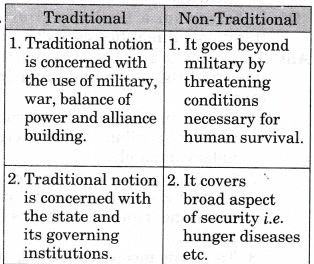
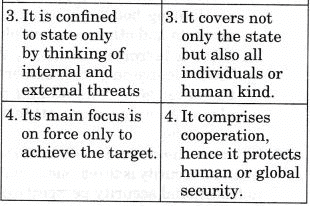 Creation and sustenance of alliances belong to traditional notion of security.
Q4: What are the differences in the threats that people in the third world face and those living in the First World face?
Ans: The threats faced by peoples in the Third World and the First World differ because of historical, political and economic conditions.
The following points explain these differences:
- Many newly independent states in the Third World experienced military conflicts with neighbouring states soon after independence; interstate war was a common concern.
- These states faced major threats not only from outside their borders but also from within, such as challenges to authority and territorial integrity.
- Internal threats often took the form of separatist or insurgent movements seeking to create a new state or greater autonomy.
- At times external and internal threats became linked-for example, neighbouring states supporting internal insurgents-so that the distinction between internal and external threats blurred.
- For many new states, therefore, both wars with neighbours and internal armed conflicts posed a severe challenge to their survival and stability.
Q5: Is terrorism a traditional or non- traditional threat to security?
Ans: Terrorism is a non-traditional security threat because it targets civilians to achieve political objectives and does not follow conventional state-on-state war rules:
- Terrorism is the deliberate use of violence against civilians to intimidate a population or coerce governments.
- It is often used as a tactic by non-state actors to pursue political aims when other means are judged ineffective.
- Common forms include hijacking, bombings in public places and attacks on symbolic targets, which aim to spread fear beyond the immediate victims.
- The global attention to terrorism rose sharply after the attacks on the World Trade Centre on 11 September 2001, which showed how non-state violence can have international consequences.
Q6: What are the choices available to a state when its security is threatened, according to traditional security perspective?
Ans: The traditional security perspective offers states three main choices when faced with a threat:
- Surrender: Accept the demands of the aggressor when faced with overwhelming force (though this is rarely declared as a policy).
- Deterrence: Prevent an attack by convincing the potential adversary that the costs of aggression will be unacceptably high.
- Defence: Actively defend against an attack when it occurs, aiming to deny the attacker their objectives and to repel or defeat the attack.
- Together, deterrence (preventing war) and defence (limiting or defeating war) form the core of a state's traditional security policy.
Q7: What is Balance of Power? How could a state achieve this?
Ans: Balance of power refers to a situation in which power is distributed so that no single state or coalition can dominate others. A state may seek to achieve or maintain a balance of power by:
- Building its own military capability to match potential rivals.
- Forming alliances with other states to combine strength against a stronger power.
- Using diplomacy to prevent the rise of a single dominant state-for example, by encouraging rivalries among potential adversaries.
- Enhancing economic and technological capacities so that military power can be supported over time.
Q8: What are the objectives of military alliances? Give an example of a functioning military alliance with its specific objectives.
Ans: Objectives:
- Alliances are formed to deter or defend against military threats from other states or coalitions.
- They formalise commitments through treaties and clarify who is considered a threat and who is a partner.
- Alliances increase the combined effective power of members relative to potential adversaries.
- They are based on national interest and can change when members' interests shift.
Example: During the 1980s, the United States supported Islamic fighters in Afghanistan to oppose the Soviet intervention; later, after the 11 September 2001 attacks and the rise of Al-Qaeda, the US policy shifted and it took military action against groups it had earlier supported. This example shows how alliances and support can change as national interests and the nature of threats change.
Q9: Rapid environmental degradation is causing a serious threat to security. Do you agree with the statement? Substantiate your arguments.
Ans: Yes. Environmental degradation can be a serious security threat because its effects are often large, long-term and cross national borders:
- Environmental problems such as climate change, desertification and sea-level rise can destroy livelihoods, reduce food and water security, and force population movements.
- Such pressures increase competition over scarce resources and can exacerbate social tensions, leading to conflict within and between states.
- Some countries may suffer disproportionately; for example, a rise in sea level of 1.5-2.0 metres could flood large parts of Bangladesh, inundate most of the Maldives and threaten significant coastal populations in countries such as Thailand.
- Because environmental threats are transnational, effective responses require international cooperation and shared norms and institutions to manage the risks.
Q10: Nuclear weapons as deterrence or defence have limited usage against contemporary security threats to states. Explain the statement.
Ans: Nuclear weapons provide deterrence by threatening unacceptable damage to an attacker, but their usefulness is limited against many contemporary security threats:
- Deterrence works primarily between states; it is less effective against non-state actors such as terrorist groups that do not control territory in the same way.
- The humanitarian and environmental consequences of nuclear use make them a morally and politically costly option, reducing their practical utility.
- Arms control and non-proliferation efforts, such as the Nuclear Non-Proliferation Treaty (NPT) of 1968, limit the spread of nuclear weapons and regulate possession. The NPT allowed states that had manufactured nuclear weapons before 1967 to keep them while asking others to forgo acquisition; it therefore constrained the number of nuclear states rather than abolish nuclear arms.
- Because many contemporary threats are transnational, non-military or low-intensity (for example, terrorism, cyber attacks, environmental degradation), nuclear weapons offer limited responses to these challenges.
Q11: Looking at the Indian scenario, what type of security has been given priority in India, traditional or non-traditional? What examples could you cite to substantiate the arguments?
Ans: India has had to address both traditional (military) and non-traditional security threats. Its strategy has included four broad components:
To strengthen its military capabilities because:
- India has fought wars with Pakistan in 1947-48, 1965, 1971 and 1999 and had a major conflict with China in 1962; such experiences made military security a priority.
- Given the presence of nuclear weapons in the region, India conducted nuclear tests (first in 1974 and later in 1998) as part of a decision to safeguard national security.
To strengthen international norms and institutions:
- Jawaharlal Nehru supported Asian solidarity, disarmament and the United Nations as a forum for settling disputes.
- India has sought a universal, non-discriminatory non-proliferation regime and used non-alignment to carve out space outside the Cold War blocs.
- India signed the Kyoto Protocol in 1997, signalling engagement with global efforts to address environmental threats.
To meet security challenges within the country:
- Various militant and separatist movements in regions such as Nagaland, Punjab and Kashmir challenged internal security; India has used a combination of political, legal and security measures to preserve unity.
- Democratic institutions, freedom of expression and electoral politics are part of the strategy to manage internal dissent peacefully.
To develop the economy:
- Economic development is treated as a key component of security so that poverty, inequality and deprivation that can fuel unrest are reduced.
- A stable, democratically elected government is expected to combine growth with human development to strengthen social cohesion and long-term security.
Q12: Read the cartoon below and write a short note in favour or against the connection between war and terrorism depicted in this cartoon.
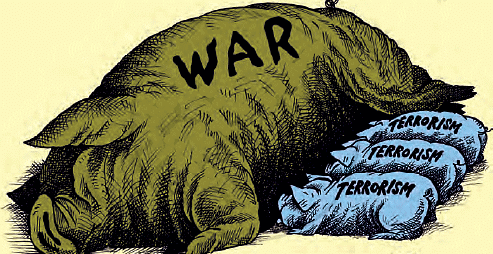
Ans: One can agree that war and terrorism are often connected, though they are distinct phenomena.
A short note in favour of the connection:
- War can create conditions-such as political instability, collapsed institutions and social grievances-that help terrorist groups to emerge or grow.
- Conversely, terrorist attacks may provoke military responses or wider conflicts, turning a campaign against non-state violence into interstate or internal war.
- Thus, violence in the form of war and terrorism can be mutually reinforcing: wars may produce terrorism, and terrorism can escalate into broader violent conflict if not managed through political solutions.
FAQs on NCERT Solutions - Security in the Contemporary World
| 1. What are the key challenges in maintaining security in the contemporary world? |  |
| 2. How does cybersecurity play a role in ensuring security in the contemporary world? | |
| 3. What is the significance of international cooperation in addressing security issues in the contemporary world? | |
| 4. How does social unrest impact security in the contemporary world? | |
| 5. What role do international organizations play in maintaining security in the contemporary world? | |