NCERT Solutions: Variations in Psychological Attributes

Q1: How do psychologists characterise and define intelligence?
Ans: All psychologists characterise and define intelligence in their own way. Alfred Binet was one of the first psychologists who worked on intelligence and defined intelligence as 'the ability to judge well, understand well and reason well.'
Wechsler intelligence test is widely used to understand intelligence in terms of functionality, i.e. its value for adaptation to the environment. He defined it as the global and aggregate capacity of an individual to think rationally, act purposefully, and to deal effectively with her/his environment.
Gardner and Sternberg have suggested that an intelligent individual not only adapts to the environment but also actively modifies or shapes it.
Thus, intelligence has certain attributes like being mentally alert and quick, a sense of humour and understanding according to psychologists.
Q2: To what extent is our intelligence the result of heredity (nature) and environment (nurture)? Discuss.
Ans: Intelligence is a product of the complex interaction of heredity (nature) and environment (nurture). There are various which shows that intelligence is the result of heredity (nature) and environment (nurture). A study on twins and adopted children supports this.
- The intelligence of identical twins reared together correlates almost 0.90. Twins separated early in childhood also show considerable similarity in their intellectual, personality and behavioural characteristics.
- The intelligence of identical twins reared in different environments correlates 0.72, those of fraternal twins reared together correlate almost 0.60, and those of brothers and sisters reared together correlate about 0.50, while siblings reared apart correlate about 0.25.
- Also, studies of adopted children show that children's intelligence is more similar to their biological rather than adoptive parents.
- With respect to the role of environment, studies have reported that as children grow in age, their intelligence level tends to move closer to that of their adoptive parents.
- Children from disadvantaged homes adopted into families with higher socio-economic status exhibit a large increase in their intelligence scores. There is evidence that environmental deprivation lowers intelligence, while rich nutrition, good family background, and quality schooling increase intelligence.
Q3: Explain briefly the multiple intelligences identified by Gardner.
Ans: Howard Gardner proposed the theory of multiple intelligences. He described the existence of eight distinct types of intelligence. Each of these intelligences is independent of the others, which interact and work together to find a solution to a problem. Eight intelligences are as follows:
(i) Linguistic intelligence: It is the capacity to use language fluently and flexibly to express one's thinking and understand others. People high on this intelligence are 'word-smart'. Poets and writers are very strong in this component of intelligence.
(ii) Logical-Mathematical intelligence: Persons high on this type of intelligence can think logically and critically. They engage in abstract reasoning and can manipulate symbols to solve mathematical problems. Scientists and Nobel Prize winners are likely to be strong in this component.
(iii) Spatial intelligence: It refers to the abilities involved in forming, using and transforming mental images. A person high on this intelligence can easily represent the spatial world in the mind. Pilots, sailors, sculptors, painters, architects, interior decorators, and surgeons are likely to have highly developed spatial intelligence.
(iv) Musical intelligence: It is the capacity to produce, create and manipulate musical patterns. People high on this intelligence are very sensitive to sounds and vibrations, and in creating new patterns of sounds.
(v) Bodily-Kinaesthetic intelligence: This consists of the use of the whole body or portions of it for the display or construction of products and problem solving. Athletes, dancers, actors, sportspersons, gymnasts, and surgeons are likely to have this kind of intelligence.
(vi) Interpersonal intelligence: This is the skill of understanding the motives, feelings and behaviours of other people to bond into a comfortable relationship with others. Psychologists, counsellors, politicians, social workers, and religious leaders are likely to possess high interpersonal intelligence.
(vii) Intrapersonal intelligence: This refers to the knowledge of one's internal strengths and limitations and using that knowledge to effectively relate to others. People high on this ability have finer sensibilities regarding their identity, human existence, and the meaning of life. Philosophers and spiritual leaders present examples of this type of intelligence.
(viii) Naturalistic intelligence: This involves complete awareness of our relationship with the natural world. It is useful in recognising the beauty of different species of flora and fauna, and making subtle discriminations in the natural world. Hunters, farmers, tourists, botanists, zoologists, and bird watchers possess more naturalistic intelligence.
Q4: How does the triarchic theory help us to understand intelligence?
Ans: The triarchic theory of intelligence was proposed by Robert Sternberg in 1985. He views intelligence as "the ability to adapt, to shape and select environment to accomplish one's goals and those of one's society and culture". According to this theory, there are three basic types of intelligence: Componential, Experiential, and Contextual.
(i) Componential Intelligence: It is also called analytical intelligence. It is the analysis of information to solve problems. People high on this ability think analytically and critically and succeed in schools. This intelligence has three components, each serving a different function.
- First is the knowledge acquisition component, which is responsible for learning and acquiring the ways of doing things.
- Second is the meta, or a higher-order component, which involves planning concerning what to do and how to do.
- Third is the performance component, which involves actually doing things.
(ii) Experiential Intelligence: It is also called creative intelligence. This involves using past experiences creatively to solve novel problems. It is reflected in creative performance. People high on this aspect originally integrate different experiences to make discoveries and inventions. They quickly find out which information is crucial in a given situation.
(iii) Contextual Intelligence: It is also called practical intelligence. This involves the ability to deal with environmental demands encountered on a daily basis. It may be called 'street smarts' or 'business sense'. People high on this aspect easily adapt to their present environment or select a more favourable environment than the existing one, or modify the environment to fit their needs. Therefore, they turn out to be successful in life.
Q5: "Any intellectual activity involves the independent functioning of three neurological systems". Explain with reference to the PASS model.
Ans: PASS model stands for Planning, Attention-arousal, and Simultaneous-successive Model of Intelligence, which was developed by J.P. Das, Jack Naglieri, and Kirby in 1994. According to this model, intellectual activity involves the interdependent functioning of three neurological systems, called the functional units of the brain. These units are responsible for arousal/attention, coding or processing, and planning, respectively.
(i) Arousal/Attention: This is basic to any behaviour as it helps us in attending to stimuli. Arousal and attention enable a person to process information. An optimal level of arousal focuses our attention on the relevant aspects of a problem. Arousal forces you to focus your attention on reading, learning and revising the contents of the chapters.
(ii) Simultaneous and Successive Processing: We can integrate the information into your knowledge system either simultaneously or successively. Simultaneous processing takes place when you perceive the relations among various concepts and integrate them into a meaningful pattern for comprehension. Simultaneous processing helps in grasping the meaning and relationship between the given abstract figures. Successive processing takes place when we remember all the information serially so that the recall of one leads to the recall of another. Learning of digits, alphabets, multiplication tables, etc., are examples of successive processing.
(iii) Planning: This is an essential feature of intelligence. After the information is attended to and processed, planning is activated. It allows us to think of the possible courses of action, implement them to reach a target, and evaluate their effectiveness. If a plan does not work, it is modified to suit the requirements of the task or situation.
These PASS processes operate on a knowledge base developed either formally or informally from the environment. These processes are interactive and dynamic in nature.
Q6: Are there cultural differences in the conceptualisation of intelligence?
Ans: Yes, there are cultural differences in the conceptualisation of intelligence. The cultural environment provides a context for intelligence to develop. A person's intelligence is likely to be tuned by cultural parameters like customs, beliefs, attitudes, and achievements in art and literature. Many theorists have regarded intelligence as attributes specific to the person without regard to their cultural background.
Sternberg's notion of contextual or practical intelligence said that intelligence is a product of culture. Vygotsky also believed that cultures have a life of their own, which grow and change, and in the process specify what will be the end-product of successful intellectual development. According to him, while elementary mental functions are universal, the manner in which higher mental functions, such as problem solving and thinking, operate is largely culture-produced.
Technologically advanced societies promote practices that foster skills of generalisation and abstraction, speed, minimal moves, and mental manipulation among children, which can be called technological intelligence. Intelligence tests developed in Western cultures look precisely for these skills in an individual.
On the other hand, technological intelligence is not so valued in many Asian and African societies. The qualities and skills regarded as intelligent actions in non-Western cultures are sharply different, though the boundaries are gradually vanishing under the influence of Western cultures. Thus, the relationships between different aspects of intelligence vary across cultures.
Q7: What is IQ? How do psychologists classify people based on their IQ scores?
Ans: In 1905, Alfred Binet and Theodore Simon made the first successful attempt to measure intelligence. In 1908, the scale was revised and the concept of Mental Age (MA), which is a measure of a person's intellectual development relative to people of her/his age group. Chronological Age (CA) is the biological age from birth. Retardation was defined by Binet and Simon as being two mental age years below the chronological age.
The concept of IQ was devised by a German psychologist, William Stern, in 1912. IQ means Intelligence Quotient (IQ), which refers to mental age divided by chronological age, and multiplied by 100. IQ is an index of brightness.
IQ = (MA/CA)×100
When MA = CA then IQ = 100
When MA > CA then IQ > 100
When MA < CA then IQ <100
According to psychologists, IQ scores are distributed in the population in such a way that the scores of most people tend to fall in the middle range of the distribution. Only a few people have either very high or very low scores. The mean IQ score in a population is 100.
- People with IQ scores in the range of 90-110 have normal intelligence.
- Those with an IQ below 70 are suspected to have 'intellectual disability'.
- Persons with an IQ above 130 are considered to have exceptional talents.
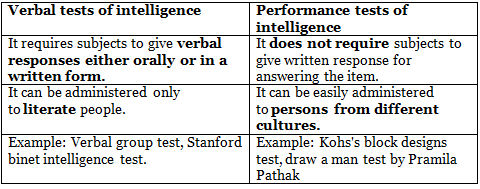
Q8: How can you differentiate between verbal and performance tests of intelligence?
Ans:
Q9: All persons do not have the same intellectual capacity. How do individuals vary in their intellectual ability? Explain.
Ans: As all the persons have different physical appearance likewise, all persons do not have the same intellectual capacity. Some are exceptionally bright and some are below average.
There are two forms of variations in the intellectual ability of the individuals, i.e. intellectual deficiency and intellectual giftedness.
1. Intellectual Deficiency:
- These individuals face enormous difficulty in learning even very simple skills and are termed 'intellectually disabled'.
- Individuals who are categorised as having intellectual disability show significant variation in their abilities, ranging from those who can be taught to work and function with special attention to those who cannot be trained and require institutional care throughout their lives.
- They can be trained in self-care skills and simple social and communication skills.
2. Intellectual Giftedness:
- Intellectually gifted individuals show higher performance because of their outstanding potential.
- Giftedness is an exceptional general ability shown in superior performance in a wide variety of areas.
- These have high ability, high creativity and high commitment.
Association on Mental Deficiency (AAMD) views intellectual disability as "significantly sub-average general intellectual functioning existing concurrently with deficits in adaptive behaviour and manifested during the developmental period", while Gifted children show early signs of intellectual superiority. Even during infancy and early childhood, they show a larger attention span, good recognition memory, a preference for novelty, sensitivity to environmental changes, and an early appearance of language skills.
Q10: Which of the two, IQ or EQ, do you think would be more related to success in life and why?
Ans:
- EQ is more related to success in life. IQ only measures our intelligence potential, which has no direct relationship to our present intelligence, while EQ is a measure of a person's level of emotional intelligence, which refers to the ability to perceive, control, evaluate and express emotions.
- A good IQ may determine your better academic performance and an advanced degree, but success means nothing if you have no one to share your successes with. People with high IQ are extremely talented and have good academic but are not able to be successful because they experience problems in family relations, workplace and interpersonal relationships. Hence, they are not able to manage these and have low performance.
- There is increasing evidence which shows leadership positions in companies require EQ as well as conventional qualifications. If a university student does not develop good EQ skills, they may be limiting their future potential. Some students may have received good grades in school exams, but without EQ, they will not be able to function well in higher education or the adult world.
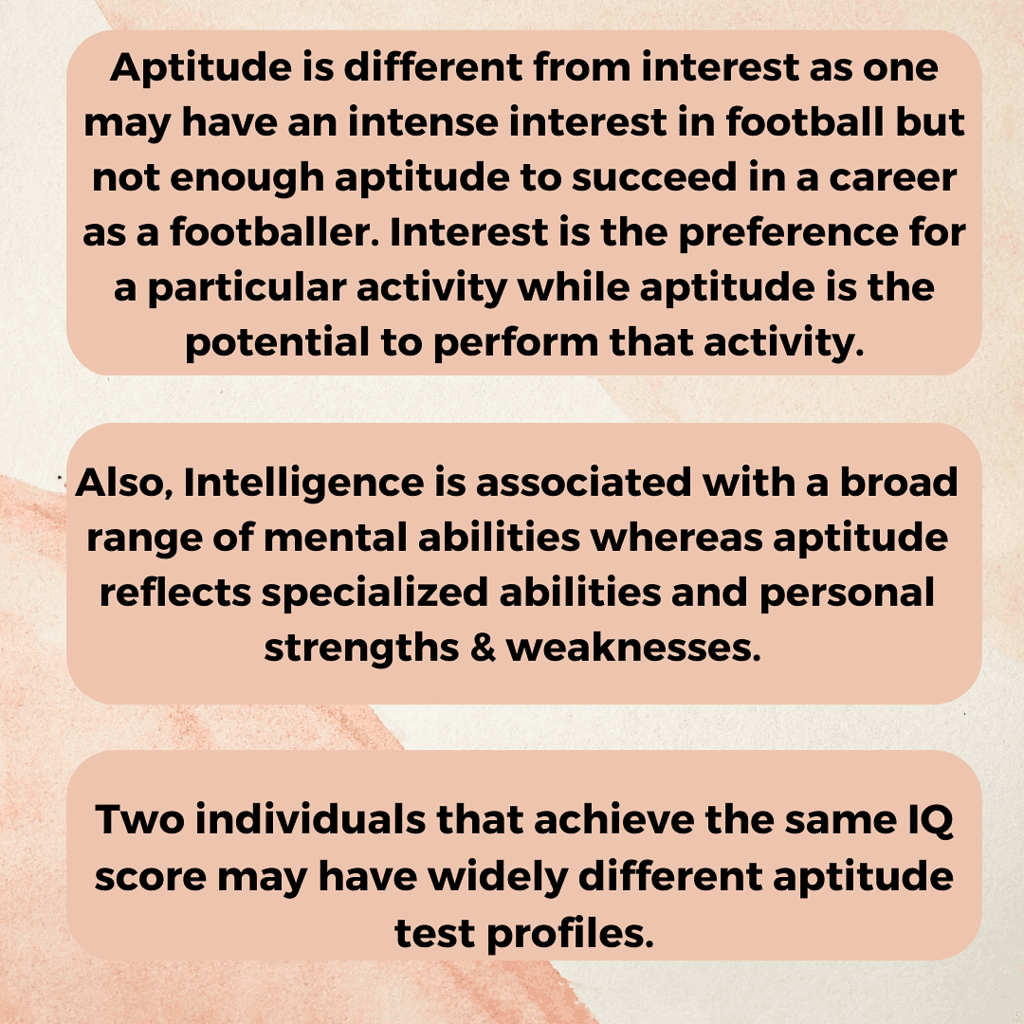
Q11: How is 'aptitude' different from 'interest' and 'intelligence'? How is aptitude measured?
Ans:
Aptitude:
It refers to an individual's potential for acquiring some specific skills. Aptitude tests are used to predict what an individual will be able to do if given a proper environment and training.
Interest:
It is an individual's preference for engaging in one or more specific activities relative to others.
Intelligence:
It is the global capacity to understand the world, think rationally and use available resources effectively when faced with challenges.
 Aptitude can be measured by two forms of tests: independent (specialised) aptitude tests and multiple (generalised) aptitude tests.
1. Independent Aptitude Test:
- Clerical Aptitude
- Mechanical Aptitude
- Numerical Aptitude
- Typing Aptitude
2. Multiple Aptitude Test: (exists in the form of test batteries)
- Differential Aptitude Tests (DAT)
- The General Aptitude Tests Battery (GATB)
- The Armed Services Vocational Aptitude Battery (ASVAB)
Q12: How is creativity related to intelligence?
Ans:
- Creativity and intelligence are not truly interrelated. An individual who has the ability to learn faster and reproduce accurately may be intelligent, but cannot be considered as creative unless he/she devise new ways of learning and doing things.
- Terman, in the 1920s, found that persons with high IQs were not necessarily creative. At the same time, creative ideas could come from people who did not have a very high IQ. Researchers have also found that both high and low levels of creativity can be found in highly intelligent children and also in children of average intelligence.
- The same person, thus, can be creative as well as intelligent, but it is not necessary that intelligent ones, in the conventional sense, must be creative.
- Intelligence, therefore, by itself does not ensure creativity.
- Researchers have found that the relationship between creativity and intelligence is positive.
- Intelligence is collaborative knowledge, while creativity is individuals imagination. All creative acts
require some minimum ability to acquire knowledge and capacity to comprehend, retain, and retrieve. - It can be concluded that creativity can take many forms and blends. Some may have more intellectual attributes, others may have more attributes associated with creativity.
FAQs on NCERT Solutions: Variations in Psychological Attributes
| 1. What are the main types of psychological attributes that vary among individuals? |  |
| 2. How do nature and nurture influence variations in psychological attributes? | |
| 3. Why do some students have higher intelligence quotient scores than others? | |
| 4. What's the difference between aptitude and achievement in psychological assessments? | |
| 5. How do personality traits affect academic and professional success? | |