NCERT Solutions - The World Population

Q1: Choose the right answer from the four alternatives given below.
(i) Which one of the following continents has the highest growth of population?
(a) Africa
(b) South America
(c) Asia
(d) North America
Ans: (a)
Explanation: Africa has the highest growth rate; Asia has the largest absolute numbers but not the highest growth rate
(ii) Which one of the following is not an area of sparse population?
(a) The Atacama
(b) South-east Asia
(c) Equatorial region
(d) Polar regions
Ans: (b)
Explanation: South-east Asia is densely populated because it offers fertile plains, favourable climate and abundant water in many areas. The Atacama, equatorial rainforests and polar regions are sparsely populated due to extreme aridity, dense forest cover and extreme cold respectively.
(iii) Which one of the following is not a push factor?
(a) Water shortage
(b) Medical/educational facilities
(c) Unemployment
(d) Epidemics
Ans: (b)
Explanation: Medical and educational facilities are pull factors because they attract people to an area. Push factors are negative conditions (such as water shortage, unemployment and epidemics) that drive people to leave a place.
(iv) Which one of the following is not a fact?
(a) Human population increased more than ten times during the past 500 years.
(b) Nearly 80 million people are added to the world population each year.
(c) It took 100 years for the population to rise from 5 billion to 6 billion.
(d) Population growth is high in the first stage of demographic transition.
Ans: (c)
Explanation: The rise from 5 billion to 6 billion took about 12 years (from 1987 to 1999), not 100 years. The other statements are factual summaries: long-term population increase over centuries, annual additions of tens of millions, and high growth during the early stage of demographic transition are all correct observations.
Q2: Answer the following questions in about 30 words.
(i) Name three geographical factors that influence the distribution of population.
Ans: Three geographical factors that influence the distribution of population are:
- Availability of water - Fresh water supports drinking, agriculture and industry, so settlements concentrate near rivers, lakes and groundwater.
- Landforms - Plains and gentle slopes favour farming, transport and construction, attracting higher population density.
- Climate - Moderate climates with comfortable temperatures and reliable rainfall support agriculture and human comfort, encouraging settlement.
(ii) There are a number of areas with high population density in the world. Why does this happen?
Ans: This happens due to the following factors:
- Geographical factors such as adequate water supply, flat and fertile land, favourable climate and good soils make certain areas more suitable for farming and settlement.
- Economic factors such as mineral resources, industrial development, and urban centres create jobs and services, drawing people for employment and higher living standards.
- Social and cultural factors such as centres of education, religion or administration, and political stability attract people; conversely, unrest or poor services push people away.
(iii) What are the three components of population change?
Ans: Three components of population change are birth rate, death rate and migration. Births add to population, deaths reduce it, and migration changes the population of a region through people moving in or out.
Q3: Distinguish between:
(i) Birth rate and death rate.
Ans:
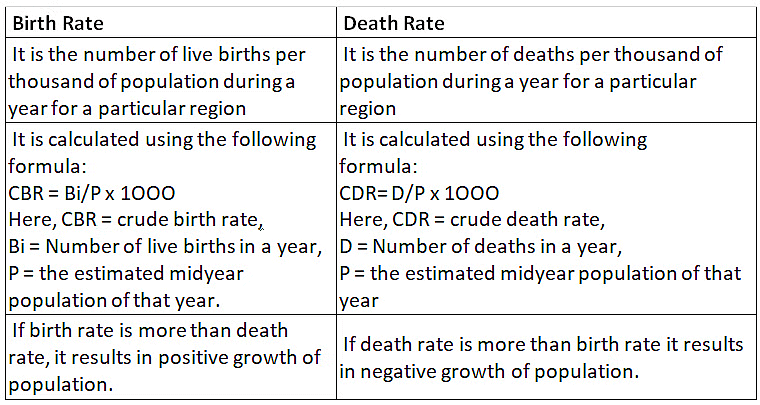
Answer:
- Birth rate: The number of live births per 1,000 people in a year. It measures the rate at which new individuals are added to the population through childbirth and is influenced by social, economic and cultural factors.
- Death rate: The number of deaths per 1,000 people in a year. It measures the rate at which people die and is affected by health care, nutrition, sanitation and age structure.
- Key difference: Birth rate increases population size; death rate decreases it. The difference between them determines natural population growth.
(ii) Push factors and pull factors of migration.
Ans:
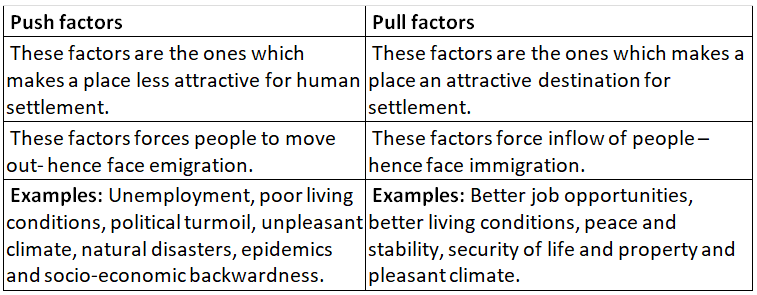
Answer:
- Push factors: Conditions that drive people to leave a place - examples include lack of water, unemployment, poverty, natural disasters, epidemics and political unrest.
- Pull factors: Conditions that attract people to a new place - examples include better jobs, educational and medical facilities, security, and improved infrastructure.
- Key difference: Push factors force or encourage people to move out; pull factors attract them to a new destination. Migration decisions usually result from a combination of both.
Q4: Answer the following questions in about 150 words.
(i) Discuss the factors influencing the distribution and density of population in the world.
Ans: The various factors that influence the distribution and density of population in the world are:
- Geographical Factors:
- Availability of water: People prefer to live where fresh water is easily available because it is essential for drinking, cooking, hygiene, agriculture, livestock and industry. River valleys, deltas and areas with good groundwater generally have higher population densities.
- Landforms: Flat plains and gentle slopes favour crop production, transport and construction; therefore such areas attract more people. Mountainous, steep or rugged areas are less suitable for large populations.
- Climate: Areas with extreme climates (very hot deserts or very cold polar regions) are sparsely populated. Comfortable climates with moderate temperatures and reliable rainfall attract settlements and support agriculture.
- Soils: Fertile soils support higher agricultural productivity. Regions with loamy and alluvial soils tend to have denser rural populations because they sustain farming and allied activities.
- Economic Factors
- Minerals: Areas with mineral deposits attract mining and related industries. These activities create jobs and settlements, increasing local population density.
- Urbanisation: Cities concentrate employment opportunities, educational and medical facilities, transport and communication, drawing people from rural areas and increasing density in urban regions.
- Industrialisation: Industrial belts and manufacturing centres provide steady employment and services, attracting migrants and increasing population concentration.
- Social and Cultural Factors: Places with religious, cultural or historical significance may attract permanent settlement. Conversely, social or political unrest, insecurity and lack of basic services push people away. Governments sometimes offer incentives to encourage settlement in sparsely populated regions, which can alter distribution patterns.
Overall: Distribution and density of population result from a combination of physical suitability and human activities. Areas that combine favourable geography with economic opportunities and social amenities tend to be densely populated.
(ii) Discuss the three stages of demographic transition.
Ans: The three stages of demographic transition are:
- Stage 1 - High birth and high death rates: Both fertility and mortality are high. High death rates arise from epidemics, poor health care and food shortages. Families often have many children to compensate for high mortality. Population growth is slow.
- Stage 2 - High birth rate and declining death rate: Improvements in sanitation, medical care and food supply lower the death rate while birth rates remain high initially. This creates a gap between births and deaths and leads to rapid population growth.
- Stage 3 - Declining birth and low death rates: As societies urbanise, become more educated and economically developed, birth rates fall. Death rates remain low. Population growth slows and may become stable. Family size is consciously controlled and life expectancy improves.
Map Skill
On the outline map of the world, show and name the following.
(i) Countries of Europe and Asia with negative growth rate of population.
Ans:
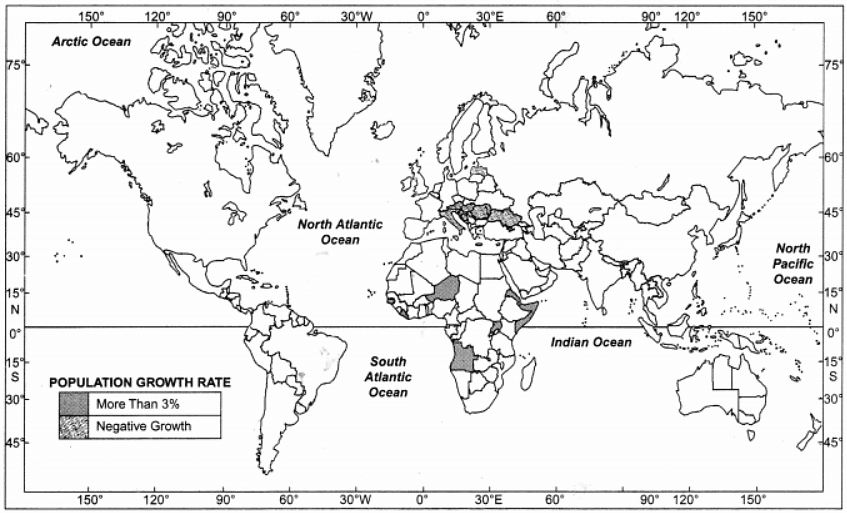
(i) Countries of Europe and Asia with negative growth rate of population are:
Latvia, Estonia, Russia, Ukraine, Albania, Bulgaria, Croatia, Slovenia, Czech Republic, Germany, Portugal, Japan, China.
Project/Activity
(i) Has someone in your family migrated? Write about her/his place of destination. What made her/him migrate?
Ans: My grandfather migrated during the Partition of India. He moved to a safer location to re-settle with family because of communal violence and the political division that followed Partition.
(ii) Write a brief report on the distribution and density of population in your state.
Ans: The population density of our city, Delhi, is 9,294 persons per sq. km. This high density reflects the concentration of jobs, services, educational and medical facilities, and transport links that draw people from other regions. Urbanisation and limited land area lead to higher density in the city compared with surrounding rural districts.
FAQs on NCERT Solutions - The World Population
| 1. What factors contribute to the growth of the world population? |  |
| 2. How does the world population impact the environment? | |
| 3. What are the challenges associated with an aging world population? | |
| 4. How does the distribution of the world population vary across different regions? | |
| 5. What are some strategies for managing the world population growth sustainably? | |





