The chapter "End of Bipolarity" explores the collapse of the Soviet Union, marking the end of the Cold War era. It focuses on the causes behind the disintegration of the Soviet system, the role of Gorbachev's reforms, and the rise of nationalism within Soviet republics. The chapter also covers the aftermath of the collapse, including the emergence of new countries, economic transitions, and shifts in global power dynamics, particularly the transition to a unipolar world led by the US. Additionally, it highlights India's relationship with post-communist countries, especially Russia, and the challenges faced by these nations in their post-Soviet period.
Facts That Matter
1. Soviet Union's Political System
Formation: The Soviet Union was established in 1922, founded on socialist principles following the Russian Revolution. The state was based on communist ideology, with a strong emphasis on state ownership of property and centralised economic control.
Leadership: The Communist Party controlled all political power, and opposition was not tolerated.
Economic Structure: The economy was state-planned, with state-run industries and a focus on heavy industry, although consumer goods were often of poor quality compared to those in capitalist nations.
2. Factors Leading to the Collapse of the USSR
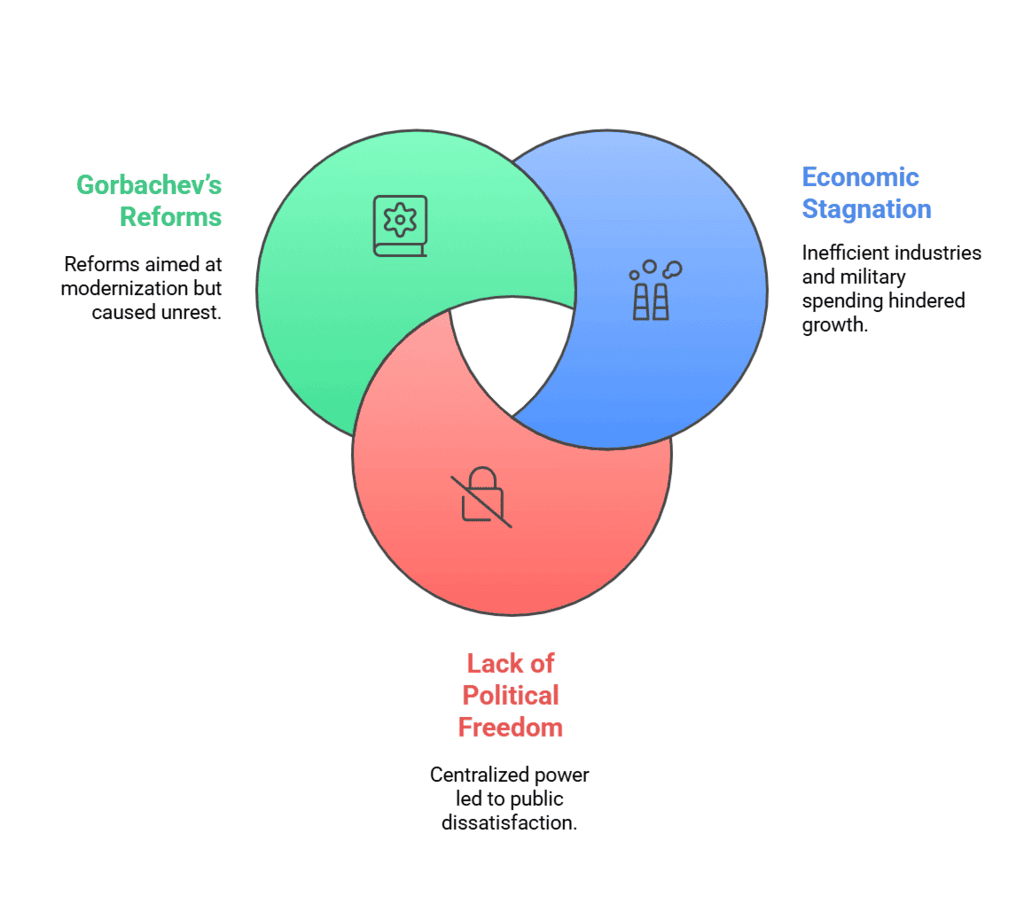
Economic Stagnation: The Soviet economy faced stagnation due to inefficient state-run industries, an overemphasis on military spending, and technological backwardness compared to the West.
Lack of Political Freedom: The centralised system, with no democratic processes or freedom of speech, led to widespread public dissatisfaction.
Gorbachev's Reforms: Mikhail Gorbachev introduced Perestroika (economic restructuring) and Glasnost (openness), hoping to modernise the Soviet system. These reforms, however, unleashed demands for greater autonomy and undermined central authority.
3. Rise of Nationalism and Dissatisfaction
Nationalism: Nationalist movements in republics like the Baltic States (Estonia, Latvia, Lithuania) and Ukraine called for independence from the Soviet Union, leading to growing separatism.
Ethnic Tensions: Regions with diverse ethnic populations, such as Central Asia and the Caucasus, struggled with the pressures of centralised Soviet control, with tensions often leading to violent conflicts.
4. The Role of 'Shock Therapy'
Transition to Capitalism: After the fall of the Soviet Union, many of the newly independent republics, including Russia, adopted shock therapy-a rapid transition from socialism to capitalism.
Key Features:
Privatisation of state-owned industries.
Market Deregulation and promotion of foreign investment.
Sudden shifts to free-market economies led to widespread economic hardship, especially in Russia.
5. Consequences of the Collapse
End of the Cold War: The ideological battle between capitalism (led by the US) and communism (led by the USSR) came to an end. This marked the start of a unipolar world where the US was the dominant global power.
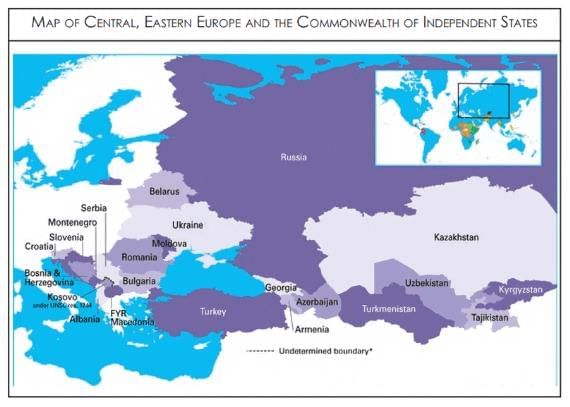
Emergence of New Nations: The collapse of the Soviet Union led to the formation of 15 independent republics, each pursuing its own political and economic future. This included the Commonwealth of Independent States (CIS), a loose association of former Soviet republics.
Power Shifts: The end of Soviet influence in Europe and the emergence of Eastern European countries seeking membership in NATO and the European Union reshaped global alliances and geopolitics.
6. India and the Post-Soviet World
Historical Ties with the USSR: During the Cold War, India had strong ties with the USSR, which included economic aid, military support, and cultural exchanges.
Post-Soviet Relations:
After the collapse of the USSR, India maintained close ties with Russia, its primary partner in defence and energy supplies.
Strategic Interests: Both countries share a vision of a multipolar world and have cooperated on issues such as nuclear energy, military hardware, and anti-terrorism efforts.
MULTIPLE CHOICE QUESTION
Try yourself: Which factor played a significant role in the disintegration of the Soviet Union?
A
The rise of nationalism and the desire for sovereignty within republics.
B
The formation of the Commonwealth of Independent States (CIS).
C
The process of transition from an authoritarian socialist system to a democratic capitalist system.
D
The decline in the value of the Russian currency 'Ruble'.
Correct Answer: A
- The rise of nationalism and the desire for sovereignty within republics like Russia, the Baltic Republics (Estonia, Latvia, Lithuania), Ukraine, Georgia, and others proved to be the most immediate cause for the disintegration of the USSR. - These republics sought independence and self-governance, leading to the fragmentation of the Soviet Union. - The desire for sovereignty was fueled by the perception of backwardness compared to Western capitalism and the alienation of ordinary people who were excluded from privileges. - This factor played a significant role in the disintegration of the Soviet Union, as it led to the emergence of new independent states and the end of the Cold War confrontations.
Report a problem
Timeline
March 1985: Mikhail Gorbachev elected as the General Secretary of the Communist Party of the Soviet Union; appoints Boris Yeltsin as the head of the Communist Party in Moscow; initiates a series of reforms in the Soviet Union.
1988: Independence movement begins in Lithuania; later spreads to Estonia and Latvia.
October 1989:The Soviet Union declares that the Warsaw Pact members are free to decide their own future; the Berlin Wall falls in November.
February 1990: Gorbachev strips the Soviet Communist Party of its 72-year-long monopoly on power by calling on the Soviet Parliament (Duma) to permit multiparty politics.
March 1990: Lithuania becomes the first of the 15 Soviet republics to declare its independence.
June 1990: The Russian parliament declares its independence from the Soviet Union.
June 1991: Yeltsin, no longer in the Communist Party, becomes the President of Russia.
August 1991: The Communist Party hardliners stage an abortive coup against Gorbachev.
September 1991: Three Baltic republics of Estonia, Latvia, and Lithuania became UN members (Later joined NATO in March 2004).
December 1991: Russia, Belarus, and Ukraine decided to annul the 1922 Treaty on the creation of the USSR and establish the Commonwealth of Independent States (CIS); Armenia, Azerbaijan, Moldova, Kazakhstan, Kyrgyzstan, Tajikistan, Turkmenistan, and Uzbekistan joined the CIS (Georgia joined later in 1993); Russia took over the USSR seat in the United Nations.
25 December 1991: Gorbachev resigns as the President of the Soviet Union; the end of the Soviet Union.
Words That Matter
1. Soviet System: The Soviet system was introduced after the Russian Revolution in 1917 based on the principles of an egalitarian society and a planned economy controlled by the state. 2. Socialist Bloc: The Eastern European countries were known as the Socialist Bloc because these countries were liberated from the fascist forces, and their political and economic systems were based on this bloc only. 3. Capitalist Economy: In this economy, land and productive assets are owned and controlled by the Capitalists. 4. Unipolar System: Affairs at the international level are dominated by only one superpower. 5. Multipolar System: Affairs at the international level cannot be dominated by one superpower only, instead of a group of countries plays an important role. 6. Egalitarian Society: It believes that all people are equally important and should have the same rights and opportunities in life. 7. Largest Garage Sale: It resulted from Shock Therapy to undervalue the valuable industries of the USSR to sell them at throwaway prices. 8. Shock Therapy: The model of transition from an authoritarian socialist system to a democratic capitalist system in Russia, Central Asia, and East Europe under the influence of the World Bank and IMF.
1. What exactly caused the end of bipolarity in international relations?
Ans. The collapse of the Soviet Union in 1991 marked the definitive end of bipolarity, dismantling the Cold War power structure that had dominated global politics since 1945. The USSR's economic stagnation, failed military interventions, and Mikhail Gorbachev's reform policies (glasnost and perestroika) accelerated this dissolution, leaving the United States as the sole superpower. This transition fundamentally reshaped the multipolar world order and international diplomatic relations.
2. How did Gorbachev's policies of glasnost and perestroika contribute to Soviet collapse?
Ans. Glasnost (openness) and perestroika (restructuring) were reform initiatives intended to strengthen the Soviet system but instead exposed deep structural weaknesses. Glasnost revealed widespread corruption and historical grievances, while perestroika's economic reforms failed to improve productivity. These policies inadvertently accelerated the USSR's disintegration by allowing public criticism, nationalism in Soviet republics, and loss of Communist Party control, ultimately leading to the end of the bipolar era.
3. What happened to the Warsaw Pact countries after bipolarity ended?
Ans. Following the end of bipolarity, Warsaw Pact nations in Eastern Europe broke free from Soviet domination and pursued independent foreign policies. Countries like Poland, Czechoslovakia, and Hungary transitioned toward democracy and market economies, eventually joining NATO and the European Union. This shift represented a dramatic geopolitical realignment, with former Soviet satellite states integrating into Western institutions and establishing their autonomy in the post-bipolar international system.
4. Why did the Soviet Union fail economically despite military strength?
Ans. The Soviet Union's economy collapsed due to excessive military spending, inefficient centrally-planned systems, and inability to compete technologically with the West. Defence expenditure consumed roughly 15-17% of GDP, draining resources from consumer goods and infrastructure. Agricultural failures necessitated costly grain imports, while the costly Afghanistan intervention (1979-1989) further depleted finances. These structural economic weaknesses ultimately proved unsustainable, contributing significantly to the end of the bipolar superpower competition.
5. What is a unipolar world order, and how did it emerge after bipolarity ended?
Ans. A unipolar world order refers to a global system dominated by a single superpower-the United States-following the Soviet Union's collapse. After bipolarity's end, America possessed unmatched military, economic, and technological capabilities, allowing it to shape international institutions and geopolitical outcomes. This unipolar moment featured American leadership in NATO, the UN Security Council, and global financial systems, though this dominance faced challenges from rising powers and regional conflicts throughout the 1990s onwards.
practice quizzes, Semester Notes, MCQs, Exam, Previous Year Questions with Solutions, Summary, Objective type Questions, Viva Questions, Revision Notes - The End of Bipolarity, Important questions, study material, Revision Notes - The End of Bipolarity, Extra Questions, Free, mock tests for examination, Sample Paper, ppt, pdf , past year papers, video lectures, Revision Notes - The End of Bipolarity, shortcuts and tricks;