NCERT Solutions - Primary Activities

Q1: Choose the right answer from the four alternatives given below.
(i) Which one of the following is not a plantation crop?
(a) Coffee
(b) Sugarcane
(c) Wheat
(d) Rubber
Ans: (c)
Explanation: Wheat is an annual cereal crop grown on large open fields for grain production and is part of extensive commercial grain cultivation. Plantation crops are typically perennial or long-term crops grown on large estates for export or processing, such as coffee, rubber and sugarcane.
(ii) In which one of the following countries co-operative farming was the most successful experiment?
(a) Russia
(b) Denmark
(c) India
(d) The Netherlands
Ans: (b)
Explanation: Denmark is well known for highly successful cooperative farming, especially in dairying. Small farmers formed co-operatives to share processing, marketing and equipment, improving incomes and efficiency while retaining family farms.
(iii) Growing of flowers is called:
(a) Truck farming
(b) Factory farming
(c) Mixed farming
(d) Floriculture
Ans: (d)
Explanation: The cultivation of flowers and ornamental plants for trade and markets is called floriculture. It is often practised near urban centres to supply florists and markets with perishable, high-value products.
(iv) Which one of the following types of cultivation was developed by European colonists?
(a) Kolkoz
(b) Viticulture
(c) Mixed farming
(d) Plantation
Ans: (d)
Explanation: Plantation agriculture was established by European colonists in tropical colonies. Large estates produced single export crops (tea, rubber, coffee, sugar) using capital, managerial control and labour to supply European markets.
(v) In which one of the following regions is extensive commercial grain cultivationnot practised?
(a) American Canadian prairies
(b) European Steppes
(c) Pampas of Argentina
(d) Amazon Basin
Ans: (d)
Explanation: The Amazon Basin is covered by tropical rainforest with heavy rainfall and dense vegetation, unsuitable for extensive commercial grain farming. The other regions (prairies, steppes, pampas) have flat fertile soils and climates suited to large-scale grain production.
(vi) In which of the following types of agriculture is the farming of citrus fruit very important?
(a) Market gardening
(b) Plantation agriculture
(c) Mediterranean agriculture
(d) Co-operative farming
Ans: (c)
Explanation: Mediterranean agriculture, found in regions with mild, wet winters and hot, dry summers, favours citrus cultivation. Such climates and cropping systems are ideal for oranges, lemons and similar fruits.
(vii) Which one type of agriculture amongst the following is also called 'slash and burn agriculture'?
(a) Extensive subsistence agriculture
(b) Primitive subsistence agriculture
(c) Extensive commercial grain cultivation
(d) Mixed farming
Ans: (b)
Explanation: Primitive subsistence agriculture, often called slash-and-burn or shifting cultivation (jhum), involves clearing and burning patches of forest for cultivation, then moving to new areas when soil fertility declines.
(viii) Which one of the following does not follow monoculture?
(a) Dairy farming
(b) Mixed farming
(c) Plantation agriculture
(d) Commercial grain farming
Ans: (b)
Explanation: Mixed farming involves growing several crops and keeping livestock together on the same farm, so it does not follow monoculture. The other types typically concentrate on a single product or crop.
Q2: Answer the following questions in about 30 words.
(i) Future of shifting cultivation is bleak. Discuss.
Ans: Shifting cultivation is losing viability because fallow periods are shortening under population pressure and land scarcity, causing soil infertility and erosion. Legal restrictions and forest conservation also limit areas available for jhum, making its future bleak.
(ii) Market gardening is practised near urban areas. Why?
Ans: Market gardening specialises in high-value, perishable crops such as vegetables, fruits and flowers for urban consumers. It is practised near towns because short transport time, good roads and proximity to wealthy buyers reduce spoilage and increase profits.
(iii) Large scale dairy farming is the result of the development of transportation and refrigeration.
Ans: Milk and dairy products are perishable; improved transport and refrigeration allow rapid collection, chilling and long-distance movement to markets. These advances support large, specialised dairies, centralised processing and wider distribution of dairy goods.
Q3: Answer the following questions in not more than 150 words.
(i) Differentiate between Nomadic Herding and Commercial Livestock Rearing.
Ans:
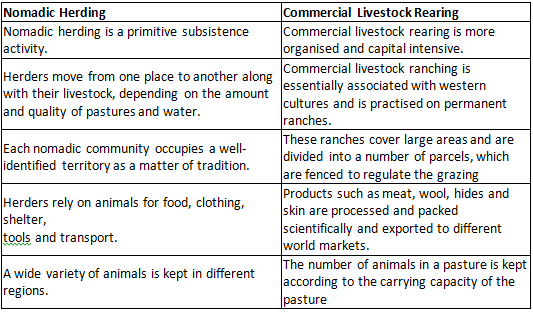
- Purpose: Nomadic herding - subsistence and traditional livelihood; Commercial rearing - production for markets and profit.
- Mobility: Nomadic herding - households move seasonally in search of pasture; Commercial rearing - animals are kept on fixed farms or ranches.
- Scale and organisation: Nomadic herds are usually smaller and family-based; commercial systems are larger, capital-intensive and often corporate or cooperative.
- Technology and inputs: Nomadic herding uses traditional methods with little external input; commercial rearing uses modern breeding, feed, veterinary care and mechanisation.
- Land use: Nomads use communal or open grazing lands; commercial units use fenced pastures, feedlots or specialised fodder crops.
- Market orientation: Nomadic produce is mainly for local use; commercial producers target regional, national or export markets.
(ii) Discuss the important characteristic features of plantation agriculture. Name a few important plantation crops from different countries.
Ans: Plantation agriculture was introduced by Europeans in tropical colonies and is oriented towards large-scale production of single crops for export.
The important characteristics features of plantation agriculture are:
- Large estates or plantations - extensive tracts of land under one ownership or management.
- Large capital investment - for land, machinery, processing units and infrastructure.
- Managerial and technical support - professional managers and skilled supervisors run operations.
- Scientific methods of cultivation - use of improved planting material, irrigation and pest control.
- Single crop specialisation - emphasis on one or a few exportable crops (monoculture).
- Cheap labour - reliance on hired labour, often seasonal or migrant workers.
- A good system of transportation which links the estates to the factories and markets for the export of the products - efficient roads, ports and processing facilities.
Few important plantation crops from different countries are:
- Tea - India and Sri Lanka
- Rubber - Malaysia
- Sugarcane and banana plantations - West Indies
FAQs on NCERT Solutions - Primary Activities
| 1. What are primary activities in the context of NCERT solutions? |  |
| 2. How are primary activities important for the economy? | |
| 3. Can you provide examples of primary activities mentioned in the NCERT solutions? | |
| 4. What role does agriculture play in primary activities? | |
| 5. How do primary activities impact the environment? | |





